

[Psy's Instagram]
SEOUL -- Crush, an R&B singer-songwriter, has joined P NATION, an entertainment agency headed by Gangnam Style star Psy.
"Welcome," Psy said in an Instagram post. A video showed the 27-year-old singer signing a contract. Crush is the fifth artist to join Psy's agency since its establishment in January this year. Other artists are singer HyunA, rapper Jessi, and Hyojong, a rapper-dancer formerly known as E'Dawn.
Before his debut in 2012, he was known among hip-hop and R&B fans for working with various artists such as Zion.T, Dynamic Duo and Simon Dominic as a featuring artist. Crush is well-known for his unique melodic rap flow and is especially popular among female hip-hop fans in their 20s.

Park Sae-jin
Experienced journalist and editor at AJU PRESS specializing in multilingual news. I cover international diplomacy, geolpolitics, and policy, consistently delivering highly accurate, compelling reporting for a worldwide audience.
Copyright ⓒ Aju Press All rights reserved.
Related News
-
 AIA Life Insurance Hosts K-Pop Concert, Donates 260 Million Won to Underprivileged Youth
AIA Life Insurance hosted a K-Pop concert and engaged in charitable activities for underprivileged groups, including children with cancer and youth in need of support. AIA Life Insurance announced on October 25 that it held the 'K-Pop Together, Give Together' concert on October 24 at KINTEX in Goyang, South Korea. The event was part of the AIA Group's 'AIA One Billion (AOB)' campaign, which aims to enhance the physical health and mental well-being of one billion people in the Asia-Pacific region by 2030. More than 7,000 attendees participated, including AIA employees and their families, sales teams, customers, and partners from South Korea, Malaysia, the Philippines, and Singapore. The concert was hosted by broadcaster Park Jae-min and singer Tiffany Young, featuring performances by Jinusean, ITZY, Park Jin-young, Chungha, and Psy. A VIP lounge offered programs showcasing K-culture and K-beauty prior to the performances. In conjunction with the event, AIA Life Insurance conducted social contribution activities. Approximately 1,000 children with cancer and their families, as well as youth in need of support, were invited to the concert. The company donated a total of over 260 million won, including 160 million won to the nonprofit organization Together with Love and 100 million won to the Korean Childhood Leukemia Foundation. Similar charitable activities were also conducted in the Philippines and Singapore in collaboration with the Kythe Foundation and Better Lives Fund, respectively. AIA Life Insurance plans to expand its existing customer experience program, 'AIA Only Experience,' into 'AIA WE (AIA Wellness & Entertainment),' combining wellness and entertainment. This initiative aims to continuously offer cultural and experiential programs that engage customers, sales channel partners, and employees. Hwang Ji-ye, head of marketing at AIA Life Insurance, stated, "It is significant that we shared the joy of Korean culture with AIA members from abroad and extended this to charitable contributions for the community. We will continue to leverage our network across Asia to provide differentiated wellness and entertainment experiences."* This article has been translated by AI.
-
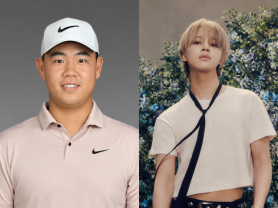 From Tom Kim to BTS, Korea debates military exemptions
Tom Kim, left, and BTS member Jimin. Courtesy of PGA Tour and HYBE SEOUL, October 04 (AJP) - South Korean golfer Tom Kim won an Asian Games gold medal in Japan on Saturday, earning not only a place atop the podium but also one of the most consequential benefits available to an elite South Korean athlete — relief from active-duty military service. His case has again put a uniquely Korean question under the spotlight. Why can one medal dramatically alter a young man’s military obligations, while some of the country’s most globally successful entertainers still have to serve? South Korea requires able-bodied men to perform mandatory military service, generally lasting 18 months in the Army or Marine Corps, 20 months in the Navy and 21 months in the Air Force. Athletes, however, can qualify for a special category known as “arts and sports personnel” by winning any Olympic medal or an Asian Games gold. Artists may qualify by placing highly in designated international arts competitions, winning certain domestic competitions in fields such as traditional Korean music, or completing designated training in intangible cultural heritage. The arrangement is routinely described in South Korea as a “military exemption,” although that shorthand is technically inaccurate. Successful athletes and artists are assigned to 34 months of service in their professional field and must complete 544 hours of public-interest activities using their skills, rather than spending their service period in a military unit. For professional athletes whose careers can hinge on a few peak years, the difference can be enormous. That was vividly illustrated at the 2024 Paris Olympics. Table tennis player Lim Jong-hoon was scheduled to enlist only about three weeks after the Games when he and Shin Yu-bin won bronze in mixed doubles. Lim, then 27, saluted toward the stands after securing the medal, while Korean fans jokingly dubbed Shin a “legal military exemption broker” for helping her partner qualify for the benefit. Lim later acknowledged that it would have been dishonest to claim the military was not on his mind during the bronze-medal match. Such episodes make for lighthearted sports stories. But military service itself is anything but a lighthearted subject in South Korea, where perceptions that celebrities or the privileged receive special treatment have repeatedly triggered public anger. “The criteria for military-service exemptions need to be substantially revised, particularly in areas such as dance and traditional Korean music, where some competitions held in Korea are international competitions in name only,” People Power Party lawmaker Sung Il-jong, a former chair of the National Assembly’s National Defense Committee, told AJP. The distinction between elite classical arts and popular culture has long been one of the system’s most politically awkward features. Winning a government-designated classical music or dance competition can qualify someone for arts personnel status. Global commercial success in K-pop, by itself, cannot. The disparity fueled years of debate over BTS, whose extraordinary international success led some politicians to argue that globally successful pop musicians contributed at least as much to Korea’s international standing as medal-winning athletes or classical musicians. The group’s members ultimately fulfilled their military obligations rather than receiving exemptions. “Korean cultural content has recently drawn worldwide attention, contributing significantly not only to enhancing the country’s global standing but also to revitalizing the cultural industry. I believe there is room to improve and supplement the special military service system so that it is applied more equitably alongside the benefits available in sports,” Kim Seung-su, a member of the National Assembly’s Culture, Sports and Tourism Committee, told AJP. Questions of fairness have also been shaped by a very different series of celebrity cases — those involving allegations of draft evasion, poor service or preferential treatment. Three days before Kim’s Asian Games victory, WINNER member Song Min-ho was sentenced by the Seoul Western District Court to one year in prison, suspended for two years, for violating the Military Service Act while serving as a social service agent. WINNER. Courtesy of YG Entertainment Song was found to have been absent without authorization for a total of 102 days between 2023 and 2024. The court said military service was an obligation tied to the country’s existence and should be performed faithfully, although it cited Song’s health problems in explaining the suspended sentence. Song admitted wrongdoing and apologized before the ruling. “Illegal acts committed by some household names in an attempt to evade military service must be dealt with firmly,” Jin Seong-joon, chair of the National Assembly’s National Defense Committee, told AJP. “Military service is a constitutional duty that all citizens are required to fulfill,” Jin added. Few cases, however, have left as deep a mark on South Korea’s collective memory as that of singer Yoo Seung-jun, also known as Steve Yoo. Yoo, one of the country’s biggest pop stars around the turn of the century, became a U.S. citizen in 2002 shortly before he was expected to fulfill his military obligation. South Korean authorities subsequently barred him from entering the country, and he became perhaps the most enduring symbol of alleged draft evasion in Korean popular culture. That controversy is still playing out nearly a quarter-century later. On Thursday, the Seoul High Court again sided with Yoo in his third round of litigation over the government’s refusal to issue him a visa, upholding a lower-court ruling that the visa denial should be revoked. Yoo has repeatedly prevailed in court while South Korean authorities have continued to resist his return. Earlier this year, the Justice Ministry said it was seeking clearer legal grounds to continue barring people deemed to have avoided military service from entering the country, explicitly citing the Steve Yoo case. Justice Minister Jeong Seong-ho, who was serving as justice minister at the time, went so far as to characterize abandoning Korean nationality to avoid military service and later returning for personal benefit as an act against the social order. Psy, who later became a global star with “Gangnam Style,” faced a different military scandal years before his worldwide breakthrough. Psy. Courtesy of P NATION He initially fulfilled his obligation by working as technical personnel at a software company from 2002 to 2005. Authorities later determined that his work did not satisfy the requirements of the alternative-service program, after investigators found that he had not properly performed the designated duties while continuing entertainment activities. He was ordered to enlist again and entered active-duty service in December 2007, ultimately spending a combined 55 months under the two service arrangements. G-Dragon, meanwhile, did serve as an active-duty soldier, but his service demonstrated how intensely celebrity military life can be scrutinized. In 2018, the BIGBANG leader faced allegations that he had received preferential treatment by using a private room while being treated for an ankle injury at a military hospital. His agency rejected the allegation, while the Defense Ministry said the hospital did not operate a special “colonel’s room” and that the single room could be used by enlisted personnel when medically necessary. The ministry also said his use of sick leave complied with regulations. Together, the cases illustrate why military service carries a cultural weight in South Korea that extends far beyond defense policy. For ordinary young men, service can interrupt university, employment and relationships. For athletes and entertainers, it can interrupt careers that may have unusually short windows at their peak. That tension is becoming harder for the government to ignore as South Korea’s demographic decline reduces the number of men available for military service. Military Manpower Administration Commissioner Hong So-young said in August that relevant government agencies had reached a broad consensus on reforming the arts and sports alternative-service program, including concentrating benefits on more prestigious competitions and potentially tightening eligibility requirements. Hong said the number of South Korean men in their 20s fell from about 371,000 in 2015 to 224,000 in 2025 and could decline to about 120,000 by 2043, making military manpower an increasingly scarce national resource. AJP Takeaways - South Korean golfer Tom Kim’s Asian Games gold medal has revived debate over a system that allows elite athletes and selected artists to avoid active-duty military service while globally successful pop stars remain ineligible. - Recent controversies involving Song Min-ho, Steve Yoo, Psy and G-Dragon show how military service remains a potent test of fairness in South Korea, particularly when celebrities appear to receive special treatment or fail to fulfill obligations. - Lawmakers across the political spectrum are calling for tougher scrutiny of South Korea's military-service system, with former defense committee chair Sung Il-jong urging an overhaul of exemption criteria and current chair Jin Seong-joon calling for firm punishment of illegal draft evasion.
-
 Travelers Seek Unique Destinations This Summer, with Manado Gaining Popularity
Manado As the peak travel season approaches in July and August, demand for travel and leisure activities is significantly increasing, highlighting a trend towards seeking unique vacation spots. Indonesia is emerging as a popular destination, following Japan and Vietnam. ◆ Indonesia Ranks Third Among Popular Overseas Destinations; Manado Reservations Up 14% On July 3, leisure platform Nolyuniverse analyzed booking data for July and August, revealing that Indonesia, with 5% of flight bookings, ranks third among popular overseas destinations, following Japan at 35% and Vietnam at 21%. The rise in travel demand for Indonesia is driven not only by the well-known Bali but also by the emerging destination of Manado. An analysis of second-quarter booking data from Kyowon Tour shows that Manado accounted for 20% of Southeast Asia bookings, a 14 percentage point increase from the previous quarter. The improvement in accessibility due to the launch of new direct flights last year, combined with its natural environment featuring volcanic landscapes and beaches, aligns with travelers' desires for new destinations. Kyowon Tour's live commerce channel, Easy Time Deal, featured Manado and conducted an encore broadcast due to high interest. The travel industry is targeting new demand with products that combine no-tip, no-option, and no-shopping coral tours with national park visits. ◆ Domestic Accommodation Bookings Surge 68%; Constitution Day Holiday Peaks Domestic travel demand is also thriving. This summer, domestic accommodation bookings have increased by 68% compared to the same period last year, with camping, caravan, and glamping reservations rising by 102%. Regionally, Gangwon Province leads with 23% of bookings, followed by Jeju Island at 11% and Busan at 9%. Notably, demand in Gangwon is evenly spread across the region, including cities like Samcheok, Donghae, and Hongcheon. The busiest day for domestic accommodation check-ins this summer is July 17, coinciding with the Constitution Day holiday, which has been designated as a public holiday for the first time in 18 years, leading to a surge in weekend travel demand. ◆ Cultural and Leisure Spending Diversifies; From Children's Shows to eSports In addition to travel, the cultural and leisure market is showing trends towards personalized consumption. With summer vacation underway, children's performances such as 'The 100-Story House in the Forest' and 'The Little Mermaid' are among the top booked shows in the musical and dance categories. In the concert sector, the summer highlight 'Psy's Summer Show in Busan' ranks first, while in sports, professional baseball and the global eSports event '2026 LoL Mid-Season Invitational (MSI)' are among the top attractions. In the exhibition sector, the collection of masterpieces titled 'Beyond Impressionism: Renoir, Degas, Van Gogh, Matisse, Picasso' is drawing significant visitor interest.* This article has been translated by AI.