

[Courtesy of Daewoo Shipbuilding & Marine Engineering]
SEOUL -- To meet tightened regulations on emissions of greenhouse gases, Daewoo Shipbuilding & Marine Engineering, a major shipbuilder in South Korea, has teamed up with the American Bureau of Shipping, a maritime classification society, to push for the joint development of decarbonization technology for super-sized vessels.
Daewoo Shipbuilding & Marine Engineering (DSME) said Tuesday that it has signed a memorandum of understanding with the American Bureau of Shipping (ABS), which provides provide classification services and develops standards and technical specifications, for a joint study on the digitalization and decarbonization of very large crude carriers and ultra larges container ships.
To ensure that shipping is cleaner and greener, the International Maritime Organization (IMO), a U.N. maritime safety agency, has adopted mandatory energy-efficiency measures to reduce emissions of greenhouse gases from ships. Innovative solutions are needed to reduce CO2 emissions from ships.
Through its joint study with ABS, DSME would address cybersecurity issues. Using a self-developed smart platform, the shipbuilder plans to apply a cybersecurity system to ships under construction.
In July, DSME earned high-level smart-ship cybersecurity certification from Lloyd's Register, a London-based organization. Cybersecurity technology is designed to protect data and software from outside threats, and DSME said its solution can support optimal operations and safety
South Korean shipbuilders work hard to develop smart ship technologies as IMG regulations will increase the preference for digital total solutions that support efficient navigation systems. Smart shipping can be divided into unmanned ships ruled by an operator from a control center onshore and autonomous ships which use a computer on board that takes decisions about the route, speed, fuel consumption, maintenance and even mooring in the harbor.
Smart ships are expected to revolutionize the landscape of ship design and operations. Smart ships can minimize human errors that caused about 70 to 80 percent of marine accidents. Route sharing and data exchanging are key elements of e-navigation.
Copyright ⓒ Aju Press All rights reserved.
Related News
-
 Denuclearization is a decades-long fight Seoul can't abandon: ex-nuclear envoy
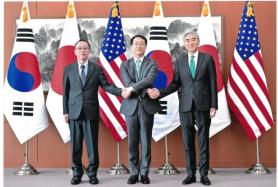
Rep. Kim Gunn of the People Power Party, right, stands beside former Foreign Minister Gong Ro-myung, left, at a ceremony honoring Gong. Kim served as Gong’s aide early in his diplomatic career. Courtesy of Rep. Kim Gunn’s office SEOUL, November 18 (AJP) - South Korea must prepare for a long effort to end North Korea’s nuclear threat, as the arsenal creates dangers that go well beyond the risk of a nuclear attack, according to a former nuclear envoy turned lawmaker. “North Korea’s denuclearization is a goal we cannot abandon,” Rep. Kim Gunn of the main opposition People Power Party (PPP) told AJP in an interview marking the release of his book, "On a Knife’s Edge: Diplomacy over North Korea’s Nuclear Program” published Monday. In the book, Kim recounts his experience as a junior diplomat during the 1994 nuclear crisis and later as South Korea’s chief nuclear negotiator. “As long as North Korea possesses nuclear weapons, we cannot escape that nuclear shadow.” For the former chief nuclear negotiator, the shadow translates into confidence emboldening a regime to take risks with conventional forces in the belief that its opponents will hesitate to retaliate. It is a judgment shaped by more than three decades in diplomacy since he entered the foreign service in 1989, including negotiations over North Korea’s nuclear program, crisis management at the presidential office and postings as ambassador to Britain and consul general in Vancouver. His understanding of nuclear deterrence took on a sharper meaning during his assignment to Cheong Wa Dae, the presidential office, beginning in 2010. That March, the sinking of the South Korean warship Cheonan killed 46 sailors in an attack Seoul attributed to a North Korean torpedo. In November, North Korea shelled Yeonpyeong Island. Kim and his colleagues maintained round-the-clock coverage, taking turns sleeping on a folding bed in the office. “At the time, we could not understand why this was happening. We were overwhelmed with responding to it,” he said. “Looking back, I think it was the nuclear shadow.” North Korea had conducted its second nuclear test in 2009. In Kim’s assessment, its growing confidence in its nuclear capability helps explain its willingness to take military risks the following year. He linked that to the “stability-instability paradox”: the theory that fear of nuclear escalation can discourage all-out war while making confrontations below that threshold seem more manageable. “North Korea thought that because it had nuclear weapons, it could take these actions and the other side would be afraid to retaliate properly,” he said. That calculation, he argued, creates another problem for Pyongyang. If confrontations stay below the nuclear threshold, missiles, warships, drones and other conventional capabilities still matter. Rep. Kim Gunn, center, then South Korea’s special representative for Korean Peninsula peace and security affairs, shakes hands with Sung Kim, right, the U.S. special representative for North Korea, and Takehiro Funakoshi, left, director-general of the Japanese Foreign Ministry’s Asian and Oceanian Affairs Bureau, at trilateral talks on North Korea’s nuclear program in Seoul. Courtesy of Rep. Kim Gunn’s office “The more it develops nuclear weapons, the more it has to build up its conventional weapons,” he said. “Can the North Korean economy sustain both? It is not sustainable.” Kim sees that burden as one reason to maintain pressure and keep denuclearization as the destination, even when progress appears remote. Asked whether he would support a verifiable agreement negotiated by a Democratic Party administration that reduced the nuclear threat without achieving complete denuclearization, he said abandoning the ultimate objective would leave South Korea permanently exposed. “Denuclearization serves North Korea’s interests, too,” he said, arguing that ordinary North Koreans have gained little from decades of nuclear development, isolation and economic hardship. His time horizon extends well beyond a presidential term. “In international relations, achieving a major goal often takes 40 to 50 years,” he said. He cited the struggle against apartheid, South Africa’s system of institutionalized racial segregation, and the U.S. policy of containing Soviet expansion. Apartheid was formally established in 1948, and South Africa held its first fully democratic national election in 1994. American containment took shape in 1947, more than four decades before the Soviet Union dissolved in 1991. For Kim, these examples show how sustained effort and changing international conditions can eventually open a path through seemingly intractable problems. He suggested South Korea should be prepared to stay committed to denuclearization for another two decades or so, a strategic horizon rather than a prediction of when a settlement would come. The patience he advocates in policy has a counterpart in the personal relationships behind diplomacy. Kim described how those relationships helped him secure American support for the “Audacious Initiative,” the North Korea policy unveiled by then-President Yoon Suk Yeol on Aug. 15, 2022, which offered substantial economic assistance linked to progress toward denuclearization. The foreign ministry’s Office of Korean Peninsula Peace and Security Affairs, which Kim headed, developed the proposal using material supplied by the presidential office. Before the announcement, he was asked to help ensure that Washington would promptly express support. He traveled to Indonesia to discuss it with Sung Kim, then the U.S. special representative for North Korea and ambassador to Indonesia. Rather than trying to settle every detail of the roadmap, the two concentrated on what the American side could endorse: the plan’s objective. “Once you start getting into the details, there is no end to it,” he said. Back in Seoul, he met Edgard Kagan, then a senior White House National Security Council official visiting the city. The two had known each other since serving in Beijing as liaison officers for the six-party talks involving the two Koreas, the United States, China, Japan and Russia. Kim explained what Seoul hoped to achieve and what he had already discussed with Sung Kim. “When you have known each other for a long time, there is trust. You have worked on the same issues,” he said. “You do not have to explain everything at length. With just a few words, you understand what the other person is thinking and what they want.” Rep. Kim Gunn, right, then a South Korean diplomat, shakes hands with then-U.S. Secretary of State Hillary Clinton, left, at ROK-U.S. foreign ministerial talks during the Lee Myung-bak administration. Courtesy of Rep. Kim Gunn’s office Such work rarely gives the public a full view of what diplomats do. Kim encountered another example in London, where he served as ambassador to Britain and as the first head of South Korea’s permanent mission to the International Maritime Organization, established within the embassy in 2021. The IMO, a United Nations agency, develops international rules governing shipping safety, security and environmental performance. For a major shipbuilding and trading country, Kim said, the stakes are substantial. Rules intended to cut ships’ greenhouse gas emissions can influence the fuels vessels use, the technologies shipyards develop and the investments shipping companies make. “The decisions made there can completely change the landscape of our shipping and shipbuilding industries,” he said. “Our jobs, the future of our shipbuilding industry and the future of our shipping industry are all at stake.” He said South Korea needs to take an active part in shaping those standards and contribute more to the institution. “It may not attract much attention, but it is enormously important,” he said. Years before those assignments, a visit to Liberia had given him a more immediate understanding of the responsibility carried by a diplomatic title. Kim was serving as first secretary and deputy head of mission in Côte d’Ivoire when he traveled to Liberia in the aftermath of its first civil war. He remembers a damaged airport, severe shortages and a hotel where the noise of a generator made sleep difficult. Around 50 Koreans were living in Liberia, he recalled, and members of the community came to the airport to welcome him with flowers. During visits to their homes, his hosts repeatedly served janchi-guksu, Korean noodles in broth. Kim liked noodles. After several consecutive meals, however, he began to wonder why they appeared everywhere he went. He eventually learned that the community had asked people in Côte d’Ivoire what the visiting diplomat enjoyed eating. “They had specially brought the noodles in from overseas to serve me,” he said. “When I found out, I was deeply moved.” Before leaving, he invited the community to dinner at his hotel and handed out calendars and towels supplied by government ministries, modest gifts that drew a response he had not expected. Some people cried. After years of war and isolation, Kim said, “They seemed to feel that their country was finally looking after them.” The gathering brought another unexpected development. The small community had been divided by a dispute, but over dinner and drinks, people began reconciling. “Who was I, for them to regard me as so important?” he said. “It suddenly hit me that I represented my country.” Rep. Kim Gunn, then South Korea’s ambassador to Britain, wears a pale blue hanbok as he addresses guests at a National Day reception in Britain. Courtesy of Rep. Kim Gunn’s office That understanding stayed with him through later assignments, including Vancouver, where he visited a gravely ill Canadian veteran of the 1950-53 Korean War. The veteran had become a successful businessman, contributed to his community and maintained a generous regard for Koreans, and Kim wanted to express his country’s gratitude while there was still time. He took a commemorative medal to the hospital and thanked him for his service. According to Kim, the veteran, who had been barely responsive, regained some strength afterward. His family told Kim that he had been able to speak with them and share his final wishes before he died several weeks later. “The family sent me a letter thanking me,” he said. “That has stayed with me.” Asked which single photograph he would keep from his diplomatic life, Kim chose one with former Foreign Minister Gong Ro-myung, taken at a ceremony honoring Gong after Kim had entered the National Assembly. As a younger diplomat, Kim had served as an aide to both Gong and former Foreign Minister Han Sung-joo. “There are several people who were like teachers to me, who taught me diplomacy,” he said. “I learned a great deal from those two ministers.” “I had reached that position through the guidance of many mentors,” he added. “That is why the photograph feels so precious.” Public service also demanded sacrifices he now describes with equal candor. Before leaving for an overseas assignment expected to last five years, Kim visited his maternal grandfather, who had helped raise him and was a deeply loving presence in his childhood. His grandfather was already very old, and Kim feared he would not see him again. “After saying goodbye, I cried and cried in the car on the way back,” he said. His grandfather died while Kim was abroad, and Kim was unable to return. It remains one of the most painful memories of his diplomatic career. Asked what he would tell the young man who passed the foreign service examination in 1989, he spoke about family. “Spend a little more time with your family,” he said. “I thought I was doing important work for our country, so I poured all my energy into it. That meant I did not spend much time with my children.” When he was stationed in Seoul, weekends disappeared into work, and there were periods when he saw his children mainly as they slept. “Looking back, even if it meant sacrificing something else, I should have spent a little more time with them and been that kind of father,” he said. “I regret living that way.” In the National Assembly, Kim wants to make the connection between diplomacy and everyday life more visible. South Korea’s geography, dependence on overseas markets and extensive investment abroad make foreign relations central to its prosperity, he argued. Yet much diplomatic work takes place confidentially, leaving the public with an incomplete understanding of its importance, and when its value is poorly understood, diplomacy struggles to receive the resources it needs. Rep. Kim Gunn of the People Power Party wears his National Assembly badge on his left lapel on Nov. 9, 2026. Courtesy of Rep. Kim Gunn’s office “Someone has to serve as the link between the public and diplomacy,” he said. “I think that is the most important responsibility of former diplomats who enter the National Assembly.” The same concern for protecting people shapes his legislation. A bill he introduced in January would strengthen coordination and information sharing among the foreign ministry, other central government agencies and local authorities when Koreans encounter trouble abroad. Another, introduced in June, would require authorities to automatically notify stalking victims of developments in proceedings involving their alleged perpetrators, rather than leaving victims to request the information themselves. For Kim, those efforts belong to the same responsibility he first felt so sharply among the Korean community in Liberia. “The goal of a foreign affairs and security specialist is to help people live safely and well,” he said. “I want to pursue more legislation and activities that directly help people in their everyday lives,” he added. “That is my ambition as a politician.”
-
 South Korea to Invest $1.04 Billion in AI Shipbuilding Initiatives
The South Korean government plans to invest 1.4 trillion won (approximately $1.04 billion) over five years to transition the shipbuilding industry to artificial intelligence (AI). The initiative will focus on automating the design and assembly processes at shipyards in Mokpo, Yeongam, Geoje, Busan, and Gunsan, while also spreading related technologies to small and medium-sized shipbuilders and equipment manufacturers.On October 12, the Ministry of Trade, Industry and Energy and the Ministry of Oceans and Fisheries held a 'Shipbuilding M.AX Alliance Strategy Meeting' in Mokpo. During the meeting, they announced the reorganization of the existing 'Autonomous Ship M.AX Alliance' into the 'Shipbuilding M.AX Alliance' and outlined plans for three flagship projects worth 1.4 trillion won over the next five years, centered around large shipyards, small shipbuilders, and equipment manufacturers.The first project will establish a lighthouse factory in Mokpo and Yeongam, applying M.AX technology to medium and large assembly processes with a total investment of 596 billion won. This initiative will also extend technology to nine nearby partner companies.Anchor company HD Hyundai Samho will lead the development of AX technology, while HD Korea Shipbuilding & Offshore Engineering will create an autonomous logistics and operations system to support process integration. Local partner Daehan Industry will collaborate with HD Hyundai Samho to develop AX technology for block assembly, and eight other partners, including Yuil and Taijin, will actively adopt the AX technology validated through HD Hyundai Samho and Daehan Industry's demonstration facilities.The government will support the anchor company's AX technology development with 160 billion won for research and development (R&D). Additionally, when the anchor company transfers AX technology to partner companies, it will provide 36 billion won for equipment distribution to facilitate on-site AX technology application.The strategy for the Geoje and Busan regions also includes the introduction of an AI-based design and collaboration platform for producing outfitting components, supported by 500 billion won in public-private investment.Anchor companies Samsung Heavy Industries and Hanwha Ocean in Geoje will transition their drawing systems to AX and implement a platform for sharing design and production information with equipment manufacturers. In Busan, where 60% of the nation's equipment manufacturers are concentrated, participating companies will adopt the design-production information sharing platform and invest in automating the equipment necessary for outfitting component production.The government will allocate 100 billion won to support the establishment of design-production collaboration platforms for anchor companies and equipment manufacturers, as well as the distribution of on-site AX equipment.Finally, in Gunsan, 310 billion won will be invested to develop AX technology for small assembly processes and disseminate it to nearby small businesses. Anchor company J Ocean Heavy Industries will expand its factory to install AX demonstration facilities for small assembly production and provide infrastructure for a dedicated 5G network.The Ministry of Trade and the Ministry of Oceans and Fisheries will invest 110 billion won to support the development of AX technology by anchor companies, the establishment of dedicated 5G network infrastructure at shipyards, and the adoption of AX technology by local small businesses.During the event, a memorandum of understanding was signed involving HD Hyundai Samho, Jeonnam Gwangju Integrated Special City, and others related to the Mokpo and Yeongam M.AX flagship project.HD Hyundai Samho and Daehan Industry will invest a total of 400 billion won to build an AI autonomous shipyard lighthouse factory in the Daebul Free Trade Zone in Yeongam and share the results with local shipbuilding companies.Additionally, the Ministry of Oceans and Fisheries and the Ministry of Trade unveiled the 'First Basic Plan for the Development and Commercialization of Autonomous Ships (2026-2035)' established under the 'Autonomous Ship Act.' The global autonomous ship market is projected to reach approximately $224.5 billion by 2035.The two ministries aim to comprehensively support autonomous ships, targeting the commencement of operations for International Maritime Organization (IMO) Level 4 fully autonomous ships and becoming the top contractor for fully autonomous ships by 2035.Under this basic plan, they will collaborate on five strategies: developing core technologies, expanding real-world demonstrations, establishing a safety operation foundation, training personnel, and leading international standards.Kim Jeong-kwan, Minister of Trade, emphasized the need for the entire K-shipbuilding sector, including small shipbuilders and equipment manufacturers, to unite their capabilities around the 'Shipbuilding M.AX Alliance' to grow together. He added, 'We will quickly advance the three flagship projects of Shipbuilding M.AX to create success stories for small shipbuilders and equipment manufacturers and spread them throughout the shipbuilding ecosystem.'Hwang Jong-woo, Minister of Oceans and Fisheries, stated, 'Autonomous ships are a new growth engine that will transform the paradigm of the shipping and shipbuilding industries. We will implement the First Basic Plan for Autonomous Ships without delay and lead the global autonomous ship market. We will also strengthen inter-ministerial cooperation to ensure the spread of M.AX throughout the shipbuilding and shipping industries.'* This article has been translated by AI.
-
Oil Tanker Crew Salaries Surge Amid Risks in the Strait of Hormuz
Salaries for oil tanker crews navigating the Strait of Hormuz have significantly increased.On October 7, the Financial Times reported that shipowners are paying substantial hazard pay to their crews. According to industry sources, captains of oil tankers traveling through the Strait of Hormuz are earning $100,000 per month, which is more than six times the typical salary of $15,000. Additionally, a bonus of $50,000 is awarded for each passage through the strait.Regular crew members are also reported to be receiving higher wages for working in dangerous areas. Large oil tankers, capable of carrying about 2 million barrels of crude oil, can have up to 35 crew members on board. These crews repeatedly navigate the strait, which is considered a high-risk area due to the potential for Iranian attacks, to transport oil out of the Gulf region.This increase in pay is seen as a factor attracting crews to perilous routes amid a war that has effectively paralyzed existing shipping networks. Many of the crew members are reported to come from the Philippines, India, and Indonesia, with some taking risks for income that is hard to come by in their home countries.However, the high wages do not guarantee the safety of the crew. According to the International Maritime Organization (IMO), since the outbreak of the U.S.-Iran war on February 28, 93 vessels have been attacked near the Strait of Hormuz, resulting in the deaths of 24 crew members.Some crew members reportedly have little choice but to undertake these dangerous voyages. Manoj Yadav, general secretary of the Indian seafarers' union, told the Financial Times that there have been instances where crew members are pressured to accept assignments by being informed that refusal would result in their repatriation costs being deducted from their wages.* This article has been translated by AI.