

[Courtesy of DSME]
Daewoo Shipbuilding & Marine Engineering (DSME) said it would deliver the two VLGCs by the first half of 2022. DSME's total orders so far this year reached $6.11 billion.
With rising fuel prices and increasing pressure to make ships greener, shipping companies are now implementing promising technologies that can reduce the levels of toxic Sulphur oxides (SOx) emitted by ships and save fuel at the same time. Dual-fuel engines are now favored in large container carriers, bulkers, tankers and cruise ships.

Copyright ⓒ Aju Press All rights reserved.
Related News
-
 Samsung shipyard's autonomous sailing system proves superior performance in test run
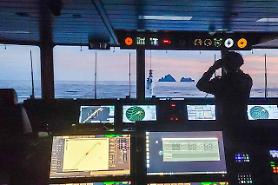
SEOUL -- A 9,200-ton ship installed with a remote autonomous system developed by Samsung Heavy Industries, a major shipbuilder in South Korea, has completed its clean and trouble-free test run on a coastal sea route covering about 950 kilometers (590 miles) for four days to prove the superior performance of avoiding collision with obstacles on a long voyage. In its test run that began on November 15 in waster off the southwestern port city of Mokpo, Samsung Heavy Industries (SHI) said that a training ship run by Mokpo National Maritime University has sailed up to Dokdo, a chain of rocky islets located in the middle of waters between the Korean peninsula and Japan. SHI said that the test ship equipped with a remote autonomous system called "Samsung Autonomous Ship (SAS)" has safely avoided the danger of colliding with other ships 29 times. In an area where fishing operations are active, SAS monitored several fishing boats approaching at the same time and presented an accurate and safe avoidance path every 5 seconds. SAS can recognize surrounding vessels and obstacles while assessing the risk of collision to find an optimal route. The shipbuilder said its solution combined radar, an automatic identification system, and camera images, along with automatic engine and ladder control as well as a 360-degree around-view function that monitors the surroundings without blind spots at day and night. Due to the nature of South Korea's marine environment with many islands, SHI said that the test run provided an opportunity to upgrade autonomous navigation technology to the next level. "This demonstration success is a meaningful achievement that confirms the performance and operational stability of SAS in a real complex maritime situation like urban roads," SHI's research center head Kim Hyun-joe said in a statement on November 24. South Korea has no safety regulations that can test autonomous ships at sea. This is the first case in which SHI established government-approved guidelines with Mokpo National Maritime University and South Korea's maritime classification society, KR, laying the legal basis for the demonstration of autonomous maritime operation. The International Maritime Organization (IMO), a U.N. maritime safety agency, has adopted mandatory energy-efficiency measures to reduce emissions of greenhouse gases from ships. SHI has partnered with DNV GL, an international classification society headquartered in Norway, to develop smart ship technology. SHI's domestic rival, Daewoo Shipbuilding & Marine Engineering (DSME) has completed the on-site performance run of its test smart ship named "DAN-V" for autonomous operation off Hwaseong, about 30 kilometers (18 miles) southwest of Seoul, using its smart ship platform DS4 that would be applied to an actual ship in 2023. South Korean shipbuilders are trying hard to develop autonomous ship technologies that can replace crew decisions with intelligent and autonomous systems integrating artificial intelligence, Internet of Things (IoT), big data, and sensors that would open an era of next-generation high-value-added ships. Smart ships are expected to revolutionize the landscape of ship design and operations. Smart shipping can be divided into unmanned ships ruled by an operator from a control center onshore and autonomous ships which use a computer on board that takes decisions about the route, speed, fuel consumption, maintenance and even mooring in the harbor. Lloyd's Register, a global professional services company specializing in engineering and technology for the maritime industry, has classified six levels for autonomous ships. For level 1 and level ships, all actions are taken by a human operator, but a decision support tool would be present and information could be delivered from shore. A level 3 ship would have a human in the loop for all operational decisions and actions. The human would be able to intercede and override autonomous operations. A level 4 ship would be similar, but the human is only a supervisor with no control over operations. Level 5 and Level 6 ships are fully autonomous.
-
 CB&I joins Daewoo shipyard project to apply liquid hydrogen storage tanks to ships
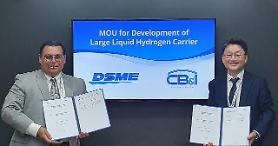
SEOUL -- CB&I, a U.S. designer and builder of storage facilities, tanks and terminals, joined hands with a major South Korean shipyard to apply liquid hydrogen storage tanks to large carriers. Liquid hydrogen, created by pressurizing hydrogen vapor, is stable for storage and transportation, has high density, and requires cooling equipment and cryogenic containers. Daewoo Shipbuilding & Marine Engineering (DSME) said that the partnership with CB&I would contribute to realizing the large size of liquefied hydrogen carriers. "The combination of our shipbuilding technology and CB&I's storage tank technology will help the domestic shipbuilding industry maintain its world's top position in the field of large liquit hydrogen carriers," an unnamed DSME official said in a statement on October 13. CB&I has provided NASA's new liquid hydrogen storage sphere that would be the world's largest liquid hydrogen storage unit. The company is also involved in a group led by Shell to develop a liquid hydrogen storage technology for tanks used at import and export terminals. Hydrogen is extremely flammable when it is mixed with very small amounts of air. The liquefaction of hydrogen requires cooling to a temperature of minus 253 degrees Celsius and subsequent storage in cryogenic containers. The advantage of liquefied hydrogen is its high density compared to compressed gas, which means that more energy can be contained in a given volume for easy transportation. Liquid hydrogen is essential in a government campaign to expand the use of fuel cells. In January 2022, a prototype won preliminary approval from a domestic maritime classification society, based on design innovation and new cryogenic materials. Amid growing demands for eco-friendly ships to cope with global economic recovery and environmental regulations, South Korea has accelerated the development of hydrogen-powered ships. A state-initiated project was launched in September 2021 to develop a maritime liquefied hydrogen fuel tank. POSCO has developed a liquefied natural gas (LNG) storage tank using high manganese steel approved by the International Maritime Organisation (IMO), a U.N. maritime safety agency. The steel group works with the state-run Korea Institute of Machinery and Materials (KIMM), DSME, and Korea Gas Safety Corp. (KGS) to develop a liquid hydrogen storage tank using high manganese steel, which is an alternative material for cryogenic services because it is easier to weld and has lower manufacturing costs than stainless steel. In April 2021, Hyosung Advanced Materials, affiliated with South Korea's Hyosung Group, secured a six-year contract from Hanwha Solutions to supply high-strength carbon fiber used to reinforce hydrogen fuel tanks.
-
 Hanwha Ocean wins $259.9 mln LNG tanker contract from Asian client
SEOUL -- South Korean major shipbuilder Hanwha Ocean, formerly known as Daewoo Shipbuilding & Marine Engineering, has won its first LNG tanker contract worth 332.2 billion won ($259.9 million) after the company went through a rebranding in April 2023. In April 2023, South Korea's Hanwha Group, one of the country's largest defense contractors, received the green light from the country's Fair Trade Commission to proceed with the acquisition of Daewoo Shipbuilding & Marine Engineering (DSME). The major shipbuilding company was rebranded into Hanwha Ocean. Hanwha Ocean said that the company won a contract from a client from the Asia region. Without disclosing the name of the client, Hanwha said that a liquefied natural gas tanker will be finished and delivered to the client by the first half of 2027. The LNG tanker contract is the shipbuilder's first contract after it changed its name earlier this year. Hanwha Ocean won a total of nine contacts including five LNG tankers and four special-purpose vessels during the first seven months of 2023. The contracts won so far this year total about $1.47 billion, which is about 21 percent of the estimated annual sales for this year.