
[epa/Yonhap News Photo]
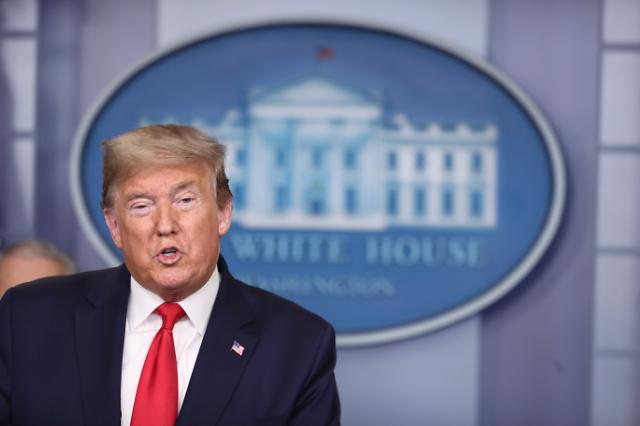
SEOUL -- U.S. President Donald Trump expressed hope, in a phone conversation with President Moon Jae-in, that South Korea could provide medical equipment support, according to Cheong Wa Dae.
Moon replied that his government would provide "maximum support" if available, as the two leaders discussed bilateral cooperation in the fight against the novel coronavirus pandemic. He then pointed out that approval by the Food and Drug Administration (FDA) might be required.
In response, Trump said he would make immediate action for that "within today," Cheong Wa Dae spokesman Kang Min-seok said. Trump showed his interest in the trend of infections in South Korea and said the country is "doing very good," he added.
South Korea has been widely lauded for its effective and swift response to the spread of the virus, taking advantage of its advanced testing capabilities. It has been exporting test kits to a number of countries.
In the 23-minute conversation, made at Trump's "urgent request," Moon said the establishment of a US$60 billion currency swap line between the two countries earlier this week was a "very timely" measure to help stabilize the international financial market.
(Yonhap)
Copyright ⓒ Aju Press All rights reserved.
Related News
-
 Minister Song Mi-ryeong Promises Compensation and Support for Tomato Virus-Affected Farmers
Minister of Agriculture, Food and Rural Affairs Song Mi-ryeong promised on November 26 to minimize damage to farmers affected by the tomato brown rugose fruit virus through loss compensation and disaster management funds.On the afternoon of the same day, Minister Song visited affected farms in Chunpo-myeon, Iksan, North Jeolla Province, to listen to the difficulties faced by farmers and discuss response measures with relevant agencies, including the Rural Development Administration and the Animal and Plant Quarantine Agency.During the visit, farmers expressed the need for adequate compensation considering the economic losses from farm closures and income gaps during fallow periods.In response, Minister Song stated, "We have decided to implement compensation for all costs related to collection, disposal, and disinfection, as well as for crops. In addition to loss compensation, we plan to minimize income gaps during fallow periods through disaster management fund support."Regarding the financial recovery of affected farms, she explained that to prevent further spread of the virus, farms will need to remain fallow for a certain period after pest control is completed and undergo inspections before replanting crops.She urged relevant agencies to strengthen responses, including monitoring, pest control, and post-management. She also advised farmers to comply with quarantine rules, such as minimizing access by outsiders, disinfecting agricultural tools, and reporting any suspicious symptoms immediately.The Ministry of Agriculture, Food and Rural Affairs currently assesses that tomato supply and demand is stable due to an increase in planting area and favorable crop conditions. It plans to continuously monitor the growth situation and the impact of fallow periods on affected farms.* This article has been translated by AI.
-
The Medical Legacy of Lee Kun-hee: Strengthening National Infectious Disease Response
The medical legacy of the late Lee Kun-hee, former chairman of Samsung, is contributing to the strengthening of the nation's infectious disease response capabilities. Based on a donation of 700 billion won (KRW) from his family, initiatives for the establishment of a specialized infectious disease hospital and research for vaccine and treatment development are being advanced, alongside an expansion of international cooperation for responding to new infectious diseases.According to the National Central Medical Center, the '2nd International Symposium on Medical Response to Emerging Infectious Diseases (EIDSS 2026)' was held over two days starting on the 23rd at the JW Marriott Dongdaemun Square Seoul.This symposium is part of the 'Korea Infectious Disease Recovery Support Project' funded by the 700 billion won (KRW) donation from the late chairman's family in April 2021. The project aims to enhance the national infrastructure necessary for the treatment and research of infectious diseases and to strengthen the response capabilities against new and high-risk infectious diseases.This year's event, the second since 2024, saw participation from over 300 experts, including medical personnel and officials from the government and related organizations in the field of infectious diseases, as well as representatives from the World Health Organization (WHO). They shared the latest research trends on new and high-risk infectious diseases and discussed strategies for integrated medical response systems linking national and regional efforts.The keynote speech honoring the late chairman was delivered by Maria Van Kerkhove, WHO's director, who introduced the latest trends in emerging viral infectious diseases. Discussions also included response strategies for the unknown infectious disease 'Disease X,' the use of artificial intelligence (AI) for infectious disease surveillance and prevention, pandemic response research, and acceleration of vaccine development.A workshop involving officials from the Central and Regional Infectious Disease Specialized Hospital focused on strengthening medical personnel capabilities through integrated education and training, as well as establishing real-time medical information and data systems.This symposium is significant as it demonstrates that the donation from the late chairman's family is contributing not only to the expansion of medical facilities but also to the activation of infectious disease research, the training of specialized personnel, and the establishment of international cooperation frameworks.The late chairman's family donated a total of 1 trillion won (KRW) to the medical sector in 2021, with 700 billion won (KRW) allocated to the infectious disease recovery support project and 300 billion won (KRW) to the pediatric cancer and rare disease recovery project. Emphasizing that "enhancing human health and quality of life is the mission of a corporation," they are working to build medical and research infrastructure that can contribute to the nation and society in the long term.Of the donations for the infectious disease recovery support project, 500 billion won (KRW) will be used for the construction of the Central Infectious Disease Hospital. The hospital is expected to have 150 beds, including general, intensive care, and high-efficiency negative pressure rooms, as well as a negative pressure operating room, biosafety testing laboratory, and clinical research center.Currently, the detailed design has been completed, and a review of the design appropriateness by the Public Procurement Service is underway. After completing the relevant administrative procedures and selecting a construction company, the goal is to begin construction next year. The Central Infectious Disease Hospital will play a role not only in treating infectious disease patients but also in training medical personnel, conducting clinical research, and supporting national infectious disease response policies.The remaining 200 billion won (KRW) is being utilized for expanding research infrastructure for infectious diseases and supporting research for vaccine and treatment development. The National Institute of Infectious Diseases and the National Central Medical Center have been actively pursuing research projects since last year, currently conducting a total of 17 research projects, including the establishment of pandemic response clinical research infrastructure and essential medical responses. Academic achievements are also being realized, with results from analyses of the mpox virus characteristics published in international journals.The late chairman paid special attention to the medical field based on a management philosophy of respecting humanity and contributing to society. In the 1990s, he established Samsung Medical Center to improve the domestic medical environment and built Samsung Seoul Hospital at a cost of 330 billion won (KRW). This recent donation from his family continues his legacy of contributing to society through the establishment of national medical infrastructure rather than one-time support.Seo Gil-jun, president of the National Central Medical Center, stated, "Even in the face of infectious disease crises, we must ensure that every citizen can receive necessary treatment in a timely manner through continuous training of specialized personnel and research, as well as establishing a national-level ongoing preparation and domestic and international response cooperation system. The National Central Medical Center will proceed without delay with the construction of the Central Infectious Disease Hospital and infectious disease research projects, and will strive to enhance infectious disease response capabilities based on the experiences and research achievements accumulated by medical personnel both domestically and internationally."* This article has been translated by AI.
-
United States Loses Measles Elimination Status for First Time in 26 Years
The United States has lost its measles elimination status for the first time in 26 years.According to the BBC, the Pan American Health Organization (PAHO), a branch of the World Health Organization (WHO), announced on the 17th (local time) that the same type of measles virus has been continuously transmitted in the U.S. for over 12 months, resulting in the revocation of the country's elimination status. Mexico and Bolivia have also lost their status.This year alone, the U.S. has reported 5,400 measles cases and 10 deaths, marking the largest outbreak since the 1990s. In Pennsylvania, a single outbreak infected more than 1,400 people and resulted in seven deaths. Jarbas Barbosa, PAHO's director, warned that "measles is spreading globally again amid ongoing gaps in vaccination."A decline in vaccination rates is cited as a contributing factor. The vaccination rate for the measles, mumps, and rubella (MMR) vaccine in the U.S. stands at 92.4%, below the 95% threshold needed for herd immunity. An assistant professor at Columbia University Irving Medical Center described the situation as a "massive setback," noting that misinformation about vaccines has eroded trust in the healthcare system since the COVID-19 pandemic, according to the BBC.The BBC also reported that the medical community views misinformation from Health and Human Services Secretary Robert F. Kennedy Jr. and President Donald Trump as major causes of the decline in vaccination rates. Vaccine skeptic Secretary Kennedy has frequently questioned the safety of the MMR vaccine, while President Trump issued an executive order this year to administer the MMR vaccine in three separate doses.Kennedy also countered that the increase in cases began before his appointment, but he continues to advocate for MMR vaccination as the most effective way to prevent measles on social media. The Centers for Disease Control and Prevention (CDC) stated that it aims to restore elimination status by expanding vaccine accessibility.Countries that lose their elimination status must submit corrective plans to PAHO that include measures to increase vaccination rates. This year, several European countries, including the United Kingdom, Spain, and Austria, also lost their measles-free status.* This article has been translated by AI.