

Journalist

Ryu Yuna and Candice Kim
Julia37@ajupress.com
-
 Conflict Over Performance Bonuses Intensifies Amid AI Boom in South Korea “I want to receive performance bonuses based on my results, but it feels like I’m playing a game where the outcome is already decided,” said Yoo, a 31-year-old employee at a major South Korean corporation. “The criteria for performance bonuses change every year, making it hard to predict. The issue isn’t the money; it’s that the standards keep changing and aren’t clearly defined.” As Samsung Electronics and SK Hynix, leaders in the domestic semiconductor industry, continue to achieve record-breaking results thanks to the AI semiconductor boom, conflicts surrounding performance bonuses and compensation systems are intensifying in the workplace. While U.S. tech giants are significantly increasing stock options and equity compensation to attract key AI talent, South Korea is witnessing repeated labor disputes over the criteria and distribution methods for performance bonuses. Samsung Electronics and its labor union signed a tentative agreement following a government mediation process, temporarily postponing a planned general strike. However, the potential for renewed conflict remains, depending on the results of a member vote on the tentative agreement scheduled for the 27th. As a key player accounting for about 20% of South Korea's total exports, any production disruptions at Samsung could significantly impact the domestic industry and financial markets. The core of the tentative agreement at Samsung Electronics is to fix the performance bonus pool for the semiconductor (DS) division at 10.5% of agreed business performance and to eliminate the payment cap, introducing an unprecedented compensation system. This change allows for substantial stock performance bonuses for employees, particularly in the memory division, marking a test of a new compensation model aligned with the AI semiconductor boom. This situation has strengthened calls for more transparency and predictability in the criteria and decision-making processes for performance bonuses. Industry experts argue that the unclear compensation system has exacerbated recurring labor disputes, and this agreement could serve as a new benchmark for performance distribution during the AI boom. This trend is expected to influence discussions on compensation systems at other ICT companies, including Kakao, which recently faced the possibility of its first headquarters strike after a vote in favor of a strike. The differences in compensation systems between South Korean and U.S. companies have become more pronounced in the wake of the AI boom. In South Korea, wage increases are primarily driven by performance bonuses rather than base salaries. An analysis of raw data from the Ministry of Employment and Labor's 'Business Labor Force Survey' by the Korea Employers Federation revealed that special payments (including performance bonuses) increased by 8.1% in the first half of 2025 compared to the same period the previous year, significantly outpacing the increase in fixed salaries (2.9%). However, the distribution of performance bonuses is heavily skewed towards large corporations. According to data received by Kim Wi-sang, a member of the People Power Party, from the Ministry of Employment and Labor, as of June last year, 43.8% of workplaces with over 300 employees and 46.2% of those with over 1,000 employees operated performance bonus systems, compared to just 6.4% of small businesses with fewer than 300 employees. Performance distribution systems are collective performance reward systems based on whether a company meets its management goals, distinguishing them from individual performance bonuses based on personal evaluations. South Korean companies tend to have a strong structure for distributing performance bonuses based on overall company performance. Cash bonuses and welfare benefits are predominant, often prioritizing organizational performance over individual contributions. This contrasts with the compensation systems of U.S. tech giants, which focus on securing key talent and individual contributions. Experts analyze that the recurring conflicts over performance bonuses stem not just from corporate culture but also from structural differences in labor market flexibility, performance evaluation methods, and risk-sharing frameworks. Eric Cambria, a professor at Nanyang Technological University, noted, “U.S. tech companies are intensely focused on securing key research personnel that will determine their AI competitiveness. The trend of concentrating stock options and long-term rewards on key developers is strengthening.” Indeed, competition for top talent among U.S. tech giants has intensified following the AI boom. Financial data reviewed by The Wall Street Journal indicates that OpenAI's average stock compensation per employee is approximately $1.5 million for 2025. Meta reflected $20.4 billion and Alphabet $27.1 billion in stock-based compensation for the same year. U.S. companies are also reinforcing structures that reflect not only overall company performance but also individual contributions and strategic input in their performance bonuses. Companies like Meta and Google are known to consider a comprehensive range of factors, including rank, individual evaluations, and organizational performance, when determining compensation. The demand for AI talent is surging. According to global recruitment platform Indeed, job postings for 'Forward-Deployed Engineers,' who directly apply AI systems in the workplace, skyrocketed from 643 in April last year to 5,330 in April this year, an increase of about 729%. Choi Jae-pil, a professor at Sungkyunkwan University's Graduate School of Business, stated, “As AI standardizes repetitive tasks, the phenomenon of concentrating rewards on 'superstar talent' that creates strategic value will intensify.” He added, “As AI enables more transparent evaluations of previously hard-to-quantify performance, the introduction of differentiated compensation systems by companies is likely to accelerate. Ultimately, in the AI era, the question of 'who is irreplaceable' will become the standard for compensation.” He further noted, “Whether companies can retain key talent will determine their competitiveness. Companies are likely to shift their compensation systems toward stock options and long-term incentives. However, South Korea still has a strong collective culture and cash-based performance bonus system, which may lead to greater internal resistance during the process of introducing differentiated compensation systems compared to the U.S.” Differences in labor market structures are also cited as a backdrop to the recurring conflicts over performance bonuses. Shin Hyun-han, a professor at Yonsei University's School of Business, pointed to 'labor market flexibility' as a reason why U.S. companies tend to disclose evaluation criteria and compensation systems more transparently. He explained, “In the U.S., dissatisfied key talents can quickly move to competitors, prompting companies to naturally offer higher compensation to retain talent. Consequently, the employees who remain in the organization are those who agree with the corporate culture.” In contrast, he noted, “In South Korea, the burden of potential wage loss and career uncertainty makes it difficult for employees to leave easily. As a result, dissatisfied employees often remain in the organization and voice their concerns.” He described this as a “vicious cycle of performance bonus disputes,” where no matter how much bonuses are increased, relative deprivation persists. Differences in evaluation methods also emerge. Professor Shin stated, “U.S. companies tend to clearly disclose KPIs (Key Performance Indicators) or OKRs (Objectives and Key Results), while South Korean companies often rely on qualitative judgments from evaluators.” He added, “As a result, information asymmetry deepens, and ultimately, the degree of freedom in dismissals influences the transparency of companies.” He emphasized that what is crucial for employees is “predictability,” suggesting that maintaining base salaries while differentiating performance bonuses could be a realistic alternative. He stated, “The clearer the criteria become, the easier it is for employees to accept the results or make rational choices to leave if necessary.” There is already a growing perception that “effort and rewards are not connected.” SJ, a thirty-something employee at a subsidiary of a major corporation, expressed his frustration, saying, “The companies we supply to are having performance bonus parties, but we end up with nothing.” He noted, “In a vertically integrated structure, the profitability of subsidiaries is often determined by internal trading structures or group-level distribution methods. There needs to be more transparent and consistent disclosure of evaluation criteria for individuals, departments, and business units so that employees can accept the results.” He added, “Currently, no matter how much performance we deliver, the company often explains it away with the logic of being in a 'crisis situation.' Clear criteria are necessary for employees to feel motivated and grow alongside the organization.” However, experts caution that simply adopting the U.S. compensation system is not the solution. Kim Jin-young, a professor at Korea University, stated, “The high compensation in the U.S. comes with the structure of accepting the risks of layoffs and income volatility. To share performance, there must be a structure that also shares risks during downturns.” He added, “In South Korea, there is often a focus solely on the high compensation of the U.S. model, but underlying it are employment instability and labor market risks. Rather than trying to solve inequality issues solely through internal performance bonuses, it is necessary to approach them from a broader social structural perspective.” Experts believe that as the AI era progresses, South Korean companies will face increasing pressure to reform their compensation systems. However, they agree that rather than simply imitating the U.S. performance compensation system, it is essential to redesign compensation structures that fit the labor market structure and organizational culture in South Korea. Professor Choi emphasized, “Ultimately, what matters is how fairly and reliably employees perceive the performance evaluation and compensation systems. In the AI era, changes in compensation systems must go hand in hand with transformations in organizational culture and labor market structures.”* This article has been translated by AI. 2026-05-23 11:07:06
 -
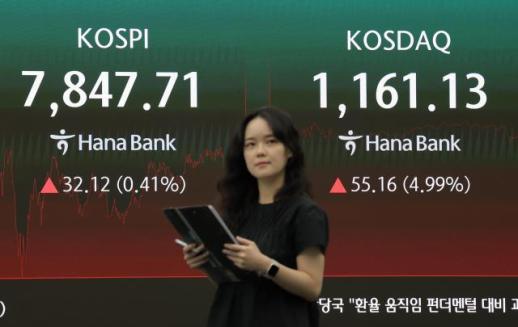 Asia AI boom lifts Nikkei to record high while KOSDAQ roars on retail frenzy SEOUL, May 22 (AJP) - Japan's main index touched new heights Friday as it led broad Asian gains refueled by AI hype, while Seoul's secondary bourse received a boost from a state-backed fund. The Nikkei 225 rose 2.68 percent to a record close of 63,339.07 amid reinforced momentum in AI- and semiconductor-related stocks following Nvidia's strong earnings. SoftBank Group surged more than 12 percent intraday after a near 20-percent jump in the previous session — the biggest one-day gain since February 2000 — on expectations surrounding Arm Holdings and a potential OpenAI IPO. AI-related shares also rallied strongly, with factory automation firm Fanuc climbing 6.61 percent, Kawasaki Heavy Industries gaining 4.48 percent and electronic components maker Taiyo Yuden soaring 11.74 percent to a record high on expectations for rising AI server demand. China's Shanghai Composite also ended 0.87 percent higher at 4,112.90, while Hong Kong's Hang Seng Index was trading up 0.85 percent at 25,602.66. Korea's benchmark KOSPI swung sharply throughout the session before closing 0.41 percent higher at 7,847.71. The index briefly fell below 7,800 in early trading before rebounding above 7,860. Retail investors bought a net 1.07 trillion won worth of local shares, while foreigners sold a net 1.92 trillion won. Institutional investors bought a net 758.3 billion won. The junior KOSDAQ surged 4.99 percent to 1,161.13, triggering buy-side sidecar curbs for a second consecutive session as growth and speculative shares rallied sharply. Investor sentiment was boosted by the launch of the "National Growth Fund," a state-backed investment program aimed at channeling household savings into AI and other strategic industries. Online allocations at several brokerages sold out within minutes after subscriptions opened Friday morning, reinforcing expectations that the fund would primarily benefit smaller KOSDAQ-listed technology and venture firms, while boosting buying interest in biotech, AI, semiconductor equipment and secondary-battery shares. Secondary-battery stocks EcoPro BM and EcoPro climbed 10.77 percent and 12.87 percent to close at 216,000 won and 146,500 won, respectively, while semiconductor equipment maker Jusung Engineering surged 20.95 percent to 224,000 won. Biotech shares also rallied broadly, with HLB jumping 8.76 percent to 50,900 won, ABELBIO rising 9.37 percent to 120,200 won and LigaChem Biosciences gaining 12.83 percent to 157,400 won. The divergence between the two benchmarks widened as Samsung Electronics and SK hynix lost momentum following weeks of steep gains tied to the global AI rally. Samsung Electronics fell 2.34 percent to 292,500 won after hitting a record intraday high of 300,500 won, while SK hynix edged up 0.05 percent to 1,941,000 won. Other major KOSPI names traded mixed. Auto shares weakened, with Hyundai Motor falling 1.65 percent to 655,000 won and Kia declining 1.85 percent to 164,800 won amid profit-taking pressure following recent gains. By contrast, electronics and industrial shares advanced. Samsung Electro-Mechanics surged 11.30 percent to 1,340,000 won, while HD Hyundai Heavy Industries rose 1.19 percent to 680,000 won and Hanwha Aerospace gained 1.04 percent to 1,261,000 won. Financial and holding company shares also strengthened, with KB Financial rising 2.70 percent to 160,000 won, Samsung Life Insurance adding 2.68 percent to 364,500 won and SK Inc. jumping 11.46 percent to 642,000 won. Among battery and biotech names on the main board, Samsung SDI climbed 5.03 percent to 647,000 won and Samsung Biologics gained 1.43 percent to 1,415,000 won. Despite the relatively muted finish for the KOSPI, intraday volatility remained elevated as investors rotated out of large-cap semiconductor names and into smaller policy-driven momentum plays linked to the government fund theme. The dollar-won exchange rate retreated to 1,517.2 won on verbal intervention from authorities after crossing 1,580 won earlier in the day as foreign equity selling extended for a 12th straight session. In a joint statement, South Korea's Ministry of Economy and Finance and Bank of Korea said they were closely monitoring the market and would take decisive action if needed. The Seoul markets are closed Monday for Buddha's Birthday. 2026-05-22 17:19:06
 -
 State-backed investment fund sparks frenzy as retail investors flood in SEOUL, May 22 (AJP) - A government-backed fund to invest in key strategic industries sparked a buying frenzy, with its online allocations selling out within minutes as soon as it became available on Friday. The fund, designed to invest in advanced industries such as artificial intelligence (AI) and semiconductors as part of President Lee Jae Myung's push to shift household assets away from heavy reliance on real estate and into the stock market, attracted strong demand from retail investors, who were drawn by tax incentives and a government-backed loss-sharing structure. Online offerings at some brokerages sold out within several minutes after sales began at 8 a.m., with banks and securities firms also seeing heavy demand both on mobile apps and in person. "We opened nearly 10,000 accounts for the fund in a single day," a staffer at a major brokerage in central Seoul said. "This morning alone, all online offerings were sold out within just 10 minutes." The staffer added that crowds had begun gathering early in the morning to open accounts for the fund, forming long waiting lines. Another brokerage also saw more than one-fifth of its 20 billion won ($14.5 million) allocation sold online within minutes after sales began at 8 a.m. Major banks including Shinhan and Woori said their mobile allocations sold out in the morning, while some branches saw customers lining up even before opening hours to sign up for the fund. "It feels more reliable because the government is involved," said a woman surnamed Bae in her 50s who visited a Korea Investment & Securities branch in Seoul's financial district of Yeouido to sign up for the fund. She said the product appealed to her because it was easier to manage alongside her daily job than short-term stock trading. "It feels more secure because the government is involved," said a woman in her 50s surnamed Bae, who visited a Korea Investment & Securities branch in Seoul's Yeouido financial district to sign up for the fund. She said the product also appealed to her because it was easier to manage alongside her daily job than short-term stock trading. The fund will be sold on a first-come, first-served basis over the next three weeks until June 11. To qualify for tax benefits, investors must be at least 19 years old and open a dedicated account used exclusively for the fund. Those who have been subject to South Korea's comprehensive income tax at least once in the past three years are not eligible to open such accounts. The fund aims to raise 600 billion won (US$435 million) from retail investors, along with 120 billion won in government funding. The combined assets will be allocated across 10 separate funds investing in strategic industries, with the government covering up to 20 percent of losses, though investors can still lose money. Financial regulators warned that the fund is a high-risk investment product, requiring investors to pass suitability assessments before investing. Despite the risks involved, demand appeared to surge as the fund offers tax benefits such as dividend income and income tax deductions. 2026-05-22 15:50:34
 -
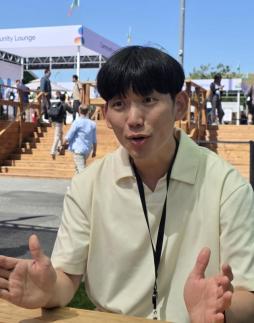 K-culture boom fuels global rise of AI Korean-learning app SEOUL, May 22 (AJP) - Riding the global mainstreaming of K-pop, Korean dramas and streaming blockbusters, a South Korean AI language-learning startup is rapidly expanding overseas, with the U.S. emerging as one of its biggest markets. TEUIDA, a South Korean language-learning app that uses AI voice recognition to simulate conversations with native speakers, has surpassed 6 million cumulative downloads worldwide, Chief Executive Jang Ji-woong said on Tuesday at Google’s annual I/O developer conference in Mountain View, California. About 30 percent of downloads came from the U.S., Jang said, while users in Southeast Asia, Europe and Japan are also driving growth. Monthly active users have reached around 600,000. Unlike conventional language-learning apps centered on memorization and repetition, TEUIDA focuses on immersive, conversation-based learning. Users speak directly to characters in filmed real-life scenarios, while AI analyzes pronunciation, context and accuracy in real time to guide the flow of the conversation. “It’s designed to feel more like talking to someone than studying a language,” Jang said. The company launched its Korean-language learning service first in Vietnam in 2019 before gradually expanding into English-speaking countries beginning in 2020. The platform now offers lessons in Korean, Japanese, Spanish and French, though Korean remains by far the most popular language among users. The app currently ranks No. 1 in Korean-language learning searches on Apple’s App Store in both the U.S. and the U.K., while also placing within the top 10 for Japanese-language learning apps. Mr. Jang said the global spread of Korean pop culture played a critical role in accelerating demand. The company’s launch coincided with BTS’s global breakout, followed by the worldwide success of Korean content such as “Parasite” and “Squid Game,” driving interest in Korean language and culture. In parts of Southeast Asia and Japan, Korean-language skills are increasingly viewed as useful for employment and education opportunities, adding to demand beyond entertainment consumption alone. The company has also sought to differentiate itself by incorporating cultural context into language learning. Lessons are filmed in authentic Korean settings — from restaurants and cafes to tourist spots such as Seoul’s Gwanghwamun district — allowing users to learn how expressions are naturally used in real-life situations. “Many users want to visit Korea and experience the culture,” Jang said, adding that the app’s appeal extends beyond simply learning the language. Earlier this year, the company launched a beta version of its English-learning service for Korean users and plans a broader rollout later this year after incorporating user feedback. Ultimately, TEUIDA aims to expand beyond Korean-language education into a broader multilingual learning platform. “Our ultimate goal is to become a multilingual app for language learners around the world,” Jang said. “This year, we are prioritizing revenue growth over profitability, though improving margins will become a priority starting next year.” 2026-05-22 11:33:16
 -
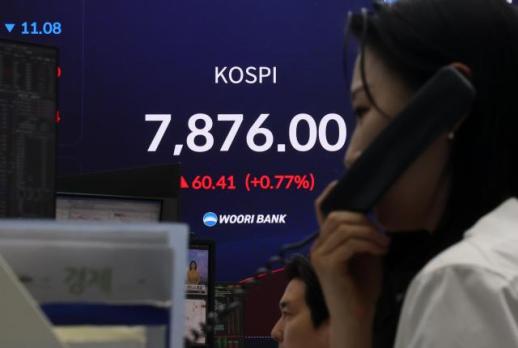 KOSDAQ triggers buy-side sidecar, Samsung Elec briefly tests 300,000 SEOUL, May 22 (AJP) - South Korean stocks erased early gains and turned lower Friday morning as foreign investors took profits after earlier record-breaking rally, while biotech and secondary-battery shares powered rally on the KOSDAQ. The benchmark KOSPI rose 0.62 percent to 7,863.71 at the opening bell, after surging 8.42 percent Thursday in its biggest single-day point gain on record. However, the index later turned lower as foreign investors extended heavy selling. As of 9:57 a.m., the benchmark index slipped 0.20 percent to 7,800.19, while the KOSDAQ jumped 5.09 percent to 1,162.25, triggering a sidecar trading curb for a second straight session. Retail investors remained aggressive buyers, purchasing a net 1.05 trillion won worth of KOSPI shares, while foreign investors sold a net 1.16 trillion won. The South Korean won remained stable, trading at 1,507.90 won against the greenback, compared with the previous session’s close of 1,506.10 won. Investor sentiment improved overnight after U.S. stocks ended higher on growing expectations of progress in negotiations involving Iran, easing concerns over a broader Middle East conflict and helping push oil prices and Treasury yields lower. The Dow Jones Industrial Average rose 0.55 percent to a record close of 50,285.66, while the S&P 500 added 0.17 percent and the Nasdaq Composite gained 0.09 percent. Chip-related shares remained a key driver of market sentiment. While Nvidia fell 1.77 percent on profit-taking despite strong earnings, memory-related stocks rallied after the company highlighted rising demand for high-capacity storage and memory products in AI data centers during its conference call. Micron Technology jumped 4.11 percent and SanDisk soared 10.75 percent, lifting sentiment toward South Korea’s semiconductor market. Samsung Electronics erased early gains after briefly touching the 300,000-won mark for the first time in intraday trading, falling 1.84 percent to 294,000 won after profit-taking accelerated following the previous session’s sharp rally. The stock also remained in focus as the company’s labor union began a six-day vote Friday on a tentative wage agreement reached earlier this week. Semiconductor equipment maker Jusung Engineering also surged 9.88 percent. The fellow chipmaker SK hynix slipped 0.46 percent to 1,931,000 won and SK Square declined 0.59 percent to 1,172,000 won. Among auto shares, Hyundai Motor dropped 2.55 percent to 649,000 won and Kia fell 2.20 percent to 164,200 won. Battery and industrial shares traded higher, with LG Energy Solution rising 2.49 percent to 411,000 won, Samsung Electro-Mechanics gaining 4.07 percent to 1,253,000 won and HD Hyundai Heavy Industries advancing 2.38 percent to 688,000 won. Doosan Enerbility also climbed 3.69 percent to 112,400 won. Financial and defense-related shares were mixed. Samsung Life Insurance rose 1.13 percent to 359,000 won, KB Financial gained 2.25 percent to 159,300 won and Hanwha Aerospace edged up 0.88 percent to 1,259,000 won, while Samsung C&T added 0.36 percent to 420,000 won. Samsung Biologics also rose 2.72 percent to 1,433,000 won. The junior KOSDAQ traded broadly higher, led by gains in biotech and secondary-battery shares. EcoPro BM surged 11.79 percent to 218,000 won, and EcoPro jumped 16.72 percent to 151,500 won. Biopharmaceutical shares were also strong, with Alteogen rising 7.68 percent to 378,500 won, Samchundang Pharm gaining 6.76 percent to 379,000 won and HLB climbing 11.54 percent to 52,200 won. Among other KOSDAQ heavyweights, Rainbow Robotics advanced 2.29 percent to 760,000 won, Leeno Industrial rose 1.54 percent to 105,600 won and EO Technics added 3.46 percent to 568,000 won. EcoPro Materials climbed 7.96 percent to 111,200 won, while JUSUNG Engineering gained 2.38 percent to 189,600 won. Oil prices also eased with Brent crude futures falling 2.32 percent to settle at $102.58 a barrel, and West Texas Intermediate crude dropped 1.94 percent to $96.35. The yield on the benchmark 10-year U.S. Treasury note slipped 0.8 basis point to 4.575 percent. Treasury yields nevertheless remained elevated as investors braced for a more hawkish Fed. Although the benchmark 10-year Treasury yield slipped 0.8 basis point overnight, it remained at 4.57 percent, while the two-year yield traded near 4.07 percent. 2026-05-22 10:41:42
 -
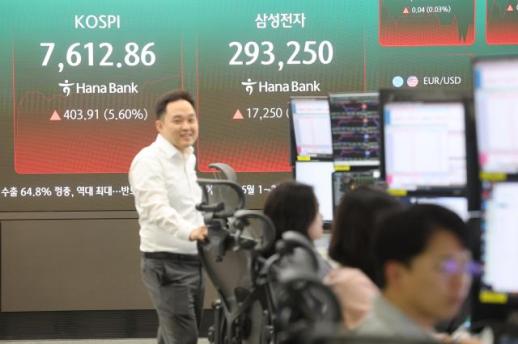 KOSPI recovers above 7,600 as Samsung averts strike SEOUL, May 21 (AJP) - South Korean stocks sharply rebounded on Thursday as investor sentiment improved on growing optimism over artificial intelligence and easing geopolitical tensions. Sentiment was also boosted after Samsung Electronics struck a tentative deal following marathon last-minute negotiations over wages and performance bonuses, easing concerns over a possible large-scale strike at the country's biggest chipmaker. The benchmark KOSPI surged 6.62 percent to 7,685.96 points as of around 10:30 a.m., while the junior KOSDAQ jumped 5.06 percent to 1,109.46. The sharp early gains triggered sidecar curbs on trading. Samsung Electronics' shares climbed 6.16 percent to 293,000 won, helping drive gains in the broader market. The South Korean won also strengthened as external uncertainties eased, trading at 1,499.5 won against the greenback, compared with the previous session’s close of 1,507.80 won. Investor sentiment improved after global oil prices and U.S. Treasury yields retreated overnight. WTI crude fell below the US$100-per-barrel mark to around $98, while the benchmark U.S. 10-year Treasury yield slipped back into the 4.5 percent range after U.S. President Donald Trump said negotiations with Iran were in the "final stages," raising hopes for a diplomatic breakthrough. The decline in oil prices and yields weakened demand for safe-haven assets and helped lift risk appetite across global markets from New York to Seoul. Chip stocks also surged, with SK hynix climbing 6.88 percent to 1,865,000 won and SK Square rising 7.48 percent to 1,106,000 won amid continued optimism over the AI-driven semiconductor boom. Automakers and industrial shares posted strong gains as well. Hyundai Motor advanced 7.43 percent to 636,000 won, Kia jumped 9.37 percent to 163,400 won and HD Hyundai Heavy Industries added 3.30 percent to 657,000 won. Battery and electronics-related shares moved higher across the board. LG Energy Solution rose 3.38 percent to 397,500 won, while Samsung SDI surged 11.12 percent to 1,179,000 won. Financial and biotech shares also joined the rally. Samsung Life Insurance soared 10.10 percent to 343,500 won, Samsung C&T climbed 7.96 percent to 400,000 won, Samsung Biologics gained 4.11 percent to 1,392,000 won and KB Financial rose 2.11 percent to 154,900 won. Defense shares were also firmer, with Hanwha Aerospace advancing 3.12 percent to 1,288,000 won. But much of the market's early gains were driven by Samsung after its management and labor union reached the deal the previous day through government-mediated talks, averting a planned strike and putting it to a union vote through May 27. The agreement eased concerns over labor unrest and addressed key union demands including bonuses and the removal of caps on incentive payments. Markets, however, would remain cautious ahead of the vote, with investors closely watching whether the deal will hold at the country's largest chipmaker, which makes up about one-fifth of the KOSPI by market capitalization. Meanwhile, across Asia, markets broadly moved higher, with Japan's Nikkei 225 surging 3.39 percent to 61,834.74, China's Shanghai Composite Index rising 0.84 percent to 4,196.94 and Hong Kong's Hang Seng Index adding 0.61 percent to 25,807.79 amid improving global risk sentiment. 2026-05-21 11:05:34
 -
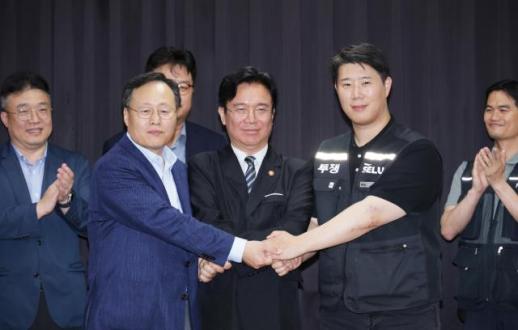 Samsung Live: Stock jumps 6% on labor accord, lifting KOSPI SEOUL, May 21 (AJP) - South Korean stocks jumped Thursday after Samsung Electronics and its labor union reached a last-minute tentative wage agreement led by Labor Minister Kim Young-hoon, easing fears of a large-scale strike at the country’s biggest chipmaker. Relief over the suspension of the planned strike fueled a sharp rally in Samsung Electronics shares, which jumped 6.43 percent to 293,750 won as of 9:33 a.m., helping lift the benchmark KOSPI 5.42 percent higher to 7,599.39. Investor sentiment improved sharply after the National Samsung Electronics Union announced that its planned May 21-June 7 general strike would be suspended "until further notice" pending a membership vote on the tentative 2026 wage agreement scheduled through May 27. Samsung Electronics, which accounts for roughly one-fifth of the KOSPI by market capitalization, has been one of the market's biggest drivers during the AI-fueled semiconductor rally. The labor dispute had centered on bonus structures, compensation for employees in loss-making divisions and the removal of caps on performance-based incentives. Under the tentative agreement signed late Wednesday at the Gyeonggi District Employment and Labor Office in Suwon, Samsung Electronics and the union agreed to separate bonuses into OPI (Overall Performance Incentive) payments and a special management incentive program for the semiconductor DS division. The DS division's special incentive pool was set at 10.5 percent of agreed business performance and, notably, will not be capped — one of the union’s key demands during negotiations. Under the agreement, 40 percent of the incentive pool will be distributed across the semiconductor division, while the remaining 60 percent will be allocated by individual business units. The DS incentives will be paid entirely in Samsung Electronics shares after tax. Employees will be allowed to sell one-third immediately, while the remaining shares will be locked up for one and two years, respectively. The two sides also agreed to postpone penalties for loss-making divisions until next year, while setting a 10-year validity period for the DS special incentive framework subject to minimum operating profit conditions. They further agreed to a 6.2 percent wage increase, including a 4.1 percent base salary raise and a 2.1 percent performance-based increase. Employees in the DX division will receive company shares worth 6 million won. The tentative agreement will be finalized following the union membership vote on the 27th. 2026-05-21 10:03:35
 -
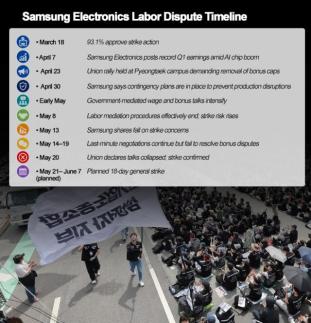 Timeline: Samsung Electronics labor dispute SEOUL, May 20 (AJP) - Samsung Electronics and its labor union failed to reach an agreement in government-mediated wage talks on Wednesday, one day before a planned strike, as disputes over bonus caps and compensation structures remained unresolved. The union said it would proceed with its planned general strike starting Thursday following the collapse of negotiations. Above is the timeline leading to the general strike, beginning with the March 18 vote in which 93.1 percent of participating union members approved strike action. At the heart of the dispute is the cap on bonus payouts, an issue that intensified after rival chipmaker SK hynix removed its bonus ceiling and distributed up to U.S. $477,000 per employee following its record 2025 performance — equivalent to 10 percent of the company’s annual operating profit. Samsung’s main labor union, which is largely led by semiconductor workers, is demanding that the company allocate 15 percent of annual operating profit to employee bonuses and remove the current payout cap altogether. 2026-05-20 15:31:06
 -
 KOSPI, Nikkei extend slide as global bond yields hit multi-decade highs SEOUL, May 20 (AJP) - South Korean and Japanese equities extended losses Wednesday as a global bond rout intensified, with surging long-term yields rattling stock markets that had largely shrugged off Middle East tensions amid the AI-driven rally. As of 10:13 a.m., the benchmark KOSPI fell 0.87 percent to 7,208.53, while the tech-heavy KOSDAQ dropped 1.97 percent to 1,062.49 amid persistent foreign selling. The Japanese Nikkei 225 also weakened as government bond yields climbed to fresh multi-decade highs, deepening concerns that elevated oil prices and stubborn inflation could keep global borrowing costs higher for longer. The Korean won also came under pressure, with the U.S. dollar rising to 1,511.50 won from 1,507.80 won in the previous session. The local market initially opened higher despite overnight losses on Wall Street, supported by rebounds in U.S. memory-chip stocks such as Micron and Sandisk following recent sharp declines. Samsung Electronics, which was set to hold a third round of wage talks with its labor union at 10 a.m. ahead of a planned general strike Thursday, edged up 0.91 percent to 278,000 won. SK hynix, however, reversed early gains to fall 1.38 percent to 1,721,000 won. Among other large-cap shares, HD Hyundai Heavy Industries surged 4.52 percent to 625,000 won, while SK Square gained 0.49 percent to 1,025,000 won and Samsung SDI added 0.55 percent to 181,800 won. Automakers and battery shares traded broadly lower. Hyundai Motor fell 1.99 percent to 592,000 won, Kia lost 2.39 percent to 151,200 won and LG Energy Solution slipped 1.37 percent to 394,500 won. Defense and industrial shares also weakened, with Hanwha Aerospace dropping 3.34 percent to 1,243,000 won, Doosan Enerbility falling 3.11 percent to 102,700 won and Samsung Electro-Mechanics declining 2.63 percent to 961,000 won. Financial and biotech shares mostly retreated as well. Samsung Life Insurance fell 2.24 percent to 305,000 won, Samsung Biologics dropped 2.30 percent to 1,315,000 won, Samsung C&T slid 3.02 percent to 369,000 won and KB Financial edged down 0.59 percent to 151,900 won. On the KOSDAQ, AI robotics and other high-valuation growth shares came under pressure as rising global yields dampened investor appetite for risk assets. Rainbow Robotics tumbled 4.05 percent to 639,000 won, extending the broader selloff in AI and robotics-related names. Secondary-battery and biotech shares also weakened. Alteogen fell 2.86 percent to 356,000 won, Ecopro dropped 2.63 percent to 118,400 won, Ecopro BM slipped 0.82 percent to 180,900 won and HLB declined 3.84 percent to 47,600 won. Samchundang Pharm plunged 7.80 percent to 337,000 won, while ABLBio lost 5.00 percent to 106,400 won and Kolon TissueGene fell 5.25 percent to 101,000 won. Overnight, the yield on the benchmark 30-year U.S. Treasury bond climbed as high as 5.197 percent, the highest level since 2007, fueling concerns that prolonged geopolitical tensions and elevated oil prices could reignite inflationary pressures. Japan's 10-year government bond yield also hit another fresh high, ending Tuesday at 2.793 percent, its highest level in nearly three decades. Japan's Nikkei 225 fell 1.11 percent to 59,881.16, while Hong Kong's Hang Seng Index dropped 0.70 percent to 25,616.02 and China’s Shanghai Composite slipped 0.46 percent to 4,150.46. 2026-05-20 10:37:47
 -
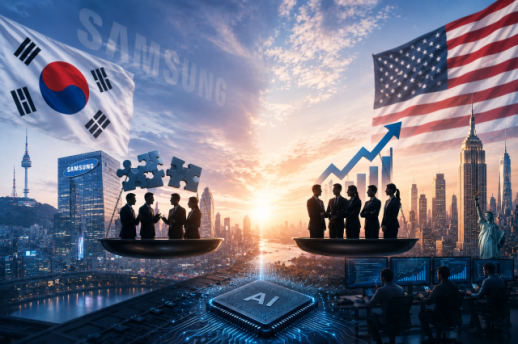 Samsung strike threat highlights widening Korea-U.S. divide in AI-era pay SEOUL, May 19 (AJP) - With memory giants Samsung Electronics and SK Hynix posting operating margins above 70 percent and quarterly chip profits of $25 billion to $35 billion, South Korea's AI-boom windfall has laid bare a compensation system still tethered to the industrial era — and the workers who built it want their share. Marathon government-mediated labor talks, watched closely by the president, politicians and investors alike, underscore the national stakes: Samsung alone accounts for roughly 20 percent of Korea's outbound shipments, and any disruption to its chipmaking lines would reverberate far beyond the factory floor. At the center of the dispute is the bonus cap. The National Samsung Electronics Union is demanding that 15 percent of operating profit be allocated to bonuses and that existing caps be abolished — a demand that has reignited a broader debate over whether South Korean companies need more transparent, equitable compensation systems. "The problem isn't the money. There just aren't clear and transparent standards," said a 31-year-old employee at a large Seoul-based company. The tension reflects a structural divergence from the United States, where AI-driven growth has largely translated into intensified talent competition and equity-based rewards. In Korea, the same boom has triggered recurring labor conflict. Wage data illustrate how much Korean pay growth depends on bonuses. According to the Ministry of Employment and Labor's Labor Force Survey, special payments — including performance bonuses — rose 8.1 percent in the first half of 2025, far outpacing the 2.9 percent increase in fixed wages. Yet profit-sharing has been uneven in application. Ministry data submitted to lawmaker Kim Ui-sang of the People Power Party on May 8 show that 43.8 percent of employers with 300 or more workers and 46.2 percent of those with over 1,000 employees pay bonuses based on annual income — compared with just 6.4 percent of companies with fewer than 300 staff. Korea's so-called performance-sharing system distributes bonuses based on overall corporate results rather than individual contribution, in contrast to the more individualized, equity-driven models common at U.S. tech firms. And even within the chip sector, the rewards remain concentrated at the top. Samsung works with roughly 150 suppliers and some 35,000 subcontracted workers — none of whom are party to the bonus dispute. "In the U.S., compensation is increasingly treated as a function of measurable contribution and strategic importance rather than role equivalence," said Erik Cambria, a professor of artificial intelligence at Nanyang Technological University in Singapore. He said major U.S. tech companies are rapidly shifting toward selective compensation structures, concentrating equity and long-term incentives on engineers and researchers viewed as critical to AI development. The scale is striking. OpenAI's average stock-based compensation reached approximately $1.5 million per employee in 2025, among the highest levels in the industry, according to financial data reviewed by The Wall Street Journal. Meta reported $20.4 billion in share-based compensation that year, while Alphabet reported $27.1 billion. The demand for high-impact AI talent is also surging. U.S. job postings for "forward-deployed engineers" — specialists who integrate AI systems directly into enterprise operations — jumped roughly 729 percent over the past year, rising from 643 openings in April 2025 to 5,330 in April 2026, according to Indeed. "While AI is standardizing routine execution, the ability to create strategic value is becoming increasingly concentrated among a small group of 'superstar' talent," said Choi Jae-pil, a management professor at Sungkyunkwan University Graduate School of Business. Choi noted that AI could make performance assessments more quantifiable and transparent, potentially making differentiated pay structures more palatable to workers — but cautioned that the shift would be harder to implement in Korea, where cash bonuses and group-based compensation remain the norm. Structural differences in the labor market compound the problem, analysts say. "Dissatisfied workers in the U.S. can easily move to other firms, pushing companies to offer better compensation to retain talent," said Shin Hyun-han, a finance professor at Yonsei University. In Korea, changing jobs carries greater risks — income loss, social stigma and career uncertainty — leaving workers with fewer exit options and more internal grievance. "Even higher bonuses may not fully resolve the frustrations of workers who feel they cannot leave," Shin said. Korean firms also tend to rely on managers' subjective judgment, often informing employees of evaluation standards only after assessments are completed — partly, Shin said, out of concern that explicit criteria could expose companies to legal challenges. U.S. companies, by contrast, tend to disclose KPIs and OKRs upfront, driven by greater labor mobility and competition for talent. The simmering tensions within Samsung — spanning both its chip and non-chip divisions — reflect a broader sense of exclusion among workers who see record-breaking profits celebrated at the top while little trickles down. "We can only watch with envy," said an employee at a parts manufacturer, who said bonuses flow mainly to flagship companies while suppliers and subcontractors are left out. "The problem is that the standards constantly change or remain unclear." Yet experts warn that importing the U.S. model wholesale carries its own risks. "Higher rewards in the U.S. also come with greater risks, including layoffs and income volatility," said Kim Jin-young, an economics professor at Korea University. "If workers expect to share in profits, they must also be willing to share the risks when business conditions deteriorate." 2026-05-19 18:00:47