

Journalist

Ryu Yuna and Candice Kim
Julia37@ajupress.com
-
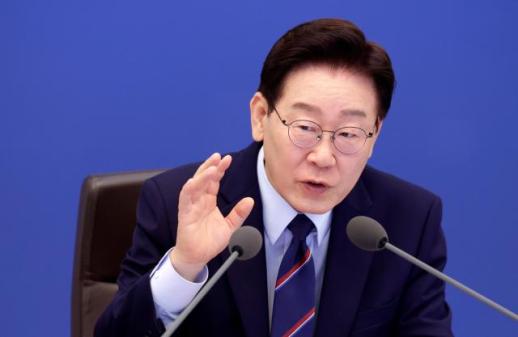 KOSPI flies to new highs after Lee clarifies controversial 'AI dividend' slip SEOUL, May 13 (AJP) - South Korea’s benchmark KOSPI returned to record-setting climb Wednesday after President Lee Jae Myung moved to calm investor concerns over controversial remarks by his top policy aide suggesting that gains from the country’s AI boom could be redistributed more broadly to the public. In a post on X on Wednesday, Lee accused some media outlets of distorting comments made by presidential policy chief Kim Yong-beom regarding a proposed “national dividend” linked to the artificial intelligence boom. Lee said Kim’s remarks referred to the possible redistribution of excess tax revenue generated from extraordinary profits in the AI sector — not the direct redistribution of corporate profits themselves. “What Kim Yong-beom referred to was a review of ways to distribute to the public part of the government’s excess tax revenue generated from extraordinary profits in the AI sector,” Lee wrote. Lee added that Kim had already clarified the proposal concerned excess tax revenue rather than corporate earnings, but “misleading reports” continued circulating despite follow-up explanations. “Political criticism and attacks that are not based on facts ultimately harm democracy,” Lee said. The clarification helped ease fears of possible government intervention in corporate earnings tied to South Korea’s booming semiconductor and AI sectors, which have driven much of the market’s recent rally. The KOSPI erased earlier losses and gained 2.63 percent to a new closing high 7,844.01. Chipmakers also renewed bull march, with Samsung Electronics rising 1.79 percent to 284,000 won and SK hynix surging 7.68 percent to 1,976,000 won. 2026-05-13 17:14:46
 -
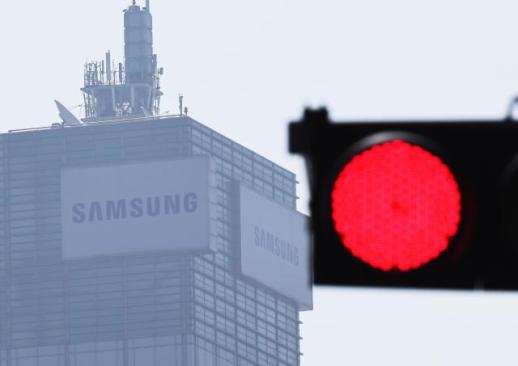 Samsung strike threat sparks debate over South Korea's emergency labor powers SEOUL, May 13 (AJP) - Chips are responsible for fueling the South Korean economy against the Middle East headwinds and historic stock rally, which explains why policy chiefs from the president to cabinet ministers are going all-out to prevent full-fledged walkouts by chipmakers and even flag the option of a rarely used emergency power to disallow a strike. The debate intensified after mediation talks between Samsung Electronics and its labor unions collapsed Wednesday dawn, pushing the National Samsung Electronics Union (NSEU) toward an 18-day strike scheduled to begin May 21. The presidential office sought to cool speculation over immediate intervention, saying there was still time before the planned strike date and that the government would continue supporting dialogue between labor and management. Under South Korean labor law, the labor minister can invoke emergency arbitration when a strike is deemed to threaten public welfare or cause “serious harm” to the broader economy. If the measure is invoked, unions must immediately suspend all strike activity for 30 days while the National Labor Relations Commission oversees mediation and possible compulsory arbitration. The measure has rarely been invoked and is generally reserved for disputes authorities believe could seriously disrupt the economy or public life. Concerns are growing over Samsung’s labor dispute because of the semiconductor industry’s outsized role in the South Korean economy. Chips account for roughly 35 percent of the country’s exports, while Samsung Electronics alone represents about 25.7 percent of the benchmark KOSPI’s total market capitalization. The union estimated that a prolonged strike running from May 21 to June 7 could trigger economic losses exceeding 40 trillion won, while also risking supply chain disruptions and customer defections during a global semiconductor boom. According to the Korea Development Institute, a 10 percent decline in semiconductor exports could reduce South Korea’s gross domestic product by approximately 0.78 percent, underscoring the economy’s heavy dependence on the chip industry. The standoff has also spilled into court. A hearing over Samsung Electronics’ request for an injunction against what it described as illegal strike actions concluded Wednesday at Suwon District Court, with the court expected to decide before the planned walkout whether to grant the injunction. Union officials argued during the hearing that the planned strike would remain within legal boundaries and would not involve violence or occupation of production facilities. “We emphasized to the court that there would be no illegal labor action, intimidation, violence or occupation of production facilities,” NSEU leader Choi Seung-ho told reporters after the hearing. The union also rejected Samsung’s warning that work stoppages could damage wafers in semiconductor production lines, saying there are multiple technical measures available to prevent contamination and losses during a strike. Union lawyers additionally accused Samsung management of unfair compensation practices. Attorney Hong Ji-na, representing the union, claimed workers accepted zero bonuses in 2024 after management cited weak semiconductor market conditions, only to later discover executives had shared roughly 388 billion won in bonuses among themselves. She also warned that Samsung’s competitiveness could weaken if high turnover and declining recruitment continue in the semiconductor division, where retaining skilled engineers is increasingly critical. Still, some economists oppose direct government intervention despite the scale of the potential fallout. “This is not an issue tied to the survival of the country,” said Kim Jin-young, an economics professor at Korea University. “Government intervention would only increase uncertainty for both labor and management and distort their decision-making process.” Kim argued wage disputes should ultimately be resolved through negotiations between companies and workers rather than state intervention, warning that repeated government involvement could weaken incentives for compromise and innovation over the long term. The risks are heightened by the nature of semiconductor manufacturing itself. Chip fabrication plants operate continuously in ultra-clean environments with tightly controlled temperature and humidity conditions, unlike traditional industries such as automobiles or home appliances that rely on segmented production lines. Industry experts say restarting halted semiconductor production can cause disproportionately larger losses than in conventional manufacturing. The structure of the industry has also fueled debate over whether traditional labor union models fit semiconductor manufacturing. Major global chipmakers such as Intel and TSMC do not house powerful unions, while Samsung itself remained effectively union-free until 2020. 2026-05-13 16:46:53
 -
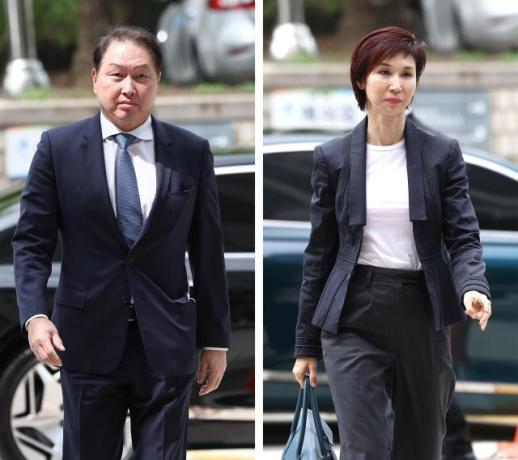 Ex-SK couple enters court-led mediation over billion-dollar asset split SEOUL, May 13 (AJP) - SK Group chairman Chey Tae-won and his estranged wife Roh Soh-yeong entered a court-led mediation process on Wednesday in South Korea's closely watched "divorce of the century" battle over one-billion-dollar property split. The Seoul High Court's family division held the first hearing in the remand trial at 10 a.m. Wednesday and wrapped up the session about an hour later after hearing positions from both sides. The court said it would hold another mediation session at the earliest possible date when both parties can attend. Roh dressed in black appeared in person alongside her legal team, while Chey was represented only by attorneys. Speaking briefly to reporters before entering the courthouse, Roh declined to answer questions on whether the recent surge in SK Group shares should be reflected in the property division or whether negotiations had made progress. The mediation follows a Supreme Court ruling last year partially overturning an appellate court decision that ordered Chey to pay Roh about 1.38 trillion won ($1 billion) in property division, one of the largest divorce settlements ever seen in South Korea. In October last year, the Supreme Court upheld the couple's divorce and a separate 2 billion won ($1.4 million) alimony award, while sending the property division portion of the case back to the Seoul High Court for reconsideration. The remand trial is now focused solely on recalculating how much of Chey's assets should be shared with Roh. If mediation fails, the court is expected to issue a new ruling based on the Supreme Court’s guidance regarding the valuation of Chey's holdings and Roh's contribution to the accumulation of family wealth. The case has drawn intense public attention not only because of the massive scale of wealth involved, but also because it could set a major legal precedent for how South Korean courts recognize a spouse's indirect contribution to the rise of family-controlled conglomerates and inherited corporate wealth. Roh is the daughter of late former President Roh Tae-woo, who governed South Korea from 1988 to 1993 during a key period of the country's industrial expansion. She married Chey in 1988, before SK Group transformed into one of Asia's largest semiconductor and telecommunications conglomerates. Their marriage publicly unraveled in 2015 after Chey disclosed he had fathered a child outside the marriage and sought a divorce. Formal legal proceedings began in 2017 after earlier mediation attempts collapsed. In the first trial in 2022, a family court ordered Chey to pay Roh 66.5 billion won in property division and 100 million won in alimony, ruling that much of Chey's SK holdings could not broadly be considered jointly accumulated marital assets. But an appellate court sharply increased the amount in 2024, awarding Roh roughly 1.38 trillion won and 2 billion won in alimony after determining that Roh had contributed to the growth of SK Group and the appreciation in value of Chey's shares. The appellate court also acknowledged Roh's role in child-rearing, household management and public-facing responsibilities as the spouse of a chaebol chairman. However, the Supreme Court later ruled that 30 billion won in funds linked to former President Roh Tae-woo constituted illegal slush funds and therefore could not be counted as Roh's contribution to the formation of SK Group's wealth, sending the case back for another review. 2026-05-13 16:00:51
 -
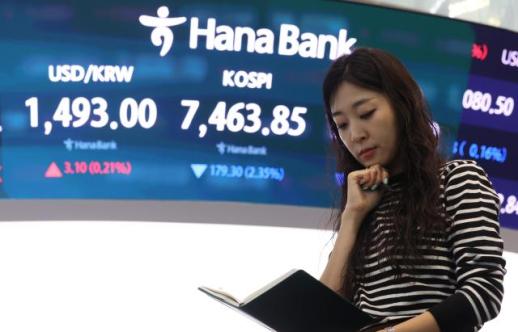 KOSPI briefly sinks to 7,400 level amid AI dividend shock and Samsung labor unrest SEOUL, May 13 (AJP) - South Korean shares extended losses for a second straight session Wednesday as fears of a monthlong strike at Samsung Electronics rattled investor sentiment after marathon government-mediated labor talks collapsed overnight. As of 10:20 a.m., the benchmark KOSPI was down 0.4 percent at 7,613.11 after briefly falling as low as 7,402. The junior KOSDAQ slipped 0.9 percent to 1,169.16. The decline followed an exceptionally volatile session Tuesday, when the KOSPI briefly surged to 7,999.67 before reversing sharply to close more than 5 percent lower after remarks by presidential policy chief Kim Yong-beom on a possible national “AI dividend” unsettled investors in South Korea’s semiconductor-heavy market. Kim suggested that part of the massive tax revenues and profits generated from the AI boom should be redistributed more broadly to the public. The sharp swings underscored how heavily South Korea’s equity rally has become concentrated in a handful of AI-linked semiconductor stocks. As investor funds increasingly pile into a small group of beneficiaries, market volatility in Seoul has outpaced that of U.S. equities. While the U.S. VIX index — often referred to as Wall Street’s fear gauge — has remained in the low 20s near historical norms, Korea’s VKOSPI has surged above 70, its highest level since market turmoil triggered by the U.S.-Iran conflict. Aggressive momentum trading and growing fear-of-missing-out buying have further amplified volatility in Seoul. According to corporate tracker CEO Score, the combined market capitalization of companies listed on the KOSPI, KOSDAQ and KONEX exchanges has surged 172.9 percent since President Lee Jae Myung took office 11 months ago, climbing from 2,597 trillion won ($1.9 trillion) in June 2025 to 7,088 trillion won as of Monday. Much of the gain has been driven by Samsung Electronics and SK hynix, which together accounted for more than 56 percent of the total increase in market value. The two chipmakers now represent roughly 42.4 percent of South Korea’s total stock market capitalization, highlighting the market’s growing dependence on AI-related semiconductor demand. That concentration intensified Wednesday’s selloff. Samsung Electronics fell 5.02 percent to 265,000 won in morning trading, while SK hynix slipped 1.63 percent to 1,805,000 won. The South Korean government and Samsung Electronics management simultaneously ratcheted up pressure on the labor union ahead of next week’s planned monthlong strike after negotiations over a profit-linked bonus system broke down early Wednesday. “A strike must never happen under any circumstances,” Deputy Prime Minister and Finance Minister Koo Yun-cheol wrote on X on Wednesday, pledging to continue mediation efforts to keep negotiations alive. Samsung Electronics, which had largely remained restrained in public comments over union activity, issued its strongest statement yet expressing “deep regret” over the union’s decision to declare negotiations deadlocked after a 17-hour mediation session at the National Labor Relations Commission in Sejong ended around 3 a.m. Among other major stocks, Hyundai Motor rose 2.32 percent to 661,000 won, while Hyundai Mobis jumped 5.66 percent to 579,000 won. HD Hyundai Heavy Industries gained 1.70 percent to 719,000 won. Battery shares also weakened. LG Energy Solution fell 0.79 percent to 439,500 won, while Samsung SDI dropped 2.38 percent to 614,000 won. Defense and industrial shares traded mixed, with Hanwha Aerospace edging down 0.47 percent to 1,278,000 won and Doosan Enerbility sliding 3.42 percent to 121,300 won. Financial stocks were mostly lower, with Samsung Life Insurance falling 1.0 percent to 296,500 won and KB Financial Group slipping 0.13 percent to 153,400 won. The Korean won weakened slightly to 1,493.80 per dollar from the previous session’s close of 1,489.90 won. Overnight on Wall Street, major U.S. indexes closed mixed as stronger-than-expected inflation data pushed Treasury yields higher and triggered profit-taking in technology shares. The Dow Jones Industrial Average rose 0.11 percent, while the Nasdaq Composite fell 0.71 percent and the S&P 500 slipped 0.16 percent. U.S. consumer prices in April came in slightly above expectations, with headline inflation at 3.8 percent and core inflation at 2.8 percent. The data pushed the benchmark 10-year Treasury yield above 4.46 percent, increasing pressure on richly valued AI and semiconductor stocks. Oil prices also climbed after hopes for a breakthrough in U.S.-Iran negotiations weakened, with U.S. crude futures settling above $102 a barrel and adding to broader inflation concerns. Elsewhere in Asia, major stock markets traded lower as investors turned cautious ahead of the summit between U.S. President Donald Trump and Chinese President Xi Jinping set to open in Beijing on Thursday, while also monitoring geopolitical tensions in the Middle East. Japan’s Nikkei 225 was trading at 62,600.17, down 0.23 percent, while China’s Shanghai Composite Index fell 0.48 percent to 4,194.29. Hong Kong’s Hang Seng Index was also trading lower at 26,322.38, down 0.097 percent. 2026-05-13 10:45:17
 -
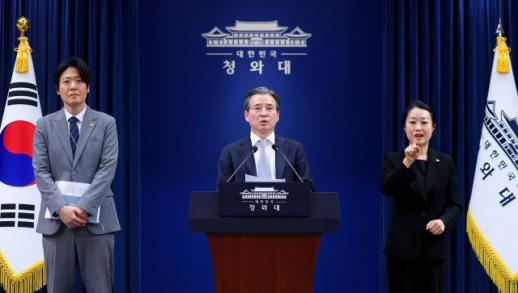 Policy chief floats 'AI dividend' concept amid AI boom in Korea SEOUL, May 12 (AJP) - South Korea's top presidential policy aide floated the idea of a national "AI dividend" on Tuesday, proposing that part of the massive profits and tax windfall expected from the artificial intelligence and semiconductor boom be structurally shared with the broader public. Presidential policy chief Kim Yong-beom argued in a social media post that the emerging AI boom was not created solely by individual firms, but by decades of national investment and collective economic development. "The AI bonanza was not generated by certain companies alone," Kim wrote. "If strategic advantages in the AI infrastructure supply chain create a structural boom and unprecedented excess tax revenue, how to use that money wisely becomes a question society must deliberate." The remarks come as South Korea's stock market has been increasingly dominated by AI-linked semiconductor giants Samsung Electronics and SK hynix. Samsung Electronics shares closed at 279,000 won on Tuesday, up about 384 percent from 57,600 won a year earlier, while SK hynix ended at 1,835,000 won, soaring roughly 841 percent from 195,000 won over the same period, underscoring how the AI-driven semiconductor rally has reshaped the country’s financial markets and broader economy. Against that backdrop, Kim argued that profits generated from industries built on "the foundations the people have cultivated over the past half century" should be shared with the broader public through institutional mechanisms. Kim warned that South Korea had squandered a similar opportunity during the semiconductor supercycle of 2021 and 2022, when large excess tax revenues were spent without long-term planning. "The scale of this cycle could be incomparable to the previous one," he said. "Allowing it to pass in the same way would mean wasting a once-in-a-generation historic opportunity." As a possible framework, Kim referenced Norway's sovereign wealth model, under which oil profits have been accumulated in a state-run fund since the 1990s and later used to support welfare and long-term fiscal stability. "In Korea's case, I would tentatively call it a 'national dividend,'" he said. Kim suggested the proceeds could be used for youth startup funding, rural basic-income programs, support for artists, expanded pension schemes or education and retraining programs designed for the AI transition era. He stressed that the final structure should emerge through broad public debate and social consensus. "If excess tax revenue never materializes, the idea of a national dividend could remain unrealistic," he said. "But letting those excess profits simply dissipate without any guiding principles could be even more irresponsible." Kim argued that the defining challenge of the AI era would not simply be generating economic growth, but managing how extraordinary profits become increasingly concentrated among dominant companies and higher-income groups. He said using part of those gains to cushion the social costs of AI-driven economic transformation should not merely be viewed as redistribution, but as a way to preserve long-term economic and social stability. Kim also suggested that if Korea successfully develops an institutional model for redistributing AI-era windfalls, it could eventually become a global reference point as governments worldwide grapple with the economic disruptions caused by artificial intelligence. "Korea could become the first country to return excess profits from the AI era back to human life," he said. "The model we begin debating and building now could later become an international standard." His remarks come as policymakers and economists globally intensify discussions over how AI-driven productivity gains may accelerate wealth concentration while reshaping labor markets and industrial structures. Kim also cited comments by Demis Hassabis, who recently argued for the need to develop new economic frameworks suited to the AI era. Earlier this month, Kim projected that Korea could post historically large tax revenues in 2026 and 2027 if the semiconductor and AI infrastructure boom extends through next year. 2026-05-12 16:12:13
 -
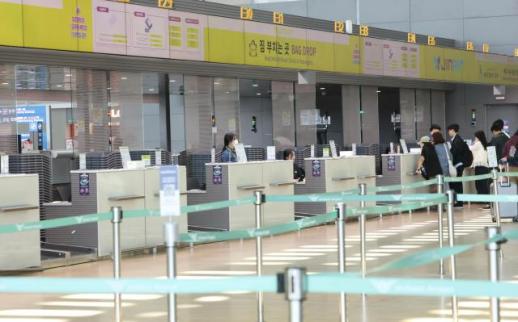 Fuel shock pushes Korean LCCs back into pandemic-like survival mode SEOUL, May 12 (AJP) - A spike in fuel prices, war-related travel restrictions and passenger jitters are pushing South Korea's budget carriers back into pandemic-era survival mode, forcing them to delay hiring as well as streamlining payrolls and flights as they try to ride out the Gulf crisis. Jin Air, a low-cost carrier under Korean Air, has informed 50 newly hired cabin crew members that they will start work in the fall instead of this week as originally planned, citing "emergency management conditions" caused by the Middle East-driven energy crisis. The airline hired 100 cabin crew members in the first half of the year, half of whom have already begun work. Despite the last-minute delay, Jin Air said it remains committed to honoring the hires. The carrier has already introduced a series of emergency cost-cutting measures, including an indefinite delay in annual safety bonus payments for employees. It has also cut 176 round-trip flights through this month to reduce fuel costs, trimming routes to destinations such as Guam and Phu Quoc Island in Vietnam. Further reductions are expected once June schedules are finalized. Low-cost carriers, whose overseas networks are heavily concentrated on Southeast Asian leisure routes, have cut around 1,000 international round-trip flights over the past two months amid the Middle East conflict. The pressure has intensified as Singapore jet fuel prices, the benchmark for Asia's aviation industry, surged to an average of $214.71 per barrel between March 16 and April 15, about 2.5 times higher than prewar levels. Airlines are increasingly concerned that higher fuel surcharges could weaken summer travel demand as operating costs continue to climb. Other budget carriers have also begun introducing unpaid leave and other belt-tightening measures. Jeju Air, the country's largest low-cost carrier, began accepting applications this week for voluntary unpaid leave among cabin crew members for June. T'way Air introduced unpaid leave for cabin crew for May and June, while Aero K, a smaller budget airline, offered voluntary unpaid leave to all employees for May. The Ministry of Employment and Labor held an emergency meeting late last month to assess postwar labor market conditions and worried that the airline industry could face broader restructuring if the conflict drags on. 2026-05-12 14:16:26
 -
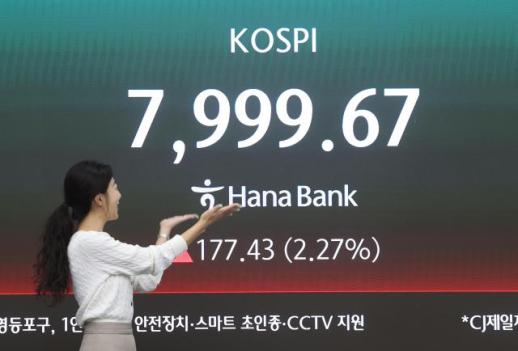 KOSPI move closer to 8,000 amid retail FOMO demand over AI SEOUL, May 12 (AJP) - South Korea’s benchmark KOSPI barreled toward the 8,000 threshold on Tuesday, nearing another four-digit milestone in just five trading sessions after first testing 7,000, as chip shares continued to attract fear-of-missing-out retail demand. As of 9:46 a.m., the KOSPI stood at 7,939.73, up 1.5 percent, while the tech-heavy KOSDAQ gained 0.83 percent to 1,217.40. The rally was driven largely by strong buying from retail and institutional investors. Individuals purchased a net 1.2 trillion won worth of local shares, while institutions added a net 368.4 billion won. Foreign investors, however, sold a net 1.59 trillion won. Market momentum remained heavily concentrated in AI-linked heavyweights, with decliners outnumbering gainers 609 to 267 on the main bourse. Major chipmakers continued their climb, with Samsung Electronics rising 0.35 percent to 286,500 won and SK hynix advancing 2.77 percent to 1,932,000 won, both heading toward fresh milestones. The upbeat mood followed another strong overnight rally in U.S. semiconductor stocks. Qualcomm surged 8.42 percent, Micron Technology climbed 6.50 percent, Western Digital gained 7.46 percent and Seagate Technology advanced 6.56 percent, lifting the Philadelphia Semiconductor Index 2.59 percent. On Wall Street, major U.S. indexes ended modestly higher despite mounting uncertainty in the Middle East. The S&P 500 and Nasdaq both closed at fresh record highs as investors continued betting heavily on the durability of the AI boom. U.S. President Donald Trump said the ceasefire with Iran was “on massive life support” after dismissing Tehran’s latest proposal as “garbage,” while also hinting at the possibility of renewed military action. The remarks helped push Brent crude futures up 2.9 percent to settle at $104.21 per barrel, reviving concerns over energy supply disruptions and inflationary pressure. Back in Seoul, sector performance remained mixed. Among automakers, Hyundai Motor gained 3.10 percent to 666,000 won, while Kia slipped 1.77 percent to 171,600 won. Industrial and energy shares traded broadly higher, with LG Energy Solution rising 1.92 percent to 477,000 won, Doosan Enerbility climbing 3.44 percent to 132,400 won and HD Hyundai Heavy Industries jumping 5.26 percent to 721,000 won. Technology-related shares also advanced. SK Square gained 2.19 percent to 1,213,000 won, while Samsung Electro-Mechanics added 3.00 percent to 927,000 won. Financial stocks were mixed. Samsung Life Insurance rose 3.84 percent to 311,000 won, Shinhan Financial Group added 1.54 percent to 98,700 won and Mirae Asset Securities advanced 1.76 percent to 80,800 won. KB Financial Group, however, edged down 0.13 percent to 158,600 won. Biotech and defense shares underperformed. Samsung Biologics slipped 0.21 percent to 1,455,000 won, while Hanwha Aerospace fell 0.84 percent to 1,304,000 won. The Korean won remained weak, trading above 1,480 per dollar compared with the previous close of 1,472.40 won. 2026-05-12 10:31:13
 -
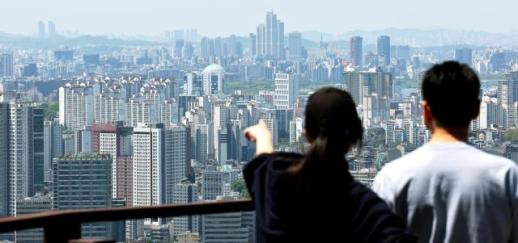 Rent inflation adds to mounting price pressures in Korea SEOUL, May 11 (AJP) -Rental offerings from monthly to longer-term contracts of more than two years are drying up in South Korea, pushing rent increases above housing price gains and adding additional pressure on inflation and household spending. The surge first emerged in jeonse system, in which tenants pay a large lump-sum deposit for two years or longer lease instead of monthly rent. It is now increasingly spilling over into the monthly rental market as more landlords move away from deposit-based leases. According to the Korea Real Estate Board, jeonse prices have risen 1.56 percent so far this year as of the first week of May, outpacing the 0.98 percent gain in apartment sale prices. In the Seoul metropolitan area, apartment lease prices climbed 2.2 percent this year, compared with a 1.79 percent increase in apartment sale prices. Outside the capital region, lease prices rose 0.94 percent, while sale prices gained just 0.2 percent. In Seoul, apartment sale prices are still rising slightly faster overall, but the gap has narrowed sharply. Lease prices have climbed 2.61 percent this year, compared with a 2.81 percent increase in sale prices. The pace of weekly gains has also accelerated. Seoul apartment jeonse prices rose 0.23 percent in the first week of May from a week earlier, marking the fastest weekly increase since November 2015. As more tenants shift toward monthly rentals amid a shortage of jeonse offerings, monthly housing costs are also rising steeply. Data from KB Real Estate showed Seoul’s apartment monthly rent price index climbed to 102.74 last month, the highest level since the index was introduced in 2015. High-end monthly rents have risen particularly sharply. In northern Seoul, the number of new monthly rental contracts worth more than 3 million won ($2,160) per month surged 53.4 percent in the first quarter from a year earlier. Yongsan became the only district in Seoul where the average monthly apartment rent exceeded 3 million won based on actual transaction prices. The increase has been especially pronounced in residential districts surrounding Seoul. The sharpest gains were recorded in Suwon’s Yeongtong District and Anyang’s Dongan District, both major residential areas in Gyeonggi Province south of Seoul, where lease prices rose 4.57 percent and 4.53 percent, respectively. Seoul’s Seongbuk District followed with a 4.2 percent increase. The trend is emerging as another source of inflationary pressure in Asia’s fourth-largest economy. Korea’s consumer price index includes both jeonse and monthly rents under housing costs. Consumer prices rose 2.6 percent in April from a year earlier, while the closely watched cost-of-living index climbed 2.9 percent. Housing, utilities and fuel prices increased 1.7 percent. While rising housing costs may not immediately drive headline inflation sharply higher, they could increasingly weigh on consumer sentiment as households devote more income to rent payments and housing-related debt costs. 2026-05-11 17:59:08
 -
 Eight out of 10 Korean retail investors pocket over $6,000 from Q1 stock cashouts SEOUL, May 11 (AJP) - Eight out of 10 South Korean retail investors who cashed out stocks in the first quarter walked away with profits, earning an average of 8.48 million won ($6,100), nearly double the 4.96 million won average loss suffered by the remaining investors, according to data released by Shinhan Securities on Monday. According to the brokerage’s analysis, Samsung Electronics provided both the joy and misery for retail investors during the first quarter. Among investors who sold Samsung Electronics shares, profitable investors recorded an average gain of 7.14 million won, while loss-making investors posted an average loss of 1.73 million won. After Samsung Electronics, the stocks that generated the largest average profits for retail investors were SK hynix with 5.94 million won, Hyundai Motor with 3.41 million won, Hanmi Semiconductor with 2.54 million won and Doosan Enerbility with 2.06 million won. Investors in their 70s and older posted the largest average gains at 18.73 million won, followed by those in their 60s with 10.11 million won. Investors in their 20s recorded the smallest gains at 1.43 million won. Male investors posted higher average gains than women, at 7.39 million won compared with 3.86 million won. The data suggests older investors were more active in taking profits during the first-quarter rally, particularly in large-cap semiconductor, nuclear-energy and defense shares that spearheaded gains in the benchmark market. South Korea’s benchmark KOSPI gained 20 percent in the first quarter. It has extended gains by another 56 percent as of Monday from the end of March amid a retail-driven frenzy led by chip and artificial intelligence-related shares. On Monday, Samsung Electronics shares rose 6.52 percent to 286,000 won, while SK hynix surged 13.23 percent to 1.909 million won, extending gains that have fueled this year’s rally. Hyundai Motor also climbed 6.04 percent to 650,000 won, while Doosan Enerbility slipped 1.62 percent to 127,500 won as of 1:53 p.m. On the tech-heavy KOSDAQ market, retail investors posted the biggest gains from stocks including Woori Technology, EcoPro, Hurim Robot and Alteogen. 2026-05-11 14:33:46
 -
 KOSPI storms past 7,800 on semiconductor rally SEOUL, May 11 (AJP) - South Korea’s main index soared nearly 5 percent Monday morning to scale a fresh peak above the 7,800 mark, powered by bellwether chip stocks and retail investors chasing the latest leg of the AI-driven rally. As of 10:39 a.m., the KOSPI was trading at 7,843.57, with a buy-side sidecar was triggered shortly after the opening bell. The KOSDAQ slipped 0.16 percent to 1,205.81. The surge followed a strong session on Wall Street on Friday, where the S&P 500 and Nasdaq closed at record highs on robust U.S. jobs data and gains in semiconductor shares. U.S. job growth totaled 115,000 in April, beating market expectations and easing concerns that the U.S.-Iran war could spill into a broader economic slowdown. Although U.S. President Donald Trump rejected Iran’s response to a U.S. peace proposal over the weekend, dimming hopes for a near-term end to the Middle East conflict, South Korean investors appeared largely unfazed as attention stayed fixed on global semiconductor demand. Market momentum again rested heavily on chip giants. Samsung Electronics rose 6.33 percent to 285,500 won after briefly touching a record 286,500 won. SK hynix jumped 12.51 percent to 1,897,000 won. Automakers also traded broadly higher, with Hyundai Motor gaining 2.77 percent to 630,000 won and Kia advancing 6.44 percent to 175,100 won. Among other major shares, SK Square climbed 4.46 percent to 1,147,000 won. Shipbuilding and industrial names remained firm, with Samsung C&T rising 5.80 percent to 447,000 won and HD Hyundai Heavy Industries gaining 3.95 percent to 684,000 won. Hanwha Aerospace added 1.22 percent to 1,323,000 won. Battery and biotech shares lagged behind the broader rally. LG Energy Solution slipped 0.73 percent to 473,000 won, while Doosan Enerbility fell 0.54 percent to 128,900 won. Samsung Biologics edged down 0.34 percent and Samsung Electro-Mechanics dropped 3.28 percent. Foreign investors turned sellers, unloading a net 1.29 trillion won worth of KOSPI shares in early trading. Retail investors poured in with 1.05 trillion won in net purchases, extending their feverish buying streak, while institutions bought a net 254 billion won. The Korean won remained stable, with the dollar trading at 1,473.80 won, compared with the previous close of 1,471.70 won. 2026-05-11 11:06:00