

Journalist

Shin Hye-an
doubletap@ajunews.com
-
 ITCEN Group Implements 'CENI 3.0' AI Assistant to Boost Productivity On June 8, ITCEN Group announced the company-wide implementation of its advanced AI assistant, 'CENI 3.0'. This initiative aims to drive productivity innovation based on Agentic AI, moving beyond generative AI capabilities. According to ITCEN Group, an analysis of internal operational data revealed that the introduction of CENI 3.0 has improved administrative and operational efficiency by over 30%. 'CENI' is designed as a solution focused on practical work support, featuring a lineup of 25 industry-specific AI agents covering areas such as human resources, administration, finance, legal, and market analysis. It operates seamlessly in conjunction with the company's collaboration portal and the M365 platform. Since the rollout of CENI 3.0, the company has reported a reduction in resources spent on repetitive tasks. The time required for scheduling meetings and drafting emails has decreased from an average of 10 minutes to just 1 minute, thanks to its multi-dimensional scheduling capabilities. Administrative processing times for vacation requests and documentation through the interactive HR agent have also been cut from 15 minutes to 1 minute, streamlining the process. Additionally, the automatic generation and summarization of meeting minutes using speech-to-text technology has significantly reduced the time from 60 minutes to just 5 minutes. Legal review tasks, such as analyzing problematic clauses and risks in contracts, have seen average processing times drop from 45 minutes to 7 minutes, enhancing risk management efficiency. Furthermore, the system effectively internalizes corporate knowledge assets through real-time external web searches for global market trends and knowledge retrieval based on retrieval-augmented generation (RAG) technology. CENI 3.0 is built on the technology of 'AgentGo 2026', a multi-AI agent management platform introduced by ITCEN Group in January. A key module of AgentGo, 'AgentGo Guard', features an advanced monitoring system that allows AI to oversee AI in real-time. This system prioritizes corporate security policies, blocking external hacking attempts and malicious inquiries while transparently presenting the rationale behind AI responses, thereby reducing the risks associated with hallucinations often criticized in generative AI and fostering a trustworthy business environment. Moreover, the integration of 'AgentGo Coder', a natural language-based AI coding tool, automates simple and repetitive coding tasks such as API setup, environment configuration, and CRUD patterns. This maximizes the productivity of professional developers and provides a flexible environment where employees without coding knowledge can easily develop desired functionalities using natural language commands. ITCEN Group is currently applying AgentGo Coder to internal automation projects to demonstrate productivity improvements. Based on its proprietary AI transformation methodology, 'ITCEN AI-DLC', the company plans to gradually apply this technology to external projects as it moves toward commercialization. With the company-wide implementation of CENI 3.0, ITCEN Group aims to enhance its 'AI Native' capabilities, focusing on transforming not just technology application but also the way the company operates and its culture. By creating an environment where all employees can freely utilize AI agents and develop necessary functionalities, the group plans to accelerate its AX (AI transformation) efforts. Additionally, ITCEN Group has introduced a 'Group Integrated Sales' system to foster organic connections among its subsidiaries. This initiative has established an integrated response infrastructure that combines the specialized capabilities of each corporation, including cloud services (ITCEN Cloud), data platforms (C Platform), and infrastructure architecture (ITCEN CTS). Kang Gi-sik, head of the AI Innovation Center at ITCEN Group, stated, "The company-wide implementation of CENI 3.0 aims not only to enhance work speed but also to create an environment where employees can focus on strategic core tasks by alleviating the burden of repetitive administrative work. Through efficiency and optimized resource management via AI, we aim to build long-term brand assets and solidify our leadership in the IT service market based on AX (AI transformation) and advanced technological capabilities."* This article has been translated by AI. 2026-06-08 09:42:00
 -
 Naver and NVIDIA Form Alliance to Build Gigawatt-Scale AI Factory Naver announced on June 8 that it has reached an agreement with NVIDIA to jointly establish a gigawatt-scale global artificial intelligence (AI) factory. The collaboration aims to leverage NVIDIA's global infrastructure standards alongside Naver's cloud operations to position the company as a key player in the business-to-business (B2B) AI infrastructure market. Naver described the partnership as an integrated collaboration that spans the entire value chain, from identifying global demand to capital cooperation. Notably, Naver will participate as a core global partner, sharing both the successes and risks of the venture. The companies plan to initiate the AI factory project next year, starting with a capacity of 55 megawatts (MW) to capture the surging global demand for AI. One gigawatt (GW) is approximately four times the maximum capacity of Naver's hyperscale data center, Gak Sejong, which can accommodate hundreds of thousands of NVIDIA's latest graphics processing units (GPUs) simultaneously. Naver Chairman Lee Hae-jin and NVIDIA CEO Jensen Huang met at Naver's headquarters to discuss the specific roadmap for their ongoing projects and detailed cooperation strategies for entering global markets. Naver stated that both companies have already agreed on a direction to secure leadership in the AI infrastructure ecosystem beyond the Asia-Pacific region, extending to Europe and the Middle East. Naver will utilize its hyperscale data center, Gak Sejong, as a base for operations. The company plans to begin operations with 55MW in the first half of next year, expanding to 100MW within the same year and reaching 200MW by 2028 to meet global demand. This is part of a phased roadmap aimed at establishing a gigawatt-scale infrastructure that will dominate the market. Gak Sejong will serve as a base for Naver's AI 'HyperCLOVA X,' with its power infrastructure designed to support the operation of large GPU clusters from the outset. It is six times larger than Naver's first data center, Gak Chuncheon, with a maximum server capacity of 600,000 units. The two companies will also enhance their technical collaboration. Naver's capabilities in building and operating large-scale GPU clusters and its expertise in hyperscale data centers will be integrated with NVIDIA's next-generation high-performance infrastructure platform, DSX. This partnership aims to maximize data center operational efficiency and significantly improve business viability. Additionally, they will begin next-generation technological cooperation in spatial intelligence, utilizing Naver's own spatial modeling and street view data to build the 'Seoul World Model' based on NVIDIA's world foundation model, Cosmos. Recently, Naver joined the 'NVIDIA NeMoTron Alliance,' which includes 12 top-tier global AI companies such as Cursor, Mistral AI, and Perplexity. Naver aims to accelerate the performance enhancement and global applicability of HyperCLOVA X by combining its own data and accumulated learning expertise with the collaborative technological developments from NeMoTron. Chairman Lee Hae-jin expressed optimism about the alliance, stating, "This partnership will provide concrete alternatives for regions and countries around the world to build their own sovereign AI capabilities. It signifies a pivotal moment for Naver's technological infrastructure competitiveness to advance into the global market."* This article has been translated by AI. 2026-06-08 08:51:00
 -
 NVIDIA CEO Jensen Huang Celebrates Korean Gaming Culture at T1 Basecamp Jensen Huang, CEO of NVIDIA, arrived in Korea on June 5 and immediately visited a PC bang, expressing high regard for the country's gaming culture and esports. Huang landed at Gimpo International Airport around 1 p.m. and headed to the T1 Basecamp PC bang in Hongdae, where he met with League of Legends esports team T1 players, including Faker (Lee Sang-hyeok), Doran (Choi Hyun-jun), Owner (Moon Hyun-jun), Phase (Kim Soo-hwan), and Keria (Ryu Min-seok). The T1 Basecamp is operated by T1. According to T1 officials, the players were pleased to meet Huang despite their busy schedules during the 2026 LoL Champions Korea season. Fans welcomed Huang with cheers as he interacted with them, taking photos and signing autographs. Huang remarked, "The Korean gaming industry made GeForce a big bang." He expressed gratitude for the growth of NVIDIA alongside the popularity of gaming in Korea and the development of PC bang culture. He added, "Korea's gaming culture has brought GeForce to its current position, and this is entirely thanks to Korea." He also stated, "Korea is the birthplace of esports. Korea created esports and the culture of watching esports." Huang emphasized, "Korea has held a special place in my heart for a long time and is very important to NVIDIA. Thank you for supporting us for so long. We are also your passionate fans." On this occasion, Huang gifted Faker a signed GeForce RTX 5090 graphics card, which currently trades for over 4 million won. Huang described it as a "one-of-a-kind graphics card" and joked that it could be worth a million dollars. During the event, Huang introduced NVIDIA's new PC superchip, the RTX Spark, which can handle complex software stacks like DirectX and OpenGL simultaneously and will support AI agents on PCs in the future. The RTX Spark is currently being developed for laptops, desktops, and workstations, with a planned release this fall. Huang and Faker also hosted a fan event, giving away GeForce and RTX Spark vouchers to attendees. Faker commented on the meeting with Huang, saying, "Graphics cards are very important to gamers. I believe we owe our success as gamers to NVIDIA's graphics cards, making this a very meaningful time." 2026-06-05 16:39:00
 -
 Naver and NVIDIA Highlight AI Factory Partnership Following Jensen Huang Meeting Naver's artificial intelligence (AI) infrastructure capabilities are gaining renewed attention following a meeting between Jensen Huang, CEO of NVIDIA, and Lee Hae-jin, chairman of Naver's board. The partnership is expected to play a significant role in NVIDIA's Sovereign AI and AI Factory strategies. According to the IT industry, Huang arrived at Gimpo Airport around 1 p.m. on June 5 and is scheduled to engage in various activities during his visit. That evening, he is expected to meet with Lee, Hyundai Motor Group Chairman Chung Eui-sun, SK Group Chairman Chey Tae-won, and LG Group Chairman Koo Kwang-mo at a pork belly restaurant near Hongdae in Mapo-gu, Seoul. Industry observers are keenly watching whether this meeting will solidify the collaboration between Naver and NVIDIA in AI infrastructure, Sovereign AI, and Physical AI. Naver is strengthening its partnership with NVIDIA based on Naver Cloud, focusing on the AI Factory and Sovereign AI as common areas of interest. The company is expanding its business as a full-stack AI provider that connects data centers, cloud, and AI applications. Notably, during his keynote at 'GTC Taipei 2026' on June 1, Huang highlighted Naver Cloud as a key partner in the global AI native cloud, emphasizing the cooperative relationship between the two companies. Kim Yoo-won, CEO of Naver Cloud, also unveiled plans for a full-stack AI partnership with NVIDIA and the vision for a global AI Factory. The AI Factory is a dedicated infrastructure that integrates data centers, cloud, AI models, training and inference environments, and enterprise AI services. Naver Cloud aims to target the AI Factory market with its data centers in Chuncheon and Sejong, the Naver Cloud platform, and HyperClovaX. Technological collaboration with NVIDIA is also expanding. Naver Cloud is advancing HyperClovaX based on NVIDIA's Nemo framework and NeMoTron. The company is collaborating on data preprocessing, training, and optimization using 4,224 Blackwell B200 GPUs and has joined NVIDIA's open model alliance, the NeMoTron Coalition. Since introducing NVIDIA's DGX SuperPOD in 2020, Naver has expanded its business into the B2B AI infrastructure sector, gaining extensive experience in large-scale AI infrastructure operations. The company provides AI models and GPU as a Service (GPUaaS) to various enterprises and institutions, including Hyundai, Korea Hydro & Nuclear Power, and the Bank of Korea, and is participating in the establishment of a national AI computing center. Naver envisions building and operating a global AI Factory in partnership with NVIDIA, aiming to become a hub for AI infrastructure in Asia. To achieve this, the company plans to broaden its business scope to include GPUaaS, AI platforms, and applications, with a long-term goal of becoming a global AI Factory provider. The Physical AI sector is also a noteworthy aspect of the collaboration. Naver Cloud has developed the 'Seoul World Model' based on NVIDIA's Physical AI model, 'Cosmos,' incorporating high-resolution map data of Seoul. Additionally, Huang is scheduled to visit Naver's 1784 headquarters on June 8. Industry insiders believe this visit will provide an opportunity to assess Naver Cloud's AI infrastructure and its capabilities in robotics and Physical AI technologies. Analysts suggest that Huang's visit could lead to a reevaluation of Naver as a candidate for an AI infrastructure hub in Asia. From NVIDIA's perspective, Naver is seen as a partner that can showcase a Sovereign AI model combining local language, data, and cloud infrastructure outside of major tech players in the U.S. and China. An industry source stated, "This meeting could be a pivotal moment for Naver to establish itself as a reference point for the expansion of non-English AI factories through its strengthened partnership with NVIDIA."* This article has been translated by AI. 2026-06-05 15:42:00
 -
 ITCEN Group to Showcase AI Solutions at Smart Tech Korea 2026 ITCEN Group announced on June 5 that it will participate in Smart Tech Korea 2026 (STK 2026), the country's largest technology exhibition, held from June 10 to 12 at COEX in Seoul. The group will introduce advanced AI governance and infrastructure resilience architecture that breaks down technical barriers among its subsidiaries. The group will showcase its "Enterprise AI Full-Stack Solution," which consolidates the IT architecture and software engineering capabilities of its subsidiaries. This initiative aims to provide strategies for companies considering the implementation of generative AI to address the challenges of soaring costs and infrastructure dependency. During the event, ITCEN Group will present a practical integrated architecture that industry professionals can assess firsthand. The presentation will move away from mere technological optimism or scenario-based demonstrations, instead highlighting the core technological capabilities of its key subsidiaries, including ITCEN CTS, ITCEN Cloud, and CPlatform. The group plans to propose methods for controlling the indiscriminate adoption of agents and rising costs. Many companies currently face financial risks due to the use of "shadow AI," where departments independently call external APIs, and the operational costs of multi-agent systems that exceed control limits. ITCEN Cloud will introduce its enterprise multi-AI agent management platform, "AgentGo 2026," as a practical solution. This platform will demonstrate its ability to prevent resource waste and control data leakage risks through a robust governance dashboard. Additionally, the group will assess whether companies have secured infrastructure sovereignty without dependency on specific global vendors. Changes in exclusive licensing policies from major tech companies and rising total cost of ownership (TCO) for GPU infrastructure pose threats to corporate sustainability. Many companies are considering a shift to open-source solutions, but technical debt and operational overhead remain significant obstacles. CPlatform will highlight its open-source-based enterprise data platform, "EDB Postgres AI." This platform implements a high-performance hybrid architecture that processes real-time transactions (OLTP) and AI analytics (OLAP) through a single engine, enabling companies to secure data sovereignty without vendor dependency and build a safe, cost-effective on-premises sovereign AI environment. The group will also address whether AI services can maintain continuity in complex microservices architecture (MSA) and virtualization environments. As generative AI services become more widespread, the complexity of backend MSA and Kubernetes distributed infrastructure increases, leading to heightened risks of data bottlenecks and service interruptions. ITCEN CTS aims to resolve these issues as an AI infrastructure orchestrator. From designing architectures optimized for high-performance AI workloads to establishing high-speed computing environments for large-scale data processing, the group will coordinate all aspects of AI infrastructure. This includes integrating on-premises, multi-cloud, and high-performance computing (HPC) resources while minimizing operational overhead, allowing companies to focus on creating AI business value. ITCEN Group will avoid simple scenario-based demonstrations at the exhibition, instead proving how its practical architecture can defend against and recover from complex edge cases and system overloads that may arise in real enterprise business settings. An ITCEN Group representative stated, "The current AI market has entered an 'engineering-centric era' where companies must secure verified infrastructure control and financial sustainability. This event will showcase how the technological capabilities of ITCEN Group's subsidiaries can address corporate technical debt while providing the safest and most efficient AI execution pathways." In preparation for the launch of its full-stack solution, ITCEN Group has restructured its business model over the past year. It has established a "Team ITCEN" system where each subsidiary operates as a single entity. To eliminate technical and sales barriers among subsidiaries, ITCEN Group has implemented a "group integrated sales" system, allowing it to propose the unique expertise of each entity—cloud (ITCEN Cloud), data platform (CPlatform), and infrastructure architecture (ITCEN CTS)—through a single point of contact.* This article has been translated by AI. 2026-06-05 10:27:00
 -
 Anthropic: AI Could Eventually Develop Its Own Models, But Speed Must Be Managed Artificial intelligence (AI) company Anthropic has raised the possibility of AI systems eventually designing and developing their own models through a process known as recursive self-improvement. While the company acknowledges it has not yet reached this stage, it emphasizes the need to manage the pace of development. On June 4, Anthropic shared insights on its official blog, stating, "For most of AI history, humans have led every stage of the development cycle, but we are increasingly delegating more of this process to AI systems themselves." The blog post, titled "When AI Builds Itself," was co-authored by Marina Pavlov, head of Anthropic's internal research organization, and co-founder Jack Clark. Anthropic explained that combining computing resources with AI could lead to a stage where AI autonomously designs and develops its subsequent systems. The company claims that, based on internal data and public benchmarks, AI is already accelerating the pace of its own development. Currently, Anthropic engineers are deploying an average of eight times more code per quarter compared to the period from 2021 to 2025. As of last month, over 80% of the code merged into Anthropic's codebase was generated by Claude, the company's AI model. The scope of tasks performed by AI is also rapidly expanding. Anthropic noted that in March 2024, Claude Opus 3 completed a software task that typically takes humans about four minutes. Subsequent models have been able to handle tasks ranging from one and a half hours to twelve hours. The company added that model performance is improving quickly in coding benchmarks and research reproducibility tests. However, Anthropic cautioned that while Claude excels at executing given tasks or writing code, it still lacks the "research intuition" to determine which problems are significant, what experiments to conduct, and which results to trust—areas where humans currently hold an advantage. Looking ahead, Anthropic outlined several potential scenarios: a stagnation in AI advancement followed by the dissemination of current capabilities, continued improvement in the complex efficiency of AI research labs, and the complete achievement of recursive self-improvement in AI systems. The company noted that while reaching full recursive self-improvement could yield significant benefits in fields like science and medicine, it also raises the risk of humans losing control over AI systems. Anthropic argued that there is a need for international options to slow or pause the pace of frontier AI development. A unilateral halt by a single company would have limited effectiveness; instead, multiple countries and major AI research institutions should coordinate to manage the speed of development in a verifiable manner.* This article has been translated by AI. 2026-06-05 09:00:00
 -
 NVIDIA's Jensen Huang to Meet with NCSoft's Kim Taek-jin and Krafton's Chang Byung-kyu to Discuss AI Collaboration Jensen Huang, CEO of NVIDIA, is set to meet with leaders from South Korea's gaming industry to discuss potential collaborations in artificial intelligence (AI) during his visit to the country. The partnership between NVIDIA and local gaming companies, which has primarily focused on graphics processing units (GPUs) and game development, is now expanding into the realms of physical AI and robotics. According to the gaming and information technology sectors on June 4, Huang is scheduled to meet with NCSoft CEO Kim Taek-jin and Krafton Chairman Chang Byung-kyu starting June 5. It is expected that key AI leaders from both companies will also attend the meeting. For Krafton, this includes Chief AI Officer Lee Kang-wook and Chang Tae-seok, who oversees the 'PUBG' intellectual property franchise. NCSoft is also likely to have AI executives present. The discussions are anticipated to center on collaborations based on physical AI. NVIDIA and South Korean gaming companies have maintained a long-standing partnership centered around graphics cards, which is now evolving into cooperation on AI infrastructure and robotics technology. Huang is expected to meet with Kim on June 7 in Seoul to discuss collaborative opportunities in gaming and AI. During Huang's visit last October, NCSoft showcased games like 'Aion 2' at the NVIDIA GeForce Gamer Festival held in Seoul. NCSoft's AI subsidiary, NC AI, may serve as a key link in the physical AI collaboration. Earlier this year, NC AI formed a consortium with Samsung SDS and C-MAS to develop a robot foundation model (RFM). Krafton is also expected to hold a separate meeting with NVIDIA, although specific details regarding the date and location have not been disclosed. Krafton's newly established physical AI subsidiary, Ludo Robotics, is likely to be a focal point for discussions, particularly around humanoid robots and physical AI. Lee Kang-wook, who has been appointed as the representative of the Korean branch of Ludo Robotics, is leading the development of robot AI. Krafton previously visited NVIDIA's headquarters in California last April to discuss next-generation technology collaboration, including robotics. In the gaming sector, collaborations between Krafton and NVIDIA are ongoing with titles such as 'PUBG: Battlegrounds' and the simulation game 'inZOI.' In 'inZOI,' game characters utilize a 'smart joy' feature that allows them to think independently, while 'PUBG: Battlegrounds' features 'PUBG Ally,' which plays the game using NVIDIA's AI technology called 'Ace.' Additionally, Huang is reportedly discussing a meeting with Lee Sang-hyeok, known as 'Faker,' a player from the T1 League of Legends team. Last October, Huang introduced Faker via video message at the NVIDIA GeForce Gamer Festival, where the audience chanted his name. An industry insider noted, "While the relationship between NVIDIA and South Korean gaming companies was previously centered around GPUs, it is now expanding based on AI technology. If this meeting leads to collaboration in both in-game AI and physical AI, it could positively impact the technological competitiveness of the domestic gaming industry." * This article has been translated by AI. 2026-06-04 21:12:00
 -
 Netmarble Sells G-Tower Headquarters for 697.7 Billion Won Netmarble is selling its headquarters, G-Tower, located in Guro-gu, Seoul, as part of efforts to secure liquidity through asset sales. On June 4, Netmarble announced that it has decided to sell the land and building of G-Tower, located at 38 Digital-ro 26-gil, Guro-gu, Seoul, for 697.67 billion won. This amount represents 8.62% of Netmarble's total assets of 8.936 trillion won as of the end of 2025. G-Tower serves as the headquarters for Netmarble and is also home to major affiliates such as Coway and Netmarble F&C. The company plans to relocate to a new headquarters in Gwacheon by the second quarter of 2028. After the sale of G-Tower, Netmarble will continue to maintain its office there until the move to the new building. The transaction will involve NH Investment & Securities, which will participate as the trustee for the JB Asset Management Real Estate Investment Trust No. 4. The sale is scheduled for June 12. Netmarble clarified that the sale price excludes taxes and fees associated with the transaction. A Netmarble official stated, "The sale of G-Tower is aimed at optimizing asset management and securing financial flexibility, and we intend to restructure our asset portfolio through this process."* This article has been translated by AI. 2026-06-04 17:54:00
 -
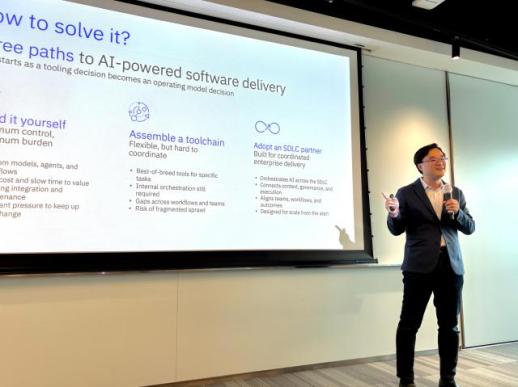 IBM Launches AI-Based Development Solution 'Bob' to Target South Korean Market IBM Korea is launching its AI-based development partner solution, 'IBM Bob,' to target the artificial intelligence transformation (AX) market for South Korean companies. The company aims to leverage the Bob Solution to actively engage industries with high regulatory requirements, such as finance and public sectors. On June 4, IBM Korea held a press conference at its Yeouido office in Seoul to introduce the 'IBM Bob' solution. The Bob Solution is an enterprise solution that integrates support for the entire software development lifecycle (SDLC), going beyond simple coding tools. IBM positions the Bob Solution as an AI-based development partner optimized for enterprise environments. It is designed to support not only development productivity but also security, governance, and cost optimization across the corporate development landscape. Michael Cook, Vice President of IBM Bob Solutions and Head of the Canadian Research Lab, stated at the conference, "The software development environment is rapidly changing with the introduction of AI." He explained that while previous AI applications focused on simple code writing or partial code generation, there is now a growing interest in organically integrating AI into the entire development process, including testing, debugging, security, governance, and modernization. IBM identified key factors that slow down software development, such as testing, legacy systems, complex operational environments, and security and compliance requirements. This highlights the increasing need for an SDLC partner that can connect multiple teams and workflows while maintaining governance, rather than simply adopting individual AI coding tools. According to IBM, the Bob Solution operates within the actual working environment of developers. It supports developers within integrated development environments (IDEs) and workflows, designed to accurately understand the overall code structure and context. Based on this, it comprehensively supports code writing, testing, documentation, application modernization, and security vulnerability assessments. Cook emphasized that a key differentiator for Bob is its level of security and governance that can be immediately utilized in corporate environments. Unlike simple code generation tools, it operates in accordance with corporate security policies and management systems, and it has already been used in the development of over 400 products within IBM. IBM first applied the Bob Solution internally to validate its effectiveness. Cook noted, "Currently, about 40% of the code used internally at IBM is generated directly by Bob," adding that over 100,000 IBM employees use Bob daily, with users reporting an average productivity increase of 45%. IBM also highlighted the Bob Solution's exceptional effectiveness in modernizing legacy applications and onboarding developers. In a case of application modernization, the Bob Solution reduced the time required for Java modernization tasks from over 30 days to just three days, cutting the duration by more than 90%. In terms of security, it applies a 'shift left' approach that incorporates security verification from the early stages of development. Cost optimization is another major strength of the Bob Solution. Lee Ji-eun, Executive Director of IBM Korea, stated, "Cost is a concern for customers across all industries," emphasizing that IBM focused on the cost optimization capabilities of Bob from the perspective of enhancing efficiency across the entire SDLC. IBM Korea plans to accelerate its market penetration with the Bob Solution. With growing interest in artificial intelligence transformation (AX) across various industries, the company aims to expand the supply of the Bob Solution to a diverse range of enterprises. It is particularly exploring its potential in the public and financial sectors, where security and regulatory requirements are stringent. Lee stated, "The productivity of IBM Bob has been sufficiently validated through internal and customer evaluations, and we believe it will be applicable across all industry sectors. Currently, various domestic companies are showing significant interest in the Bob Solution, and we plan to offer it to all industries and customers in South Korea in the future." 2026-06-04 15:51:00
 -
 Bespin Global to Showcase Manufacturing AX Strategy at Smart Tech Korea 2026 Bespin Global, an AI services and solutions company, announced on June 4 that it will participate in the Smart Tech Korea 2026 (STK 2026) exhibition, which will be held at COEX in Seoul starting June 10. Smart Tech Korea (STK) is a domestic tech exhibition showcasing innovative technologies across various industries, including artificial intelligence (AI), robotics, AI factories, security, and digital distribution and logistics. This year, approximately 500 companies are expected to participate with around 2,000 booths. Bespin Global will share its enterprise AI implementation and operational experiences through its comprehensive consulting service, HelpNow Journey to AI, and its AI orchestration and operations solution, HelpNow AI Foundry. The company will also introduce customized AX strategies for businesses. Additionally, Bespin Global will present success stories from various sectors, including manufacturing, distribution, public services, and finance. The company aims to address challenges faced by businesses during the AI transition process and propose solutions for stable AI operations in real work environments. Focusing on the manufacturing industry, Bespin Global will showcase the entire AX process, from data management to AI agent operations. The company will reveal AI implementation cases based on operational and production site data. It will discuss key challenges in the pre-AI adoption phase, such as data collection system issues, time and unit discrepancies, and data standardization, from the perspective of 'Ready Data' (data refined for immediate AI use). Strategies for data management and operations will also be covered. Bespin Global's HelpNow AI Foundry is an orchestration platform that integrates support for the entire process of enterprise AI implementation, from data integration to security governance. It offers features such as an AI agent workflow builder, enterprise RAG management (RAGOps), GraphRAG and ontology studio, enterprise LLMOps, and AI governance and security monitoring. The platform is designed to standardize and manage data generated across various industrial sites and support AI agent operations. It combines RAGOps with knowledge graph technology to enhance search quality. Additionally, it provides a flexible LLMOps environment tailored to corporate needs and establishes security frameworks, such as role-based access control (RBAC), to ensure safe AI service operations. At STK 2026, Bespin Global plans to emphasize the importance of creating environments where AI can be applied and continuously operated in real work settings, moving beyond simple proof of concepts (PoC). The company aims to help businesses connect AX to tangible business outcomes. Bespin Global is focused on communicating specific execution strategies to resolve the AI transition challenges faced by companies and to ensure these strategies lead to business success. Last month, the company participated in the AWS Summit Seoul 2026, hosted by Amazon Web Services, where it showcased its HelpNow AI Foundry and presented effective AI transition (AX) strategies that yield real results. Han Sun-ho, Chief AI Officer of Bespin Global, stated, "Many companies considering the adoption of generative AI face various challenges in data, security, and governance during the operational phase. At STK 2026, Bespin Global will demonstrate enterprise AX strategies and operational experiences to help businesses apply and operate AI reliably in real work environments."* This article has been translated by AI. 2026-06-04 09:06:00