
Journalist

Elizabeth Englezos
-
 South Korea’s top court rejects trust firm liability limits not explained to buyers South Korea’s Supreme Court has ruled that a trust company cannot rely on a contract clause limiting its liability if it did not explain the clause to the buyer. The decision means the trust company may still be responsible for penalties tied to delayed occupancy. According to the legal community on the 26th, the Supreme Court’s Third Division, with Justice Lee Sook-yeon as presiding justice, recently upheld a lower court ruling that partly favored the plaintiff in a lawsuit filed by a person identified as A against K Trust Co. seeking a refund of the purchase price. The dispute arose over the sale of a unit in a knowledge industry center building in Seoul’s Geumcheon District. K Trust, which had signed a managed land trust agreement with the project developer, was the seller that directly executed the sales contract. A became a party to the contract in March 2022 after buying the sales rights from the original buyer. Construction was not completed by the promised move-in date of July 2022. After the delay exceeded four months, A filed suit in November that year seeking to cancel the contract and obtain a penalty payment. The contract stated that if occupancy did not occur within three months of the scheduled move-in date, the buyer could cancel and receive 10% of the sale price as a penalty. During the litigation, K Trust argued it was shielded by a “liability-limitation clause.” The clause said the trust company, as seller, would bear responsibility only within the scope of the trust property and trust agreement, while the developer, as settlor, would be responsible for all obligations including returning cancellation payments. K Trust argued that any refund obligation belonged to the developer, not the trust company. The trial and appellate courts rejected that argument and ruled for A, finding the trust company had to fulfill its obligations as a contracting party. The Supreme Court agreed. The court said the clause “limits or exempts the trustee’s liability to perform obligations to the buyer to the extent of the trust property,” and that it is a matter that “can directly affect” a buyer’s decision on whether to enter the contract. It added that even if such clauses are common in the trust industry, buyers generally have limited transaction experience and lack specialized knowledge of managed land trusts, making it difficult to assume they could anticipate the clause’s existence and content without a separate explanation.* This article has been translated by AI. 2026-04-26 11:24:09
 -
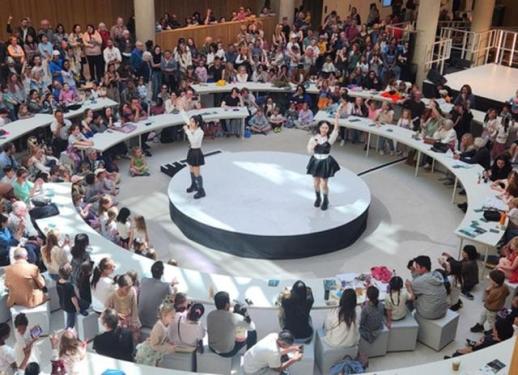 K-pop takes Oxford University by storm as Korean culture gains global spotlight SEOUL, April 26 (AJP) - K-pop has taken center stage at one of the world's most prestigious academic institutions, highlighting the growing influence of Korean popular culture in reshaping global education and cultural landscapes. A K-pop performance was held at the University of Oxford's Stephen A. Schwarzman Centre for the Humanities last Saturday, drawing hundreds of visitors including students and local residents, who gathered around a circular stage to watch the unusual, lively event in a traditionally conservative academic space. The performance featured a string of K-pop songs including Rosé's catchy song "APT." and several tracks from Netflix' hit animated series "KPop Demon Hunters" such as "Golden," "Soda Pop" and "Your Idol." The atmosphere soon resembled a pop concert, with the audience cheering and responding enthusiastically. Saturday's event was part of an event marking the opening of the centre, named after Blackstone co-founder Stephen A. Schwarzman, who donated 185 million pounds (about US$370 million). The centre brings together humanities departments, libraries, and performance spaces under one roof, with the aim of bridging the humanities and contemporary culture, reflecting the university's broader efforts to make academic spaces more accessible to the public. Many see this as a pivotal moment for traditionally scholarly disciplines to engage wider audiences through K-pop, suggesting that global popular culture now plays a key role in shaping the modern humanities. The event was organized in collaboration with the university's Korean studies programs, supported by South Korean energy company Samchully, which has provided 2.5 billion won (about $1.7 million) in funding since last year. The university is also slated to open a centre dedicated to Korean studies this fall, with plans to hold a week-long event to promote Korean culture early next year. 2026-04-26 11:23:49
 -
 Mandatory Spending Nears 55% of South Korea Budget as Basic Pension, Education Grants Top 100T Won More than half of the government’s total spending next year is set to be locked in as legally mandated outlays, rapidly narrowing fiscal flexibility. The basic pension and education grants to local governments are emerging as key drivers of the burden as they approach a combined 100 trillion won a year. According to the government’s 2025-2029 National Fiscal Management Plan submitted to the National Assembly last year, total spending next year is projected at 764.4 trillion won, with mandatory spending at 415.1 trillion won, or 54.3%. With mandatory spending rising faster on average (6.3% a year) than total spending (5.5%), its share is expected to climb to 55.0% in 2028 and 55.8% in 2029. Most mandatory spending is statutory welfare outlays, including basic livelihood support, health insurance, the four major public pension programs and the basic pension. As South Korea enters a super-aged society, both the number of recipients and benefit payments are increasing. Related spending is estimated to exceed 200 trillion won next year and expand to 237 trillion won by 2029. Beyond welfare, the cost of transfers to local governments is also rising quickly. Local allocation tax and education grants, which are linked to domestic tax revenue, are expected to top 150 trillion won next year and reach the 170 trillion won range by 2029. The basic pension and education grants are cited as variables that could reshape the fiscal structure. As the government has set a goal of cutting mandatory spending by 10% during the process of drafting next year’s budget, observers expect reform talks around the two programs to accelerate. The basic pension is seen as a leading item with room to adjust eligibility and payment methods. President Lee Jae-myung has proposed differentiated payments based on the principle of “the higher, the lower,” increasing the likelihood of changes. Education grants, meanwhile, automatically rise because they are tied to domestic tax revenue even as the school-age population declines. That structure has fueled recurring debate over surplus funds, and critics warn the fiscal burden could grow further if tax revenue increases, such as from strong semiconductor exports. Under the fiscal plan, basic pension spending is projected to rise from 25 trillion won next year to 28.2 trillion won in 2029, while education grants increase from 77.1 trillion won to 85.9 trillion won. Combined, the two items are expected to total about 100 trillion won and account for roughly one-quarter of mandatory spending. Academics have already outlined potential savings under reform scenarios. A research report commissioned by the Ministry of Economy and Finance, now the Ministry of Planning and Budget, found that gradually raising the eligibility age for the basic pension could save up to 603.4 trillion won through 2065. Analysts have also said revising the formula that links education grants to domestic tax revenue could significantly reduce the burden. Kim Hak-su, a senior research fellow at the Korea Development Institute, estimated in a report that savings could reach up to 1,046.8 trillion won from 2021 to 2060.* This article has been translated by AI. 2026-04-26 11:19:08
 -
 Seoul to Run 'Seoul Welcome Week' for Foreign Tourists May 1-8 Seoul is rolling out a broad welcome campaign for foreign visitors, aiming to provide tightly linked services from airports to major downtown areas during the spring peak travel season. The Seoul Metropolitan Government said Sunday it will run “2026 Seoul Welcome Week (Seoul Welcome Week 2026)” from May 1 to 8 with the Seoul Tourism Association. The city is targeting a Northeast Asia travel rush as Japan’s Golden Week overlaps with China’s Labor Day holiday, as demand to visit Korea rises amid events such as K-pop concerts. The main hubs will be Myeongdong and Yeouido. The city will set up a “welcome center” near Myeongdong Station and a “welcome booth” at Yeouido Hangang Park, operating them intensively from May 1 to 5. It will extend the campaign through May 8 via major tourist information centers and local tourism “antenna shops.” At the Myeongdong welcome center, the city will run a “Seoul styling spot” and an “AI smart travel guide consultation desk” to provide tailored information. Interactive offerings will include an art-drawing guestbook and K-pop cover dance performances. A K-beauty experience zone will also be offered for visitors to try current Seoul trends. At Yeouido Hangang Park, the city will operate tourist information programs tied to the Seoul Spring Festival. Along with multilingual assistance, the site will offer a “daenggi meori” traditional hair-ribbon styling experience and souvenir-giveaway events. The city said the week is also designed to expand travel routes “from Seoul to the rest of the country.” Working with local tourism antenna shops, it plans to introduce region-specific content and provide discount coupons to encourage foreign visitors to travel outside Seoul. Seoul also highlighted a “welcome from departure” strategy. In cooperation with China Eastern Airlines, it will place welcome leaflets at departure airports on major routes including Shanghai, Qingdao and Nanjing. The city also plans to spread welcome messages across Seoul through outdoor digital billboards, mobility advertising and hotel media platforms. Kim Myeong-ju, director general of Seoul’s Tourism and Sports Bureau, said foreign tourist arrivals to Korea in the first quarter rose about 23% from a year earlier, showing a rapid recovery in demand. “Through a welcome system that runs from the airport to the city center, we will further enhance Seoul’s appeal as a destination,” he said. 2026-04-26 11:18:17
 -
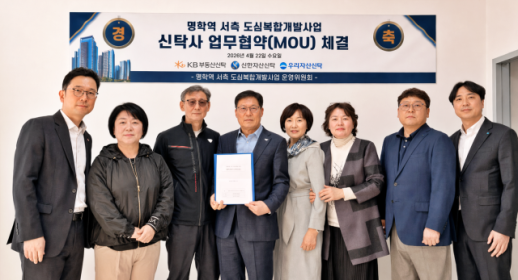 Woori, KB and Shinhan Asset Trusts Sign MOU for Anyang Mixed-Use Redevelopment Anyang’s Manan district area west of Myeonghak Station is set to be redeveloped into a mixed-use space combining housing and commercial functions. Woori Asset Trust, KB Real Estate Trust and Shinhan Asset Trust said April 26 they signed a memorandum of understanding to advance the urban mixed-use redevelopment project west of Myeonghak Station in Anyang. The project aims to revitalize an aging residential neighborhood and underused land near the station on Seoul Subway Line 1. The site is close to the station and offers convenient transportation, with access to nearby commercial and everyday amenities. Under the agreement, the consortium will provide overall advice and project management support, including reviewing the project structure, preparing financing plans and helping coordinate among stakeholders. The companies said they will draw on their experience in redevelopment, development capabilities and fund-management expertise to help keep the project stable from its early stages. A consortium official said the project will improve housing conditions in central Anyang and reorganize urban functions more efficiently, adding that the group will do its best to ensure the project moves forward smoothly.* This article has been translated by AI. 2026-04-26 11:15:41
 -
 Trump Evacuated After Gunfire at WHCA Dinner; Same Hotel as 1981 Reagan Shooting Gunfire broke out at the White House Correspondents' Association dinner, prompting an emergency evacuation of President Donald Trump and drawing renewed attention to a past presidential shooting at the same hotel. CNN reported that the shooting on April 25 (local time) occurred at the same location where President Ronald Reagan was targeted in an assassination attempt while in office. The Washington Hilton Hotel was the site of the March 30, 1981, attack in which Reagan was shot by John Hinckley Jr. as he was leaving the hotel. Reagan suffered a serious injury, including a gunshot wound that pierced a lung and caused severe internal bleeding. During the dinner, Trump was rushed out under U.S. Secret Service protection. He later wrote on his social media platform, Truth Social, that a suspect had been arrested and that all attendees were safe. He also said he planned to hold a news conference in the White House briefing room 30 minutes later to explain the situation.* This article has been translated by AI. 2026-04-26 11:15:14
 -
 WMO Warns Strong El Nino Possible by Mid-2026, Raising Flood Concerns for South Korea The World Meteorological Organization has formally announced that a strong El Nino could develop by mid-2026. South Korean climate experts urged early preparations for possible heavy rain in the country’s south and for water-resource management, with some warning the event could intensify into a “super El Nino.” According to the Science Media Center Korea on Saturday, the WMO said Thursday afternoon (Korea time) that sea-surface temperatures are rising rapidly in the equatorial Pacific, making it likely El Nino will return around May to July 2026. The WMO said the episode is likely to develop into a strong El Nino. El Nino refers to sea-surface temperatures in the central and eastern equatorial Pacific running at least 0.5 degrees Celsius above average. Through ocean-atmosphere interactions, it can disrupt global climate patterns and trigger a mix of extremes depending on the region, including drought, heavy rain, heat waves and shifts in hurricane activity. In its outlook for May to July, the WMO projected above-average surface temperatures in nearly all regions, with especially pronounced warmth expected in the southern United States, Central America, the Caribbean, Europe and North Africa. Rainfall signals vary widely: precipitation is expected to increase in southern South America, the southern United States, the Horn of Africa and parts of Central Asia, while drought is forecast for Australia, Indonesia and parts of South Asia. During the Northern Hemisphere summer, hurricane activity tends to increase in the central and eastern Pacific, while Atlantic hurricane formation is typically suppressed. The WMO cautioned that uncertainty remains in intensity forecasts because of the “spring predictability barrier,” adding that forecast accuracy improves after April. In South Korea, scientists are debating whether the event could grow to a record scale. Kuk Jong-seong, a professor in the Department of Earth and Environmental Sciences at Seoul National University, said the odds of a strong El Nino are “very high,” citing unusually warm tropical oceans, heat buildup in the western Pacific warm pool and the potential for ocean-atmosphere coupling. He said it would be difficult to rule out a super El Nino if westerly wind bursts occur repeatedly in the western and central Pacific in April and May, pushing the Nino 3.4 index to 2.5 degrees Celsius or higher. During the 2015 super El Nino, widespread abnormal weather was observed, including global heat, drought and heavy rain. Yeasook Oh, a professor in the Department of Climate and Energy Systems Engineering at Ewha Womans University, said El Nino events that develop in summer do not affect South Korea in a consistent way and can be highly variable. He said variability in rainfall and temperature is likely to be greater than normal. Huh Chang-hoi, also a professor at Ewha Womans University, countered—citing his own research—that South Korea’s climate is not strongly influenced by El Nino or La Nina. Experts also urged caution in timing any assessment of impacts. Koo Ja-ho, a professor of atmospheric sciences at Yonsei University, and Park Jae-heung, a research professor at Seoul National University, noted that El Nino typically develops in summer and fall and peaks in winter. They said regional impacts such as temperature and precipitation should be evaluated based on the winter of December 2026 to February 2027, not May to July 2026. Climate specialists warned that any El Nino developing on top of already elevated global temperatures could have broader effects than in the past. * This article has been translated by AI. 2026-04-26 11:09:16
 -
 South Korea to Inspect Livestock Traceability, Grading and Origin Labels; DNA Tests Possible South Korea’s Ministry of Agriculture, Food and Rural Affairs said Saturday it will conduct a joint inspection of livestock product traceability, grading and country-of-origin labeling from Sunday through May 15, working with the National Agricultural Products Quality Management Service, the Animal and Plant Quarantine Agency and local governments. The roughly three-week crackdown will focus on businesses suspected of violating rules on price and grade labeling and origin labeling for livestock products sold online and through other channels, the ministry said. If inspectors suspect false labeling of traceability numbers during on-site checks, they will also conduct DNA identity tests. The Korea Institute for Animal Products Quality Evaluation has carried out on-site checks under the livestock traceability system and used the results to improve operations. The ministry said the institute has also established a notice requiring it to report field findings to enforcement agencies, a step officials expect will improve the efficiency of inspections. Jeon Ik-seong, head of the ministry’s livestock distribution team, said the government will continue to strengthen inspections and enforcement against violations of the traceability system to eliminate illegal distribution and supply consumers with safe, reliable livestock products.* This article has been translated by AI. 2026-04-26 11:03:44
 -
 South Korea to Launch ‘So-Prize 2025’ Hanwoo Sale With Discounts Up to 50% South Korea’s Ministry of Agriculture, Food and Rural Affairs said Saturday it will run a nationwide Hanwoo beef discount campaign from Sunday through May 10, offering markdowns of up to 50% at Nonghyup-affiliated Hanaro Mart stores, major supermarkets and leading online malls. The online Hanwoo marketplace operated by the Hanwoo Self-Reliance Fund will hold its sale from Sunday through April 30. Most online and offline retailers will run promotions from April 29 through May 10. Store-by-store schedules are available on the websites of the Hanwoo Self-Reliance Fund, the National Hanwoo Association and Nonghyup Economic Holdings. Discounted items include popular cuts such as sirloin, brisket and other beef used for bulgogi and soup, spanning grades from 1++ to Grade 2. Participating sellers plan to offer, per 100 grams of Grade 1 beef, sirloin at 7,160 won and brisket at 4,810 won, about 16% to 25% below typical prices. Lee Jae-sik, the ministry’s director general for livestock policy, said the event was designed to give households a chance to buy high-quality Hanwoo at more reasonable prices during Family Month. He said the ministry will continue discount campaigns to ease consumers’ burden and help stabilize livestock product prices.* This article has been translated by AI. 2026-04-26 11:03:16
 -
 Trump Says He Will Hold White House Briefing After Suspected Shooting at Press Dinner President Donald Trump said he would hold a White House news conference after what he described as a suspected shooting incident at a dinner for the White House press corps on April 25 local time. In a post on his social media platform, Truth Social, Trump said law enforcement asked those at the scene to leave under established procedures and that they would comply immediately. "We will hold a press conference in the White House briefing room in 30 minutes," he wrote. Trump added that the first lady, the vice president and all Cabinet members were safe. He said he had spoken with event officials and that the dinner would be held again within 30 days. Earlier, Trump was evacuated after what the report described as gunfire-like sounds during the dinner at the White House. He later said the suspect was arrested, crediting law enforcement.* This article has been translated by AI. 2026-04-26 10:57:48