

Journalist

Jung Sung-chun
-
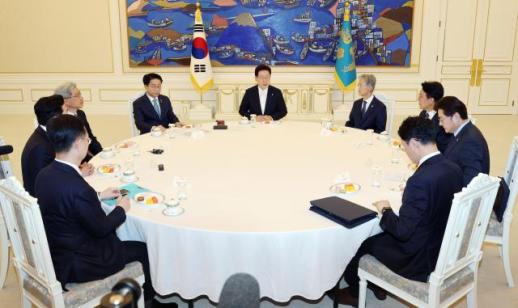 President Lee Addresses Election Paper Shortage at Meeting with Key Officials President Lee Jae-myung addressed the shortage of ballots during the June 3 local elections, stating, "Regardless of the number, the failure to guarantee the exercise of voting rights and adequate realization of citizen sovereignty is a very serious issue that leaves us speechless."The president made these remarks during a meeting with key officials at the Blue House.Attendees included National Assembly Speaker Cho Jung-sik, Prime Minister Kim Min-seok, Constitutional Court Chief Kim Sang-hwan, and Supreme Court Chief Justice Jo Hee-dae, who gathered to discuss comprehensive reforms in election management.President Lee noted, "I understand everyone is busy with their duties, but I felt it was necessary to convene this meeting given the current situation is not something we can overlook."He emphasized that the Election Commission is an independent body as defined by the constitution, stating, "No one can officially comment on its operations, and even if mistakes occur, the current interpretation of the constitution makes it difficult to verify what is happening."However, he stressed, "We cannot ignore this situation," adding that elections are central to the constitutional order and the realization of citizen sovereignty.The president expressed a desire for the independent constitutional leaders present to engage in official discussions on how to address the issue, stating, "While we may not find clear solutions today, it is essential to clarify the facts surrounding this matter."He further noted, "In some form, there must be accountability from the perspective of the citizens, and we should also discuss possible alternatives and measures."Constitutional Court Chief Kim Sang-hwan remarked that the unprecedented ballot shortage during the June 3 elections has damaged public trust and pride in South Korea's democracy and electoral system.He stated, "Despite facing numerous challenges, South Korea's democracy has traditionally advanced step by step through the wisdom of our people and a firm commitment to constitutional values. Although we have encountered unexpected difficulties and setbacks, we have always learned from them to create a more mature and stable democracy."Kim added, "Therefore, we must use this incident as a painful lesson to thoroughly investigate the facts, legally assess the situation, and critically examine and improve our electoral system and its operations, hoping to advance toward a democracy that all citizens can firmly trust."Supreme Court Chief Justice Jo Hee-dae asserted, "There is no room for debate that the voting rights of citizens, as sovereigns, must never be violated," expressing deep regret over the fact that some citizens were unable to exercise their precious voting rights due to the ballot shortage in the recent local elections.He also addressed the judiciary's role in preventing such occurrences in the future, stating, "We must work on institutional improvements to ensure this does not happen again, and the judiciary will do its utmost to uphold the fairness of elections and protect citizens' rights through its constitutionally mandated role."Lee Gyu-yeon, the Blue House spokesperson, stated during a briefing at the press center that the attendees unanimously agreed on the need for a thorough investigation into the matter and the establishment of preventive measures. He added, "Depending on the results of investigations or national inquiries, we will hold those responsible accountable and develop comprehensive reforms in election management to restore public trust."* This article has been translated by AI. 2026-06-08 17:27:00
 -
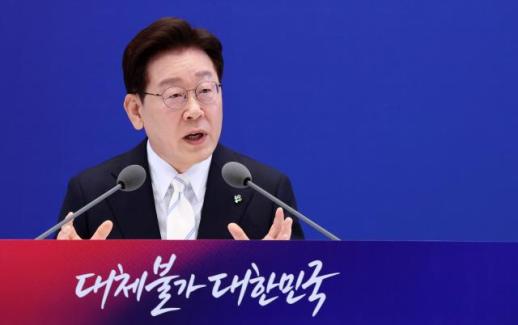 President Lee: Media Must Bear Responsibility for Special Protections President Lee Jae-myung emphasized the importance of the media during a press conference on June 8, stating, "The media is crucial. It is one of the key pillars supporting a democratic republic. Therefore, it must be protected and guaranteed. However, it must also bear corresponding responsibilities." During the event at the Blue House, he remarked, "The media should be protected. In a democratic society, information serves as the basis for the judgment of the sovereign, and the primary role of the media is to convey that information accurately. However, when that information is distorted, manipulated, or false, it misleads the judgment of the sovereign. That is truly dangerous." Lee acknowledged that "mistakes due to misinterpretation of facts are unavoidable," but he stressed that "manipulating facts is an act that undermines the constitutional order. If there is intent behind it, I believe it constitutes a serious crime." He further stated, "If the media, which enjoys special protection and guarantees from the national community, deliberately spreads fake news that disrupts the national system, it must be held accountable for acts that disturb public order. In my view, it seems that accountability is not well enforced in South Korea." Lee also criticized the practice of quoting someone's claims as facts, saying, "It is wrong to report someone’s assertion as if it were a fact by placing it in quotation marks. If it is a falsehood but is reported with quotes, it is still false reporting. That does not absolve one of responsibility." * This article has been translated by AI. 2026-06-08 17:24:00
 -
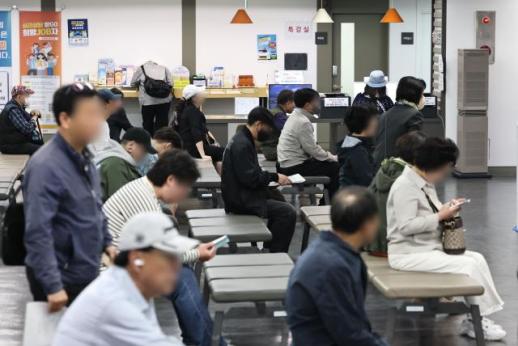 One in Five Wage Workers in South Korea Lacks Retirement Benefits More than one in five wage workers in South Korea are estimated to be in a blind spot regarding retirement benefits. Despite the expansion of retirement pension systems and improvements in regulations, the increase in part-time, short-term, and non-regular workers, particularly among women and youth, has significantly contributed to this issue. According to a report by the Korea Labor Institute titled "Estimation and Characteristics of the Retirement Benefit Blind Spot," approximately 471,400 out of 22,143,000 wage workers, or 21.3%, were estimated to fall into this category as of 2024. The retirement benefit blind spot refers to workers who are excluded from the coverage of the Employee Retirement Benefit Security Act or those who, while legally covered, do not actually receive retirement benefits. This includes workers who work less than 15 hours a week, those with less than one year of continuous employment, and those on repeated short-term contracts. The proportion of workers in this retirement benefit blind spot has decreased from 26.6% in 2015. However, it still means that more than one in five wage workers lacks protection for retirement benefits. Historically, a significant portion of the blind spot was due to "substantial blind spots" where employers failed to properly implement the system despite it being applicable. Recently, however, there has been an increase in "institutional blind spots" where workers do not meet the legal requirements for retirement benefits from the outset. Women make up more than half of those in the blind spot, influenced by a labor market structure characterized by career interruptions, part-time work, and short-term contracts. By age group, those aged 60 and older represent the highest proportion at 37.1%, followed by youth aged 15 to 29 at 23.9%. This trend is attributed to the high prevalence of part-time and short-term jobs among older workers and the instability faced by young workers entering the job market. Industries such as health and social welfare services, accommodation and food services, and wholesale and retail trade show a high proportion of workers in the blind spot. These sectors often have many small businesses with short labor contracts and frequent job changes. Critics argue that addressing the retirement benefit blind spot cannot be viewed solely as an issue of regulatory enforcement. With the changing structure of the labor market leading to an increase in workers outside the legal application criteria, there is a need to reassess the scope of the system. As the labor market rapidly evolves due to aging, the rise of platform work, and an increase in ultra-short-term employment, it is crucial to improve the retirement benefit system to ensure it serves as a fundamental mechanism for securing income in old age. The Korea Labor Institute stated, "It is necessary to enhance the effectiveness of legal rights to retirement benefits while providing institutional support for workers who are not currently protected under existing criteria. We should discuss ways to redesign the boundaries of retirement benefit applicability."* This article has been translated by AI. 2026-06-08 17:21:00
 -
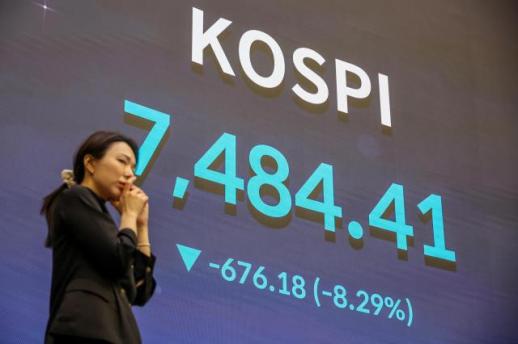 Chip sell-off sends KOSPI below 8,000 SEOUL, June 8 (AJP) - South Korea's benchmark KOSPI closed at 7,484.41, down 676.18 points, or 8.29 percent, from the previous session, falling below the 8,000-point level According to the Korea Exchange, the KOSPI opened at 8,048.09, down 112.50 points, or 1.38 percent, from the previous close, before extending its losses throughout the session. The index fell as low as 7,442.73 during intraday trading. The tech-heavy KOSDAQ also declined sharply, ending the day at 911.39, down 91.05 points, or 9.08 percent. Amid the sharp market sell-off, circuit breakers were triggered on both the KOSPI and KOSDAQ markets. Sell-side sidecars, which temporarily suspend program-driven sell orders, were also activated in both markets. 2026-06-08 17:17:53
 -
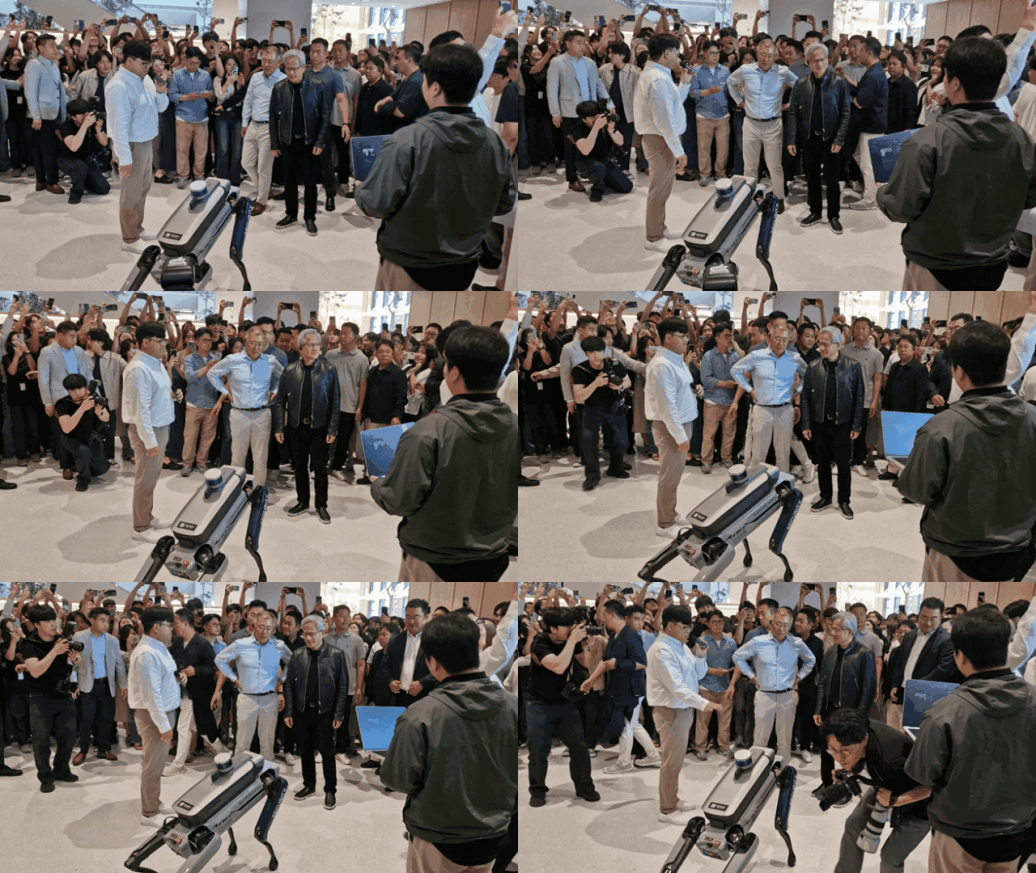 Jensen Huang: Now is Hyundai's Time as He Showcases Physical AI Alliance "The era after artificial intelligence (AI) will be Hyundai Motor Group's time." On June 8, Jensen Huang, CEO of NVIDIA, visited Hyundai Motor Group's Yangjae headquarters, emphasizing the scalability of the company's physical AI. Dressed in a black leather jacket, Huang was welcomed by Chairman Euisun Chung and Vice Chairman Jae-hoon Chang. After passing through the main entrance, he took time to sign autographs and pose for photos with employees gathered on the right side. The atmosphere was electric, reminiscent of a concert. Chairman Chung also joined employees in taking selfies to celebrate the occasion. Huang toured the displayed hydrogen fuel cell vehicle Nexo and an automated hydrogen refueling robot. He praised the Pony, calling it "the first car of the Hyundai brand" while giving a thumbs-up. He showed keen interest by asking about the water tank capacity of a robotic exhibit. He also interacted with Spot, the four-legged robot used for security and patrol at the Yangjae headquarters. When Spot greeted him in English, Huang jokingly replied, "Then I'll give you my credit card," prompting laughter from those nearby. Under Chairman Chung's guidance, Huang explored Kia's purpose-built vehicle (PBV) PV5, even posing in the driver's seat. He examined the vehicle's interior with great interest. While viewing the mobility robot platform Mobed displayed in the plaza, Huang remarked, "It would be great to apply this technology to off-road vehicles," expressing his fascination. Huang stated, "Hyundai Motor Group is a massive company in the mobility sector and a true expert. We aim to combine AI with Hyundai's mobility expertise to change the future. We can also transform the future of robotics." He added, "The next wave of AI will be in mobility and physical AI. A time is coming when AI will understand the world and enter the real world to perform valuable tasks for people. Now is Hyundai's time." In closing, Huang praised Chairman Chung, stating, "He is a remarkable person who has built such an incredible company."* This article has been translated by AI. 2026-06-08 17:12:00
 -
 South Korea outlines strategy to attract 2 million cruise visitors SEOUL, June 08 (AJP) - South Korean government and tourism officials met with industry representatives aboard a docked cruise ship in Busan on June 5, 2026, to outline a strategy aimed at expanding international cruise tourism, the Korea Tourism Organization said Monday. The 21st Cruise Development Council meeting took place aboard Royal Caribbean's 169,000-ton Spectrum of the Seas, marking the first time the annual council convened on an active vessel. About 90 officials from regional governments, the cruise industry, and academia attended the event to discuss ways to improve port excursions and encourage local spending. During the meeting, the Korea Tourism Organization (KTO) announced its 2026 revitalization plan funded by a supplementary budget. The initiative includes joint marketing campaigns with Royal Caribbean, familiarization tours for cruise line operators, and participation in international port exhibitions. Officials highlighted recent efforts to tailor services for visitors, citing a pilot program launched in Busan on May 12, 2026. A dedicated shuttle bus connecting the port terminal to the Seomyeon Medical Street area increased the disembarkation rate among ship crew members from 29 percent to 49 percent. Representatives from several South Korean ports shared specific regional strategies. Incheon focused on its fly-and-cruise programs, while Busan presented plans for overnight port calls linked to local festivals. Officials from Jeju, Yeosu, Sokcho, and the Saemangeum Development and Investment Agency also outlined their development goals. Wendy Yamazaki, Royal Caribbean's vice president for the Asia-Pacific region, presented an overview of core tasks for growing the country's cruise sector from a global operator's perspective. "We will do our best to attract cruise tourists through cooperation between the private sector, government, and academia based on the discussions at this council," said Han Yeo-ok, director of the international tourism content division at the KTO. "We will carry out comprehensive marketing to expand our global network and achieve the era of 2 million cruise tourists visiting South Korea early." 2026-06-08 17:09:55
 -
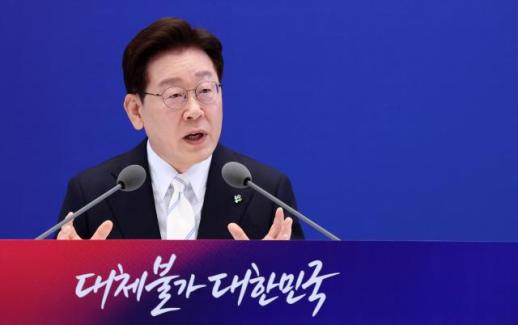 President Yoon Advocates for Future Investments from Surplus Tax Revenue President Yoon Suk Yeol stated on June 8 that surplus tax revenue generated from the booming semiconductor industry should be invested in future growth potential for the nation.He addressed the contentious issue of excess profit distribution among companies like Samsung Electronics, emphasizing the need for a cautious approach due to its potential impact on national industrial competitiveness.During a press conference at the Blue House marking his first year in office, President Yoon acknowledged that there could be significant debate over how to utilize surplus tax revenue. He asserted, "Surplus tax revenue should be invested in ways that enhance the growth potential of South Korea for future generations."He stressed the importance of distinguishing between the use of surplus tax revenue and excess profit distribution, stating, "These are completely different issues."Regarding the use of surplus tax revenue for general fiscal spending, President Yoon expressed a negative view. He remarked, "If we spend more when we have more and less when we have less, we are abandoning the role of fiscal policy. Treating surplus tax revenue like regular tax revenue and depleting it through general spending should be excluded."On the topic of excess profits, he noted, "It is difficult to easily conclude whether this is a matter of labor disputes or management rights. If our country introduces such a system first, companies may relocate their investment and production bases overseas, which could have serious implications for national industrial policy."He added, "The issue of excess profits is very challenging but an unavoidable reality," emphasizing that it requires international discussion rather than being confined to domestic discourse.Earlier, in his commemorative speech, President Yoon pledged to make 2026 the year when the bold dream of an 'Irreplaceable Korea' begins, stating, "We will leverage South Korea's experiences, capabilities, values, and the national energy to overcome crises to usher in a new era of the 'K-Initiative.'"To achieve the vision of an 'Irreplaceable Korea,' he outlined four key national goals: becoming a super-gap industrial powerhouse, a global leader in diplomacy and security, a normal society, and a government that saves lives.President Yoon concluded, "We will advance as a super-gap industrial powerhouse where all citizens and regions equally share in growth opportunities and benefits, continuously discovering and nurturing 'global super-gap growth engines' that will play a pivotal role in South Korea's next-generation industries beyond semiconductors."* This article has been translated by AI. 2026-06-08 17:09:00
 -
 Samsung Heavy Industries Finalizes Major FLNG Contract in Africa Samsung Heavy Industries announced on June 8 that it has finalized a contract worth 3.6536 trillion won for a large floating liquefied natural gas (FLNG) production facility with a shipowner in Africa. The finalized FLNG contract follows preliminary work agreements and ongoing processes. Currently, the upper module work is underway, and the facility is expected to be delivered in 2028 after module installation and commissioning. The FLNG, which will be installed offshore, is emerging as an alternative to onshore LNG plants amid unstable energy supply chains. Notably, this FLNG incorporates the 'Lesson Learned System' based on the successful experiences of previous FLNG projects. A Samsung Heavy Industries representative stated, "We have analyzed accumulated data to incorporate feedback, optimize design and processes, and implement an evolved standard FLNG." They added, "Samsung Heavy Industries will leverage its FLNG standardization experience as a strategic asset to maintain its competitive edge in the FLNG sector." Additionally, Samsung Heavy Industries announced earlier that it has secured a contract for an LNG carrier worth 385.5 billion won from a shipowner in Oceania, actively pursuing expansion in its order book.* This article has been translated by AI. 2026-06-08 17:09:00
 -
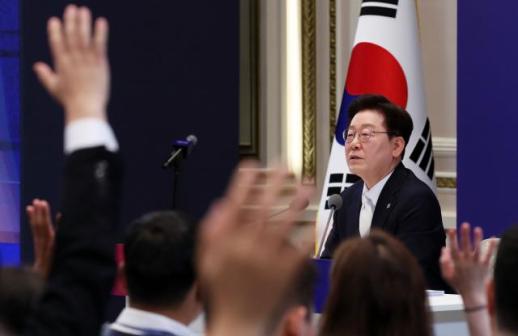 President Lee Criticizes Election Commission Over Ballot Shortage President Lee Jae-myung criticized the Election Commission for its mismanagement of the ballot shortage during the June 3 local elections. However, he emphasized that this issue is “entirely different” from the allegations of election fraud raised by some opposition parties, including the People Power Party.During a press conference at the Blue House on June 8, marking his first anniversary in office, President Lee described the ballot shortage as “absurd,” stating, “This has completely undermined the image of a model democratic nation like South Korea.”He clarified that the issue of ballot shortages should not be conflated with claims of election fraud, asserting, “There is a significant difference between using falsehoods for political gain and the legitimate concern of how it is possible that people could not vote in our country.”President Lee pointed out that the core issue is that the ballot shortage obstructed citizens' right to participate in the electoral process.He stated, “If the government fails to manage the exercise of voting rights in a democratic republic like South Korea, it is not just a matter of the number of votes or the results; it is a very serious issue in itself.”He also expressed gratitude for the activism of young people regarding this matter.“I find the young people who raised this issue to be truly valuable and admirable,” he said, adding, “I must admit I hadn’t considered it myself. I thought, ‘How could a few people not voting affect the results?’”He continued, “People like us may have become somewhat insensitive. I reflect on whether there is a lack of sensitivity to the exercise of sovereignty,” and acknowledged that he has much to learn from the youth who raised fundamental questions about the exercise of sovereignty in South Korea.Following the press conference, President Lee met with key officials at the Blue House to discuss the ballot shortage and potential reforms for the Election Commission.Attendees included National Assembly Speaker Chung Jin-suk, Prime Minister Kim Boo-kyum, Chief Justice Kim Myung-soo, and Constitutional Court President Kim Sang-hwan, excluding the resigned Election Commission Chairman Noh Tae-ak.The press conference, lasting 167 minutes, was conducted without a predetermined script, allowing over 20 journalists to ask questions freely as directed by the host and President Lee.The slogan for the conference was “Irreplaceable South Korea,” reflecting a vision for the nation to become not just one that the world watches, but one that the world needs.Regarding the results of the June 3 local elections, President Lee candidly expressed, “It was an unavoidable question, and I struggled with it a lot.” He added, “I believe it was ultimately a warning from the public. The people are watching, listening, and will act at some point. It made me realize how formidable the public can be.”He remarked, “In any case, I was not in a good state for two to three days after the election,” concluding, “The bottom line is my shortcomings.”On the proposed special prosecutor law related to allegations of prosecutorial misconduct, he stated, “It should be handled according to law and common sense. If there is wrongdoing, it should be dismissed; if not, it should be left alone,” suggesting that a neutral special prosecutor would be preferable.Additionally, President Lee wore a tie with a white background and blue stripes, similar to the one he wore during the national appointment ceremony on August 15 last year.A Blue House official explained that this symbolizes a commitment to not lose sight of the original intention and hope for South Korea.* This article has been translated by AI. 2026-06-08 17:06:00
 -
 Iran Claims U.S. Involvement in Israeli Attacks, Hints at Further Action Tensions between Iran and Israel have escalated again after two months of relative calm, with Iran accusing the United States of being involved in Israel's renewed attacks. On June 8, during a regular briefing, Iranian Foreign Ministry spokesman Esmail Baghaei stated, "No one believes that the Zionist regime (Israel) acts without prior coordination and cooperation with the U.S. in our region. We still have information that the U.S. is coordinating with this regime in both offensive and defensive areas." He added, "While it is always debatable whether the Zionist regime listens to the U.S., the responsibility of the U.S. as a party to the ceasefire is clear. Regardless of whether the U.S. directly violates the ceasefire or does so through the Zionist regime in Lebanon, the U.S. bears responsibility, and it must account for the escalation of tensions." The current conflict began when Israel launched airstrikes on Beirut, Lebanon, on June 7, despite opposition from U.S. President Donald Trump. In retaliation, Iran fired missiles at Israel on the night of June 7 and the morning of June 8, prompting Israel to respond with airstrikes on major cities in Iran, including Tehran. Iran has demanded that the U.S. cease hostile actions against Lebanon as a condition for a ceasefire. Baghaei warned that these attacks could negatively impact negotiations between the U.S. and Iran. He stated, "Such incidents undoubtedly raise suspicions. We are still exchanging messages with the U.S. amid severe distrust." He further emphasized that Israel's actions in the region cannot be separated from U.S. policy, criticizing the contradictory attitudes and confusing statements from the U.S. as complicating diplomatic processes. He added, "The actions of the past 24 hours will only exacerbate this confusion." Baghaei also hinted at the possibility of further Iranian responses, stating, "We will act wherever necessary, as required by our national interests and security. We will not allow Israel and the U.S. to rely solely on general statements for maintaining a ceasefire while repeatedly attacking. " He acknowledged that the military conflict would inevitably affect diplomatic processes, saying, "The diplomatic efforts initiated to end the forced war will naturally be impacted. If the reason for negotiations is undermined, that process will also be affected." However, he clarified that diplomatic channels have not been completely severed. Baghaei noted, "Message exchanges are ongoing," and mentioned that the visit of Pakistan's Interior Minister to Tehran was part of efforts to continue dialogue. He characterized Iran's response the previous night as "entirely defensive actions under the U.N. Charter." In response to the U.S. claim of being unaware of the Lebanese attack, he suggested, "This implies that Israel is deceiving the U.S., or that there is cooperation and division of roles between the U.S. and Israel. Based on experience, the latter is more accurate."* This article has been translated by AI. 2026-06-08 17:06:00