


Latest by
-
 Goodbye Jamsil Baseball Stadium: Final Farewell After 44 Years of Memories The Jamsil Baseball Stadium in Seoul, which has shared the joys and sorrows of Korean baseball for 44 years since its opening in 1982, is set to host its final regular season game before reconstruction.On October 12, the stadium will feature a matchup between the Doosan Bears and the Lotte Giants, marking the last regular season game to be held at Jamsil.After completing postseason games and special events scheduled for October and November, the stadium will be demolished. A new 30,000-seat domed stadium is planned to be built, with an expected opening in 2032.Jamsil Baseball Stadium boasts impressive dimensions, with distances of 100 meters to the left and right field fences and 125 meters to center field, along with a fence height of 2.6 meters, making it one of the largest in the country. The first baseball game was held in July 1982 during a high school invitational tournament, and from 1983, it served as the home ground for the MBC Cheongryong, contributing to the history of Korean professional baseball.Former manager Kim In-sik will throw the ceremonial first pitch for the game. Kim managed the OB Bears, the predecessor of the Doosan Bears, and the Doosan Bears from 1995 to 2003, leading the team to two championships. The club has honored him by selecting him to throw the first pitch at the stadium's final regular season game.Following the game, the Doosan Bears will hold a ceremony to commemorate the history of Jamsil Baseball Stadium and bid farewell. The event will feature club legends representing various eras, who will share their final goodbyes to the stadium that has been a part of their journey for so long.* This article has been translated by AI. 2026-10-12 17:36:20
-
AI Robots for Mine Clearance and Explosive Disposal Established at First Defense AX Base in Pangyo On October 12, the military established a foundation for the development and demonstration of artificial intelligence (AI) technology to be used in hazardous missions such as mine clearance and explosive disposal. The first Defense AX (AI Transformation) base was opened in Pangyo, Gyeonggi Province, aimed at connecting advanced civilian technology with military needs to reduce the risk exposure of soldiers and enhance mission capabilities. The Ministry of National Defense held the opening ceremony for the Defense AX base in Pangyo Techno Valley, presided over by Defense Minister Kang Shin-cheol. Approximately 150 representatives from the public and private sectors, including officials from the Ministry of Science and ICT, the Ministry of Trade, Industry and Energy, the Ministry of SMEs and Startups, and the National AI Strategy Committee, attended the event. The newly opened Army Pangyo AX base is the first of five planned Defense AX bases nationwide, with Ajou University serving as the lead institution. It will focus on operating 'Physical AI' technology applicable to humanoid and multi-legged robots. At the Pangyo base, efforts will be made to collect Physical AI data and train AI models for robots using this data. The Ministry of National Defense plans to utilize this technology for transporting supplies in hazardous areas, explosive disposal, chemical and biological reconnaissance, and mine clearance. The goal is to integrate AI technology into missions that expose soldiers to danger. The Defense AX base serves as a collaborative space connecting military needs with advanced civilian technology. It aims to establish a secure foundation for utilizing defense data and support joint research and demonstrations among the military, universities, and businesses. Following Pangyo, the Ministry of National Defense plans to sequentially open bases in Yongsan, Daejeon, Busan, and Yangjae in Seoul. The Joint Chiefs of Staff and each military branch will operate a total of five bases in collaboration with selected lead institutions, promoting research and demonstrations in various fields. The Yongsan base will work with Korea University to conduct demonstrations of military command and control using classified data. The Daejeon base will focus on AI research with KAIST and Agentic AI. The Busan base, serving the Navy and Marine Corps, will collaborate with UNIST on intelligent logistics support and marine AX demonstrations. The Yangjae base for the Air Force will work with Seoul National University on target automatic identification and other air force AX demonstrations. Minister Kang emphasized, "The Defense AX base is a space where military field experience meets the technology and wisdom of academia and industry. It is in this meeting that the concept of 'how to fight' is established, and when that concept is firmly in place, advanced technology becomes a tool for victory." He added, "With the advancement of cutting-edge science and technology, we have entered a battlefield where 'thinking exists.' The Defense AX base is the first step in opening that era, and I urge everyone gathered here to become the leaders of that future." The Ministry of National Defense plans to strengthen technology development based on the collaboration of industry, academia, and the military centered around the Defense AX base, aiming to connect civilian AI technology with the needs of the defense sector to drive AI and data-based defense innovation.* This article has been translated by AI. 2026-10-12 17:36:10
-
2026 Haenam Mi-nam Festival to Focus on Tourists, Eliminates Formalities "This year, the guests at the Haenam Mi-nam Festival are the tourists." The Haenam County government is making significant changes for the upcoming '2026 Haenam Mi-nam (味南) Festival,' which opens on October 30. The festival will eliminate formal ceremonies, guest introductions, and designated seating, aiming to make residents and visitors the main focus. The festival will take place from October 30 to November 1 at Duryunsan Provincial Park in Samsan-myeon, under the theme 'Dyeing in the Flavors of Haenam.' One of the most notable changes this year is the opening ceremony. The traditional town parade and formal ceremonies will be removed, and the protocol will be minimized to focus on the festival's core elements: food and performances. There will be no separate seating for dignitaries. Instead of designated seats for attendees, the festival will adopt an open seating arrangement where residents and tourists can sit together and enjoy the performances. The opening event will feature a performance centered around this year's agricultural product, rice, followed immediately by the 'Mi-nam Trot Celebration Show,' without a formal ceremony. The Haenam County government aims to create a flow of events that allows tourists to enjoy the programs without unnecessary delays. The festival will focus on Haenam's agricultural and marine specialties and culinary offerings. An integrated exhibition hall will showcase this year's theme, 'Haenam Rice,' connecting displays, experiences, sales, and online broadcasts. There will also be food and snack areas featuring local businesses and residents. Large-scale booths for selling agricultural and marine products will allow visitors to taste and purchase Haenam's specialties directly. Programs for tourist participation, such as a cabbage mixing event and rice cooking experiences, will also be available. The festival will feature performances, including a trot celebration show with popular singers and romantic concerts throughout the event. Yoon Yong-han, head of the festival team at Haenam County's tourism office, stated, "This year's Haenam Mi-nam Festival will be a true celebration for visitors, minimizing formalities and focusing on the festival's core story. We hope tourists from across the country will comfortably enjoy the flavors and beauty of Haenam." The Haenam Mi-nam Festival, now in its ongoing years, connects Haenam's agricultural and marine specialties with tourism content. This year's festival will be held from October 30 to November 1 at Duryunsan Provincial Park, emphasizing food and experiential programs centered around Haenam rice while significantly reducing formalities.* This article has been translated by AI. 2026-10-12 17:36:10
-
Alcohol Consumption to Be Banned at Seoul Station Plaza Starting March 2027 The area around Seoul Station Plaza is set to be designated as a prohibited area for alcohol consumption starting November 9. A fine of 50,000 won will be imposed for drinking in this area beginning March 1, 2027. Jung-gu announced on October 12 that it plans to designate the plaza and surrounding areas as a no-drinking zone based on the National Health Promotion Act and local ordinances. From today until November 8, Jung-gu will conduct an administrative notice period to gather opinions from citizens and relevant organizations. The designated area includes a total of 13,283 square meters around Seoul Station Plaza and its outdoor spaces. Indoor facilities such as restaurants within the plaza, as well as the Seoul Skywalk, underground passages, and subway station entrances, are excluded. This measure aims to reduce disturbances caused by repeated drinking and loud noise in the plaza. Seoul Station serves as a major transportation hub, connecting KTX, regular trains, subway lines 1 and 4, and the airport railroad. However, concerns about public safety and traffic disruptions have been raised due to ongoing drinking and disturbances in the plaza area during daytime hours. A survey conducted by Jung-gu among 1,238 users of Seoul Station Plaza found that 96.4% of respondents supported the designation of the no-drinking zone. Seoul Station Plaza straddles the administrative boundaries of Jung-gu and Yongsan-gu. To enhance the effectiveness of management and enforcement, both districts have been working together to designate their respective areas as no-drinking zones simultaneously. Yongsan-gu also announced plans to designate 6,570 square meters around Seoul Station Plaza as 'Yongsan-gu No Drinking Zone No. 1' starting November 9. This area includes 2,340 square meters in front of Seoul Station and 4,230 square meters in the surrounding western area. Both districts will operate a promotional and guidance period until February 28, 2027. During this time, they will collaborate with the Seoul City government, Korea Railroad Corporation, and police to inform the public about the no-drinking zone and provide on-site guidance. Starting March 1, 2027, individuals caught drinking in the designated area will face a fine of 50,000 won. Kim Gil-seong, head of Jung-gu, stated, "Seoul Station Plaza is the first face that many citizens and tourists from around the world encounter in the capital. We will systematically manage the no-drinking zone with relevant agencies to transform it into a 'plaza for everyone' where anyone can stroll with peace of mind."* This article has been translated by AI. 2026-10-12 17:36:00
-
 KOSPI falls 3.7% to under 6,400 SEOUL, October 12 (AJP) - Foreign investors sold South Korean stocks for a 10th straight session on Monday, pushing the benchmark Korea Composite Stock Price Index (KOSPI) below 6,400. The selling continued two trading days after Samsung Electronics posted the largest quarterly operating profit ever reported by a Korean company. The KOSPI shed 241.7 points, or 3.6 percent, to 6,384.2. Foreigners net sold 2.02 trillion won ($1.51 billion) of shares on the main board, bringing their October total to nearly 10 trillion won. Samsung Electronics and SK hynix each fell more than 4 percent, and the tech-heavy secondary KOSDAQ lost 4.8 percent. Samsung Electronics dropped 4.4 percent to 250,500 won ($187.8). SK hynix fell slightly harder with a 4.5 percent drop to 1,605,000 won ($1,203.1). Holding company SK square, the largest shareholder in SK hynix, lost 6.3 percent to 984,000 won ($737.6). That was the steepest drop among the 10 largest stocks on the main board by market value. Samsung reported on Thursday a preliminary third-quarter operating profit of 107.4 trillion won ($80.5 billion), the first time a Korean company has topped 100 trillion won in a single quarter. Foreigners still sold 2.43 trillion won of Korean shares that day. Local brokerages have tied the run of foreign selling to rising U.S. borrowing costs. The U.S. 10-year Treasury yield stood above 5.2 percent on Monday. Retail investors took the other side, buying a net 1.47 trillion won ($1.10 billion). Institutions sold 110.7 billion won ($83.0 million). Decliners beat gainers 720 to 166, and the main index in Seoul traded below Thursday’s close all session. Korean markets were shut Friday for Hangeul Day. The KOSDAQ fell more steeply than the main board, shedding 43.1 points to 849.2. Tokyo markets were closed for Sports Day, a national holiday. The Nikkei 225 last finished Friday at 69,030.9, little changed. The won strengthened 9.9 won to 1,334.1 per dollar. Samsung’s earnings have not slowed the foreign exit. Until U.S. yields ease, Korean retail buyers are left absorbing what foreign funds sell, and they have not yet put a floor under the market. AJP Takeaways Foreign investors net sold 2.02 trillion won ($1.51 billion) of South Korean shares on Monday, pushing the KOSPI below 6,400. The selling hit the two chip leaders. Samsung Electronics fell 4.4 percent and SK hynix 4.5 percent, two trading days after Samsung reported a 107.4 trillion won ($80.5 billion) quarterly operating profit. Retail investors bought a net 1.47 trillion won ($1.10 billion), but the KOSPI still lost 3.6 percent to 6,384.2. Tags: Samsung Electronics; SK hynix; SK square; Korea Composite Stock Price Index (KOSPI); KOSDAQ; Nikkei 225; U.S. Treasury yield; won-dollar exchange rate; foreign investors; Hangeul Day 2026-10-12 17:31:48
-
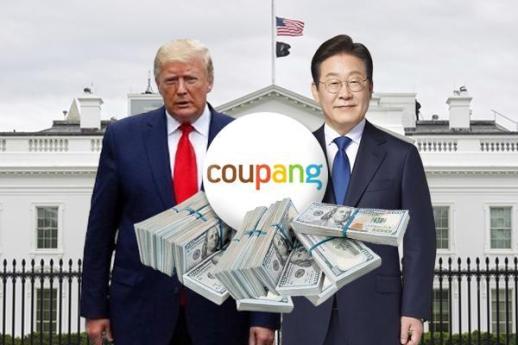 South Korea weighs lobbying registration and disclosure rules SEOUL, October 12 (AJP) - South Korea's Justice Ministry is reviewing a proposal to introduce a formal lobbyist registration system requiring individuals and organizations seeking to influence legislation to disclose their activities. The ministry commissioned a study on lobbying regulations from Hong Wan-sik, a law professor at Konkuk University, and received the findings in June. The report recommends requiring lobbyists to register and publicly disclose their activities, initially focusing on the National Assembly and local councils before gradually extending the regulations to central and local government agencies. The proposal would mark a significant shift in South Korea, where lobbying takes place through businesses, industry associations, law firms and other interest groups without a comprehensive legal framework requiring lobbyists to register and disclose their activities. Although lobbying itself is not categorically illegal, the absence of a dedicated regulatory system has long raised questions about transparency and the distinction between legitimate advocacy and improper influence. Hong argued that interactions between interest groups and public officials were already widespread and that leaving such activities without systematic oversight could encourage corruption. The ministry's review follows discussions at a Cabinet meeting in December 2025, when Justice Minister Jeong Seong-ho called for a system under which registered lobbyists could operate within clearly defined legal boundaries. Previous attempts to regulate lobbying have failed. Civic groups proposed mandatory registration and disclosure requirements as early as 2000, while several related bills were introduced during the 17th National Assembly, which served from 2004 to 2008. None became law. The debate comes as other major economies have adopted different approaches to political lobbying. In the United States, the Lobbying Disclosure Act requires covered lobbying firms and organizations to register and submit quarterly reports identifying their clients, lobbying issues, government institutions contacted and lobbying income or expenditures. Germany introduced a federal lobbying register in 2022, requiring covered interest representatives seeking to influence the Bundestag or federal government to disclose information about their activities, policy interests and finances. Japan, however, has no comparable comprehensive national lobbyist registration system. The Organization for Economic Cooperation and Development (OECD) has identified gaps in Japan's lobbying regulations and recommended greater disclosure of interactions between public officials and interest groups. The U.S. system has also drawn attention in South Korea because of the lobbying activities of Coupang, the U.S.-listed e-commerce company whose principal market is South Korea. According to U.S. federal lobbying disclosures, Coupang reported $2.27 million in lobbying expenditures in 2025 and another $2.37 million in the first half of 2026. The figures include expenses associated with outside lobbying firms, as required under U.S. disclosure rules. The company's lobbying activities have involved Congress, the White House and federal agencies, including the Office of the U.S. Trade Representative. In the second quarter of 2026 alone, Coupang paid $250,000 to Ballard Partners, a lobbying firm with close ties to U.S. President Donald Trump, according to a federal disclosure report. 2026-10-12 17:30:06
-
 Foreign exodus deepens despite Korea's red-hot chip power SEOUL, October 12 (AJP) — South Korea’s KOSPI, the unrivalled best-performing major stock index in the first half, is among the worst performers in the second half after surrendering nearly half its earlier gains. The retreat has been led by record foreign net selling exceeding 227.6 trillion won as of Monday — roughly 25 times the 9 trillion won sold throughout 2025 — despite stronger-than-ever fundamentals, according to the Financial Supervisory Service. Memory bellwethers Samsung Electronics and SK hynix have been setting earnings records quarter after quarter, fueling red-hot exports on course to reach the $1 trillion annual milestone, with chips accounting for roughly half of shipments. The won has strengthened more than 7 percent against the dollar this year, reversing its first-half weakness. It closed at 1,335.1 per dollar, strongest since October 2024. Inflation remains around a manageable 3 percent, although persistent price pressures prompted the Bank of Korea to raise interest rates in both July and August. Major international investment banks have raised their average growth forecast for 2026 to 3.5 percent, which would mark the strongest expansion since the post-pandemic rebound in 2021. Yet the foreign retreat suggests deepening unease over the froth in the AI boom and the Korean companies powering it. Investors are questioning how much longer extraordinary chip profits can last — and how much of that prosperity share prices have already anticipated. What began as profit-taking and portfolio rebalancing increasingly reflects questions about future demand. Higher U.S. bond yields have raised the returns competing for investors’ money, while the approaching end of major share buybacks is weakening the market’s ability to absorb continued selling. “For foreign investors, the durability of the earnings boom may matter more than the latest quarterly profit figure alone,” a Yuanta Securities analyst told AJP. Monday’s trading sharpened that disconnect. Returning from the Hangeul Day holiday, the KOSPI closed down 241.69 points, or 3.65 percent, at 6,384.24 — its steepest daily decline since Sept. 2. It lost both the 6,500 and 6,400 levels during the session. The benchmark has fallen for four consecutive sessions, shedding 619.50 points, or 8.85 percent, over that period. Foreign investors extended their selling streak to five sessions, unloading a net 2.025 trillion won at the regular-session close. Institutions sold another 110.6 billion won. The KOSPI 200 volatility index jumped 10.65 percent to 40.73, reflecting heightened market anxiety. The pressure followed Samsung Electronics’ Oct. 8 guidance for record third-quarter operating profit of 107.4 trillion won ($80.2 billion). Its shares fell about 2.4 percent on the announcement day. “The earnings were better than expected, but not dramatically so,” the Yuanta analyst said. Strong results offer less support when investors have already anticipated them and are looking for evidence of the next advance. Foreign selling also predates the latest market decline. “The KOSPI was one of the world's strongest-performing markets through June, yet foreign ownership continued to decline,” the analyst said. “Foreign investors were rebalancing their portfolios while retail investors were buying heavily.” That pattern suggests the initial retreat included locking in gains and reducing exposure to stocks whose rapid appreciation had increased their weight in portfolios. The concern has since broadened. “Investors are now increasingly uncertain about the outlook for the broader AI market,” said Woo Seok-jin, an economics professor at Myongji University. September’s selling was concentrated in the two companies benefiting most directly from the boom. Foreigners sold a net 21.51 trillion won of KOSPI shares, with Samsung Electronics and SK hynix accounting for 16.47 trillion won, or 76.6 percent, according to Korea Exchange (KRX) data. The concentration points to a reassessment of Korea’s dominant investment theme. The semiconductor exposure that powered the rally leaves the market vulnerable when investors question the durability of AI spending. Current shortages and rising memory prices demonstrate strong demand today. Investors must also judge whether spending on AI services and data centers will keep expanding fast enough to sustain exceptional profitability as chipmakers add capacity. “There are concerns about whether the overall pie of AI investment will keep growing and which companies will get a bigger slice,” Woo said. The selling does not establish that an AI collapse is imminent. It suggests some investors are becoming less willing to assume that the current pace of growth will continue. Higher U.S. Treasury yields reinforce that caution. They increase the return available without taking equity risk and reduce the present value of profits expected further into the future, making investors more demanding about the price they pay for growth. The Institute of International Finance reported $19.2 billion in emerging-market equity outflows in September following a more hawkish Federal Reserve stance. Korean selling was a major contributor to that total, placing the retreat within a broader tightening of global financial conditions. “Oil prices have fallen, but U.S. bond yields remain high, so stocks have shown little response,” the Yuanta analyst said. A major source of buying support is also fading. Samsung and SK hynix announced combined share repurchases of 55 trillion won in August. Samsung’s 15 trillion won program was intended for employee compensation, while SK hynix committed 40 trillion won to repurchases and cancellations. By Oct. 6, Samsung had purchased its planned number of shares, while SK hynix had completed about 83 percent of its program by value. The approaching end of those purchases helps explain why continued foreign selling can now have a greater impact on prices. A buyer that had absorbed substantial supply is stepping back. The Yuanta analyst said further repurchases remained possible after the companies’ detailed earnings announcements. But additional corporate buying would support prices without necessarily resolving doubts about future earnings. 2026-10-12 17:29:45
-
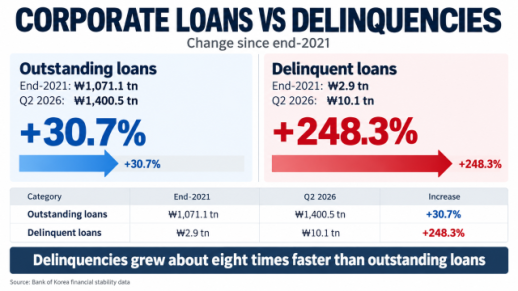 Korea Inc.'s delinquencies simmer beneath the chip halo SEOUL, October 12 (AJP) — Strip away the chip halo and stress is deepening across corporate Korea, with overdue loans growing far faster than lending as elevated financing costs push vulnerable smaller companies closer to default. Delinquent corporate loans at domestic banks reached 10.1 trillion won ($7.6 billion) in the second quarter, more than triple the 2.9 trillion won recorded at the end of 2021, according to Bank of Korea data submitted to Democratic Party lawmaker Ahn Do-geol. Outstanding corporate loans at banks increased 30.7 percent over the same period to 1,400.5 trillion won. Overdue debt thus grew at roughly eight times the pace of lending. Across banks and nonbank financial institutions, corporate lending reached 2,000.1 trillion won in the second quarter. The corporate loan delinquency rate at nonbank institutions stood at 6.28 percent, compared with 0.68 percent at banks, highlighting sharper deterioration outside the banking sector. Smaller businesses face a particularly heavy burden. Across financial institutions, the delinquency rate on loans to small and medium-sized enterprises stood at 2.94 percent in the second quarter, more than 10 times the 0.28 percent rate for large corporations, according to separate BOK data submitted to the National Assembly. Among vulnerable self-employed borrowers — those with multiple debts and either low income or weak credit — the delinquency rate rose to 12.7 percent from 12.1 percent at the end of 2025. The weakness extends beyond borrowers already behind on payments. The BOK identified 5,632 marginal companies in 2025, equivalent to 19.1 percent of firms covered by its analysis. Among SMEs, the share rose to 20.0 percent from 15.5 percent in 2021. The central bank defines marginal companies as businesses whose operating profits have failed to cover interest expenses for three consecutive years. Stress is especially pronounced among cooperative lenders. The number of mutual-finance cooperatives and community credit cooperatives with delinquency rates of at least 10 percent climbed 66.2 percent in six months to 339 at the end of June, according to data submitted to Democratic Party lawmaker Song Ok-joo. Corporate loan delinquency rates reached 10.24 percent at credit unions and 10.17 percent at community credit cooperatives, far above their household-loan delinquency rates. For syndicated loans jointly extended by cooperatives, delinquency rates ranged from 14.64 percent at credit unions to 17.87 percent at forestry cooperatives. Worse, most new lending has gone toward operating needs rather than fixed investment. Loans to industries by deposit-taking institutions increased 30.6 trillion won in the second quarter. Working capital accounted for 23.7 trillion won, or about 77 percent, of that increase, while facility financing rose by 6.9 trillion won. Working-capital loans finance wages, raw materials and other day-to-day expenses. Their growth does not by itself establish that companies are borrowing to repay existing debt, but it shows that lending is expanding much faster for ongoing operations than for investment in facilities. Those financing needs are rising against a backdrop of elevated borrowing costs. The average rate on new bank loans to SMEs increased 16 basis points to 4.38 percent in August, returning to its June level — the highest since February 2025. The overall corporate lending rate rose to 4.30 percent, the highest since March 2025, while the rate for large companies stood at 4.21 percent. Market funding also remains expensive. The yield on three-year corporate bonds rated AA- stood at 4.627 percent on Monday, just 2.6 basis points below the July 24 level of 4.653 percent, which was the highest since November 2023. The BOK estimated in its September financial stability assessment that a 25-basis-point increase in interest rates would add about 3.6 trillion won to companies’ annual interest burden. Its analysis of previous tightening cycles found that bank corporate loan delinquency rates tended to respond most strongly about 15 months after a rate increase. The impact on SMEs and vulnerable household borrowers peaked around nine months later. The second-quarter deterioration therefore predates the BOK’s back-to-back rate increases in July and August. Those hikes could add pressure to borrowers whose repayment capacity was already weakening, with much of the effect yet to appear in delinquency figures. BOK Gov. Shin Hyun-song acknowledged that uneven burden during a parliamentary audit Monday. “When interest rates rise, vulnerable borrowers are hit particularly hard,” Shin told lawmakers, stressing the importance of targeted fiscal support alongside monetary policy. The central bank has nevertheless kept further tightening on the table as inflation remains above target and financial imbalances, including household debt and housing prices, persist. The policy dilemma lies in the widening gap beneath Korea’s headline growth. Record chip earnings can lift exports and national income while smaller businesses struggle to cover interest payments. Further tightening aimed at containing inflation could deepen that divide before the effects of the summer’s hikes have fully worked through the economy. AJP Takeaways - Corporate delinquencies are rising far faster than lending: Overdue bank loans more than tripled to 10.1 trillion won in Q2 from end-2021, while outstanding corporate loans rose 30.7 percent. - Stress is concentrated among smaller and weaker borrowers: SME delinquency rates were more than 10 times those of large corporations, while the rate for vulnerable self-employed borrowers reached 12.7 percent. - Higher rates could expose more weakness: Much of the deterioration predates the BOK’s July-August tightening, meaning the full impact of higher borrowing costs has yet to show up in delinquency data. 2026-10-12 17:29:07
-
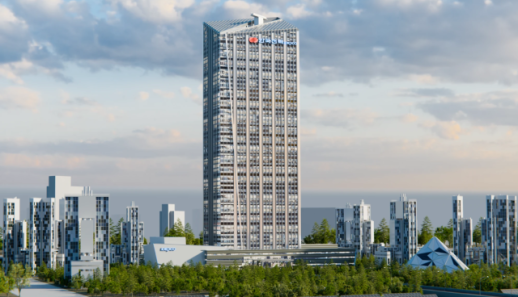 Samsung, SK hynix to cover 80% of chip power grid costs in Honam: KEPCO SEOUL, October 12 (AJP) — Samsung Electronics and SK hynix would have to shoulder about 80 percent of the 1.4 trillion won ($1.05 billion) needed to build the initial power supply network for a major semiconductor manufacturing complex in South Korea's southwestern Honam region unless government funding is provided, the head of Korea Electric Power Corporation (KEPCO) said Monday. KEPCO President and CEO Kim Dong-cheol outlined the cost-sharing arrangement during a parliamentary audit in response to questions from People Power Party lawmaker Kim Do-eup about transmission facilities planned for the project's first stage. “KEPCO's share would likely be less than 20 percent,” Kim said. “Samsung and SK hynix are supposed to cover the rest.” The cost-sharing arrangement, however, could change if the government provides funding under a law that allows central and local governments to cover 50 to 100 percent of the cost of building and operating infrastructure for semiconductor clusters, including power supply facilities. Kim said that without such support, the utility and the two chipmakers would share the costs according to their respective electricity use. Separately, KEPCO executives said the utility's financial constraints had prompted an earlier proposal for Samsung Electronics and SK hynix to pay 25 trillion won ($18.76 billion) in electricity bills upfront to help finance power grid expansion. Kim Jae-gun, Head of KEPCO's Power Grid Division said the company must reduce its bond issuance limit from five times its capital to twice that level by the end of 2027. “We proposed the advance-payment plan to address the problem on our own,” he said. The utility's chief also acknowledged that keeping bond issuance within the lower limit was one of KEPCO's biggest financial challenges. He said the plan had been drawn up by KEPCO following a policy proposal and a related bill introduced by Democratic Party lawmaker Park Jeong, before being presented to Samsung Electronics and SK hynix, which rejected it in September. 2026-10-12 17:28:31
-
LG Energy Solution and Samsung SDI Close Lower Despite Strong ESS Performance Expectations On October 12, LG Energy Solution and Samsung SDI, leading companies in the energy storage system (ESS) sector, closed down 0.75% and 1.41%, respectively, compared to the previous trading day. According to the Korea Exchange, LG Energy Solution finished at 398,000 won, while Samsung SDI closed at 561,000 won. As reported by Yonhap News, shares related to secondary batteries initially rose in early trading on expectations of strong performance due to the benefits from ESS, but ultimately fell due to a sharp decline in the KOSPI. Both stocks saw an increase of around 5% in the morning, driven by expectations of rising ESS demand from the expansion of AI data centers. However, they lost all their gains and ended lower as the KOSPI dropped. The decline in the KOSPI was primarily attributed to significant net selling by foreign investors. IBK Investment & Securities analyzed that LG Energy Solution's preliminary operating profit for the third quarter of this year exceeded market expectations by more than double, largely due to one-time compensation from North American automotive clients. Samsung SDI, which had been in the red until the first quarter of this year, recorded an operating profit of 203.8 billion won in the second quarter, breaking a streak of seven consecutive quarters of losses. However, it appears that one-time factors also influenced Samsung SDI's third-quarter operating profit, including a production tax credit (AMPC) subsidy of 121 billion won and a settlement profit of approximately 150 billion won from acquiring a stake in Synergy Shells, a joint venture with General Motors in the U.S. Meanwhile, the KOSPI experienced a sharp decline as major semiconductor stocks, including Samsung Electronics and SK Hynix, fell by more than 4%.* This article has been translated by AI. 2026-10-12 17:28:20