

Journalist

Kim Dong-young and Candice Kim
-
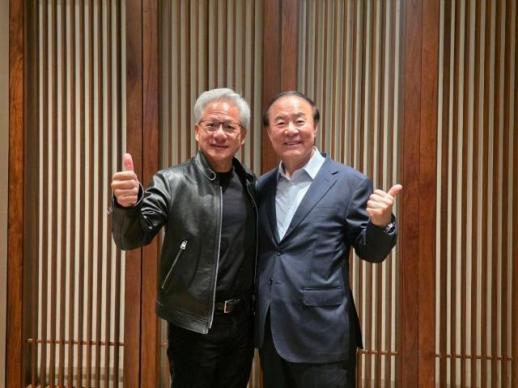 Nvidia's Jensen Huang wraps up visit to Korea with chip deal with Samsung Elec SEOUL, June 09 (AJP) - Nvidia CEO Jensen Huang concluded his official four-day visit to South Korea Monday evening, securing a comprehensive, long-term memory and foundry supply roadmap with Samsung Electronics to power the next generation of artificial intelligence hardware. Huang wrapped up his multi-industry tour with a private meeting with Jun Young-hyun, Vice Chairman and Head of Samsung Electronics’ Device Solutions (DS) Division, at the Shilla Hotel in Seoul. The high-stakes meeting finalized a localized supply chain for high-bandwidth memory (HBM), which acts as the critical bottleneck for scaling advanced AI accelerators. Following the meeting, Vice Chairman Jun expressed strong confidence in the partnership’s trajectory. "I had a lot of good conversations with Jensen, and honestly, although we have been cooperating for a long time, I think we had the best conversation so far today," Jun told reporters. "We comfortably had many good conversations, and we discussed how we will collaborate in the short term on HBM4 and foundry cooperation." The two leaders mapped out both immediate and future supply lines. According to Jun, Samsung is prioritizing the delivery of its 6th-generation HBM4 and Server Low-Power Memory Modules (SOCAMM) to meet current demand. "In the short term, starting this year, we must sufficiently supply HBM4 and SOCAMM," Jun said. "Then, from next year, we talked a lot about long-term cooperation, such as HBM4E, the foundry business, and HBM5." Samsung has already shipped samples of its 7th-generation HBM4E to Nvidia. Beyond memory, Jun confirmed that Samsung and Nvidia are actively expanding their foundry (contract manufacturing) partnerships. "Currently, we are collaborating on autonomous driving chips required for 4-nanometer and 8-nanometer processes, and Nvidia’s accelerator chip called the Groq chip," Jun said, adding that "discussions on next-generation cooperation are also underway." The Samsung meeting served as the capstone to a broader Nvidia initiative to leverage South Korea’s "physical AI" ecosystem. During his doorstep press conference earlier that evening, Huang emphasized the necessity of massive infrastructure and robust supply chains to transition from software-based AI to physical robotics. "The next wave of AI is physical AI where AI can interact with the physical world, Robotics," Huang said, praising the country's unique manufacturing and electronics capabilities. "Korea is in a very unique position in the world of physical AI," Huang said, praising the country's unique manufacturing and electronics capabilities. "Manufacturing, heavy industries, electronics, and software in AI must unite, must fuse together into Robotics." Huang also addressed market concerns about the AI boom, firmly stating that the demand for AI infrastructure is only beginning. "Intelligence is a commodity, which mainly means intelligence plus character is not a commodity," Huang told reporters, crediting the Korean national character—the "ability to suffer" and "resilience"—as a primary driver for his investment in the country. "If you combine that with AI, incredible, incredible things. It is the reason why I'm here today." When asked about Huang’s earlier comment designating SK Hynix as Nvidia’s "largest memory partner," Jun offered a measured, results-oriented response regarding Samsung's competitive position. "We will work hard on our tasks," Jun said. "We will show it through results later." Following the private meeting and press conference, Jun joined other top Samsung semiconductor executives, including Foundry Business President Han Jin-man, at Nvidia's 'Korea AI Ecosystem' reception. The reception, attended by leaders from SK Hynix and LG Electronics, marked the official end of Huang’s visit before his departure. 2026-06-09 14:50:23
 -
 Alteogen Secures European Patent for ALT-B4, Strengthening SC Platform Competitiveness Alteogen announced on June 9 that its recombinant human hyaluronidase, ALT-B4, has received a patent grant decision from the European Patent Office (EPO). The company plans to proceed with the necessary steps to complete the patent registration across various European countries. With this patent registration, Alteogen secures exclusive rights to ALT-B4 in Europe. The company has been actively pursuing patent applications and registrations for ALT-B4 in major markets, including the United States and Europe. ALT-B4 is a key substance in the subcutaneous (SC) injection formulation change platform. Alteogen developed this substance using domain swapping technology. Currently, global pharmaceutical companies such as MSD, AstraZeneca, GSK, and Biogen are developing SC formulation therapeutics utilizing ALT-B4 under licensing agreements. The first commercial product based on ALT-B4 is MSD's 'Keytruda SC,' which is sold in the United States under the name 'Keytruda Qle.' This product is considered the first successful case of commercializing the ALT-B4 platform. ALT-B4 has also been granted a substance patent in the United States, ensuring exclusive rights until 2043. The company plans to strengthen its intellectual property protection through a portfolio that includes patents for formulations and dosages. Chun Tae-yeon, CEO of Alteogen, stated, "Results are becoming visible in major therapeutic markets such as the United States and Europe," and added, "We will strengthen our global partnerships and commercialization foundations." In January, Alteogen signed a $285 million contract with GSK subsidiary Tesaro for the development of the SC formulation of the immuno-oncology drug 'Zempare.' In March, the company entered into a $579 million agreement with Biogen to develop two therapeutic products in SC formulation.* This article has been translated by AI. 2026-06-09 14:45:00
 -
 Future Industry Shares Surge 17% Following Alois Acquisition Announcement Future Industry is experiencing a 17% increase in shares following the announcement of its acquisition of management rights in Alois, a KOSDAQ-listed company. According to the Korea Exchange, as of 2:17 PM, Future Industry's shares rose by 5,350 won (17.09%) to 36,650 won compared to the previous trading day. The news that Future Industry will acquire all shares held by Alois's largest and key shareholders has reportedly boosted investor sentiment. Future Industry announced that it signed a stock transfer agreement to acquire 12,751,342 shares from former CEO Kwon Chung-sik, current CEO Shin Jeong-gwan, and Director Lee Si-young. The total acquisition amount is approximately 20.4 billion won, which represents 15.77% of Future Industry's equity. The purchase price per share is set at 1,600 won, and upon completion of the transaction, Future Industry will hold about 36.8% of Alois's shares, becoming its largest shareholder. The transfer is scheduled for July 9. Future Industry plans to leverage this acquisition for growth and to diversify its business portfolio, aiming to secure future growth drivers through collaboration in technology development between the two companies. In particular, Future Industry intends to integrate its semiconductor inspection technology and AI-based systems with Alois's next-generation media streaming devices and edge computing sectors to target the high-performance embedded market. The company expects that this acquisition will not only enhance business diversification and financial stability but also resolve the management disputes that have hindered Alois's growth between its founder and current management.* This article has been translated by AI. 2026-06-09 14:42:00
 -
 Xi Jinping Visits North Korea, Honors China-North Korea Alliance Chinese President Xi Jinping continued his visit to North Korea on June 9, marking the second day of his trip alongside North Korean leader Kim Jong Un, emphasizing the traditional friendship between the two nations. According to China's state-run Xinhua News Agency, Xi and Kim visited the Friendship Tower in Pyongyang and the Central Cadre School of the Workers' Party of Korea. This visit was interpreted as a demonstration of the China-North Korea alliance, forged during the Korean War, and a commitment to pass on the ties between the two communist parties to future generations. Established in 1959, the Friendship Tower commemorates the Chinese People's Volunteer Army's participation in the Korean War and is a customary stop for high-ranking Chinese officials visiting North Korea. It serves as a prominent symbol of the traditional friendship between the two countries. The two leaders visited the site accompanied by their spouses. Xi presented a wreath inscribed with the Chinese phrase meaning 'The martyrs of the Chinese People's Volunteer Army will be immortal' and observed a moment of silence. Xinhua reported that Xi and Kim shared a mutual understanding that the history of their countries fighting together in the 1950s is an eternal shared memory. They agreed to jointly manage the memorial facilities for the Chinese People's Volunteer Army and to enhance revolutionary tradition education and moral education for the youth, aiming to inherit and develop the spirit of the anti-American resistance, known in China as the Korean War. Following their visit to the Friendship Tower, the two leaders toured the Central Cadre School, where they observed classroom activities and participated in a commemorative tree planting on campus. They planted a fir tree together, symbolizing the enduring friendship between China and North Korea. A plaque inscribed with the phrase 'The friendship between China and North Korea will remain evergreen' was placed in front of the tree. Xi is scheduled to return to China after having lunch with Kim.* This article has been translated by AI. 2026-06-09 14:42:00
 -
 Mandatory Drug Testing for Civil Service Exam Passers Before Appointment Individuals who pass the civil service exam will now be required to undergo mandatory drug testing before their appointment. The Ministry of Personnel Management announced that a revised regulation on civil service hiring physical examinations was approved at a cabinet meeting on June 9. This amendment aims to prevent the influx of drugs into the public sector. Earlier this year, a 30-year-old civil servant working in a city hall in southern Gyeonggi Province was found to have been involved in drug trafficking and use. As a result, the ministry will expand drug testing, which previously applied only to specific public service roles such as police and firefighters, to include general and foreign service positions as well. Under the new regulation, successful candidates of the civil service exam will be tested for six types of drugs, including methamphetamine, marijuana, opium, and cocaine, similar to the tests conducted for police and firefighter positions. Candidates must receive a favorable evaluation from the physical examination to be appointed as civil servants. The revised regulation will take effect one week after its announcement at the cabinet meeting and will apply to candidates who pass the exam thereafter. Choi Dong-seok, head of the Ministry of Personnel Management, stated, "As drugs have increasingly infiltrated the daily lives of citizens, it has become a significant social issue. We will continuously improve systems to prevent the spread of drugs in the public sector and build a trustworthy civil service for the public."* This article has been translated by AI. 2026-06-09 14:42:00
 -
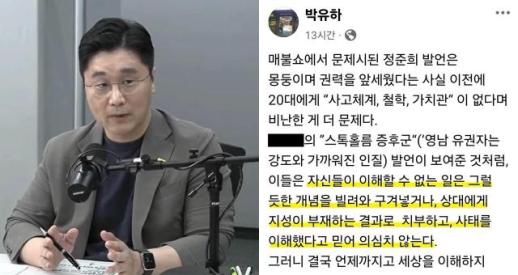 Park Yoo-ha Critiques Jeong Jun-hee's Comments on Youth Mindset As controversy continues over comments made by the cast of the progressive YouTube channel "Maebul Show," Sejong University Professor Park Yoo-ha has sharply criticized Professor Jeong Jun-hee's remarks. On June 9, Park expressed on her social media that the issue lies not just in the terms "club" or "power" but in the perception that young people lack a framework of thought, philosophy, and values. She strongly condemned the elitist mindset prevalent in some progressive circles. Park stated, "It is problematic to discuss philosophy with those in their 20s who are still learning, but it is even more concerning to hold a sense of superiority based on that. This is rooted in shallow knowledge." She also referenced former Democratic Party lawmaker Choi Kang-wook's comments on "Stockholm syndrome." Park argued, "They believe they understand situations by borrowing plausible concepts to explain things they cannot comprehend, attributing the lack of understanding to the other party's ignorance, thus remaining trapped within their own confines." She continued, "The problem lies in their unfounded sense of superiority, which has long gone unchallenged and has ultimately transformed into a sense of justice that persists to this day." Park noted that the belief in needing to lead the public has allowed various conspiracy theories to flourish and has enabled them to avoid proper apologies amid repeated controversies. She criticized that their notion of 'the people' stems from an elitist perspective that does not view the public as equals. Particularly, Park highlighted the term 'ebebe' mentioned during the broadcast, stating, "Hearing the voices of young men as mere babbling before language is a dangerous sign. Violence always emerges when respect for others as fellow humans is lost." In response to her post, one netizen remarked, "Basically, left-leaning individuals perceive the public as an ignorant group they must lead." The user added, "They deeply believe their thoughts are unconditionally correct and that they must guide the public's misguided beliefs toward their own correct convictions, leaving no room for self-reflection. Problems arise when they try to fit the changing times into their outdated ideologies and behaviors from decades ago." Other netizens also reacted, saying, "This is a more fundamental critique than the club comments," "That sense of superiority has always been a point of contention," and "This is a matter of respect for citizens, not just political views."* This article has been translated by AI. 2026-06-09 14:39:00
 -
 Coupang slapped with 500 million won fine over misleading ads SEOUL, June 9 (AJP) - Coupang was slapped with a fine of 500 million won (US$327,000) for misleading ads about discounts offered to paid membership subscribers for one-time offers, the Korea Fair Trade Commission (KFTC) said on Tuesday. According to the watchdog, it fined the e-commerce platform the highest applicable fine and ordered corrective measures for ads run from August 2020 to May 2022 that promoted its "Wow" member prices as cheaper than regular prices while concealing that the discounts were based on a one-time coupon issued when customers signed up for the paid membership. The KFTC said Coupang began using such deceptive marketing practices in 2020, when paid membership programs among online shopping platforms were taking off. The agency said consumers who sign up for a platform's paid membership are more likely to make repeat purchases, making membership benefits a key factor in attracting and retaining customers. Coupang initially advertised its member prices as if the discounts were consistently available to paid subscribers, while one-time coupons were offered separately. Later, it began applying a one-time sign-up discount to the advertised member prices, making it appear that the lower prices were a permanent membership benefit and applied more broadly than they actually were. The KFTC said this may have misled consumers into believing they could repeatedly purchase products at those prices, even though the discounts were available only once. It added that Coupang continued these misleading ads for a long period to attract more members, calling it a serious violation involving the concealment and omission of important information. KFTC senior official Lee Young-hee estimated that Coupang's membership increased by about 4.5 million during that period, although it was difficult to calculate the ads' direct impact on sales because consumers can sign up for the membership through various channels. She added, "The current legal cap on fines is low compared with the severity of some violations, which limits the effectiveness of enforcement," vowing that the agency is pursuing revisions to relevant laws including raising the fine ceiling. 2026-06-09 14:38:14
 -
 Jensen Huang and Xi Jinping Deliver Key Messages on the Korean Peninsula This week, two global figures made significant visits to the Korean Peninsula. Jensen Huang, the CEO of NVIDIA, returned to South Korea after seven months, while Chinese President Xi Jinping visited North Korea for the first time in seven years. The two leaders discussed AI collaboration and China-North Korea cooperation, respectively, just 200 kilometers apart in Seoul and Pyongyang. This striking contrast encapsulates the current situation on the Korean Peninsula. Huang's visit carries deeper significance than typical visits from foreign business leaders. As the AI revolution accelerates, NVIDIA has established itself at the center of the global AI ecosystem, dominating the GPU market. NVIDIA's GPUs are integral to generative AI, large data centers, and the robotics industry. In this context, South Korea has emerged as a key player in the AI era, boasting a diverse industrial portfolio that includes semiconductors, robotics, automotive, energy, and data. South Korean companies hold a unique competitive edge in high-bandwidth memory (HBM), essential for AI servers. It has become increasingly difficult to discuss the AI revolution without acknowledging South Korea's semiconductor industry. This is why Huang frequently visits South Korea; collaboration with the country is essential for discussing the future of AI. In contrast, Xi's visit to Pyongyang reveals another reality. North Korea continues to view its nuclear arsenal as a core means of regime maintenance, and China seeks to maintain its strategic relationship with North Korea. Amid increasing military cooperation between Russia and North Korea, China's reaffirmation of its ties with North Korea complicates the security environment in Northeast Asia. The topics discussed in Seoul and Pyongyang starkly differ. In Seoul, the focus was on AI, semiconductors, and future industries, while in Pyongyang, discussions centered on security and military cooperation. The two locations within the Korean Peninsula appear to be living in entirely different eras. However, a closer examination reveals that AI and nuclear issues are not entirely separate. AI is increasingly utilized in military contexts, and the competition between the U.S. and China regarding AI is viewed through the lens of national security. Nuclear issues are also not merely military concerns. The North Korean nuclear situation impacts South Korea's investment environment, diplomacy, and overall economic strategy. Regardless of technological prowess, increased security anxiety can undermine national competitiveness. We have entered an era where economics and security can no longer be separated. Realistically, South Korea faces competition on two fronts: one is the global technological hegemony competition surrounding AI and advanced technologies, and the other is the geopolitical competition intertwined with the North Korean nuclear issue and U.S.-China strategic rivalry. While threats from reality exist, the pace of technological revolution is too rapid to focus solely on security. Ultimately, South Korea's task is clear. It must secure future growth drivers through AI and semiconductors while maintaining unwavering security capabilities to ensure peace on the Korean Peninsula. Relying solely on one aspect will not guarantee the nation's future. Jensen Huang and Xi Jinping are on different paths, yet they pose the same question to South Korea: Are you prepared to lead the future from the center of the AI revolution? And do you possess the capability to manage the North Korean nuclear issue and geopolitical instability in the process? The simultaneous presence of these two figures on the Korean Peninsula this week symbolically highlights the dual challenges South Korea must address in the coming decades. On one side lies AI and semiconductors; on the other, nuclear weapons and missiles. Ultimately, South Korea's future hinges on how wisely it manages these two challenges.* This article has been translated by AI. 2026-06-09 14:36:00
 -
 Special Prosecutor's Office to Deploy Two Prosecutors for Ongoing Investigation The second comprehensive special prosecutor team plans to deploy two prosecutors to assist with the ongoing investigation.On June 9, the special prosecutor's office announced it has received confirmation from the Ministry of Justice regarding the dispatch of Lee Sang-don, a prosecutor from the Daegu District Prosecutors' Office, and Park Dal-jae, a prosecutor from the Ansan branch of the Suwon District Prosecutors' Office. The timing of their deployment has not yet been determined.Lee has previously participated in the investigation into the accountability for the Itaewon tragedy that occurred on October 29, 2023, while working in the Criminal Division 3 of the Seoul Western District Prosecutors' Office.Since its establishment on February 25, the special prosecutor's office has faced challenges in maintaining its full complement of 15 prosecutors, which has affected its investigation and prosecution efforts.On May 26, Kang Nam-soo, head of the Major Economic Crimes Investigation Unit at the Seoul Western District Prosecutors' Office, was appointed as an inspector at the Ministry of Justice, reducing the number of dispatched prosecutors to 12.In response, the special prosecutor's office requested the Ministry of Justice to send three additional prosecutors. Unable to find volunteers internally, the Ministry of Justice publicly recruited prosecutors for dispatch through its internal network, 'Epros,' from June 2 to June 8.* This article has been translated by AI. 2026-06-09 14:36:00
 -
 Fair Negotiation Environment for Franchise Owners and Headquarters, Says Fair Trade Commission Chair Joo Byeong-ki, chairman of the Fair Trade Commission, stated on June 9 that the commission will do its utmost to ensure a healthy market order in the franchise sector, which serves as a crucial pillar for domestic consumption and income distribution. During a meeting with representatives from the Korea Franchise Industry Association, the Korea Convenience Store Industry Association, and the National Franchisee Council, Joo emphasized that "fair distribution and a virtuous cycle of innovation are essential conditions for sustained economic growth in advanced countries." The Fair Trade Commission gathered industry opinions to prepare detailed operational guidelines for the franchisee association registration system, which is set to be implemented by the end of the year. This registration system is designed to enhance the negotiating power of franchisees, allowing associations that meet certain criteria to register with the commission and officially request negotiations on transaction terms with franchisors. Joo stressed the importance of ensuring that franchisees can negotiate fairly with franchisors to prevent unfair practices in the franchise business and to ensure that transaction terms are determined reasonably. He added, "The newly revised Franchise Business Act must effectively empower franchisees to request negotiations, and we will operate the registration system to guarantee the public representation and rational decision-making of franchisee associations." While there are expectations for enhanced negotiating power among franchisees, concerns have also been raised about potential side effects during the implementation of the system. The Korea Franchise Industry Association and the Korea Convenience Store Industry Association mentioned the possibility of weakened representation due to the establishment of multiple franchisee associations, while the National Franchisee Council pointed out that overly stringent registration requirements could hinder the guarantee of negotiation rights. Joo assured that the system will be designed and implemented to provide franchisees with substantial negotiation opportunities without excessively increasing the burden on franchisors. The Fair Trade Commission plans to review the opinions raised by the industry and finalize the amendments to the enforcement decree within the year.* This article has been translated by AI. 2026-06-09 14:33:00