

Journalist

Kim Dong-young and Candice Kim
-
 CJ CheilJedang Expands Special Food Support for Rare Disease Patients to Adults CJ CheilJedang is expanding its support for special foods for patients with congenital metabolic disorders, such as phenylketonuria (PKU), to include adults. On June 9, CJ CheilJedang announced that it has signed a memorandum of understanding (MOU) with the Korea Disease Control and Prevention Agency and the Korea Rare & Intractable Diseases Association to establish a support system for purchasing special foods for rare disease patients. The agreement aims to create a public-private partnership that ensures patients who require special diets throughout their lives can reliably access HaeBban low-protein rice even after reaching adulthood. PKU is a rare disorder caused by a congenital deficiency of an enzyme that breaks down phenylalanine, an amino acid found in protein. It occurs in approximately one in every 60,000 newborns, and without proper dietary management, it can lead to neurological and mental health issues. Patients must limit their intake of phenylalanine for life, making it difficult to consume regular rice. Previously, patients under 19 years old could receive government support for special foods, but adults were excluded from this assistance, forcing them to purchase remaining supplies individually or rely on expensive foreign products. Under the new agreement, patients aged 19 and older will be able to apply for special foods quarterly through an online portal called the 'Rare Disease Helpline.' This support system is set to begin operations on July 1. HaeBban low-protein rice has a protein content reduced to one-tenth that of regular HaeBban rice. The production process, which removes the protein from the rice, takes over 24 hours, making the production time more than ten times longer and the manufacturing cost more than double that of standard products. CJ CheilJedang began developing HaeBban low-protein rice in March 2009, following a suggestion from an employee with a child suffering from a congenital metabolic disorder. After investing 800 million won and conducting seven months of research, the company established its own technology and manufacturing facilities, launching the product in October of the same year. Despite its low profitability, production has continued as part of the company's social contribution efforts for rare disease patients. To date, the cumulative production has reached approximately 2.9 million units. Kim Chan-ho, head of CJ CheilJedang's Strategic Support Division, stated, "This agreement lays the foundation for a stable supply of HaeBban low-protein rice to patients over 19 years old. We will continue to do our best to ensure smooth production and supply."* This article has been translated by AI. 2026-06-09 16:06:00
 -
 Government to Enhance Marriage Incentives with Housing Benefits for Newlyweds Newlyweds will see relaxed income criteria for public rental housing, along with increased opportunities for special housing supply applications. The government aims to make marriage economically beneficial by significantly revising housing and asset formation support systems.On June 9, the Ministry of Economy and Finance unveiled its "marriage-friendly policy reform plan" during the third Youth Policy Ministerial Meeting. Key initiatives include housing support, tax benefits, and asset formation assistance.The income criteria for public rental housing will be eased for married young couples. Currently, the income requirements for newlyweds are stricter than those for single-person households, which could lead to denial of housing applications after marriage registration, even if the couple qualified beforehand. To expand access, the income threshold for newlyweds will be raised to double that of single young adults.Additionally, unmarried young individuals living in public rental housing will be allowed to renew their contracts once, even if their income and asset levels exceed the limits after marriage. To alleviate loan burdens, newlyweds extending their jeonse loans will receive a 50% reduction in the additional interest rate, applying a rate of 0.15% regardless of combined income.This month, a new special supply program will be introduced for families with newborns (children under two years old), regardless of the seven-year marriage requirement, allowing for a 10% allocation of private housing.Tax benefits will also be expanded. Previously, homeowners without property could only receive a 40% income deduction on repayments for jeonse loans. However, since this support was limited to the head of the household, couples who registered their marriage would lose benefits previously available to each partner. The government is considering extending the income deduction to spouses in cases of weekend couples or relocations of public institutions.Married couples owning two compact cars will be eligible for a fuel tax refund for one vehicle per household. A comprehensive evaluation of the compact car fuel tax refund system will determine whether to extend its expiration and make necessary adjustments.To assist young people in asset formation, the government will introduce a "marriage incentive." The income threshold for joining the Youth Future Savings Plan will be significantly increased to double that of single-person households (up to 117.9 million won annually). Additionally, support for settling in agriculture and fisheries will be raised, and couples operating independent households will see expanded loan support for agricultural startups after marriage registration.A ministry official stated, "We will promptly implement feasible measures in next year's budget, while those requiring coordination with other policies, such as real estate market conditions and household debt management, will be thoroughly reviewed as medium- to long-term projects."* This article has been translated by AI. 2026-06-09 16:03:00
 -
 End of Jeonse? Restrictions on Non-Resident Homeowners' Jeonse Loans Loom As the proportion of monthly rent in Seoul's apartment rental market surpasses 50% and the number of jeonse listings rapidly declines, there are concerns that additional restrictions on jeonse loans for non-resident homeowners could accelerate this trend. The government aims to curb leveraged investments such as gap investments, but there are fears that further regulations could heighten instability in the rental market, which is already experiencing a decrease in supply.According to industry sources, President Lee Jae-myung stated at a press conference the previous day that "jeonse is a form of private finance unique to South Korea" and that "the extensive provision of jeonse loans has been a primary cause of rising housing prices." He emphasized the need to prevent speculation using other people's money, indicating a strong commitment to blocking leveraged investments. His direct attribution of the jeonse loan issue to rising housing prices suggests that discussions on tightening regulations may gain momentum.Financial authorities are also reviewing related regulations. The Financial Services Commission announced in April its plans to introduce loan restrictions for non-resident homeowners for speculative purposes as part of its "2026 Household Loan Management Plan." On May 21, Financial Services Commission Chairman Lee Ok-won mentioned the need to continue examining regulations on loans for non-resident homeowners, emphasizing the separation of real estate and finance. The authorities have also begun investigating jeonse loans secured by homeowners in regulated areas of the metropolitan area since late April.Market analysts predict that the government’s tax reform plans could lead to stringent measures, such as applying the total debt service ratio (DSR) to jeonse loans. Currently, under the October 15 measures from last year, only the interest on loans for homeowners in regulated areas is subject to DSR calculations.If jeonse loan regulations are tightened, it is expected to effectively block the inflow of financial resources into speculative demands like gap investments. According to a Financial Services Commission survey, the estimated amount of jeonse loans obtained by homeowners in regulated areas of the metropolitan area is approximately 9.2 trillion won, with around 59,000 cases recorded. The government believes that without blocking the structure of home purchases utilizing jeonse deposits, it will be challenging to enhance the effectiveness of loan regulations.Lee Eun-hyung, a researcher at the Korea Construction Policy Institute, noted that "jeonse loans were originally introduced to support vulnerable groups during periods of low interest rates, but the scope and application have expanded excessively over time." He added that it is essential to consider how to address both supply expansion and demand suppression simultaneously.The issue is that the jeonse market is already rapidly contracting. According to statistics from the Ministry of Land, Infrastructure and Transport, the proportion of monthly rent in new rental contracts for Seoul apartments reached 54.2% from January to May this year, up from 45.9% during the same period last year. This marks an increase of over 8 percentage points in the share of monthly rent in the new rental market for Seoul apartments within a year.The decline in jeonse listings continues. As of today, real estate big data firm Asil reports that the number of jeonse listings for Seoul apartments stands at 18,574, down more than 26% from 25,240 a year ago. There are expectations that additional restrictions on jeonse loans for non-resident homeowners could further accelerate the shift to monthly rent.The reduction in jeonse is also a result of changing choices among both landlords and tenants. With rising interest rates and concerns over deposit accidents, tenants find large jeonse deposits burdensome, while landlords prefer monthly rent or half-jeonse arrangements due to loan regulations and tax burdens.The government and financial authorities already reduced the jeonse loan limit for homeowners to 200 million won through the September 7 measures last year. If additional regulations are implemented, while the demand for investment in homes with jeonse may decrease, there are concerns that this could simultaneously lead to a reduction in jeonse supply and an increase in monthly rent burdens.Choi Kyung-ho, head of the Housing Neutrality Research Institute, stated, "Jeonse is a system based on the premise of leveraging investment returns, that is, price increases. If prices stabilize, it will naturally shrink. However, if it shrinks not because of stabilization but due to the aggressive push for a one-household, one-home policy, the burden on tenants will increase significantly." He further emphasized that to artificially reduce jeonse, a proactive approach is needed to transition to affordable monthly rent through supplier financing, alleviating housing cost burdens. 2026-06-09 16:03:00
 -
 Government to Revamp Real Estate Tax System Focusing on Actual Use The South Korean government has initiated a major overhaul of its real estate tax system, emphasizing the principle of actual residence and use. The aim is to reduce tax benefits that were previously granted solely based on long-term asset ownership, instead providing selective advantages for properties that are genuinely occupied or utilized. According to the Ministry of Finance, the government is currently reviewing a tax reform bill set to be announced next month. This reform is interpreted as an effort to lower expected profits from real estate holdings and create a market environment focused on actual demand. One of the most significant changes in this tax reform is the long-term capital gains tax exemption. Under the current system, property owners who hold real estate for a certain period benefit from tax deductions on capital gains. The government has identified that this structure has led to unintended consequences, such as encouraging long-term asset retention without actual residency, often through gap investments. Market analysts predict that if the long-term exemption shifts to focus on actual residency, the tax burden will increase for multiple property owners and those holding assets for investment purposes. The tax system for agricultural land is also under review. Currently, there are tax reductions for capital gains on farmland that meets specific criteria. However, the reform proposal aims to scrutinize the actual farming activities more closely. There are expectations that land taxation will be strengthened, particularly for non-business land and investment-type assets, including rural forest land. Revisions to property taxes are another major concern. Discussions are underway regarding increasing the tax burden through adjustments to the fair market value ratio. In the past, property price levels were the focal point of tax discussions, but future emphasis is expected to shift toward limiting unearned income and expected returns from real estate. Ultimately, tax benefits are likely to be differentiated based on actual residency and use rather than the duration of ownership. While the strategy of holding onto a single valuable property for an extended period was previously effective, actual residency is expected to become a significant factor moving forward. The proposed changes to the long-term exemption and the tightening of taxes on non-business land are likely to impose additional burdens on asset holders. The increased tax burden may discourage holding properties that are not intended for actual residence or use. Consequently, there is speculation that non-residential properties and idle land may enter the market around the time of the tax reform announcement. Some experts warn that the increased tax burden resulting from the reform could lead to adverse effects, such as rent hikes and tax resistance, indicating a need for protective measures. Lee Eun-hyung, a researcher at the Korea Construction Policy Institute, stated, "Considering the significant impact of the previous presidential campaign's focus on construction and real estate issues, it is concerning that current measures emphasize demand suppression rather than housing supply. We need to think about how to address both supply expansion and demand suppression together." 2026-06-09 16:00:00
 -
 Trump Prevents Further Escalation Between Iran and Israel, But Peace Talks Remain Uncertain President Donald Trump has pressured Israeli Prime Minister Benjamin Netanyahu to halt further escalation between Iran and Israel. However, the recent developments have exposed fractures in U.S.-Israeli relations over Lebanon, and the uncertainty surrounding peace negotiations remains significant amid U.S. maritime blockades and Iranian pressure on shipping routes. In an interview with Axios on June 8, Trump revealed he told Netanyahu, "'Bibi, you should be careful. Otherwise, you will be left alone very soon.'" 'Bibi' is Netanyahu's nickname. Trump noted that he received calls from five Gulf nations urging Netanyahu to cease airstrikes, stating, "These countries were very worried. They really liked the agreement we were negotiating." Trump also claimed that Iran contacted the U.S. to convey a message: "(We) will not attack anymore and please tell Israel not to attack (Iran) again." This indicates that Trump intervened directly as Netanyahu's ongoing conflict with Iran jeopardized U.S.-led peace talks. According to Axios, the recent military confrontation between Iran and Israel began when Israel conducted airstrikes targeting the Iran-aligned militant group Hezbollah in Beirut on June 7. In retaliation, Iran launched missiles at Israel, and hostilities continued until the morning of June 8. As the situation threatened to escalate into full-scale war, Trump called Netanyahu to pressure him to halt the Iranian attacks. CNN reported that the two leaders spoke multiple times within a few hours. Consequently, Netanyahu announced a halt to further airstrikes. In a video message, he stated, "Airstrikes on this front are currently on hold because the terrorist regime in Tehran has been hit and has stopped its attacks against us." Axios reported that Israel had initially planned a large-scale airstrike targeting dozens of sensitive Iranian sites, which would have marked the largest attack on Iran since April. However, Netanyahu warned, "If that terrorist regime makes the mistake of attacking us again, we will respond with overwhelming force," leaving open the possibility of retaliation for any future Iranian attacks. Iran's military also announced it would cease operations against Israel for the time being. The Central Military Command of the Islamic Revolutionary Guard Corps stated, "We have inflicted painful responses on the Zionist regime (Israel) and declare the cessation of operations by the Iranian military." However, it emphasized that if enemy aggression and malice continue, it would respond with much stronger and overwhelming measures. Lebanon Disputes and Hormuz Tensions Complicate Negotiations Nevertheless, the ceasefire between Israel and Iran does not signify an end to hostilities between the U.S. and Iran. Notably, differences in positions regarding Lebanon have emerged as a variable in the peace negotiations. The Wall Street Journal highlighted that these discrepancies are complicating the talks. Esfandiyar Batmanghelidj, CEO of the Bosphorus and Bazaar Foundation, analyzed that Iran is testing the reliability of U.S. security commitments through the Lebanon issue. He stated, "Iran wants to see if Trump can restrain Israel in its own backyard. If Trump can do that, it might protect any agreement with Iran from further Israeli interference." While direct confrontations have calmed for now, tensions surrounding the Strait of Hormuz continue. U.S. Central Command (CENTCOM) announced that it neutralized the Palau-flagged M/T Marivex, which was heading toward Iran through international waters in the Gulf of Oman. Iran is also expanding its pressure on maritime routes, mentioning the potential for control over the Red Sea through Yemen's Houthi rebels. According to Iran's semi-official Mehr News Agency, Ismail Qaani, commander of the Quds Force of the Islamic Revolutionary Guard Corps, stated on social media, "From the Strait of Hormuz to the Bab-el-Mandeb Strait, a new security belt of resistance will be established from the Persian Gulf to the Red Sea." Within Iran, hardline messages continue. Mohammad Bagher Ghalibaf, Speaker of the Iranian Parliament leading the peace negotiations with the U.S., stated, "The U.S. is not seeking a ceasefire or dialogue," emphasizing the need for a firm response to protect the rights of the Iranian people. He added, "We should not rely on promises or slogans but pursue victories based on Iran's authority and rationality." Amid these developments, Trump expressed optimism regarding the peace negotiations. According to CNN, on June 9, after attending an NBA Finals game in New York, Trump told reporters that an agreement to end the war with Iran could be reached within 2 to 3 days. He stated, "We are in the final stages of what will be a very, very good agreement," asserting that the deal would not allow Iran to possess nuclear weapons in any form. He added, "The strait will open immediately. It will open as soon as we sign, and that could happen within 2 to 3 days." However, CNN noted that Trump has previously suggested imminent agreements that later led to renewed conflicts.* This article has been translated by AI. 2026-06-09 15:57:00
 -
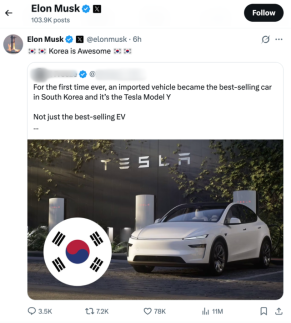 Musk Celebrates Tesla Model Y's Top Sales in South Korea Elon Musk, CEO of Tesla, reacted to the news that the electric SUV Model Y topped sales in South Korea. On June 8, Musk shared a post on his social media platform X, celebrating that the Model Y ranked first in sales in the South Korean automotive market last month. The post included a South Korean flag emoji and the message, "South Korea is amazing." The post highlighted a historic moment in the South Korean market, which is home to Hyundai and Kia. It noted that one-third of all imported cars sold in South Korea this year were Teslas, stating, "No other imported car model has achieved such a record." According to the Korea Automobile Importers and Distributors Association (KAIDA), 8,762 Model Ys were sold in South Korea in May, surpassing the sales of the top domestic model, the Kia Sorento, by about 900 units. This marks the first time an imported car model has topped the monthly sales rankings in South Korea, as well as the first instance of an electric vehicle achieving this milestone. Thanks to the strong sales of the Model Y, Tesla also became the top-selling imported car brand in South Korea last month, surpassing established brands like BMW and Mercedes-Benz. The increase in Model Y sales can be attributed to price reductions and the impact of subsidies. Tesla lowered the selling price of the Model Y by importing a version from China and added its own incentives to reduce the final purchase price. 2026-06-09 15:57:00
 -
 Trump: Iran Peace Agreement Possible Within Days President Donald Trump stated that a peace agreement with Iran could be reached within the next two to three days. On June 9, CNN reported that Trump made the comments to reporters while returning to the White House after attending Game 3 of the NBA Finals in New York the previous night. He expressed optimism that a deal to end the conflict with Iran could be finalized soon. "We are in the final stages of what will be a very, very good agreement," Trump said. He emphasized that the agreement would not allow Iran to possess nuclear weapons in any form. He added, "The Strait of Hormuz will open immediately. It will happen as soon as we sign, and this could be within two to three days." He also noted that he believes there are no remaining issues and that all parties are "very close" to an agreement. Trump also mentioned that Iran and Israel have agreed to cease attacks on each other following a recent escalation in tensions. "They were exchanging attacks, and now both sides have agreed to stop through me," he said. However, CNN pointed out that Trump has previously expressed optimism about reaching an agreement, only for tensions to flare up again. Earlier that day, during a phone campaign event supporting Senator Lindsey Graham of South Carolina ahead of the primaries, Trump stated, "I believe we are winning that fight," and predicted a "complete victory" would be declared within two weeks. Despite the recent agreement to cease hostilities, Iran has warned that it will resume attacks if Israeli airstrikes continue in southern Lebanon. Last weekend, Iran and Israel exchanged airstrikes, which had previously jeopardized the ongoing peace negotiations between the U.S. and Iran. Following an Israeli strike on Hezbollah positions in southern Beirut on June 7, Iran retaliated by launching missiles at Israel. This marked the first attack on Israeli territory by Iran since a ceasefire took effect on April 8, two months prior. Israel also reported that it targeted military sites in central and western Iran within hours. In response, Trump quickly intervened, leading both Iran and Israel to announce their respective agreements to halt attacks. 2026-06-09 15:54:00
 -
 KOSPI Rebounds Over 8% to Near 8100 After Previous Day's Plunge The KOSPI index surged more than 8% on June 9, recovering from the previous day's sharp decline and approaching the 8100 mark. The rebound was fueled by a significant rise in U.S. semiconductor stocks and a recovery in investor sentiment following a reduction in geopolitical risks in the Middle East, leading to a wave of bargain buying by institutional investors. According to the Korea Exchange, the KOSPI closed at 8096.93, up 612.52 points (8.18%) from the previous trading day. The index experienced a rapid increase early in the session, triggering a temporary trading halt due to program buying. Although it gave back some gains, buying pressure returned after the lunch break, boosting momentum. In the securities market, institutions were net buyers of 24.98 trillion won, driving the index higher. In contrast, foreign and individual investors sold a net 2.02 trillion won and 615.2 billion won, respectively. The market showed strength across various sectors due to the influx of bargain buying, although some differentiation among sectors emerged during the process of digesting the recent volatility. Notably, the semiconductor sector saw significant gains. Expectations for improved earnings driven by increased investment in artificial intelligence (AI) data centers, combined with bargain buying following recent declines, were supported by the strong performance of U.S. semiconductor stocks. Samsung Electronics rose 8.97% to close at 322,000 won, while SK Hynix surged 15.91% to finish at 2,215,000 won. Other notable gainers included SK Square, which rose 13.51%, and Hanmi Semiconductor, which increased by 9.07%. Stocks related to domestic consumption also performed well. Expectations for domestic economic recovery and improved earnings forecasts due to an increase in foreign visitors contributed to gains for Hyundai Department Store (12.25%), Shinsegae (9.09%), A.P. (10.79%), and Amorepacific (6.67%). Conversely, stocks that had surged recently due to expectations of collaboration with NVIDIA faced profit-taking, resulting in declines. NAVER fell 7.89%, LG Electronics dropped 7.46%, LG CNS decreased by 7.04%, and Hyundai AutoEver declined 8.64%. The KOSDAQ index also rose, closing at 967.81, up 56.42 points (6.19%) from the previous day. In the KOSDAQ market, foreign and institutional investors were net buyers of 311.3 billion won and 201.4 billion won, while individual investors sold a net 512.1 billion won. Among the top market capitalization stocks, Alteogen (12.78%), Rino Industry (16.33%), Kolon TissueGene (15.23%), Peptron (6.29%), EcoPro BM (4.95%), EcoPro (2.09%), Rainbow Robotics (2.13%), JUSUNG Engineering (4.87%), and Samchundang Pharm (1.46%) all rose, contributing to the index's rebound. Lee Kyung-min, a researcher at Daishin Securities, noted, "The domestic market plummeted the previous day due to rising U.S. Treasury yields, a sharp drop in U.S. semiconductor stocks, and escalating military conflicts in the Middle East. However, today, bargain buying has led to a rebound in both the KOSPI and KOSDAQ." He added, "U.S. semiconductor stocks have recovered from their declines based on expectations for the AI investment cycle, and the easing of tensions between Iran and Israel has also positively influenced investor sentiment." He further stated, "A rebound is occurring primarily among large semiconductor stocks that had seen significant declines, and the recent concentration on large-cap stocks appears to be easing."* This article has been translated by AI. 2026-06-09 15:51:00
 -
 Hana Asset Management Launches Hyundai and Kia ETF Amid AI Focus "Jensen Huang, CEO of NVIDIA, has declared that the next phase of AI is 'Physical AI.' As we enter the era of Physical AI, South Korean companies with global manufacturing competitiveness, particularly Hyundai and Kia, are increasingly standing out in the market," said Kim Tae-woo, CEO of Hana Asset Management, during a press conference on June 9 in Seoul. Investor interest has recently shifted from major semiconductor stocks like Samsung Electronics and SK Hynix to the Hyundai Group. As Physical AI emerges as the next growth axis in the AI industry, the launch of exchange-traded funds (ETFs) featuring Hyundai and Kia is gaining momentum. On this day, Hana Asset Management launched the '1Q Hyundai Kia Bond Mixed 50' ETF. This product invests 25% each in Hyundai and Kia, totaling 50%, while the remaining 50% is allocated to government bonds and monetary stabilization securities with a maturity of six months or less. It tracks the 'KEDI Hyundai & Kia Bond Mixed 50 Index' and has a total expense ratio of 0.10% per year. The structure of the ETF is also notable for targeting retirement pension investors. While the investment in risk assets is limited to 70% in retirement pension accounts, this product, as a second-generation bond mixed ETF reflecting retirement pension supervision regulations, is not subject to risk asset investment limits, allowing for a maximum 100% allocation within retirement pension accounts. Additionally, when investing alongside stock ETFs like 1Q 200 Active, the stock exposure in retirement pension accounts can be increased to as much as 85%. Kim Seung-hyun, head of the ETF and Quant Solutions Division, emphasized, "At this point, the core of the AI wave is Physical AI. The Hyundai Group, with its global manufacturing competitiveness, particularly Hyundai and Kia, is at the center of this development." He further described the product as one that combines the advantages of stocks and bonds by investing in both companies and short-duration bonds. As the perception of Hyundai Group as a leading beneficiary of Physical AI spreads, competition among asset management firms to launch ETFs is intensifying. On the same day, Samsung Asset Management also launched the 'KODEX Hyundai Robotics Value Chain TOP3 Plus' ETF, which includes Hyundai, Kia, Hyundai Mobis, Hyundai AutoEver, and Hyundai Glovis.* This article has been translated by AI. 2026-06-09 15:51:00
 -
 LG's Chloe and AI Worker Showcase Advances in Physical AI Technology A white robot, about the height of a person, extended its fist and formed a heart shape with its hands. As it moved its head from side to side toward the audience, attendees captured the moment on their phones. This was LG's robot, Chloe, showcased to demonstrate its ability to recognize its surroundings and interact with people. The launch event for the Physical AI Development Project took place on June 9 at LG Science Park in Magok, Seoul. The event featured next-generation technologies poised to lead South Korea's physical AI industry. Following Chloe's demonstration, the semi-humanoid robot AI Worker, developed by Roboteers, made its appearance. This time, the focus was on its operational capabilities. Wearing a VR headset, an operator moved their hands, and the AI Worker mimicked those movements with its robotic arm from several meters away. The robot picked up an object from a table, moved it to another location, and set it down, demonstrating its dexterity with fingers that adjusted grip strength to handle the object. The event was organized by the Ministry of Science and ICT and the Institute of Information and Communications Technology Planning and Evaluation (IITP) to officially launch the Physical AI Development Project and share the direction of related technology development. Physical AI is a key mission of the national innovation project "K-Moonshot," announced by the government earlier this year. While generative AI focuses on creating text and images, Physical AI is seen as the next-generation technology that enables AI to perceive, judge, and act in real physical environments, potentially transforming the manufacturing, logistics, mobility, and robotics industries. The Ministry plans to reduce reliance on foreign physical AI simulation platforms and secure independent world model technology through this project. World models help AI learn the physical laws and environmental changes of the real world in a virtual space, serving as a crucial foundation for implementing next-generation physical AI foundation models. Ryu Je-myung, Deputy Minister of Science and ICT, stated, "Korea is at a pivotal moment where it can lead the Physical AI era, possessing both manufacturing competitiveness and AI capabilities. We believe this is a golden opportunity, and the government is focusing its policy efforts on establishing strategies and fostering ecosystems related to this field." He added, "In the future, general models will evolve beyond simple task execution to become agents that can independently assess situations and achieve goals. To achieve this, securing synthetic data and world model technology that can replace and supplement real-world data is essential." The project will be led by LG Electronics, with participation from ten organizations, including Mind AI, Holiday Robotics, Roboteers, CrowdWorks, Alchera, KT, Korea Advanced Institute of Science and Technology (KAIST), Seoul National University, and the Korea Information and Communication Technology Association. The Ministry plans to invest a total of 34 billion won over two years to achieve world-class performance in a short period. The goal is to enhance the simulation performance of world models and the transfer performance to robotic foundation models, aiming to improve the success rate of actual robot final actions by 20 percentage points compared to scenarios without world model application. To achieve this, a demonstration pipeline will be established that connects "world model learning → robotic foundation model linkage → demonstration and performance evaluation → case analysis and re-learning" within the shortest timeframe, with four rounds of repeated verification over two years. In the final stage, the project aims to generate commercially viable outcomes through demonstrations in manufacturing and logistics settings. 2026-06-09 15:51:00