

Journalist

RYU SO HYUN
-
 South Korea Steelmakers Hold Up in Q1 as Hyundai Steel Returns to Profit Hyundai Steel returned to profit this year, but the rebound was limited by higher raw-material costs and currency headwinds. Dongkuk Steel Group improved profitability on stronger exports. In a regulatory filing Thursday, Hyundai Steel said first-quarter consolidated revenue rose to 5.7397 trillion won ($5.7397 trillion won) and operating profit totaled 15.7 billion won. It swung from an operating loss of 19.0 billion won a year earlier. Operating profit, however, fell 63.7% from the previous quarter, missing market expectations. The company cited higher coking coal prices and a heavier exchange-rate burden, while product prices faced downward pressure. In a conference call, Hyundai Steel said price normalization is under way as low-priced imports are pushed out and steelmakers reflect higher costs in prices. It said construction demand is unlikely to improve much in the first half, but demand should be maintained at a certain level through large projects by Samsung Electronics and SK hynix. Hyundai Steel said the impact from the war in the Middle East is limited. It said annual export volume to the region is about 140,000 tons, accounting for less than 1% of total sales. While higher oil prices weigh on profitability, it said it is working to defend margins, including shifting long-distance logistics to shorter routes to cut shipping costs. The company said rebuilding demand would emerge from six months after the war ends, adding it would respond jointly with South Korean construction firms if such demand materializes. Dongkuk Steel said in a preliminary earnings release that first-quarter revenue was 857.2 billion won and operating profit was 21.4 billion won, up 403.8% from a year earlier. After posting operating profit of 59.4 billion won last year amid weak steel demand, the company said it has shown a recovery trend starting in the first quarter. Dongkuk Steel said the improvement reflected its strategy to expand global exports. It said higher export volumes led to increased production and sales of long steel products, and it plans to adjust the share of export sales flexibly in response to changes in domestic demand this year. Dongkuk CM, an affiliate of Dongkuk Steel Group, also improved results on higher selling prices and cost controls, returning to profit from the previous quarter. First-quarter operating profit was 11.2 billion won, down 25.9% from a year earlier, but it reversed an operating loss of 3.8 billion won in the prior quarter. External conditions for the steel industry remain challenging, including a slowdown in construction. Still, the industry is watching for higher import prices as the government tightens anti-dumping investigations and for a possible demand pickup as the seasonal peak approaches. With structural oversupply and a delayed demand recovery, the pace of improvement is expected to be gradual. An industry official said some of the rise in raw-material costs has been reflected in selling prices, supporting results, but energy costs and uncertainty in downstream demand remain high. The official said it will take time for a full-fledged improvement in profitability.* This article has been translated by AI. 2026-04-24 16:22:09
 -
 Hana Securities Q1 Net Profit Rises 37.1% to 103.3 Billion Won Hana Securities said on Thursday it posted first-quarter consolidated operating profit of 141.6 billion won and net profit of 103.3 billion won. Operating profit rose 47.9% from a year earlier, and net profit increased 37.1%. The company said it sustained strong earnings by responding quickly across business lines despite a volatile market environment. In wealth management, it cited higher fee income amid a strong stock market and increased revenue from financial products as it expanded offerings during the market upswing. In investment banking, it said results improved as it focused on high-quality deals and also delivered gains in acquisition finance. In sales and trading, Hana Securities said it maintained its lead in issuing derivative-linked securities and prioritized risk management amid market swings tied to rapidly changing international conditions. A Hana Securities official said the company secured stable growth momentum by broadening profit foundations in its core businesses, adding that it will strengthen competitiveness through new businesses such as promissory note issuance while stepping up efforts to expand productive finance, including the supply of venture capital.* This article has been translated by AI. 2026-04-24 16:21:16
 -
 TSMC Says It Will Begin Mass Production of A13 Chip Process in 2029 The world’s largest contract chipmaker, Taiwan Semiconductor Manufacturing Co., said it plans to begin mass production of its A13 advanced manufacturing process in 2029. TSMC made the announcement at its North America Technology Symposium, which opened April 22 in Santa Clara, California. The company described A13 as an improved version of A14, its next-generation process technology now under development. TSMC previously unveiled A14 in 2025 as the successor to the current leading-edge 2-nanometer process. The company said A13 uses A14’s circuit structure to increase density and reduces area by 6% compared with A14. It said the process is aimed at smaller, more efficient designs for next-generation artificial intelligence, high-performance computing and mobile devices, and offers improved power efficiency. TSMC plans to start mass production of A14 in 2028.* This article has been translated by AI. 2026-04-24 16:19:08
 -
 Woori Financial Q1 Net Profit Slips 2.09% on Middle East Risks Despite Strong Fee Growth Woori Financial Group said its first-quarter net profit edged down as a currency shock tied to Middle East risks weighed on results, despite a sharp rise in noninterest income. Woori Financial said April 24 that first-quarter net profit totaled 603.8 billion won, down 2.09% from a year earlier. Net interest income rose 2.3% to 2.3032 trillion won, supported by growth in corporate finance and a steady net interest margin. The bank’s NIM increased to 1.51% in the first quarter from 1.49% in the fourth quarter of last year, up 0.02 percentage points. Noninterest income climbed 26.7% to 454.6 billion won as the contribution from nonbank units such as securities and insurance expanded. Fee income hit a quarterly record of 576.8 billion won. Woori Financial said profit was pressured as gains related to securities and foreign exchange fell in the wake of the Middle East war, and as one-off provisions tied to overseas units were reflected in results. A Woori Financial official said securities- and FX-related gains declined and the group set aside provisions of about 100 billion won for Indonesia’s Bank Woori Saudara, adding that the factors were temporary and driven by external conditions. The official said the company expects a recovery as recent market indicators stabilize. The group’s ratio of substandard or lower loans rose to 0.68% at the end of the first quarter from 0.63% at the end of last year. The bank’s delinquency rate was 0.38% and the card delinquency rate was 1.80%, up 0.04 percentage points and 0.27 percentage points, respectively. Woori Financial’s common equity Tier 1 ratio stood at a record 13.6% at the end of the first quarter, up 0.7 percentage points from the end of last year. Affiliate Woori Card posted first-quarter net profit of 43.9 billion won, up 33.8% from a year earlier. Woori Financial Capital earned 40.0 billion won, up 30.7%. Tongyang Life Insurance, acquired last year, reported net profit of 25.0 billion won. Woori Investment & Securities said net profit surged 976.9% on a stronger stock market. A Woori Financial official said efforts to strengthen capital adequacy and diversify earnings are translating into market confidence, adding that the group plans to expand shareholder returns as profit contributions from nonbank units gain momentum. Separately, Woori Financial’s board on April 24 approved a first-quarter dividend of 220 won per share, up 10% from a year earlier. The dividend will be paid tax-free. 2026-04-24 16:17:24
 -
 TotalEnergies ENEOS Signs 15-Year Solar Power Purchase Deal With Thailand’s Jintana French energy company TotalEnergies and Japanese petroleum distributor ENEOS said their joint venture, TotalEnergies ENEOS Renewables Distributed Generation Asia Pte. Ltd., signed a 15-year power purchase agreement on the 22nd with Thai apparel manufacturer Jintana Intertrade. Under the deal, Jintana will install a 650-kilowatt-peak rooftop solar system at its factory in Nakhon Ratchasima province in northeastern Thailand. About 1,000 panels are expected to generate 1,000 megawatt-hours of electricity a year, covering roughly 55% of the plant’s power demand. The project is projected to cut carbon dioxide emissions by about 480 tons annually. TotalEnergies ENEOS will handle the system’s design, installation, operation and maintenance, while Jintana will purchase the electricity produced during the contract period. TotalEnergies ENEOS was established in 2022 and is based in Singapore, developing distributed solar projects for corporate customers across Asia.* This article has been translated by AI. 2026-04-24 16:12:18
 -
 Iran Plans Strait of Hormuz Transit Fees, With Exemptions for Russia Iran is moving to impose transit fees on ships passing through the Strait of Hormuz while granting exemptions to some friendly countries, including Russia, foreign media reported. Xinhua, citing Russia’s state-run RIA Novosti, reported on the 24th that Kazem Jalali, Iran’s ambassador to Russia, said Iran is applying exemptions for Russia and some other countries. “Currently, there are exemptions for some countries,” Jalali said. “I don’t know what will happen in the future, but Iran’s Foreign Ministry is trying to apply the planned exemptions to friendly countries like Russia.” His remarks came as Iran’s push to charge for passage through the strait takes clearer shape. Iran has been reviewing a fee plan since the war with the United States and Israel, citing the cost of ensuring security in the waterway. Iran’s Islamic Revolutionary Guard Corps has set the lifting of U.S. blockades on Iranian ports and ships as a condition for reopening the strait. Iran has already collected what it described as its first transit-fee revenue. Hamidreza Hajibabaei, a vice speaker of Iran’s parliament, said on the 23rd that the funds had been deposited into a central bank account. The Strait of Hormuz is a key energy corridor linking the Persian Gulf and the Gulf of Oman. Before the war, about 20 million barrels a day of oil and gas moved through the strait, roughly one-fifth of global oil consumption. The fee system is fueling debate over Iran’s control of the strait. The Guardian reported that Iran’s 10-point peace plan includes charging up to $2 million (about 2.9 billion won) per vessel. Ships seeking passage would be required to submit information on cargo, destination and beneficial ownership, then pay the fee and obtain approval before transiting a designated route under IRGC escort, the report said. The reported exemption for Russia underscores Iran’s use of the strait as a diplomatic and economic pressure tool — pressing the United States and the West with fees and demands to lift blockades, while carving out exceptions for friendly countries. The scope of any exemptions remains unclear. Jalali did not specify whether eligibility would be based on a ship’s flag, its cargo, or how long exemptions would apply. His comment that “I don’t know what will happen in the future” also left unanswered whether Russia’s exemption would be permanent.* This article has been translated by AI. 2026-04-24 16:10:20
 -
 Hyundai E&C Seeks Resident-Only On-Demand Shuttle Linking Apgujeong Redevelopment Zones Hyundai Engineering & Construction said April 24 it is pushing to introduce a resident-only demand-responsive transport, or DRT, service linking redevelopment Zones 2, 3 and 5 in Apgujeong-dong, Seoul’s Gangnam district. The company said the Apgujeong Hyundai area totals about 10,000 households, functioning like a small city. With key routes stretching about 1.4 kilometers from Zone 2 to Zones 3 and 5, it said a more efficient way to connect not only within the complexes but also to nearby destinations has been needed. DRT is a transit service that changes vehicle routes in real time based on user requests rather than fixed lines. Using demand data, it aims to cut waiting, detours and walking time. Hyundai E&C said it plans to analyze residents’ travel patterns to provide tailored mobility. In its own simulation, travel time between Apgujeong Zone 5 and Jamwon Hangang Park fell to about 10 to 14 minutes with DRT, from 20 to 45 minutes previously. It also projected sharp reductions in waiting and walking time, narrowing variations in travel time. The company said it would connect major hubs — including Apgujeong Station on Line 3, Apgujeong Rodeo Station on the Bundang Line and department stores — with the Han River waterfront and on-site community facilities in a single mobility system. In February, Hyundai E&C signed a business agreement with Hyundai Motor Co. to plan mobility-based services tailored to the construction industry and is developing a DRT model for apartment complexes. Demonstration data from Hyundai Motor’s on-demand service, Shucle, showed waiting time fell 71% and walking time 88%, the company said. “If connectivity is improved from on-site community spaces to the Han River, commercial facilities and transit hubs, the same distance can deliver a completely different daily experience,” a Hyundai E&C official said. “We will develop Apgujeong into a future-oriented living area where mobility is part of the design.” Hyundai E&C has secured the construction contract for Apgujeong Zone 2 and has been selected as the preferred bidder for Zone 3. In Zone 5, it is competing for the contract with DL E&C.* This article has been translated by AI. 2026-04-24 16:09:21
 -
 Blue House: South Korea Secures 74.62 Million Barrels of Crude for May Cheong Wa Dae said April 24 that South Korea has secured 74.62 million barrels of crude oil for May — about 87% of last year’s monthly average imports — easing concerns about supply disruptions as the war in the Middle East drags on. Kang Hoon-sik, the presidential chief of staff, said at an emergency economic briefing at the Chunchugwan press center that the government is “staking everything” on securing alternative crude supplies. He said South Korea has diversified not only suppliers but also tanker routes, and has obtained additional volumes from the Americas and Africa, cutting reliance on the Middle East by 13 percentage points, from 69% to 56%. For May, the government plans to import 23.99 million barrels from Saudi Arabia and 16 million barrels from the United Arab Emirates via alternative routes not involving the Strait of Hormuz. Kang called it the result of a rapid joint response by the government and private sector, saying the recovery trend is continuing on the back of strong semiconductor exports and swift government action. He added that major foreign media outlets, including The Wall Street Journal, and international investment banks have positively assessed South Korea’s response to the energy crisis and raised growth forecasts. Still, Kang warned that the impact of inflation may only be beginning. “International oil and raw material prices remain high. We cannot let down our guard,” he said. He said rising prices weaken purchasing power and can undermine a recovery in domestic demand, and pledged to ensure swift execution of the supplementary budget, including support payments for damage from high oil prices. He said the government is mobilizing all available administrative resources so companies can operate normally without worrying about raw materials and the public can maintain daily life. On naphtha, Kang said measures in the supplementary budget — including support for the gap in import unit prices — are being implemented, and that 2.1 million tons secured through a special envoy’s visit will be brought in in stages starting late this month. He said the government expects the risk indicator to shift to yellow — meaning 2 to 3 months of supply — starting about a month from now.* This article has been translated by AI. 2026-04-24 16:05:11
 -
 IBK Industrial Bank of Korea Wins Vietnam License as 10th Wholly Foreign-Owned Bank President Lee Jae-myung’s state visit to Vietnam produced a major financial milestone: Vietnam’s central bank has issued a license to establish a wholly foreign-owned bank for the first time in nine years, to South Korea’s IBK Industrial Bank of Korea. Vietnam’s VnExpress reported on April 24 (local time) that Nguyen Ngoc Canh, deputy governor of the State Bank of Vietnam, disclosed the decision a day earlier during a meeting with Jang Min-young, IBK’s chairman and CEO. IBK became the third South Korean bank to obtain an operating license in Vietnam, following Shinhan Vietnam Bank and Woori Vietnam Bank. Canh said South Korea currently has the largest number of financial institutions and banks in Vietnam.Financial Services Commission Chairman Lee Eok-won wrote on X on the same day that the president’s visit had “expanded the territory of K-finance,” as he outlined key outcomes reached in Vietnam. The most notable result was IBK’s final approval for its Vietnam unit, which officials said would serve as a key base to support South Korean small and medium-sized companies operating there. In January, Korea Development Bank’s Hanoi branch also won approval after seven years. Lee said South Korea has “overwhelming achievements,” including establishing the most banks and the second-largest number of foreign bank branches in Vietnam. ◆ As of March 2026, Vietnam has nine wholly foreign-owned banks As of the end of March, Vietnam had nine wholly foreign-owned banks in operation, including Shinhan Vietnam Bank and Woori Vietnam Bank. The most recent foreign bank to receive a license before IBK was UOB Vietnam, approved in 2017. IBK’s entry makes it the 10th wholly foreign-owned bank, marking the first new license in nine years. The State Bank of Vietnam views the SME sector as a core growth engine, citing its role in job creation and the social safety net, as well as large funding needs at Vietnam’s current stage of development. Canh said he expects IBK, which has more than 60 years of experience in SME finance, to provide comprehensive financial services not only to South Korean companies in Vietnam but also to local SMEs. Jang said IBK was founded to support SMEs and that about 75% of its outstanding credit is concentrated in that sector. He said the bank’s experience building and operating financing mechanisms for SMEs would be put to practical use in cooperation with Vietnam. Founded in 1961, IBK is 68.5% owned by the South Korean government. It currently operates two branches in Vietnam and is expected to expand its local business following the wholly foreign-owned bank license. During the visit, the Korea-Vietnam Financial Cooperation Forum shared examples of bilateral cooperation in insurance, capital markets, nonperforming loans and QR payments. Lee said he would work to further broaden financial cooperation between the two countries, adding that the Financial Services Commission would be a “running mate” as K-finance expands globally. The two countries also moved to speed up cooperation on payment infrastructure. The Korea Financial Telecommunications & Clearings Institute and Vietnam’s NAPAS signed a contract to link QR payments during the visit. Once the service launches within the year, users will be able to use the same payment apps they use in South Korea in Vietnam without separate currency exchange. Lee said the change would also reduce fees by about 2 percentage points per transaction, calling it a practical benefit for travelers, as Vietnam is the second-most visited destination for South Koreans.* This article has been translated by AI. 2026-04-24 15:57:22
 -
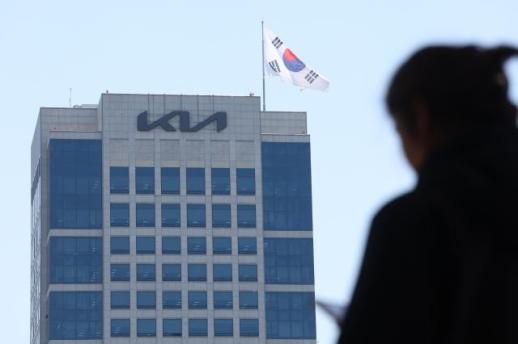 Kia Q1 profit fall near 30% on higher U.S. tariffs and Gulf shipping costs SEOUL, April 24 (AJP) — South Korean carmaker Kia, like its sister company Hyundai Motor, suffered a double-digit decline in earnings in the first quarter despite record sales, as higher tariff costs on U.S. shipments and shipping disruptions linked to Gulf tensions weighed on profitability. Operating profit fell 26.7 percent on year to 2.2 trillion won ($1.52 billion), reflecting an estimated 755 billion won increase in U.S.-related tariff costs compared to a year earlier, the company said Friday. Sales nevertheless rose 5.3 percent on year to a record 29.5 trillion won on strong demand for SUVs and electrified vehicles, even as overall industry conditions softened. Global wholesale volumes edged up just 0.9 percent to around 780,000 units, pointing to limited volume growth behind the top-line expansion. Operating margin fell to 7.5 percent from 10.7 percent a year earlier, as increased production and shipping costs eroded profitability. The cost of sales ratio rose to 80.3 percent from 78.3 percent, while selling and administrative expenses jumped 17.1 percent, underscoring mounting cost pressure. The decline was largely cost-driven, with tariff impacts, rising raw material prices and increased incentives — particularly in Europe — weighing on profitability, alongside a weaker regional mix and higher warranty-related expenses. Regional performance remained mixed. While India and Latin America posted strong growth of 11.6 percent and 34.6 percent, respectively, North America saw volumes decline 2.1 percent and the Middle East plunged 31.2 percent, reflecting the impact of the war. Despite an overall 5.5 percent fall in car demand in the U.S., Kia’s sales rose 4.1 percent and its market share climbed to 5.6 percent, helped by hybrid and EV sales surging 73.5 percent and accounting for 19.3 percent of total sales. Kia shares closed Friday at 153,400 won down 3.2 percent. 2026-04-24 15:55:24