
Journalist

Samuel Garrett
-
 Aigis Asset Management to Appoint Cho Gap-ju as CEO Aigis Asset Management said it will appoint Cho Gap-ju, head of its new business initiative unit, as its new CEO. The company said on the 27th it plans to name Cho CEO at a board meeting scheduled for the 28th. Aigis said the appointment is intended to ensure continuity in managing client assets as changes in corporate governance proceed, while having an experienced executive directly review key issues and strengthen communication with stakeholders. Cho joined the firm in its early days in 2011 and served as CEO from 2015 to 2021. “I will do my best to work closely with key stakeholders, including institutional investors, so that protecting client assets and the company’s stable growth can be achieved together,” Cho said. The company said Cho will leave matters related to the stake sale to the shareholder representative and will personally ensure there is no disruption to major business operations while the sale process is underway. * This article has been translated by AI. 2026-04-27 14:57:14
 -
 BOJ Seen Holding Rates as Yen Nears 160 per Dollar; Focus on Ueda’s Guidance Japan’s central bank is widely expected to keep its policy rate unchanged at a meeting on the 28th, shifting market attention to what Gov. Kazuo Ueda says as the yen nears 160 per dollar. Investors are focused on how clearly the Bank of Japan signals willingness to raise rates again after holding steady. Bloomberg News reported on the 27th that markets expect the BOJ to maintain the policy rate at 0.75%. Until a few weeks ago, many investors had expected another increase as part of the bank’s policy normalization. That view has faded after international oil prices jumped following a military clash between the Trump administration and Iran. Markets now price only a 7% chance of a rate hike this month, and economists have increasingly pushed their expectations to June. As rate-hike expectations ease, pressure has grown on the BOJ to address yen weakness. The yen traded around 159.50 per dollar in Tokyo on Monday morning, near levels that prompted Japanese authorities to intervene in 2024 to support the currency. Japan’s finance minister, Satsuki Katayama, said at a recent Bloomberg event, “Japanese authorities are in close contact with the U.S. side 24 hours a day,” while warning against speculative moves. Ueda’s remarks are under scrutiny in part because of last April. After the BOJ held policy steady then, his comments on the yen were taken as a cautious stance on rate hikes, and the currency fell sharply. Investors worry the yen could weaken again if his message after another hold is seen as too soft. At the same time, the BOJ faces risks in signaling a strong commitment to further tightening. Since the Iran war, uncertainty over oil prices and supply chains has increased. Higher rates could help support the yen, but they could also add to slowdown pressure from higher energy costs. Bloomberg, citing sources, reported the BOJ’s final decision could be delayed until the last moment. Inflation data underscore the dilemma. Japan’s March consumer inflation accelerated for the first time in five months. Services producer prices rose 1.25% from the previous month, the biggest increase in about 36 years excluding periods tied to consumption tax hikes. A weaker yen is pushing up import costs, and companies have continued raising prices. The BOJ may find it difficult to hike immediately because of growth concerns, but it also cannot fully rule out further increases given currency weakness and inflation pressure. The meeting is expected to test how the BOJ balances a hold decision with language that keeps the door open to additional hikes. That balancing act is also expected to show up in the quarterly outlook to be released with the meeting. Bloomberg reported policymakers may consider raising their inflation forecast for the fiscal year that began this month from 1.9% by a significant margin, while trimming growth projections. The median market estimate is that the BOJ will cut its growth forecast for the current fiscal year to 0.8% from 1.0%. Markets are watching whether Ueda leaves room for further hikes even if the BOJ holds rates. Bloomberg said the key issue is how strongly the BOJ communicates its willingness to raise rates to curb yen weakness.* This article has been translated by AI. 2026-04-27 14:54:09
 -
 Hanmi Semiconductor shares jump after Chairman Kwak buys company stock Hanmi Semiconductor shares surged after news that its largest shareholder bought more company stock. According to the Korea Exchange, as of 2:45 p.m. on the 27th, Hanmi Semiconductor was trading at 374,500 won, up 26.73% from the previous session. The stock hit an intraday high of 379,500 won, a record. In a regulatory filing, the company said Chairman Kwak Dong-shin acquired 9,576 shares through open-market purchases. The purchase totaled about 3 billion won, at an average price of 315,407 won per share. After the transaction, Kwak’s stake rose to 33.57%. Hanmi Semiconductor said the purchase was intended to boost corporate value. Kwak previously bought additional shares in January and in November last year. Since 2023, his cumulative purchases have been reported at about 56.5 billion won. Hanmi Semiconductor said it maintains the No. 1 global market share in TC bonders used to produce HBM. With mass production of HBM4 ramping up this year, it is supplying “TC Bonder 4” to global manufacturers. It plans to launch a next-generation “Wide TC Bonder” by year-end to support future HBM production. The company also plans to release a second-generation hybrid bonder prototype within the year for the hybrid bonding market, which is expected to be applied to full-scale mass production starting in 2029. It plans to begin operating a hybrid bonder factory in the first half of next year.* This article has been translated by AI. 2026-04-27 14:51:45
 -
 Hanwha Ocean posts 441.1 billion won Q1 operating profit, up 78% from prior quarter Hanwha Ocean extended its earnings rebound on a high-margin business mix led by LNG carriers. The company said Sunday that on a consolidated basis it posted first-quarter 2026 revenue of 3.2099 trillion won and operating profit of 441.1 billion won. Revenue fell 3% from the previous quarter and 2% from a year earlier. Operating profit rose 78% from the prior quarter and 71% from a year earlier. Revenue edged down as fewer operating days weighed on output, but the commercial ship division drove growth on higher-priced projects and a larger share of LNG carriers. The naval ship division kept revenue steady, centered on submarine and surface-ship construction, while the energy plant division declined temporarily as projects ended. Profitability improved as the company maintained a high-margin LNG carrier mix and saw clearer gains in other ship types. It also cited benefits from a weaker won, cost cuts, productivity improvements and the impact of some early deliveries. In the first quarter, Hanwha Ocean booked orders totaling $2.45 billion, including four LNG carriers, seven very large crude carriers and one wind turbine installation vessel. A company official said profitability gains should continue as revenue recognition accelerates for high-priced commercial ship projects, adding that Hanwha Ocean will strengthen competitiveness based on its design and construction experience and systems integration capabilities.* This article has been translated by AI. 2026-04-27 14:51:15
 -
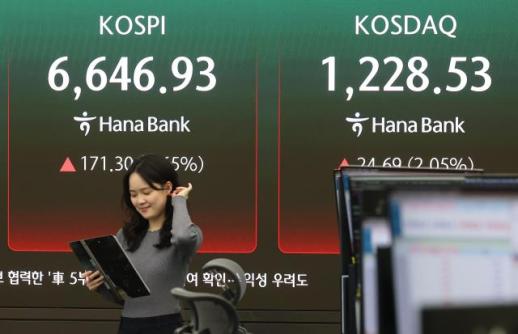 AI Boom Splits Asian Stocks: Korea, Taiwan and Japan Rise as India, Southeast Asia Fall Asian stock markets are diverging depending on who benefits from the artificial intelligence boom. Despite an energy shock triggered by the Iran war, Northeast Asian markets have rebounded on strong tech shares, while South and Southeast Asia remain weighed down by higher oil prices. Bloomberg reported on April 27 that Taiwan’s TAIEX rose 9.9% from the start of the Iran war on Feb. 28 through April 24. Over the same period, South Korea’s KOSPI gained 3.7%, Japan’s Nikkei 225 added 1.5%, and China’s CSI 300 rose 1.25%. The CSI 300 tracks the 300 largest stocks by market capitalization in Shanghai and Shenzhen. By contrast, South and Southeast Asian markets stayed weak. India’s Nifty 50 fell 5.8%, Indonesia’s Jakarta Composite Index dropped 10.4%, and the Philippine Stock Exchange index slid 9.5%. The MSCI ASEAN index declined 7.5%. Analysts pointed to AI as the key driver of the gap. Marvin Chen, a strategist at Bloomberg Intelligence, said South Korea, Taiwan and Japan all have high dependence on oil, but “AI ultimately made the difference.” Bloomberg said demand tied to the AI boom has helped the global semiconductor supply chain, including Taiwan Semiconductor Manufacturing Co., Samsung Electronics and SK hynix, and appears relatively insulated from geopolitical risks. In India and Southeast Asia, however, rising oil prices are feeding inflation, worsening current accounts and weakening currencies, while also limiting policymakers’ room to respond. Sonal Varma, an economist at Nomura Holdings, cited several factors: India and Southeast Asia are more exposed to the energy shock than Northeast Asia and have fewer buffers; Northeast Asia’s fiscal conditions are relatively solid; and the AI boom is supporting growth and markets in Northeast Asia but offering little lift to India and Southeast Asia. South Korea, meanwhile, showed relative weakness in currency markets despite gains in equities. Since the war began, China’s yuan has risen 0.5% against the dollar, while the won has fallen 2.7%, one of the larger declines among major Asian currencies. Gary Tan, a portfolio manager at Allspring Global Investments, said the divergence reflects a clash between a long-term, technology-led structural shift and a short-term, war-driven macroeconomic shock, with Asia at the center of both trends.* This article has been translated by AI. 2026-04-27 14:49:36
 -
 CJ Logistics Launches Campaign to Cut Shipping Costs, Promote Small Food Sellers CJ Logistics said Monday it is launching “Hamkke Sane, Gachi One,” a project to identify promising small and midsize food companies and support them with logistics subsidies and promotion. The campaign targets small merchants with strong products and fresh ideas who still struggle to expand sales channels because of shipping and marketing costs. Any food seller that ships and sells products by parcel delivery can apply through the campaign’s official website from Monday through May 25. CJ Logistics said it will select 30 companies after evaluating taste and quality, price competitiveness and suitability for delivery. Of those, 20 will each receive 1 million won in shipping support. Another 10 will receive up to 2 million won in shipping support and help producing promotional content called “O-NE Pick Review,” featuring a well-known influencer. The company said it partnered with mukbang review YouTuber “Heukbaek Review,” which has 830,000 subscribers, to boost credibility and reach. The videos will be uploaded to CJ Logistics’ YouTube channel, “Ige One (O-NE),” with purchase links to connect viewers to sales. Two selected companies that draw strong consumer response will also get a chance to be featured on Heukbaek Review’s main channel. A CJ Logistics official said the campaign was designed to ease small merchants’ logistics burden and help competitive products reach more consumers. The official said the company will continue practical partnership programs that allow it to grow alongside small and midsize businesses and small merchants across industries.* This article has been translated by AI. 2026-04-27 14:49:00
 -
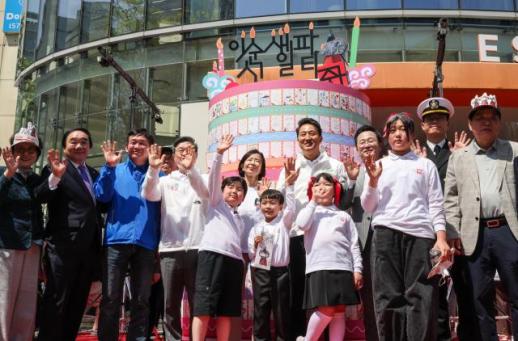 Admiral Yi still towers over Seoul - in stone and in spirit SEOUL, April 27 (AJP) -The bronze figure of Yi Sun-sin stands immovable over Gwanghwamun, but his presence is anything but static. Centuries after his death, the admiral remains one of South Korea’s most revered figures — often mentioned alongside Sejong the Great — his legacy woven into daily life, civic pride and national memory. That legacy came alive over the weekend as Seoul citizens turned out in force for the 2026 Yi Sun-sin Festival. Seoul’s Jung-gu District said Monday that about 40,000 people visited the festival held on April 25 to mark the 481st anniversary of the admiral’s birth — roughly double the turnout from last year’s inaugural event. The district, believed to be the birthplace of Yi Sun-sin in 1545, staged the event not just as a commemoration but as a reclaiming of historical identity — a reminder that beneath the dense urban grid lies the origin story of one of Korea’s defining figures. The festival opened with a parade along a 160-meter honorary road dedicated to the admiral, stretching from Jingoogae in Chungmuro to the Myeongbo intersection. More than 90 participants joined the procession, including four children who share Yi’s April 28 birthday — a symbolic passing of legacy across generations. The march blended pageantry with intimacy: uniforms, flags and footsteps echoing through streets that now hum with traffic, but once marked the beginnings of a national hero. Naval honor guards staged ceremonial performances, bringing martial discipline into a civic setting, while cultural programs unfolded across the venue. A fitness contest titled “Iron Yi Sun-sin” crowned the district’s strongest participant — a modern reinterpretation of the admiral’s famed resilience and leadership under pressure. Across the country, similar commemorations are unfolding, notably in Asan, home to the Hyeonchungsa Shrine, where Yi’s spirit is formally enshrined. Families and visitors filled the grounds, moving between hands-on programs — from traditional games to book art, VR horseback riding and robotics exhibits — where history met technology in playful dialogue. A food zone featuring 20 local restaurants anchored the festival in the everyday rhythms of the district, while a three-meter-tall birthday cake installation, built from 481 congratulatory cards submitted by residents, offered a quiet, collective tribute. Kim Gil-sung, mayor of Jung-gu, said the district would continue to promote its identity as the birthplace of Yi Sun-sin — not as a relic of the past, but as a living narrative embedded in the city. And as long as the admiral stands watch over Gwanghwamun, that narrative is unlikely to fade. 2026-04-27 14:48:50
 -
 Fierce showdown looms in Busan as former IT expert likely to join race for local elections SEOUL, April 27 (AJP) - Ha Jung-woo, the presidential adviser for artificial intelligence and future strategies, is highly likely to declare his bid for the upcoming local elections as early as this week. The Busan native, who has been repeatedly courted by the ruling Democratic Party (DP), is expected to run in the southern port city's northwestern district of Buk-gu against Han Dong-hoon, the former leader of the main opposition People Power Party (PPP), in what is likely to be a fiercely contested race between the two rival parties. The DP's leader Jung Chung-rae met him for dinner over the weekend and reportedly persuaded him to run. After repeated overtures from Jung, Ha seemed close to making up his mind about entering the race, though President Lee Jae Myung earlier made a light-hearted quip urging him "not to be swayed" by them, a comment many interpreted as a calculated move to raise Ha's profile, as he is still a political novice and largely unknown to many. Once Ha formalizes his candidacy for the seat left vacant by former incumbent Jeon Jae-soo, who stepped down to run for mayor of Busan, a heated clash with Han awaits. But Ha appears to have an advantage over Han, given his local roots, having been born and raised in the area through high school and his shared alma mater with Jeon, which could boost his appeal to voters. Han, who is running as an independent candidate after being expelled from the PPP in January this year over allegations that included hundreds of defamatory comments about disgraced former President Yoon Suk Yeol and his wife Kim Keon Hee posted on the conservative party's online bulletin board, will also have to compete with the PPP's candidate, Park Min-sik, a former minister of Patriots and Veterans Affairs. The district, the only one of Busan's 18 districts won by the DP in the 2024 general election despite being traditionally considered a conservative stronghold, has become a must-win battleground for the DP and would likewise be crucial for Han as he seeks a political comeback. But the three-way race would make it difficult for the PPP to win, with some pundits speculating that it could lead to an eventual merger between Han and Park, though that remains to be seen. Meanwhile, this year's local elections to elect about 4,000 metropolitan mayors, provincial governors and other local government heads nationwide are slated for June 3. 2026-04-27 14:48:22
 -
 Vietnam Warns of Fake Traffic-Fine Sites Stealing Bank Card Data A new scam in Vietnam is using small traffic fines as bait to steal bank card information, authorities and local media reported. The scheme typically cites a fine of 50,000 dong (about 2,800 won), encouraging victims to enter card details without suspicion. Reports say even residents of major cities have been deceived. VnExpress reported that a Hanoi resident, Ngoc Ha, received a text message on April 25 saying her vehicle had committed a traffic violation and instructing her to immediately visit a specific website to resolve the fine. She said the domain included the word “Dichvucong,” meaning public service, leading her to believe it was an official site. The site, however, was a counterfeit that copied the domain name and interface of the national public services portal. Ha said, “Because the screen looked familiar, I didn’t suspect anything.” The page claimed her vehicle had committed an “obstructing parking” violation and assessed a 50,000-dong fine. It also prompted users to pay immediately by entering a card number, cardholder name, expiration date and CVV code. Ha said she intended to pay because the amount was small, but she did not have her card and could not recall the details. “If not for that, I would have lost all my money,” she said. VnExpress reported that many people received similar messages last week. ◆ Hanoi police: No traffic-violation notices by text or phone; report fake portals Hanoi police issued an official warning, describing the scam as a tactic that sends messages about allegedly unresolved traffic violations and lures recipients to a fake link, allowing criminals to take control of cards and withdraw money from accounts. Police said the link is designed with an interface similar to the national public services portal to gain trust. If a victim enters bank card information, including a card number and an OTP code, criminals can seize control of the card and withdraw funds, police said. Police also stressed that there is currently no method of notifying traffic violations by text message or phone call. Violations are notified in writing, and vehicle owners or related parties are summoned to a police station, they said. Those who want to check violations should use the official traffic police website or the VNeTraffic app. Authorities said scams using fake websites have persisted in Vietnam for years, with tactics evolving. Fraudsters impersonate familiar banks, government agencies, e-commerce platforms and other services to steal accounts and money. Such messages may be distributed through fake base stations or unregistered SIM cards. While mobile carriers have tightened subscriber verification to block unregistered SIM use, scam attempts continue, the report said. Authorities urged the public to use only official websites and to carefully check domains, security certificates and unusual signs in interfaces and language. Passwords, OTP codes and personal information should never be provided to unverified sites. Anyone who suspects fraud should immediately lock their account and report it to authorities. Vietnamese internet users voiced concern and criticism. One commenter wrote that they hoped VNeID would quickly integrate systems under centralized management so problems could be reported through a single channel. The commenter also warned that having separate apps for traffic, taxes and other services increases risk, adding, “If people in cities are being fooled, I’m more worried about rural areas.” Another commenter said the public should recognize that the government does not impose fines or penalties by phone, adding that “if you go in person, your money stays safe.” Others also said scams have become too common during the digitization process.* This article has been translated by AI. 2026-04-27 14:44:48
 -
 Korea IR Council Holds Inauguration Ceremony for New Chairman Kim Gi-gyeong The Korea IR Council said Monday it held an inauguration ceremony for its 10th chairman, Kim Gi-gyeong. According to the council, Kim, born in 1966, earned a bachelor’s degree in law from Seoul National University. He previously served at the Korea Exchange, including as head of the Stock Market Department at the KOSPI Market Division, deputy head of the Management Support Division, deputy head of the KOSDAQ Market Division and head of the Management Support Division. The Korea IR Council began in 2009 as a nonprofit incorporated association established by the Korea Exchange. It has hosted corporate investor relations briefings to support capital market development, operated training programs to cultivate IR professionals and organized IR awards. Through its affiliated Corporate Research Center, it also provides research on small and midsize companies, contributing to a sound investment culture.* This article has been translated by AI. 2026-04-27 14:44:17