
Journalist

Samuel Garrett
-
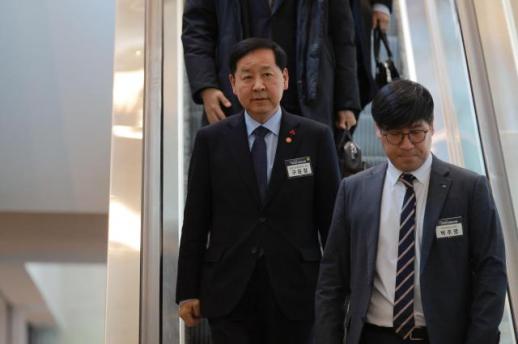 S. Korea, U.S. finance chiefs share concerns over won volatility Seoul, April 19 (AJP) —South Korean and U.S. finance chiefs agreed a volatile exchange rate is undesirable for the interests of the two countries, the Ministry of Finance and Economy said in a statement Monday. Finance Minister Koo Yun-cheol met with U.S. Treasury Secretary Scott Bessent during the G20 Finance Ministers and Central Bank Governors Meeting in Washington, D.C., last Friday to discuss key bilateral issues including the action plan for Seoul's pledge of investments in the U.S., foreign exchange rate, and supply chain disruptions from the Gulf conflict. The primary agenda was the high volatility of the Korean won. "Both ministers agreed that excessive volatility in the Korean won is not desirable, and agreed to continue consultations on foreign exchange market developments," the statement said. Last month, the average daily gap between the appropriate non-deliverable forward (NDF) rate—based on the weekly closing price of the won at 3:30 p.m.—and the actual final quote for one-month NDFs in New York was tallied at 12.2 won. This marks the first time since 2020 that the gap between the appropriate quote and the actual exchange rate has exceeded 10 won. "We shared the view that the volatility of the Korean won has been particularly high and decided to maintain a cooperative relationship to stabilize foreign exchange market trends," Koo separately wrote on his X page, adding that the two leaders also discussed the impact of the U.S.-Israel and Iran conflict on the Korean economy. Another key issue was the ongoing discussion regarding investment in the U.S. following tariff negotiations. South Korea plans to invest a total of $350 billion in the U.S. market over the next 10 years, including a $150 billion investment in the shipbuilding industry. The U.S. had once rolled back tariffs on Korean automobiles from 15 percent to 25 percent, citing delays in legislation by the Korean National Assembly. In response, the National Assembly passed the Special Act on Investment in the U.S. on March 12. Koo explained the Korean government's efforts to implement memorandums of understanding regarding bilateral investments, including the Special Act, to which Bessent responded positively. In the Seoul foreign exchange market on Monday, the won opened at 1,479.5 per dollar. 2026-04-20 10:50:50
 -
 Korea's antitrust watchdog weighs naming Coupang's Kim as group head SEOUL, April 20 (AJP) - South Korea's antitrust regulator is poised to decide as early as next week whether to name Coupang founder Bom Kim as the e-commerce group's controlling shareholder, a shift that would bring the U.S. citizen under the country's toughest corporate disclosure and anti-self-dealing rules for the first time. The Korea Fair Trade Commission (KFTC) is in the final stages of reviewing whether to replace the Coupang corporate entity with Kim, chairman of Nasdaq-listed parent Coupang, as the group's designated "same person," industry and regulatory sources said Sunday. A ruling must be issued by the May 1 statutory deadline. Investigators are zeroing in on whether Kim's younger brother, Vice President Yoo Kim, and other relatives hold stakes in or take part in the management of Coupang's Korean affiliates — one of the conditions that would disqualify the group from keeping a corporate designation. Coupang has pushed back, arguing that no grounds exist for a change. The company has reportedly told regulators that Yoo Kim is an unregistered executive at Coupang, not at any Korean affiliate, and therefore does not take part in local management. However, sources say the vice president received about 14 billion won ($9.48 million) in compensation and incentives from Coupang over the four years through 2025, including $430,000 in pay and 74,401 restricted stock units last year alone. Whether the KFTC accepts that argument again this year is far from certain. Tensions between the two sides have flared over document submissions, with the watchdog examining whether Coupang's partial refusal to hand over requested materials may constitute a violation of the Fair Trade Act, which carries penalties of up to two years in prison or fines of 150 million won. Chairman Kim was issued an official warning in 2021 after omitting 15 relatives from a disclosure filing, though regulators declined to refer the case for prosecution. Coupang's designation has long been an outlier. It is one of only eight of the 46 conglomerates subject to cross-shareholding restrictions last year whose designated head is not a natural person — a group that otherwise consists largely of state-linked or ownerless firms such as POSCO, KT and Nonghyup. The watchdog first designated Coupang as a large business group in 2021, citing enforcement difficulties in applying the rules to a foreign national, and has maintained the corporate designation ever since. A shift to an individual designation would subject Kim to disclosure obligations covering his personal dealings and expose any companies owned by him or his relatives to regulations barring preferential intra-group transactions — closing a loophole that critics argue lets the founder control the group without the accountability borne by Korean chaebol chiefs. 2026-04-20 09:51:21
 -
 North Korea test-fires tactical ballistic missiles with new warheads, state media says SEOUL, April 20 (AJP) - North Korea has conducted a test of a "surface-to-surface tactical ballistic missile," state media reported on Monday. According to the state-run Korean Central News Agency, the test was conducted the previous day to "evaluate the power of warhead of the improved surface-to-surface tactical ballistic missile Hwasongpho-11 Ra." "Five tactical ballistic missiles, launched towards the target area around an island about 136 km away, struck the area of 12.5~13 hectares with the very high density, fully displaying their combat might," KCNA said. The purpose of the test was to "verify the characteristics and power of cluster bomb warhead and fragmentation mine warhead applied to the tactical ballistic missile," it added. The country's leader Kim Jong-un, accompanied by his daughter Ju-ae, expressed "great satisfaction" over the test, touting that the development of different cluster bomb warheads would "boost the high-density striking capability to quell a specific target area as well as the high-precision striking capability." He also encouraged defense and military officials to "continuously make successes in the important undertakings to acquire and update various ultra-modern technologies necessary for the combat preparedness of our army." Sunday's test comes just a few weeks after similar missile launches earlier this month, believed to have tested KN-23–series weapons, similar to Russia's Iskander-type missiles. But this time, they appeared to carry cluster-munition and fragmentation-mine warheads, both designed to maximize damage by dispersing submunitions or metal fragments across a large area. A day earlier, South Korea's military said it detected multiple short-range ballistic missiles launched from Sinpo in South Hamgyong Province toward the East Sea at around 6:10 a.m. and they flew approximately 140 kilometers. "The simultaneous launch of five missiles striking 12.5 to 13 hectares demonstrated the ability to hit a wide area beyond simple precision strikes," said Lim Eul-chul, a professor at Kyungnam University's Institute for Far Eastern Studies. "It was also unusual to gather all key commanders responsible for border areas with South Korea in one place, suggesting the tested weapon will be deployed to frontline units." 2026-04-20 09:45:56
 -
 Toss Bank Launches E-Braille Service for Visually Impaired Customers Toss Bank said on the 20th it will introduce an e-braille service, the first by a South Korean internet-only bank, to improve access to financial information for customers who are visually impaired. The service will initially apply to frequently issued bankbook copies and will later expand to a broader range of financial and certification documents. The e-braille service automatically converts financial documents issued on mobile devices into braille files. Customers can review the contents on their own using assistive devices such as braille information terminals, without needing help from others. The bank said the feature is designed to make numbers, account details, tables and other information clearer than audio guidance alone. Toss Bank said it developed its own e-braille conversion logic and solution for the rollout, focusing on improving accessibility across the full process of using its services. It also improved the screen-reader user experience throughout the bankbook-copy issuance process to make the service easier to use for visually impaired customers. The service is available in the Toss Bank app through the menu for issuing a bankbook copy (account-opening confirmation). The bank said it will review real-world usability and reflect customer feedback as it works to strengthen accessibility for more financial and certification documents. A Toss Bank official said, "It is meaningful to be able to introduce a service that improves financial access for visually impaired customers to mark the Day of Persons with Disabilities," adding, "We will continue to strengthen accessibility so that anyone can use financial services without discrimination, without missing even small customer feedback."* This article has been translated by AI. 2026-04-20 09:21:00
 -
 Woori Bank, Kibo to Provide About $150 Million in Support for SMEs Hit by Mideast War Risks Woori Bank will work with the Korea Technology Finance Corp., known as Kibo, to support small and medium-sized companies affected by global instability, including the war in the Middle East. The bank said Sunday it signed a business agreement with Kibo on an “inclusive financial support” program to help SMEs overcome the crisis. Woori plans to make a special contribution of 4 billion won to Kibo and provide about 210 billion won in financial support. Eligible firms include direct exporters to the Middle East, companies hurt by disruptions in Middle East crude oil supply chains, businesses facing management difficulties, and companies affected by the Middle East war that are recommended by Woori Bank. Participating firms will be offered benefits including a higher guarantee coverage ratio to 100% from 85%, support for guarantee fees of 0.5 percentage points, special treatment in calculating guarantee limits, eased screening, and preferential guarantee limits. “This agreement was prepared to minimize the management shock to SMEs caused by the Middle East war,” said Park Hwa-geun, a deputy general manager in Woori Bank’s corporate sales strategy division. “We will continue to cooperate with related institutions to respond to external risks, while faithfully carrying out our push to shift toward productive finance and expand inclusive finance.”* This article has been translated by AI. 2026-04-20 09:09:00
 -
 Korea and India to elevate ties to "entirely new level" SEOUL, April 20 (AJP) -South Korean President Lee Jae Myung said Seoul and India are entering “an entirely new level” in bilateral ties, positioning each other as “the most critical strategic partners” as global supply chains fracture under prolonged geopolitical shocks stemming from the Middle East conflict. Speaking at a dinner meeting with the Korean community in New Delhi Sunday, Lee framed his state visit as a turning point in bilateral ties, signaling a shift toward deeper cooperation in supply chains, energy security and advanced manufacturing. “With supply chain instability and global economic crises becoming structural amid the fallout of the Middle East war, Korea and India are in a position to become indispensable partners to one another,” Lee said. He expressed confidence that his summit with Prime Minister Narendra Modi would elevate the relationship “to an entirely new level,” underscoring India’s emergence not merely as a consumer market but as a central node in global production and supply networks. Lee highlighted structural parallels between the two economies, noting that both rely heavily on imported raw materials and energy — a shared vulnerability that opens space for strategic cooperation in securing stable supply chains. The visit marks the first state trip by a South Korean leader to India in eight years and is widely seen as part of Seoul’s broader push to deepen engagement with the Global South while recalibrating its economic and security posture. Lee also struck a symbolic note, referencing Korean novelist Choi In-hoon’s “The Square,” drawing parallels between the Korean Peninsula’s division and the diasporic Korean experience in India. He praised the local Korean community as a model for peaceful coexistence and future reunification. Earlier in the day, Lee met Indian External Affairs Minister Subrahmanyam Jaishankar, who emphasized the need to turn global instability into an opportunity to further solidify bilateral ties. Accompanying the president is a large business delegation of around 200 executives, including top conglomerate leaders such as Lee Jae-yong, Chung Eui-sun and Koo Kwang-mo, signaling the strong commercial focus of the trip. The delegation is expected to participate in business forums and sign memorandums of understanding aimed at expanding cooperation in semiconductors, green energy, infrastructure and defense manufacturing. Following his India leg, Lee will travel to Vietnam, where South Korean firms have built extensive manufacturing bases, making it Seoul’s third-largest trading partner after China and the United States. The twin visits reflect South Korea’s strategic intent to diversify economic partnerships and reduce exposure to geopolitical chokepoints, particularly as energy and logistics disruptions tied to the Strait of Hormuz continue to ripple through global markets. 2026-04-20 07:26:55
 -
 Korea’s Skin Booster Market Shifts as ECM Products Expand, Raising Regulatory Questions Competition in South Korea’s skin booster market is shifting quickly as more pharmaceutical and biotech companies enter the field and products based on human tissue spread. Skin boosters refer to injectable procedures that deliver substances such as hyaluronic acid and collagen into the dermis to help moisturize, improve elasticity and support skin regeneration. The market, long led by products such as PharmaResearch’s Rejuran and Juvlook, is increasingly seeing late challengers promote ECM (extracellular matrix) offerings. According to Grand View Research, the domestic skin booster market totaled $87.7 million (about 128.7 billion won) in 2024 and is projected to grow 16% annually through 2030. Rejuran has dominated the sector, and PharmaResearch’s revenue topped 500 billion won last year on growth in its aesthetics business centered on the product. But as the market expands and new products multiply, its once-dominant position is weakening, with ECM skin boosters at the center of the change. L&C Bio’s “Ellavie Rituo,” launched in late 2024, is made by leaving only the collagen structure from donated deceased skin tissue, turning it into powder and injecting it. The company now has about 2,000 hospital and clinic accounts. L&C Bio is also reviewing an additional production-facility expansion, targeting October. If carried out, output is expected to rise from 30,000 units to as many as more than 150,000 units a month by the end of this year. Lee Seung-eun, an analyst at Yuanta Securities, forecast that Rituo revenue could expand to 50 billion won this year from about 6 billion won a year earlier. Other drug and biotech companies are also moving in. CGBio’s affiliate CGBiomeditech, which is expanding its ECM business based on its parent company’s human-tissue processing capabilities, recently acquired CGBio’s Seongnam human-tissue processing tissue bank to secure a production base. GC Wellbeing has launched “GCell Rebonne” and is accelerating its push into medical aesthetics. MS Bio handles tissue processing, while GC Wellbeing has built a system to manage and supply raw materials through a distribution tissue bank at its Eumseong plant in North Chungcheong Province. Hugel has also joined the market by signing a domestic distribution contract for Hans Biomed’s “CellrDM.” Differences in oversight are also fueling the spread of ECM products. Rituo is classified as human tissue, meaning it is subject to procedures different from medical devices such as Rejuran and Juvlook. Medical devices must go through the Ministry of Food and Drug Safety’s process for each product, including intended use and indications. Human tissue, by contrast, can be supplied to hospitals and clinics without separate approval for each product, creating a relatively lower barrier to entry. Lee Jun-seok, an analyst at Hanyang Securities, said, “The ECM skin booster business depends on stable procurement of raw materials,” adding that success will hinge on “how reliably companies can secure human tissue that meets regulatory requirements.” At the same time, debate is intensifying over the use of human tissue for cosmetic purposes. Critics have raised ethical concerns because donated tissue is used in commercial procedures. Kwon Dong-ju, an attorney at law firm Yulchon, said at the K-Bio Health Forum on April 16, hosted by Democratic Party lawmaker Seo Dong-seok under the theme “Reasonable regulatory measures for the proper use of donated human tissue,” that it is not reasonable for products with the same purpose and method of administration as other injectable skin boosters already approved as medical devices to be regulated entirely differently. He argued that the Human Tissue Act should explicitly ban cosmetic use. * This article has been translated by AI. 2026-04-20 06:03:18
 -
 Korea's first tanker slipping past Hormuz on its way home SEOUL, April 19 (AJP) -A tanker carrying petroleum products is heading to South Korea after passing through the Strait of Hormuz during a brief reopening, in what would mark the first such arrival since the waterway’s intermittent blockade began amid tensions between the United States and Iran. According to shipping industry sources on Sunday, the vessel — identified as the Navik 8 McAllister — transited the strait on the evening of April 18, when access was temporarily restored, allowing a number of ships in the Persian Gulf to move into the Gulf of Oman. The reopening was short-lived as Iran’s Islamic Revolutionary Guard Corps reinstated the blockade later in the evening. The tanker is carrying around 500,000 barrels of petroleum products, including naphtha, gasoline, jet fuel and diesel, and is currently moving through the Indian Ocean after clearing the Gulf of Oman. It is expected to arrive at Ulsan Port in southern coast around May 10. If the shipment reaches its destination as scheduled, it would mark the first case of a tanker passing through the strait and arriving in South Korea since late February, when the Eagle Valour exited just before the initial closure. Most vessels that managed to pass during the brief reopening were bound for China and India, with only a limited number heading toward South Korea. The other successful vessels are yet to be identified. Despite its significance, the cargo is unlikely to ease supply pressures. At roughly 500,000 barrels, it falls far short of meeting South Korea’s energy demand, suggesting that tight supply conditions and elevated oil prices could persist until stable access through the strait is restored. The stop-and-go nature of traffic through the chokepoint continues to underscore the vulnerability of energy supply chains, with ripple effects expected across fuel prices and the broader economy. 2026-04-19 17:35:32
 -
 Korean Banks Expand Corporate Lending Despite Rising Delinquencies Under ‘Productive Finance’ Push Korean banks are accelerating corporate lending despite the risk of rising delinquency rates, stepping up funding after the government’s push for so-called productive finance. Banks have even overhauled key performance indicators, or KPIs, to drive lending. Critics warn that aggressive expansion, combined with weak regional economies, could undermine asset quality in coming years. As of the end of last month, corporate loans at the five major commercial banks — KB Kookmin, Shinhan, Hana, Woori and NH NongHyup — totaled 859.7737 trillion won, up 15.0483 trillion won from the end of last year, according to the financial sector on Saturday. Loans to large companies rose 8.7127 trillion won to 179.0119 trillion won over the same period. Lending to small and midsize companies increased 6.3356 trillion won to 680.7618 trillion won. Behind the faster pace of lending is the government’s productive-finance agenda. Financial authorities have laid out a plan to invest a combined 1,240 trillion won in productive finance over the next five years, including private and policy financing. The banking sector is expected to provide 614 trillion won, with the remainder backed by policy finance. The Financial Services Commission has also specified that, of this year’s total 240 trillion won in corporate financing, 106 trillion won should be concentrated outside the Seoul metropolitan area. Meeting those volume targets is pushing banks toward more aggressive lending from this year. Banks have responded by launching new products and rewriting KPIs. KB Kookmin Bank reclassified about 1,000 industries as “productive finance” sectors and lowered lending hurdles for companies with weaker collateral. Shinhan Bank newly assigned 25 points to productive-finance items. Hana Bank said it will apply a 1.2-times weighting to lending performance in core advanced industries, meaning a 1 billion won loan would be counted as 1.2 billion won in performance terms. Industrial Bank of Korea, a state-run lender, also added 10 productive-finance products to its KPIs, including loans to foster advanced-technology companies, a special support program for regional advanced-innovation industries, IBK Hope DREAM loans for small merchants, IBK Value Growth loans for small merchants, loans to support companies hit by tariff damage, and loans to support industrial safety activation. As banks raced to expand supply, the four major commercial banks — KB, Shinhan, Woori and Hana — posted 31.7 trillion won in productive-finance lending in the first quarter. That equals 47.2% of their annual target, reaching nearly half the goal in three months. Concerns are also growing. With the economic slowdown dragging on and more so-called zombie companies emerging, some warn that added financial support for sectors such as construction, petrochemicals and steel — amid Middle East-related risks — could later return as a wave of bad loans. The financial sector typically recalculates corporate credit ratings each April and May based on companies’ 2025 financial statements, and expects more downgrades in areas such as petrochemicals. A downgrade can trigger demands for repayment or higher interest rates. But banks, under the productive-finance drive, may face pressure to offer support such as rate cuts or maturity extensions even to firms whose ratings have fallen. “Even before productive finance gets going, companies look like they’re dying because of Middle East-related risks,” a financial industry official said. “Concentrating funding on large companies and having them distribute work to their subcontractors is a way to minimize bad loans.”* This article has been translated by AI. 2026-04-19 17:06:00
 -
 Korean Banks Face Rising Corporate Loan Delinquencies as Business Lending Grows Government and financial regulators have been urging banks to expand funding for innovative companies under the banner of “productive finance,” but banks are facing a growing dilemma. As tighter rules on household lending pushed banks to increase corporate loans, delinquency rates have also climbed sharply. With business lending rising quickly, the jump in delinquencies is adding to banks’ risk-management burden. According to the Financial Supervisory Service on April 19, the delinquency rate on corporate loans at domestic banks stood at 0.76% at the end of February, up 0.09 percentage point from the previous month. It was the highest level in nine months since May last year (0.64%). The rate was also higher than the household-loan delinquency rate of 0.45%, underscoring growing asset-quality pressure in the corporate sector. By company size, the delinquency rate on loans to small and midsize enterprises rose to 0.92%, up 0.10 percentage point from a month earlier, the highest since May last year (0.95%). Conditions worsened further for smaller corporate borrowers: the delinquency rate on loans to SME corporations climbed to 1.02%, up 0.13 percentage point, returning above 1% for the first time in nine months since May last year. Delinquencies on loans to large companies also increased, reaching 0.19% at the end of February, the highest level in 28 months since October 2023. The rise is being attributed to a weakening domestic economy and greater external uncertainty that are increasing repayment strain across businesses. The data predate any impact from the U.S.-Iran war, suggesting the figure could worsen. Corporate loans carry higher risk weights than household loans, which can significantly increase risk-weighted assets and put downward pressure on banks’ common equity Tier 1 capital ratios. If nonperforming loans rise and banks set aside more loan-loss provisions, profitability and capital buffers can be eroded. That can put the government’s push to expand corporate lending at odds with banks’ efforts to control risk. With the government reinforcing its “productive finance” drive, banks say they have limited room to manage loan growth on their own. Authorities are pressing for stronger corporate support and balanced regional development, making expansion of business lending difficult to avoid. In recent months, commercial banks have moved competitively into the sector, including by awarding extra points in key performance indicators for new “productive finance” lending. Industry officials have warned that expanding lending without tighter asset-quality controls could increase bad loans. “A rapid rise in corporate lending, combined with an upswing in delinquencies, is quickly increasing the burden of soundness management,” a financial industry official said. “Aggressively expanded corporate loans could lead less to positive effects such as support for the real economy and more to higher delinquency rates and growing potential bad debt.” 2026-04-19 17:04:16