

SEOUL, September 02 (AJP) - South Korean online retailers are rushing to adapt after the United States eliminated a duty-free exemption for packages under $800, a move that threatens to raise costs and dampen demand in one of their most important overseas markets.
Beginning Aug. 29, American consumers ordering from Korean platforms face a 15 percent tariff on purchases that had previously entered the country without customs duties.
The policy shift, announced by the Trump administration, has rattled Korea’s cross-border e-commerce sector, which relies heavily on U.S. shoppers for sales of fashion and beauty products.
The change affects a significant slice of business.
In the second quarter, Korean companies’ direct online sales abroad totaled 738.8 billion won, or about $530 million, according to Statistics Korea. The United States accounted for 138.2 billion won, or $99 million — nearly a fifth of the total — making it the third-largest destination after China and Japan.
To soften the blow, retailers are retooling their systems. Musinsa, a popular fashion marketplace, said it will now include U.S. tariffs in the final checkout price rather than charging customers separately on delivery, while also warning of potential customs delays.
Beauty company CJ Olive Young has adopted a similar approach, automatically applying a 15 percent duty at checkout.
Other companies are placing the burden directly on customers. Amorepacific said U.S. buyers will be billed not only a 15 percent tariff but also an $18.30 clearance fee, collected by DHL on delivery.
For Korean sellers, the worry is whether higher costs will blunt the enthusiasm of U.S. consumers for K-beauty creams, trendy streetwear and other cultural exports that have powered sales overseas.
“We’re keeping a close eye on how this develops,” one industry official said. “Discounts and promotions may be the only way to keep American customers coming back.”
Copyright ⓒ Aju Press All rights reserved.
Related News
-
 Trump tariffs to top agenda when Democrats take control: Strickland
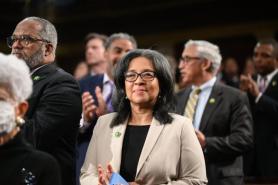
Rep. Marilyn Strickland. Courtesy of Congresswoman Strickland's Office SEOUL, November 16 (AJP) - Revisiting President Donald Trump's signature tariff policy will be a top priority when Democrats take control of the House and Senate in January, said a veteran Democratic lawmaker recently elected to a fourth term representing Washington state. "One of the things we can do, because the Democrats will now control the House and the Senate, is to look at our tariff policy to ensure that it's fair and that we are not doing anything that will harm our allies," Rep. Marilyn Strickland said in a recent video interview with AJP. "I am very excited to share with you that Hakeem Jeffries, the incoming Speaker of the House, has said that dealing with tariffs will be one of the first things that we do in the next Congress," said the lawmaker, who is one of the first Korean American women elected to Congress. Strickland was born in Seoul in 1962 to a Korean mother and an African American father who served in the U.S. Army. Poorly designed tariffs raise costs for American consumers and businesses, she argued, placing the treatment of trading partners at the heart of the affordability debate that helped shape the midterm elections. For South Korea, that debate bears directly on a trading relationship built on lowering barriers. The South Korea-U.S. free trade agreement, which took effect in March 2012, reduced or eliminated tariffs across much of bilateral trade. Trade in goods and services between the two countries totaled $241.6 billion in 2025, according to the Congressional Research Service. The November 2025 bilateral trade and investment deal established a 15 percent tariff framework for many Korean goods and lowered automobile tariffs from 25 percent to 15 percent in exchange for Korean investment commitments totaling $350 billion. The agreement followed Trump's April 2025 "Liberation Day tariff" announcement in the opening months of his second presidency, part of the most sweeping tariff increases since the Smoot-Hawley Tariff Act of 1930. Strickland's ties to South Korea are personal as well as political. "I tell folks that I am a proud Korean American, African American woman. I was born in Seoul and was raised by a Korean woman. I will always be a daughter of Korea." When she took her first congressional oath on Jan. 3, 2021, Strickland wore a hanbok, becoming the first member to wear the traditional Korean attire at a congressional swearing-in, according to her office. She wanted her mother, watching on television during the pandemic, to be able to distinguish her among hundreds of lawmakers. Rep. Marilyn Strickland, center, wears a hanbok as she takes the oath of office at the U.S. Capitol in Washington, D.C., on Jan. 3, 2021. Screenshot from Strickland’s X account The choice also carried a broader message. Against a backdrop of anti-Asian hostility and rhetoric she described as racist, Strickland wanted to affirm that her Korean and Black heritage had a place in American public life. "It was important to demonstrate that, as a woman who is Korean and Black, I am proud of my heritage and that I am as American as anyone else is," she said. "I wanted to send a message about what being American means, and my life experience is part of the American experience." That connection informs a policy agenda spanning trade, industrial cooperation and the South Korea-U.S. alliance. Shipbuilding offers a point of agreement with the Trump administration. "Korea is so dominant when it comes to shipbuilding. I had the opportunity to visit Hyundai Heavy Industries and Samsung when I was in Korea recently," she said. She was impressed by the scale of Korean shipyards, their workforce and the speed and quality of construction. The challenge for the United States, she said, is to draw on that expertise while training American workers and attracting investment in domestic shipbuilding. The November 2025 agreement earmarked $150 billion of South Korea's $350 billion investment commitment for shipbuilding cooperation under the MASGA initiative, short for Make American Shipbuilding Great Again. The accompanying joint fact sheet called for cooperation on workforce development, shipyard modernization, maintenance and repair, and supply chains. In Washington state, the industry encompasses ferry construction and commercial vessel repair around Seattle and Tacoma, alongside naval maintenance at the Puget Sound Naval Shipyard in Bremerton. On the East Coast, Hanwha Systems and Hanwha Ocean completed their $100 million acquisition of Philly Shipyard in December 2024, giving the Korean group a U.S. production base. Strickland pointed to partnerships in the Philadelphia area as examples of cooperation that should bring together Korean investment and expertise with American manufacturing and jobs. She also linked shipbuilding capacity to security in the Indo-Pacific, noting that her district includes Joint Base Lewis-McChord, a major military installation supporting operations in the region. Her recent visit to South Korea included an Oct. 14 meeting with Foreign Minister Cho Hyun, who sought her support for implementing commitments made by the two countries' leaders. Strickland reaffirmed bipartisan congressional support for the alliance. U.S. Rep. Marilyn Strickland, left, and Foreign Minister Cho Hyun pose for a photo during their breakfast meeting in South Korea on Oct. 14, 2026. Courtesy of the Ministry of Foreign Affairs "I want to reiterate that the alliance between the Republic of Korea and the United States remains strong. You are one of our best allies, and we know that it is important for us to continue to work together on deterrence against North Korea, but also in the Indo-Pacific. We want to keep it free and open," she said. Asked about the transition of wartime operational control, she left detailed military judgments to commanders while emphasizing readiness and shared responsibility. The 2025 joint fact sheet reaffirmed cooperation toward that transition and South Korea's commitment to develop the capabilities needed to lead the allies' combined conventional defense against North Korea. "In order for the operations to work, both parties have to step up and pull their weight and do their part and be prepared. I am confident that can happen," she said. Strickland brings those priorities to a Congress whose balance of power has shifted decisively toward Democrats. The former Tacoma mayor defeated Republican Chris Chung in Washington's 10th Congressional District to secure a fourth term. Democrats won majorities in both the House and Senate in the Nov. 3 elections, setting up divided government for the final two years of Trump's presidency. She serves on the House Armed Services Committee and the Transportation and Infrastructure Committee, with assignments covering military personnel, readiness, the Coast Guard and maritime transportation. Her office announced Nov. 10 that she had been elected vice chair for communications of the New Democrat Coalition for the next Congress. Jeffries announced his candidacy for speaker after the election and outlined a first-100-days agenda that includes reversing Trump's tariffs and Medicaid cuts. His election as speaker would require a formal House vote when the new Congress convenes in January. Congressional control, however, would not automatically translate into tariff relief or allow Democrats to enact their agenda without negotiation. Legislation generally requires approval from both chambers and the president's signature, unless Congress overrides a veto. Most contested legislation in the Senate faces a 60-vote threshold to end debate, although final passage generally requires a simple majority. For Strickland, the central domestic test is whether Democrats can convert their electoral gains into tangible relief from the cost of daily life. "The affordability crisis is the most important issue for the American people right now across the country in every district," she said. She singled out healthcare alongside gasoline, groceries and childcare, accusing the administration and congressional Republicans of eroding families' economic security. "The administration and the Republican majority have kicked millions of people off of healthcare," she said. "Healthcare and the affordability crisis are top priorities for the American people." In her assessment, Republican losses reflected the electoral consequences of policies that disproportionately hurt the party's own constituents. "I am hopeful that my Republican colleagues learned their lesson. They got wiped out in the elections in the House, and a lot of that is simply because the votes that they took to take healthcare and food away and to drive up the cost of living affect their districts more than they affect Democratic districts," she said. "So hopefully people have learned from experience. They saw what happened in '26; they want to avoid it in '28. I am hopeful that they will come out from under the knee of Donald Trump and put the people they represent first. That's how we have bipartisan support." Rep. Marilyn Strickland. Courtesy of Congresswoman Strickland's Office Defense remains one avenue for cooperation, she said. "There's what I call a governing center that understands the importance of defense that will get it over the finish line," she said. "Anytime we work on a defense bill out of our House Armed Services Committee, it typically comes out of the committee in a bipartisan way. When it comes out of the House Armed Services Committee, the Senate will do some things with it as well." She distinguished between agreement on military priorities and the inclusion of unrelated political provisions. In July, she voted against the House version of the fiscal 2027 National Defense Authorization Act, saying restrictions on voting had been attached to a measure containing worthwhile bipartisan defense policies. She made clear that securing a defense bill could not come at the expense of voting rights. The incoming majority faces a further balancing act in investigating the Trump administration. Strickland supported accountability but cautioned against allowing investigations to overshadow the commitments on which Democrats had campaigned. "We have to be strategic about where we go after this administration," she said. "We cannot let coming after the Trump administration turn this into a circus that takes away from the fact that we promised to improve the quality of life for the American people," she said.
-
 UK Considers Tariffs on Chinese Electric Vehicles Amid EU Pressure
The United Kingdom is reportedly moving towards imposing tariffs on Chinese electric vehicles in response to demands from the European Union (EU).On October 4, The Times reported that the UK government has been preparing to levy tariffs on Chinese electric vehicles, having previously delayed action due to concerns over potential retaliation from China. However, officials now believe that the losses incurred from being excluded from the EU's 'Made in Europe' industrial policy would be far greater.Currently, the UK does not impose additional tariffs on Chinese electric vehicles, applying only a standard 10% import duty on general automobiles. This contrasts with the United States, which has effectively blocked Chinese cars from its market, and the EU, which imposes tariffs of up to 45% on Chinese electric vehicles.The EU has expressed concerns that the UK could serve as a bypass for Chinese vehicles entering the European market, leading to demands for the UK to impose tariffs on these imports. The EU has warned that failure to comply could result in UK products being excluded from benefits such as subsidies, tax incentives, and public procurement under the 'Made in Europe' policy.For the UK, losing competitiveness in its largest market, the EU, could have significant repercussions, especially given the close ties between the UK automotive industry and EU supply chains. In the first half of this year, 58% of the UK's automotive exports went to the EU, while exports to China accounted for only about 4%.Thus far, the UK government has refrained from accepting the EU's tariff demands due to fears of retaliation from China, as well as the desire to attract local investments from Chinese companies and maintain sales of UK vehicles in the Chinese market.However, if the UK government changes its stance and imposes tariffs on Chinese electric vehicles, it could pose challenges for Chinese automakers.Chinese brands such as BYD, SAIC's MG, and Chery have rapidly expanded their market presence in the UK. As of September, Chinese brands accounted for 23% of the UK new car market, nearly one in four new cars sold. Notably, Chery's Jaecoo 7 was the best-selling new car model in the UK last month.Despite the potential for tariffs, analysts suggest that Chinese companies are likely to continue investing in the UK market rather than withdrawing. Victor Zhang, Chery's UK regional head, stated, "Tariffs may come and go, but they won't change our investment in the UK. We will remain in the UK."In the EU, Chinese automakers are still expanding their market presence with hybrid vehicles that are not yet subject to tariffs. Some electric vehicles have maintained price competitiveness even after tariffs, and companies like BYD are also establishing local production facilities in Europe to avoid tariffs.* This article has been translated by AI.
-
Trump Hints at Lowering Tariffs on Steel for Alaska LNG Project
The United States has suggested the possibility of lowering tariffs on steel and other materials used in the Alaska liquefied natural gas (LNG) project, creating a mix of optimism and caution within the domestic steel industry.While new contract opportunities are anticipated due to the construction of large pipelines and LNG terminals, there is skepticism about the actual reduction of U.S. steel tariffs amid ongoing trade uncertainties.According to the Ministry of Trade, Industry and Energy, South Korea and the U.S. have agreed to review the feasibility of the Alaska LNG project through a strategic investment initiative called 'Project North.' In this context, U.S. officials indicated they might lower tariffs on steel and other materials to encourage participation from South Korean companies.The domestic steel industry is focusing on supply opportunities for pipes used in gas pipelines and plates needed for LNG terminal construction. The Alaska LNG project involves building a large pipeline to transport natural gas produced in the north to the south, along with an export terminal. The construction of long-distance pipelines requires a significant amount of steel, which could expand contract opportunities for companies like SeAH Steel and POSCO, as well as Hyundai Steel.If tariff reductions materialize, it could positively impact the price competitiveness of South Korean materials. Notably, South Korea's steel exports to the U.S. from January to August this year reached 958,707 tons, a 36.2% increase compared to the same period last year. With ongoing demand for U.S. energy infrastructure, a tariff reduction could further boost export growth. Currently, the U.S. imposes a 50% tariff on South Korean steel and aluminum products.However, the industry remains cautious about whether actual tariff reductions will occur. Frequent changes in trade policy under the Trump administration raise concerns, and if these benefits are limited to the Alaska LNG project, the overall impact on the domestic steel industry may be limited.Moreover, there are growing pressures in the U.S. to tighten import regulations on South Korean steel. The American Iron and Steel Institute (AISI) recently sent a joint letter to the U.S. government, citing a significant increase in imports of South Korean steel and calling for additional regulations. They noted that imports of South Korean long products have surged more than sixfold in two years and are demanding the introduction of a tariff-rate quota (TRQ) that would increase tariffs on quantities exceeding a certain threshold.The decision to proceed with the project remains uncertain. The South Korean government has stated that this agreement does not guarantee investment and that it will decide on participation after reviewing commercial viability and domestic legal requirements. Ultimately, the actual benefits for domestic steel companies will depend on the confirmation of the project, the scope and applicability of tariff reductions, and the actual supply volumes.A steel industry official remarked, "The U.S. prioritizes the protection of its domestic steel industry, so it is uncertain how flexibly existing tariff policies will be applied for a specific project. Even if tariffs are lowered, if conditions such as prioritizing the purchase of U.S. products or local sourcing are attached, domestic steel companies may not receive the expected benefits."* This article has been translated by AI.