
[Yonhap Photo]
On Wednesday, Korean Air posted a notice of applications for voluntary retirement on its intranet. The program targets employees who are over 50 years and in service for more than 15 years. Exceptions include flight attendants, technical and research personnel, overseas service personnel.
Labor costs account for 20.9 percent of Korean Air's fixed expenses. In November, the number of Korean Air executives was cut from 108 to 79. Hanjin has been under pressure to enhance their corporate governance and transparency in accounting and management.
Cho Won-Tae, 43, who was officially designated as Hanjin Group chairman in May to succeed his father who died on April 8, told a meeting of Korean reporters in New York in November that internal and external uncertainties could delay the turnaround of Korean Air.
Hanjin has been hit hard by a series of scandals which led to multiple investigations into the late chairman's wife and two daughters.
Copyright ⓒ Aju Press All rights reserved.
Related News
-
 Jin Air Joins Competition for Free In-Flight Wi-Fi Following Korean Air and Asiana
South Korea's low-cost carrier Jin Air will introduce the satellite internet service Starlink. The competition for high-speed free in-flight Wi-Fi has intensified as it expands from major airlines like Korean Air and Asiana to low-cost carriers.According to the airline industry on November 17, Jin Air plans to implement SpaceX's low-orbit satellite internet service Starlink next month. Starlink utilizes satellites positioned in low Earth orbit to provide high-speed internet access on aircraft. It offers faster communication speeds and lower latency compared to existing paid in-flight Wi-Fi, and its free availability has led to high customer satisfaction.In South Korea, Korean Air and Asiana Airlines first introduced Starlink on long-haul flights to the United States and other destinations on September 15. They have since increased the number of aircraft equipped with the service from 14 to 42. This means that 20.2% of their total fleet of 208 aircraft have adopted Starlink.The Hanjin Group has announced plans to sequentially introduce Starlink to Air Busan and Air Seoul, which are set to merge with Jin Air in the future. As a result, low-cost carriers that have been hesitant to adopt free in-flight internet services are now taking action.Multiple low-cost carriers, including Trinity Airlines, Jeju Air, Eastar Jet, and Parata Airlines, are also considering the introduction of free in-flight Wi-Fi services. New carriers are expected to emerge as early as the first half of next year.The push for airlines to expand and consider free internet services is driven by fierce competition for passenger acquisition. In particular, low-cost carriers face a structure where fare differences between routes are minimal, making it difficult to secure a competitive advantage based solely on price.According to the Financial Supervisory Service's electronic disclosure system, the average fare per international passenger for the third quarter of this year (including seat sales and fuel surcharges) was 175,946 won for Jin Air and 177,000 won for Jeju Air, showing little difference. Trinity Airlines, which has a higher proportion of long-haul routes, reported a higher fare of 222,133 won. With similar fare levels, the market analyzes that Jin Air is seeking differentiation through in-flight convenience services.Kim Kwang-ok, a professor at Korea Aerospace University, stated, "For Jin Air, in the context of fierce competition among low-cost carriers with similar fares and flight times, in-flight Wi-Fi is a differentiating factor that passengers can immediately perceive. It can be seen as a strategy to secure loyal customers by encouraging repeat boarding from those who have experienced it."* This article has been translated by AI.
-
 S. Korea approves merger of Jin Air, Air Busan and Air Seoul
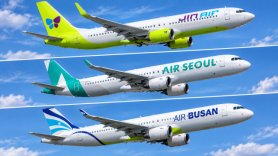
A composite illustration shows aircraft operated by Jin Air (top), Air Seoul (middle) and Air Busan (bottom), which are set to merge into a single low-cost carrier in March 2027. AI-generated image SEOUL, November 12 (AJP) - South Korea has approved the merger of three low-cost carriers — Jin Air, Air Busan and Air Seoul — clearing a major regulatory hurdle ahead of their planned integration in March 2027. The Ministry of Land, Infrastructure and Transport said Thursday it had granted conditional approval for the merger, requiring the airlines to strengthen flight safety systems and implement consumer protection measures. The Fair Trade Commission (FTC) also approved the merger, concluding that it was unlikely to restrict competition because all three airlines already belong to Hanjin Group. The approvals follow clearance from Vietnam's Competition Commission last month, completing the domestic and overseas competition reviews required for the merger. Jin Air aims to launch the integrated airline on March 17, 2027, pending approval at an extraordinary shareholders' meeting and the issuance of a unified Air Operator Certificate (AOC). Under the ministry's conditions, Jin Air must complete safety inspections related to changes in its operating systems and obtain necessary approvals from foreign aviation authorities before the merger takes effect. The airline must also submit monthly progress reports on its safety and consumer protection commitments. As part of the integration, Jin Air submitted a plan to develop Busan into its second aviation hub, expanding international operations at Gimhae International Airport. The airline plans to increase international routes from 28 to 33 and weekly flights from 281 to 339 following the merger. The ministry said it would closely monitor the integration of Korean Air's full-service and low-cost airline subsidiaries to ensure flight safety and consumer convenience. It also plans to consider measures to strengthen competition among other low-cost carriers as Korean Air's aviation group expands.
-
 Korean stocks tumble as foreign selling hits chipmakers
Graphics by AJP Song Ji-yoon SEOUL, November 16 (AJP) - South Korean stocks plunged Monday as heavy foreign and institutional selling battered semiconductor shares, leaving the benchmark KOSPI barely above 5,100 amid persistent uncertainty surrounding Nvidia's leadership transition. The KOSPI fell 3.59 percent, or 190.03 points, to close at 5,100.50, extending its losing streak to three sessions. The index traded between 5,069.83 and 5,327.99. Foreign investors sold 1.37 trillion won ($1.03 billion ) worth of shares, as institutions unloaded 464.7 billion won. Retail investors bought 1.35 trillion won but failed to offset the selling pressure. The index opened slightly higher at 5,305.40 before reversing course as foreign and institutional selling accelerated. It briefly lost more than 4 percent during the session before recovering some ground toward the close. The selloff extended last week's weakness following the resignation of Nvidia founder Jensen Huang as chief executive officer, which has raised questions about the chipmaker's future investment strategy and the broader AI supply chain. Wall Street ended Friday's session with technology shares under pressure. The Nasdaq Composite fell 0.91 percent, while the S&P 500 declined 0.40 percent. The Dow Jones Industrial Average edged up 0.10 percent. Nvidia slipped 2.01 percent, while AMD plunged 8.75 percent and Broadcom fell 4.76 percent. The Philadelphia Semiconductor Index dropped 3.43 percent, reflecting renewed concerns over the industry's outlook. Investors are now looking ahead to Nvidia's quarterly earnings announcement and Anthropic's anticipated Nasdaq listing later this week, two events that could influence sentiment toward AI-related stocks. The uncertainty has hit South Korean memory chipmakers particularly hard, as investors reassess whether the rapid expansion of AI infrastructure can sustain demand and elevated memory prices. SK hynix dropped 7.24 percent to 1,128,000 won in the supplied market snapshot, while Samsung Electronics fell 4.51 percent to 196,700 won. Samsung Electro-Mechanics plunged 8.07 percent to 786,000 won, while SK Square, a major shareholder in SK hynix, declined 9.32 percent to 691,000 won. Samsung Electronics' preferred shares fell 4.57 percent to 162,700 won, while Samsung SDI lost 2.62 percent to 465,500 won. Other actively traded stocks also struggled, with Kumho Engineering & Construction dropping 3.84 percent to 10,780 won. By contrast, KB Financial gained 0.88 percent to 160,400 won, while Naver remained unchanged at 172,500 won. Airline-related shares outperformed despite the broader market decline. Hanjin KAL rose 6.63 percent to 217,000 won, while Jeju Air gained 5.11 percent to 7,200 won and Air Busan advanced 1.56 percent to 1,823 won. The airline sector gained 3.5 percent, while leisure equipment and products rose 3.45 percent. Factory machinery shares advanced 2.78 percent, with SNT Dynamics gaining 7.93 percent to 29,950 won and Samik THK rising 4.92 percent to 7,250 won. The tech-heavy KOSDAQ fell 4.86 percent, or 34.01 points, to close at 665.65, after trading between 664.98 and 708.34. Retail investors bought 378.2 billion won worth of shares, while foreign investors sold 210.7 billion won and institutions unloaded 154.3 billion won. Semiconductor equipment and component stocks suffered sharp losses. Jusung Engineering plunged 11.07 percent to 153,400 won, while Simtech dropped 12.58 percent to 109,100 won. Jeju Semiconductor declined 10.32 percent to 53,900 won, and Hana Micron fell 15.37 percent to 24,500 won. Young KAI EMC tumbled 17.18 percent to 9,110 won, extending losses across actively traded technology-related shares. By contrast, selected venture capital and smaller technology stocks advanced. Mirae Asset Venture Investment surged 18.41 percent to 14,860 won, while Namuga jumped 30 percent to 18,850 won, reaching the daily upper price limit. Genians edged up 0.44 percent to 34,450 won, while AP Satellite gained 0.59 percent to 10,240 won. Throughout Asia, Japan's Nikkei 225 fell 2.4 percent to 59,662.02, while China's Shanghai Composite declined 0.9 percent to 3,602.57. Hong Kong's Hang Seng Index bucked the regional weakness, gaining 0.5 percent to 23,743.33. The Korean won strengthened against the dollar, with the exchange rate quoted at 1,335.20 won per dollar, down 0.21 percent. Oil prices held near recent levels as investors weighed renewed hostilities in the Middle East against signs that global crude supply was recovering. West Texas Intermediate crude gained 0.24 percent to $88.80 a barrel, while Brent crude edged up 0.1 percent to $95.91. Iran reportedly attacked a U.S. helicopter base in Bahrain on Sunday, raising fresh concerns over regional security and shipping near the Strait of Hormuz. However, the International Energy Agency projected a global oil surplus of about 2 million barrels per day this quarter as shipments through the strait gradually recovered.