
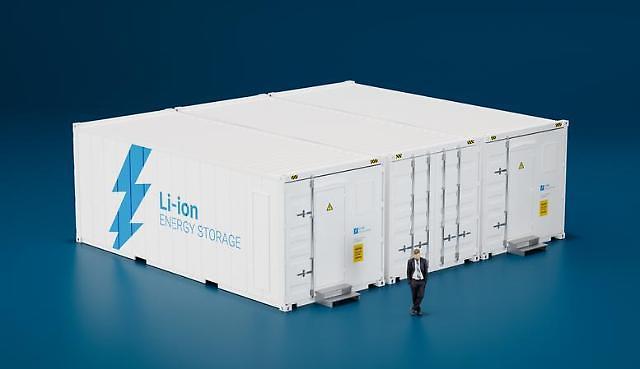
[Gettyimages Bank]
Current test centers can just test and evaluate small-sized batteries for smartphones and internet of things (IoT) devices. The Ministry of Trade, Industry and Energy said in a statement on February 3 that it would inject up to 24 billion won ($21.5 million) into the establishment of a new test center that will focus on the application of new parts and materials for battery production.
"It is vital to acquire core technologies for the production of battery parts and materials in order to nurture the secondary battery industry," an energy ministry official was quoted as saying. The ministry said research teams at the center can provide feedback and consulting services, while experts can detect and analyze problems.
South Korea is accelerating its transition to a carbon-free country by promoting clean energy. Government data showed that some 10.6 trillion won worth of secondary batteries for electric vehicles and energy storage systems were produced in South Korea last year.
Park Sae-jin
Experienced journalist and editor at AJU PRESS specializing in multilingual news. I cover international diplomacy, geolpolitics, and policy, consistently delivering highly accurate, compelling reporting for a worldwide audience.
Copyright ⓒ Aju Press All rights reserved.
Related News
-
 Samsung SDI Unveils Battery Solutions for AI Data Centers at RE+
Samsung SDI showcased battery products and power solutions for artificial intelligence (AI) data centers at a U.S. energy industry exhibition. On November 17, Samsung SDI announced its participation in the 'RE+ (Renewable Energy Plus) 2026' event, which opened in Las Vegas. RE+ is the largest energy industry exhibition in North America, with over 1,300 global companies participating and more than 40,000 expected visitors this year. At the exhibition, Samsung SDI introduced battery products and related technologies for AI data centers under the slogan 'AI Thinks, Battery Enables.' In the main hall of the Las Vegas Convention Center (LVCC), three exhibition zones were set up: energy storage systems (ESS), uninterruptible power supplies (UPS), and battery backup units (BBU). In the ESS zone, Samsung displayed its integrated ESS solution 'Samsung Battery Box (SBB)' featuring nickel cobalt aluminum (NCA) and lithium iron phosphate (LFP) prismatic batteries produced locally in the U.S. The SBB 2.0 model was designed to allow access to internal safety devices by opening the front and side doors. The prismatic battery brand 'PrismStack,' unveiled at 'Interbattery 2026' in March, was also introduced to the North American market for the first time. In the UPS zone, Samsung showcased the prismatic battery solution 'U8A3,' which met all standards in the indoor large-scale fire test (Indoor LSFT) conducted in July. According to Samsung SDI, U8A3 is the world's first product to pass this test. Additionally, the lithium manganese oxide (LMO) prismatic battery cells used in U8A3 were also revealed. The BBU zone featured a range of battery products that supply power to servers during power outages or sudden fluctuations. Products utilizing various materials from high-nickel NCA to LFP, as well as high-capacity and high-output 21,700 cylindrical batteries, were displayed. Samsung SDI also presented an integrated energy solution. Regarding the recently mass-produced SBB 2.0 at its U.S. SPE factory, it introduced a turnkey 'AC Wrap' solution that supplies not only batteries but also power conversion systems (PCS) and energy management systems (EMS). Samsung SDI emphasized that it offers a 25-year long-term warranty for its ESS products, which can help reduce maintenance and replacement costs for customers operating ESS over the long term. They also showcased the AI-based safety management system 'SBI (Samsung Battery Intelligence),' which analyzes battery status and lifespan, detecting and predicting anomalies to prevent ESS fires. An experiential space for visitors was also set up. A media kiosk allowed users to touch the screen to configure the SBB 2.0 installation environment and observe the process of power being supplied from the BBU to the AI data center. Additionally, a large LED screen introduced battery solutions, and a meeting room utilizing the SBB exterior was established for product consultations with clients. A Samsung SDI representative stated, 'With the increasing demand in the North American ESS market, the quality and safety of batteries have become more important than ever. We will combine our accumulated technological capabilities and local production capabilities to become the optimal solution partner.' Meanwhile, Samsung SDI secured over 60 GWh of battery orders in the U.S. energy storage system (ESS) market by October this year and aims to secure an additional 60 GWh by the end of the year. To meet the growing demand, it plans to utilize local production bases StarPlus Energy and Synergy Cells and gradually expand production capacity.* This article has been translated by AI.
-
 KAIST finds why battery additives backfire when mixed
Courtesy of KAIST SEOUL, November 17 (AJP) - Battery additives that each extend the life of lithium-ion cells can work against each other when combined, shortening battery life instead of protecting it, South Korean researchers have found. KAIST said Tuesday that a joint team led by Choi Nam-soon, a professor in the Department of Chemical and Biomolecular Engineering, and Seo Dong-hwa, a professor in the Department of Materials Science and Engineering, identified the chemical reaction behind the conflict and developed a new additive that avoids it. The finding matters because electric vehicle batteries are judged as much by how long they hold their capacity as by how much energy they store. A car that starts with ample driving range covers less distance on a single charge as its battery fades, and the fading accelerates in hot conditions, where unwanted chemical reactions inside the cell speed up. Additives mixed into the electrolyte, the liquid that carries lithium ions between a battery's two electrodes, are a standard defense against this decay. Added in small amounts, they form a thin protective film on the electrode surfaces that suppresses the unwanted reactions, in effect coating the inside of the battery. The film is especially important on anodes containing silicon, a material increasingly used in electric vehicle batteries because it stores large amounts of lithium. Silicon swells and shrinks sharply during charging and discharging, and when the swelling damages the film, the electrolyte breaks down again and lithium is steadily consumed to rebuild it. The battery loses capacity because less lithium remains available for charging. The researchers examined what happens when two widely used additives, lithium bis(oxalato)borate, known as LiBOB, and succinonitrile, known as SN, are used together. Each performs well on its own. In combination, the team found, a byproduct created as LiBOB breaks down triggers the unwanted decomposition of SN, which in turn blocks the formation of a stable protective film on the anode. The damaged film lacked lithium fluoride, a key protective ingredient, and electrical resistance inside the cell rose. At high temperatures the electrolyte broke down faster and lithium was consumed more quickly. Additives installed to protect the battery ended up weakening its protection. To solve the problem, the team turned to triisopropanolamine borate, or TPAB, a compound that joins an amine group and a borate group in a single molecule. Rather than mixing separate additives and hoping their chemistry stays compatible, the design builds the protective functions into one structure. In batteries using TPAB, stable protective films formed on both the cathode and the anode, suppressing the reactions that drain the electrolyte. The team confirmed the performance in high-energy cells built with the high-nickel cathodes and graphite-silicon anodes used in electric vehicles. The TPAB cells retained more capacity after repeated charging and discharging than cells using the conventional additive pair, and degraded less after long storage at high temperature. The results were obtained in laboratory test cells, and the additive has not yet been applied to commercially produced batteries. The work points to a new standard for additive development. How good each additive is on its own, the researchers argue, matters less than what the additives do to each other once they share a battery. "We showed that additives that each perform well can actually shorten battery life when used together," Choi said. "Precisely controlling the reactions between additives and building a stable protective film is the key to making batteries last." She said she expects the result to contribute to the development and commercialization of electric vehicle batteries that hold their charging capacity through long use. Lee Ki-hun and Han Seung-hee of the Department of Chemical and Biomolecular Engineering and Seo Ji-won of the Department of Materials Science and Engineering, all at KAIST, are co-first authors of the paper, which was published online in ACS Energy Letters on Oct. 19 and selected as a cover article. The research was funded by Samsung SDI, the National Research Foundation of Korea under the Ministry of Science and ICT, and the Korea Planning and Evaluation Institute of Industrial Technology under the Ministry of Trade, Industry and Energy. Journal/Source: ACS Energy Letters Title: Rational Integration of Multiple Additives for High-Temperature Lithium-Ion Batteries Link/DOI: 10.1021/acsenergylett.6c02555
-
LG Energy Solution and Samsung SDI Showcase Next-Gen Battery Technologies at RE+ 2026
Samsung SDI and LG Energy Solution are set to showcase next-generation battery technologies targeting artificial intelligence (AI) data centers and power grids at the RE+ (Renewable Energy Plus) 2026 exhibition in Las Vegas, USA. The companies aim to penetrate the energy storage system (ESS) and data center power solution markets based on local production in North America.According to industry sources, Samsung SDI and LG Energy Solution will participate in the largest energy industry exhibition in North America from November 17 to 19. Approximately 1,300 companies involved in solar energy, ESS, power grids, and electric vehicle charging infrastructure will attend the event.LG Energy Solution will emphasize integrated solutions that encompass not only battery supply but also power system construction and operation. The exhibition space has been expanded by about 20% compared to last year, covering 279 square meters.The company will introduce an 'AI Data Center Integrated Power Infrastructure' themed 'Powering Future of AI,' which combines ESS, uninterruptible power supplies (UPS), battery backup units (BBU), and energy management systems (EMS). During the exhibition, expert sessions will focus on integrating ESS systems for AI data centers and building power infrastructure.Additionally, LG Energy Solution will unveil its 'JF3 AC LINK,' an ESS product designed for power grids that utilizes lithium iron phosphate (LFP) batteries produced in the U.S. This product increases energy density per unit area by approximately 26% through high-density arrangements and incorporates digital twin and AI-based power stabilization technologies.In the realm of next-generation technologies, the company will showcase a power system that combines sodium-ion batteries with semiconductor transformers (SST), developed to ensure stable power supply despite frequent charging and discharging and rapid changes in power consumption.Other products on display include the 'JP6' rack system for UPS and the cylindrical '2170 BBU' for data centers. LG Energy Solution has secured over 50 GWh of battery production capacity in North America and is expanding its business scope from system design to operation and asset management using its ESS subsidiary, Vartek, and the software platform, Aeross Suite.Changbeom Kang, head of LG Energy Solution's ESS battery division, stated, "LG Energy Solution will accelerate its growth as an energy platform company supporting the stable growth of the future AI industry by combining local production competitiveness, differentiated technology, and intelligent operational capabilities."Samsung SDI will present its power ESS solution 'SBB (Samsung Battery Box)' and various battery types for UPS and BBU under the theme 'AI Thinks, Battery Enables.'The flagship product is the 'SBB 2.0,' an ESS solution that includes battery cells and safety devices housed in a 20-foot container, utilizing LFP batteries. Samsung SDI has improved safety and lifespan using prismatic battery technology and has recently completed establishing a local production system in North America for full-scale supply.The company will also debut its 'U8A3' prismatic battery solution for UPS in the North American market. This product, made with lithium manganese oxide (LMO) materials, has met all standards in large indoor fire tests conducted by global safety certification organization UL Solutions. It features multi-safety designs from cells to modules and racks to handle rapid power load changes in AI data centers.Additionally, Samsung SDI will showcase a cylindrical battery for BBU that achieves both high output and high capacity. The company has been supplying batteries for data centers since 2017 and is expanding its product range from high-nickel NCA to LFP.A Samsung SDI representative stated, "We will showcase locally tailored products and technologies targeting the rapidly growing U.S. market, with a strategy to lead the North American market with technologies specialized for the AI era."* This article has been translated by AI.