
Journalist

Lee Hugh
=
-
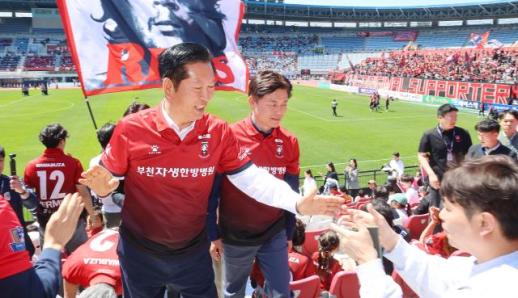 Jung Cheong-rae says timing of special counsel bill will follow public, party input Jung Cheong-rae, leader of the Democratic Party, said Monday the party will decide when to move a bill calling for a special counsel to probe alleged manipulated investigations and indictments under the Yoon Suk Yeol government after gathering views from the public, party members and lawmakers. Jung spoke to reporters after a visit to Dongducheon Big Market in Dongducheon, Gyeonggi Province. He said the party should coordinate with the presidential office, noting that on May 4 President Lee Jae-myung asked the party to determine the timing after collecting public opinion and holding deliberations. “Since the presidential office has stated its position, the party will also decide what to do by collecting lawmakers’ views through a caucus meeting and asking party members,” Jung said. At the same time, Jung reiterated his push to hold what he called “political prosecutors” accountable for actions taken under the Yoon administration and said Lee should be relieved through a special counsel probe. “If, under the Yoon Suk Yeol government, they were obsessed with taking down political opponents and suppressing the opposition and tried to indict and punish people with falsehoods or fabrication, that itself is a crime,” Jung said. He added that the Ssangbangwool remittances-to-North-Korea case and the Daejang-dong case involving Lee were “clearly” fabricated indictments and said “the victim should, of course, be given relief.”* This article has been translated by AI. 2026-05-05 16:00:13
 -
 Samsung Biologics union to shift from strike to open-ended work-to-rule campaign The Samsung Biologics labor union is ending a five-day, full-scale strike that began May 1 and will return to worksites on May 6, shifting to an open-ended work-to-rule campaign. The union is also said to be weighing an extension of the strike, raising the possibility of a prolonged dispute if an agreement is not reached soon. Industry officials said May 5 that labor and management plan to resume talks with a one-on-one meeting on May 6 between a human resources executive and the union chair, followed by a tripartite meeting on May 8 with the Labor Ministry participating. With the sides far apart, however, many in the industry say a deal remains uncertain, fueling concerns that production disruptions and losses totaling several hundred billion won could become reality. The two sides held their first tripartite meeting at 10:15 a.m. the previous day for about two hours but only confirmed their differences. They later met separately with the Labor Ministry, but did not produce additional agenda items or a concrete path forward. In a statement, the union said management asked both sides to halt all forms of labor action and to mutually withdraw legal disputes, including allegations of unfair labor practices. The union said it refused, arguing it would only lower the level of action without gaining anything in return. The union launched the company’s first full-scale strike since Samsung Biologics was founded in 2011, starting on Labor Day, May 1. Estimated losses so far are about 150 billion won to 300 billion won. If the stoppage continues, projected losses from production disruptions could reach about 640 billion won, according to estimates cited in the industry. Ahead of the planned May 1 strike, the union also abruptly halted work in some processes starting April 28. That stoppage reportedly froze a key aliquoting process, triggering knock-on disruptions across production lines and disrupting process flow. The company has reportedly selected which products to keep producing and discarded some products that were deemed likely to deteriorate. As a result, production has already been disrupted for products including cancer drugs, medicines related to human immunodeficiency virus, or HIV, and treatments for atopic dermatitis, according to the report. An industry official said biologic drugs can require an entire batch to be discarded if even one step is delayed, amplifying losses. A major sticking point is the union’s demand that the collective bargaining agreement require prior union consent for key management matters such as hiring, performance evaluations and mergers and acquisitions. The company has maintained that such provisions are difficult to accept because they directly affect management and personnel authority, viewing them as an infringement on management rights. A business community official warned that requiring prior union consent for M&A or major staffing decisions could undermine management’s ability to make decisions for future growth and could ultimately leave the company less competitive. The union plans to return to work starting the afternoon of May 6 but begin an open-ended work-to-rule campaign by refusing overtime and holiday work. It has also signaled it could launch a second strike if no agreement is reached. An industry official said the risks extend beyond direct losses from halted production, citing potential penalties for contract nonperformance, heightened scrutiny from regulators and customers switching to alternatives. The official added that in the global contract development and manufacturing organization, or CDMO, market, fast-following competitors are closing in, and delayed decision-making could cost orders. The official also said the strike risk, emerging amid an international environment of strengthening U.S. protectionism, could increase the chance of competitors benefiting at Samsung Biologics’ expense. 2026-05-05 15:49:14
 -
 South Koreans’ Crypto Holdings Halve in a Year as Stablecoin Holdings Double South Korean investors’ crypto holdings and trading volume have dropped by more than 60 trillion won over about a year, while stablecoin holdings moved in the opposite direction, more than doubling. The shift is widely attributed to money moving into a strong stock market and to a preference for dollar-linked assets amid a weak won. Data the Bank of Korea submitted on Monday to Rep. Cha Gyu-geun of the Rebuilding Korea Party, a member of the National Assembly’s Planning and Finance Committee, showed domestic crypto holdings totaled 60.6 trillion won as of the end of February. The figure sums investors’ assets at month-end market prices across the country’s five major crypto exchanges: Upbit, Bithumb, Korbit, Coinone and Gopax. Holdings surged from 50.6 trillion won in August 2024 to a peak of 121.8 trillion won in January last year, when U.S. President Donald Trump took office. They have since fallen to less than half that level in 1 year and 1 month. Average daily trading value also declined. It rose from 2.7 trillion won in August 2024 to 17.1 trillion won at the end of December that year, but stood at about 4.5 trillion won in February. Won-denominated deposits on exchanges, often seen as funds waiting to be invested, fell to 7.8 trillion won in February from 10.7 trillion won at the end of December 2024. The decline was attributed to a combination of a buoyant domestic stock market drawing investment funds and falling crypto prices. Stablecoin holdings, however, increased. They rose from 88.5 billion won at the end of July 2024 to a peak of 872.3 billion won at the end of December last year. The total eased to 607.1 billion won in February, but was still about 2.2 times the level in January last year (278.2 billion won). Industry officials pointed to stronger demand for dollar-based assets amid a high exchange rate. Kim Min-seung, head of Korbit’s research center, said fluctuations in the won-dollar exchange rate appeared to have influenced demand for stablecoin investments. He added that with most coins weakening on overseas exchanges, funds that had moved abroad may also have returned to the domestic market. * This article has been translated by AI. 2026-05-05 15:48:17
 -
 CJ Cup Byron Nelson Opens May 21 in Texas With Scheffler, K-Culture Showcase CJ Group-sponsored PGA Tour event The CJ Cup Byron Nelson will be played May 21-24 at TPC Craig Ranch in McKinney, Texas. The tournament will offer a $10.3 million purse (about 15.16 billion won) and is a full-field regular-season PGA Tour event with 144 players. The winner earns 500 FedExCup points and a two-year tour exemption, along with entry into that year’s signature events and next season’s Players Championship, plus spots in the major championships. First held in 2017, The CJ Cup has positioned itself as a global sports-and-culture platform promoting Korean food and culture. Last year, the PGA Tour honored it with a “Best Title Sponsor Award,” citing how effectively the sponsor’s brand identity and philosophy were integrated into the event. Last year’s tournament also drew attention when Kai Trump, granddaughter of U.S. President Donald Trump, visited the venue at CJ Group’s invitation. She watched play featuring Scottie Scheffler, Jordan Spieth and Si Woo Kim, then toured the “House of CJ,” a promotional complex near the 18th-hole fairway designed to showcase K-lifestyle experiences. CJ said she showed strong interest in Korean food and cosmetics. Building on that response, organizers will expand the House of CJ this year. Located in the gallery plaza, it will cover 750 square meters (about 227 pyeong), about 20% larger than last year, and will add interactive features such as augmented-reality experiences and digital challenges. On-site attractions will include a CJ Olive Young K-beauty experience zone, CJ ENM music content, ScreenX screenings, K-cocktail tastings and Tous Les Jours bakery samples. CJ will also debut a new brand, “Durumi,” to gauge global reaction to Korean street food. The bibigo concessions, another signature feature, will operate at the seventh and 17th holes. The seventh hole will follow a “chef’s dining” concept with menus developed with star chefs, while the 17th will highlight spicy special items and events. Defending champion and world No. 1 Scheffler drew notice last year when he said, “It was raining and it was a tough day, but Korean food helped me keep going.” CJ will also continue its corporate social responsibility programs. Its “Bridge Kids” junior golf development initiative, launched in 2017, will run again this year, with 16 selected junior golfers receiving mentoring such as one-point lessons from PGA Tour players and trying bibigo lunch boxes. In addition, a “Birdie Charity Program” will donate $1,000 for each birdie at the 17th hole to support mental health programs for local children and teenagers. The tournament’s distinctive winner’s trophy is also a focal point. Inspired by the metal-type book “Jikji,” the trophy is made in Hangul, with past champions’ names — including Tiger Woods and Jack Nicklaus — engraved in Korean.* This article has been translated by AI. 2026-05-05 15:45:16
 -
 NXT to Start Charging for Market Data as KRX Raises Prices, Expands Services Nextrade (NXT) is moving to charge for market data it has provided for free. With the Korea Exchange (KRX) also revamping prices and services, South Korea’s stock-market data business is entering a more direct monetization phase. According to the financial investment industry on May 5, Nextrade plans to begin charging for market data starting next March. A Nextrade official said, “NXT has provided data free of charge since launching in March last year, but we plan to switch to a paid system starting next March.” Nextrade has already signed data-supply contracts with major market-information providers in and outside South Korea and is pushing to convert previously free data into paid products. The company is expected to set its rates at about half the Korea Exchange level and expects data-business revenue to grow to 10% to 20% of total sales. It is also preparing internally, including by tightening accounting procedures. The exchange is also accelerating efforts to reorganize and expand the business through pricing adjustments and service changes, including raising prices in March for “historical data,” which provides past figures. Brokerages said it was effectively the first price increase since commercial sales of historical data began in 2017. A KRX official said revenue in the segment was 1.9 billion won in 2024, but “after the Kospi enjoyed a boom last year, including ranking first in returns among major countries’ indexes, it jumped to 4.2 billion won, up 121% in a year.” The official added, “By understanding customer preferences and offering standardized products, we improved convenience in selecting and using data by market unit.” KRX is focusing on improving delivery speed by adopting cloud-based infrastructure. It is continuing cloud upgrades this year and has also reorganized product structures. Since last year, the exchange has expanded subscription models to meet demand from customers who want daily data delivery. It has also built a system to automatically supply large-volume datasets, including order-book quotes and trade execution data, widening its service scope. To improve overseas investors’ access to data, KRX is upgrading services centered on the Korea Data Marketplace (KDM). It is also reviewing a data business based on disclosure filings and plans to introduce an XBRL-based disclosure system next year to explore ways to turn disclosures into data products. * This article has been translated by AI. 2026-05-05 15:39:14
 -
 White House: No Trump-Kim Meeting Planned During Mid-May China Trip President Donald Trump has no meeting planned with North Korean leader Kim Jong Un during his mid-May trip to China, the White House said May 4 local time. A White House official, responding to a question, said, “There is no such meeting on the schedule at this time,” Yonhap News Agency reported. The White House said Trump’s China visit is set for May 14-15, with a U.S.-China summit planned with Chinese President Xi Jinping. The White House’s use of the qualifier “at this time” indicates a North Korea-U.S. summit is not part of the official itinerary, though it does not completely rule out a separate meeting if the two sides later coordinate one. Earlier, Prime Minister Kim Min-seok said he held a roughly 20-minute surprise meeting with Trump at the White House during a U.S. visit on April 13. Kim told a meeting with South Korean correspondents that Trump said, “It would be great to meet (Kim Jong Un). But it could be when I go to China this time, or it might not be, or it could be after that,” Kim recounted. * This article has been translated by AI. 2026-05-05 15:33:13
 -
 Korean court orders matchmaking client to pay marriage fee and penalty despite quitting A Seoul court has ruled that a matchmaking service member must pay a contracted marriage “success fee” even after quitting over alleged personal data exposure. The court also said the member owed a penalty for failing to notify the company of the marriage. According to legal officials on May 5, Judge Bang Chang-hyeon of the Seoul Central District Court, sitting alone in Civil Division 83, ordered B to pay matchmaking company A a success fee of 11.88 million won and a penalty of 35.64 million won, for a total of 47.52 million won, in a lawsuit seeking payment under the contract. B signed a membership contract on Sept. 14, 2022, to receive five introductions over one year and to pay 11.88 million won within two weeks once a marriage was confirmed. The contract also said the fee was due even if the marriage resulted from meetings after the contract period or after the five introductions, and that failure to report a marriage would trigger payment of three times the success fee. B met C, a member of an A affiliate, in January 2023 and married in June that year, but did not inform A. A then sued for the success fee and the penalty. B argued the contract had been mutually terminated by agreement in May 2023, but the court rejected the claim. The judge said it was acknowledged that B’s father protested what he said was disclosure of B’s personal information and, acting as B’s representative, expressed an intent to withdraw, and that A said it would process the withdrawal. However, the court said there was no evidence to treat that as a legal mutual termination of the contract. The court found B had made an ordinary “membership withdrawal,” but said that did not eliminate the duty to pay the success fee. It cited the one-year service period, the time it typically takes for a couple to marry after first meeting, and B’s agreement at signing to pay even if the marriage occurred after the contract period. On the penalty, the court treated the clause as a contractual punitive provision and said B owed it because the success fee was not paid. The judge said the success fee functioned as a deferred payment for services and that the company needed a way to indirectly enforce payment, especially because it would be difficult to learn of a member’s marriage without notification. The court also dismissed B’s claims that A unlawfully leaked personal information and that, contrary to the financial information provided at signup, A supplied false or exaggerated details about salary and assets, leading to serious conflict with C’s family during the formal meeting between families. The judge said there was no evidence to support those assertions. The court said it was recognized that in June 2019 B completed a personality test on A’s website and agreed to the collection and use of personal information, including arranging meetings with affiliate members. It added that A provided information about B’s salary and assets based on what B entered at signup. Even if B’s claims were true, the court said, A did not provide B’s information to unrelated parties or profit-seeking companies, but to C’s side, a potential marriage partner. The judge added that the marriage was not broken off due to the information provided and that because B and C ultimately married, B could not belatedly raise alleged data exposure or false or exaggerated information to resist A’s claims. * This article has been translated by AI. 2026-05-05 15:31:25
 -
 Trump Warns Iran Over Strait of Hormuz Attacks, Urges South Korea to Join Maritime Operation The monthlong ceasefire between the United States and Iran is showing signs of strain as the two sides fail to narrow differences despite behind-the-scenes talks. With reports that a South Korean ship in the Strait of Hormuz was hit in an Iranian attack, President Donald Trump publicly urged South Korea to join a U.S.-led maritime operation in the waterway. On May 4 (local time), The Guardian and other outlets reported that Trump, in an interview with Fox News, warned Iran over “Project Freedom,” an operation to help merchant ships trapped in the Strait of Hormuz escape. “If they’re going to target U.S. ships, Iran’s military will disappear from the face of the Earth,” he said. Trump called the U.S. maritime blockade of Iran “one of the greatest military operations ever carried out,” and said Iran had recently become far more flexible in negotiations. He said the outlook was either reaching an agreement through “good-faith negotiations” or resuming military operations, stressing that both diplomatic and military options remain on the table. The U.S. military said that day it intercepted Iranian cruise missiles, drones and attacks by armed small boats while supporting the passage of two U.S.-flagged vessels through the strait. Trump also wrote on his social media platform, Truth Social, that U.S. forces sank seven Iranian small boats. Trump directly mentioned South Korea, saying Iran had fired several times at “unrelated countries,” including a South Korean cargo ship, in connection with ship movements tied to Project Freedom. He said no other ships transiting the strait had suffered damage at this point, aside from the South Korean vessel. “It seems like it’s time for South Korea to join this operation,” he said. The remarks appeared to refer to the HMM Namu, a ship that was in the Strait of Hormuz when a fire broke out. Trump reiterated a similar stance in an interview with ABC News. According to a call transcript posted on X by reporter Jonathan Karl, Trump said there had been multiple shots fired at a South Korean ship and that South Korea “needs to take action in some way.” He added that the South Korean ship had been sailing alone and was not under escort. South Korea’s government, however, has continued to take a cautious approach to dispatching forces to the Strait of Hormuz or joining a U.S.-led coalition. Iran’s Mehr News Agency said on April 29 that South Korea had been seeking a careful balance among U.S. pressure, energy security, humanitarian considerations and the need to keep communication channels with Tehran open. Iran resumes attacks on UAE after 1 month Iran also carried out its first attack against the United Arab Emirates since the May 8 ceasefire with the United States, heightening regional трев. The UAE Defense Ministry said it detected four cruise missiles launched from Iran, intercepted three over its territorial waters and said the fourth fell into the sea. Fujairah’s media office said in a statement that civil defense teams were immediately deployed to extinguish a fire in the Fujairah Oil Industry Zone, and that three Indian nationals suffered serious injuries and were taken to a hospital. The developments fueled speculation that Iran resumed attacks on the UAE in response to the U.S. launch of Project Freedom to help ships leave the Gulf. The UAE has recently moved closer to the United States after declaring it would withdraw from the Organization of the Petroleum Exporting Countries, or OPEC. Bloomberg Economics researcher Beca Wasser said the episode showed the U.S.-Iran ceasefire is “very fragile,” and that the most likely scenario is a prolonged period of sustained tension with intermittent clashes. Inside Iran, reports said hard-liners and moderates differ over how to respond to the United States. Foreign Minister Abbas Araghchi, who is leading Iran’s negotiating team with Washington, urged both sides to halt armed conflict. In a post on X, he said events in Hormuz “clearly show there is no military solution to a political crisis,” and warned the United States not to be pulled back into a quagmire by “malicious forces,” adding that the UAE should also be cautious. He also criticized the U.S. operation, saying “Project Freedom is nothing but Project Deadlock.” 2026-05-05 15:25:29
 -
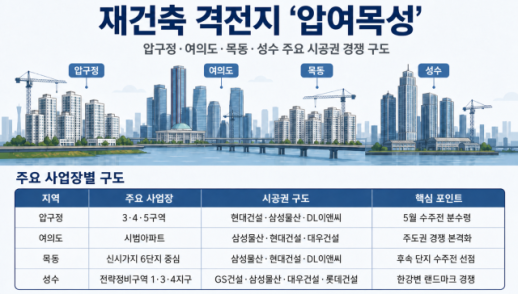 Seoul’s ‘Ap-Ye-Mok-Seong’ rebuild zones set off fierce contractor battles Seoul’s top redevelopment districts — Apgujeong, Yeouido, Mok-dong and Seongsu — are moving into full-scale contractor selection. Known collectively as “Ap-Ye-Mok-Seong,” the areas sit along the Han River and major residential corridors, making them a focal point for builders’ brand competition. As of May 5, the industry said 12 key projects in these districts have either selected a builder this year or are preparing to do so: Apgujeong Districts 3, 4 and 5; Yeouido’s Sibeom Apartments; Mok-dong Complexes 5, 6, 10 and 14; and Seongsu Strategic Redevelopment Zones 1, 2, 3 and 4. Combined, the projects are estimated at about 26 trillion won and more than 35,000 households. In Apgujeong, the contests for Districts 3, 4 and 5 are reaching a May turning point. Hyundai Engineering & Construction has been named preferred bidder for Apgujeong District 3, a project to rebuild 3,934 existing households into 5,175. The construction cost proposed by the association alone totals 5.561 trillion won. Hyundai secured preferred-bidder status after two solo bids led to a shift toward a negotiated contract, though the final builder must still be approved at a members’ meeting. Apgujeong District 4 is increasingly likely to move to a negotiated contract after Samsung C&T submitted the only bid. The project, covering the area around 481 Apgujeong-dong in Gangnam-gu, carries construction costs in the 2.1 trillion won range. Samsung C&T is highlighting cooperation with British design firm Foster + Partners and a financing partnership framework. Apgujeong District 5 has shaped up as a head-to-head between Hyundai Engineering & Construction and DL E&C, with the project cited at about 1.5 trillion won. Hyundai is emphasizing its “The H” brand and the symbolic status of Apgujeong Hyundai Apartments. DL E&C is promoting its “Acro” brand and terms it says would reduce members’ burden, including a fixed construction price, lower financing costs and higher revenue from general sales. A contractor-selection meeting is expected later this month. In Yeouido, Sibeom Apartments is drawing the most attention. The project would rebuild 1,584 households into 2,493 units in towers up to 65 stories, with total costs estimated at around 1.5 trillion won. Samsung C&T, Hyundai Engineering & Construction and Daewoo E&C are said to be interested. In earlier Yeouido deals, Samsung C&T won Daegyo Apartments, Daewoo E&C won Gongjak Apartments and Hyundai Engineering & Construction won Hanyang Apartments. The Sibeom outcome is widely seen as a key factor in who leads Yeouido’s redevelopment drive. In Mok-dong, the first contractor selection for the 14 Sinshigaji complexes is coming into view, led by Mok-dong Complex 6. DL E&C submitted a bid proposal aimed at a negotiated contract, moving closer to securing the job. The plan would rebuild the site into 14 buildings ranging from two basement levels to 49 stories above ground, totaling 2,173 households. The project is valued at 1.2129 trillion won. The association plans to hold a contractor-selection meeting on June 27. Seongsu Strategic Redevelopment Zone is also in focus as a potential high-rise residential belt along the Han River. Zone 1 has selected GS E&C as builder. The project covers 194,398 square meters in Seongsu-dong 1-ga, with plans for 17 buildings from four basement levels to 69 stories above ground and 3,014 households. The planned construction cost is 2.154 trillion won, the largest among the four Seongsu zones. GS E&C proposed the new complex name “Rivenic Xi.” For Seongsu Zone 3, a solo bid by Samsung C&T has been discussed as a possibility. The project would build 2,213 households in Seongsu 2-ga 1-dong. It slowed for a time over the selection of a designer but has resumed procedures after a re-tender. Seongsu Zone 4 had been a contest between Daewoo E&C and Lotte E&C, but uncertainty has grown after an earlier bid was invalidated and the process moved to re-bidding. Zone 4’s construction cost is valued at 1.3628 trillion won. Industry officials said the decisive factors in this year’s Ap-Ye-Mok-Seong contests are likely to be brand, design and financing terms. With construction costs rising to around 10 million won per 3.3 square meters, proposals are increasingly judged on how much they can reduce the burden on association members. In major projects in Apgujeong, Seongsu and Yeouido, key criteria now include not only high-end branding but also guaranteed completion, project financing, relocation-loan terms and plans to maximize revenue from general sales. A representative of a major construction company said, “Ap-Ye-Mok-Seong is a market where the issue goes beyond winning a single project — it’s about whether a builder can create a branded town in Seoul’s core locations,” adding, “With construction-cost burdens rising, members have no choice but to weigh financial stability and project terms along with the brand.” 2026-05-05 15:05:50
 -
 South Korea's annual labor hours drop to 1,739 by 2030: data SEOUL, May 05 (AJP) - South Korea is projected to reduce its annual labor hours to 1,739 by 2030, a shift that signals the nation's gradual departure from a culture of long-duration work toward global standards, data released by the Ministry of Employment and Labor showed Tuesday. The trajectory, identified in a report by the Korean Association of Industrial Relations, meets the objective of the lbor ministry to align with the average of the Organisation for Economic Co-operation and Development. It marks a significant move for a country that has historically maintained one of the most grueling work schedules in the developed world. Progress has already been substantial, according to recent data. Annual work hours dropped from 1,996 in 2017 to 1,859 in 2024, representing a reduction of 137 hours over a seven-year period. This decline stems primarily from legal reforms, including the implementation of the 52-hour maximum work week and the wider adoption of the five-day system. These measures successfully targeted long-duration labor by reducing the number of employees working far beyond the standard 40-hour limit. Despite the improvement, the report warns that the current pace may be difficult to maintain. South Korea still ranks sixth for the longest working hours among 37 OECD member states, trailing only nations such as Mexico, Colombia, and Costa Rica. A primary obstacle remains the structural rigidity of the South Korean labor market. Over 53 percent of the workforce is concentrated in a strict 40-hour weekly schedule, a lack of diversity that researchers say prevents further natural reductions. In contrast, only 12.5 percent of French workers and 30.9 percent of German workers follow such a uniform pattern. Within the European Union, only Luxembourg and Portugal show a similar concentration of 40-hour work weeks, at 55.4 percent and 57.3 percent, respectively. Cultural norms regarding leisure further complicate the transition. While nearly 50 percent of the workforce in major European nations takes leave during the summer, only 3 percent of South Korean workers do the same. The disparity is often attributed to office environments where employees feel pressured to avoid taking consecutive days off. To address this, the report suggests the government must expand the range of available work arrangements and foster a culture where workers can fully utilize their annual leave. Researchers also emphasized the need to protect industrial output during this shift. The report argued that a simple cap on hours is insufficient and that the government must ensure shorter hours are paired with increased efficiency to prevent a drop in national productivity. The Ministry of Employment and Labor established a dedicated task force for reducing actual working hours in September last year. It followed this with a joint declaration and a specific policy roadmap in December. 2026-05-05 15:05:17