
Journalist

Lee Hugh
=
-
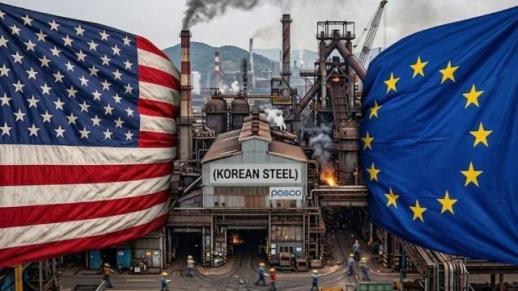 Double tariff whammy hits Korean steel as EU barriers pile on top of U.S. tariffs SEOUL, April 15 (AJP) - When it rains, it pours for South Korean steelmakers as they face collateral damage from higher trade tariffs in Europe on top of U.S. duties aimed at curbing cheap Chinese imports. The European Parliament and the Council of the EU hammered out a deal on Monday (local time) after late-night negotiations, setting tariff-free quotas at 18.3 million tons per year — nearly halved from about 35 million tons permitted under the current safeguard regime. Imports exceeding the cap will face a 50 percent duty, up from 25 percent. The measures, pending formal endorsement and a plenary vote expected in May, are set to take effect on July 1. The agreement also introduces a "melt and pour" traceability rule requiring importers to prove where raw steel was first smelted and cast — a provision targeting steel from overcapacity countries, chiefly China, routed through third-party processing. "We cannot afford to turn a blind eye to global overcapacity reaching critical levels," said EU Trade Commissioner Maros Sefcovic. Global steel overcapacity is projected to reach 721 million tons by 2027, more than five times the EU's annual consumption. Whether the target is primarily China, the blow nevertheless falls hard on South Korea. The EU bought $3.71 billion worth of South Korean steel in 2025, making it the country's largest export market — down from $4.48 billion in 2024, according to the Korea International Trade Association. South Korea shipped about 3.31 million tons to the bloc last year, of which about 2.58 million tons entered duty-free under country-specific quotas. EU posed as relief to the U.S. that has been imposing 50 percent levies on steel and aluminum imports from June last year. The new EU framework resets baseline quotas to 2013 import levels — well before the global oversupply cycle intensified — meaning Seoul's allocation is expected to shrink significantly. Korean steelmakers are still reeling from the U.S. blow. POSCO and Hyundai Steel, the country's two dominant producers, are estimated to have paid a combined $281 million in U.S. tariffs between March and December 2025. Korean steel exports to the United States have since plummeted after tariffs were doubled to 50 percent in June, with demand described by industry sources as "nearly depleted." The pressure compounds a longer-running squeeze from cheap Chinese steel flooding global markets. At home, Hyundai Steel ran two rounds of early retirement programs in 2025 and permanently closed half of its rebar capacity at its Incheon plant in January, shuttering a 90-ton electric furnace as the domestic construction slump deepened. In November 2025, the National Assembly passed the K-Steel Act, a 570 billion won support package to fund industry restructuring and bolster exports. But with the EU now confirming the tariff overhaul that had been under discussion since last October, pressure on Seoul to secure favorable quota terms has intensified. "Korean steel exports to the EU were already constrained within existing quotas, with limited room to expand," said Lee Jae-yoon, senior research associate at the Korea Institute for Industrial Economics and Trade. "With the U.S. market effectively shut and domestic demand still weak, the EU should have been a growth outlet — but these new protective measures, combined with the EU Carbon Border Adjustment Mechanism, are closing that window." The double tariff squeeze has nonetheless forced a strategic pivot toward the United States. POSCO acquired a 20 percent stake worth $582 million in Hyundai Steel's planned $5.8 billion electric arc furnace mill in Louisiana, with commercial production expected in 2029. POSCO has also signed a strategic partnership memorandum with Cleveland-Cliffs, the second-largest U.S. crude steel producer, though the company said in a March regulatory filing that no final decision on equity participation or investment size has been reached. The EU's move is driven by a broader structural strain. European steel capacity has shrunk by 65 million tons since 2007, with about half of that loss since 2018. The sector operates at around 67 percent capacity — well below the 80 percent considered healthy — while import penetration hit a record 29 percent in the third quarter of 2025. Lee said Korean steelmakers will ultimately need to pivot toward green steel to navigate the tightening trade environment. Building production facilities in Europe — unlike in the United States — holds little commercial appeal, given the continent's own supply glut. "The U.S. offers higher prices, high energy costs that keep out cheap imports, and insufficient domestic capacity — making it attractive for investment," Lee said. "Europe is the opposite. It already has overcapacity, so there is little merit in setting up local production just to avoid tariffs." The Korean government is also moving to cushion the blow. Seoul has been in continuous contact with Brussels since the European Commission first unveiled the proposal in October, and has maintained those channels since Monday's agreement. "We have been in constant dialogue with the EU since the initial proposal, and remain in close contact regarding the steel tariff and quota framework. No tangible agreement on Korea's specific allocation has been reached yet," a spokesperson for the Ministry of Trade, Industry and Energy said. 2026-04-15 14:36:45
 -
 American YouTuber gets 6 months in prison over multiple bizarre offenses SEOUL, April 15 (AJP) - American YouTuber Johnny Somali, who stirred controversy with a series of bizarre behaviors including insulting a statue in central Seoul symbolizing victims of Japan's wartime sexual slavery, was sentenced to a prison term on Tuesday. The Seoul Western District Court handed down a six-month prison term along with 20 days of detention to Somali, whose real name is Ramsey Khalid Ismael, on charges including obstruction of business and the distribution of false information through graphic photos and provocative images. The court also banned him from being hired by institutions related to children, adolescents, and people with disabilities for five years. Wednesday's ruling came after prosecutors in February sought a three-year prison sentence for his offenses including kissing the statue, causing disturbances on public buses and subways, and streaming obscene videos online in 2024, among others. "He was found guilty of all charges," the court said, adding that he repeatedly committed crimes for personal profit through online platforms, calling them as a "serious disregard for South Korean law and order." The court, however, exercised some leniency in its sentencing, taking into consideration that he had been unable to return to his home country for an extended period under a travel ban. Somali told the court that he regretted his actions and wanted to apologize to the South Korean public. 2026-04-15 14:28:32
 -
 International Symposium to Reassess Video Art Pioneer Nam June Paik Marks 20th Anniversary of Death Korea Arts Council (ARKO) and the Nam June Paik Art Center will jointly host an international academic symposium, “Paik After Paik,” on April 23 at the ARKO Arts Theater Grand Theater in Seoul, ARKO said Tuesday. The event marks the 20th anniversary of the death of video art pioneer Nam June Paik (1932-2006). Nine leading researchers from South Korea and abroad will review the state of Paik scholarship built over the past 60 years and discuss how his legacy can be reinterpreted within contemporary debates on art, technology and culture. Organizers said the symposium approaches Paik not as a closed historical subject but as a field of inquiry that continues to be reshaped within today’s technological environment and systems of knowledge. The program includes a keynote address, two sessions and a panel discussion. The keynote will be delivered by Hannah Higgins, a professor at the University of Illinois Chicago, who will revisit Paik’s experiments in the 1960s by linking them to conditions of learning and knowledge production in the age of artificial intelligence. Session 1, “The Structural Terrain of Paik Studies,” will examine research methods and institutional foundations with a focus on curatorial practice, media theory and archives. Participants are Lee Sook-Kyung, director of the Whitworth at the University of Manchester in the U.K.; Lev Manovich, distinguished professor at the CUNY Graduate Center; Hannah Fajersztajn, collection coordinator for the Nam June Paik Archive at the Smithsonian American Art Museum; and art historian Son Boo-kyung. Session 2 will broaden discussion by connecting Paik to 21st-century themes including data science, machines and labor, posthumanism and transnational cultural practice. Participants are Woo Jung-a, a professor at Pohang University of Science and Technology; Douglas Barrett, an assistant professor at Syracuse University; Lee Hyun-ae, an academic research professor at Chung-Ang University; and Jun Okada, an associate professor at Emerson College. ARKO and the Nam June Paik Art Center said the symposium aims to build an international research network linking scholars, arts institutions and archives. It is their first joint academic project under a memorandum of understanding signed in December 2025, and organizers said it will serve as a starting point for cooperation including archival research, journal publication and international researcher exchanges. ARKO Chairman Chung Byung-kuk said he hopes the symposium, through cooperation with the Nam June Paik Art Center, will help expand Paik research. “ARKO will continue to support efforts to invigorate discourse in the visual arts,” he said. Park Nam-hee, director of the Nam June Paik Art Center, said the symposium will review accumulated scholarship and rethink it in light of contemporary technological environments and conditions of knowledge. She said she hopes it will encourage audiences to see Paik not only as a historical figure but as an open subject of research shaping the present and future. The symposium is free and open to the public, with advance reservations recommended. More information is available on the ARKO and Nam June Paik Art Center websites. * This article has been translated by AI. 2026-04-15 14:27:25
 -
 Korean Films ‘Hope,’ ‘Colony’ and ‘Dora’ Invited to Cannes as Park Chan-wook Named Jury President Despite the box-office success of the film 'The Man Who Lives With the King,' the broader Korean film industry remains under strain. Against that backdrop, three Korean films — 'Hope,' 'Colony' and 'Dora' — were invited to the 79th Cannes Film Festival, and director Park Chan-wook was appointed president of the competition jury. The most prominent selection is director Na Hong-jin’s 'Hope.' Cannes included the film in its competition lineup, announced April 9 as part of the festival’s official selection. The competition section is Cannes’ centerpiece, bringing together the year’s most closely watched films. It is Na’s first time in Cannes’ main competition. Since his debut with 'The Chaser,' he has maintained ties with the festival through films including 'The Yellow Sea' and 'The Wailing.' The new film also marks his first release in 10 years since 'The Wailing,' adding weight to its competition berth. Director Yeon Sang-ho’s 'Colony' was also invited, landing in the Midnight Screenings section. That program spotlights genre films — including action, thriller, horror, noir and fantasy — that combine craft with broad appeal. Yeon has been selected by Cannes again following 'The King of Pigs,' 'Train to Busan' and 'Peninsula.' Another Korean entry is director Jung Joo-ri’s 'Dora,' invited to the Directors’ Fortnight. The Fortnight’s organizing committee announced the selection on April 14. The noncompetitive section, founded by the French Directors Guild, is known for highlighting distinctive new voices. Artistic director Julien Rejl described 'Dora' as a free and original film inspired by Freud’s early 20th-century “Dora” case, exploring a young woman’s desire — and the passion and confusion that follow — within the context of Korean cinema. Jung’s debut feature 'A Girl at My Door' was invited to Cannes’ Un Certain Regard in 2014, and 'Next Sohee' was selected as the 2022 Critics’ Week closing film. With 'Dora,' all three of her feature films have been invited to Cannes. 'Dora' follows two wounded characters as they are swept into a complex emotional spiral. The film has drawn attention for pairing singer-actor Kim Do-yeon with Japanese actor Sakura Ando. It is an international co-production that received investment and production support from France, Luxembourg and Japan. Park’s appointment further underscores Korea’s presence at this year’s festival. Cannes named Park president of the 79th competition jury, saying it is the first time a Korean has held the post. Park has long been associated with Cannes through films including 'Oldboy,' 'Thirst' and 'Decision to Leave.' Having attended Cannes as an award winner, a competition director and a juror, he will now lead the panel that decides the top prizes. The Cannes invitations alone are unlikely to resolve the industry’s difficulties. Still, as the downturn continues, the festival’s renewed attention to Korean films is being welcomed, and this year’s lineup is expected to prompt a fresh look at where Korean cinema stands now.* This article has been translated by AI. 2026-04-15 14:21:27
 -
 Seo Dong-ju Shares Feelings After Missed Miscarriage Surgery Broadcaster Seo Dong-ju has spoken publicly about how she has been coping after a missed miscarriage. On April 14, Seo posted a video titled “How Seo Dong-ju Heals Grief Through Drawing” on her YouTube channel, “Seo Dong-ju’s Tto.Do.Dong.” In the video, Seo said it had been four days since she underwent a curettage procedure and that she was doing well. “After a few days, I feel a lot better,” she said, adding that she cried less than she expected and has been improving as each day passes. Seo said she is now in a stable condition. “After going through it, it wasn’t a big deal,” she said. “If anyone is in a similar situation, I hope you don’t worry too much. With time, you can endure it, and you’ll be OK.” She said she did not want to spend too long crying or holding on to negative energy. Seo said she had spent the past two months eating well and trying to keep positive thoughts, and she did not want that effort to go to waste. With her next cycle approaching, Seo said she worried that sinking into sadness could harm both her physical and mental health. “So I tried, no matter what, to keep myself enjoying life,” she said, adding that she has been trying to eat even healthier, take walks and get plenty of rest. Her husband said Seo is “mentally very strong,” and that watching her get through it gave him strength. He added that the period had been harder for him than for her. Seo, the daughter of late comedian Seo Se-won and broadcaster Seo Jeong-hee, married a Korean American man in 2010 and divorced in 2014. She remarried in June last year to a non-celebrity man four years younger than her.* This article has been translated by AI. 2026-04-15 14:09:25
 -
 Kona I Posts 94% Jump in Q1 Operating Profit on Premium Metal Card Exports Fintech company Kona I said Tuesday it posted first-quarter consolidated revenue of 76.6 billion won ($766 billion) and operating profit of 24.6 billion won. Revenue rose 31.3% from a year earlier and operating profit jumped 94%, the company said. The card industry typically sees weaker volumes early in the year because overseas financial institutions place orders in cycles, but Kona I reported double-digit growth in both revenue and profit. Kona I said expanded exports of premium metal cards drove the results, citing steady growth in demand for high-end cards globally even as mobile payments spread. Its payments platform business also grew, the company said, as the central government expanded budget support for local currency programs. Kona I said it maintained its operating base in major local governments including Gyeonggi Province and expanded the platform to new areas including Jincheon, Sejong, Chungju and Sangju, boosting transaction volume. The company said its shift to an open platform also helped, as it broadened links with mobile payment services such as Naver Pay and Kakao Pay and diversified rewards. Chief Executive Cho Jeong-il said both overseas exports and the domestic platform business posted meaningful year-on-year growth. He said the company expects growth momentum to continue for the full year, noting that global card volumes tend to be concentrated in the second half. * This article has been translated by AI. 2026-04-15 13:57:37
 -
 OPINION: Set aside the ghost whispers — it is time for Iran and Israel to speak directly Wars in the Middle East are often described in terms of missiles, airstrikes and troop movements. Yet much of the region’s conflict unfolds elsewhere — in the shadows of diplomacy, through intermediaries, and in signals that are never formally acknowledged. This quieter dimension might be called “ghost whispering”: the informal, deniable channels through which states exert pressure, shape perceptions and influence outcomes without direct confrontation. For decades, the confrontation between Iran and Israel has operated within this framework. It has been a conflict sustained not only by open hostility, but by a system that allows both sides to act without fully committing to war — or to peace. Public diplomacy and private signaling rarely align. States project restraint in official forums while pursuing leverage through proxies, intelligence operations and selective escalation. Iran has extended its influence through regional networks — from Lebanon to Gaza and beyond — enabling it to apply pressure without direct engagement. Israel, for its part, has relied on pre-emptive strikes, covert operations and deterrence to contain perceived threats before they consolidate. This model has proved durable. It reduces the immediate costs of confrontation while allowing strategic competition to persist. But it also has a consequence: it delays resolution. Israel’s strategic posture is often framed as ideological. In practice, it is also deeply structural. The country’s geography — narrow, exposed and lacking strategic depth — has long encouraged a doctrine of anticipatory defense. At its narrowest point, Israel is little more than 15 kilometers across. In such conditions, waiting for threats to fully materialize is rarely seen as an option. History reinforces this logic. The experience of displacement and persecution, culminating in the Holocaust, has embedded a powerful assumption: security cannot be outsourced. Yet this logic exists alongside another, equally entrenched narrative. For Jews, the land represents a historical return. For Palestinians, it is a lived continuity. The events of 1948 — independence for Israel, catastrophe for Palestinians — did not resolve this contradiction. They institutionalized it. The result is not simply a territorial dispute, but a conflict of memory, identity and legitimacy. Such conflicts are not easily settled through conventional diplomacy. For years, indirect confrontation provided a form of stability. Proxy actors absorbed much of the conflict, allowing the principal states to avoid sustained direct engagement. That distance is now narrowing. Recent cycles of escalation — including direct exchanges and a widening geographical scope — suggest that the informal boundaries governing the conflict are weakening. The consequences are no longer confined to the region. Energy markets, shipping routes and global financial conditions now react almost immediately to developments in the Gulf. A conflict once buffered by distance is becoming harder to contain. The obstacles to resolution are well known, and remain largely unchanged. Jerusalem, central to three major religions, resists simple partition. Israeli settlement expansion complicates territorial compromise. Palestinian political fragmentation limits the possibility of unified negotiation. Even where frameworks for peace exist, their practical implementation has become increasingly difficult. “Ghost whispering” has allowed the conflict to be managed. It has not allowed it to be resolved. Indirect pressure, strategic ambiguity and proxy warfare can sustain a balance of sorts. But they also create a system in which escalation is possible without accountability, and de-escalation is difficult without direct engagement. In that sense, the same mechanisms that have prevented full-scale war have also prolonged instability. Iran and Israel have existed in mutual hostility since 1979. Over time, that hostility has become embedded — less a temporary condition than a structural feature of regional order. Reversing it will require more than incremental adjustments. The core disputes — nuclear capability, regional influence, territorial claims — are too complex to be resolved quickly. But the current model, built on distance and deniability, is approaching its limits. A shift toward direct engagement, however tentative, may be the only viable starting point. Without it, the conflict will remain mediated through others — and extended by that mediation. The Middle East has long been shaped by what is said in private and denied in public. The next phase may depend on whether its principal actors are willing to reverse that equation. *The author is a columnist of AJP. 2026-04-15 13:55:17
 -
 Ryu Ji-hyeon to Lead South Korea Baseball Team Through 2026 Asian Games Ryu Ji-hyeon, who guided South Korea to its first World Baseball Classic quarterfinal in 17 years at the 2026 tournament, is set to remain in charge through the 2026 Aichi-Nagoya Asian Games in September. The Korea Baseball Softball Association said Tuesday that it selected Ryu as the top candidate to manage the Asian Games national team after an open recruitment process for coaches to be sent to this year’s age-group international competitions. The association held a meeting of its performance improvement committee on April 10 and conducted interview evaluations. Ryu received favorable marks across the criteria, including the detail of his national team operations plan, analytical ability and leadership, according to the association. If his appointment is finalized following board approval and other procedures, Ryu will lead the team at the 2026 Aichi-Nagoya Asian Games, to be held in Japan from Sept. 21 to 27. South Korea has won four straight Asian Games baseball gold medals, from the 2010 Guangzhou Games through the 2022 Hangzhou Games held in 2023. Association President Yang Hae-young said the selection focused on choosing a capable coach with transparency and fairness as the top priorities. He said the association will move quickly to assemble the coaching staff and select players once the remaining approval steps are completed.* This article has been translated by AI. 2026-04-15 13:39:00
 -
 KPGA Tour Opens April 16 in Chuncheon as Ok Tae-hoon, Jang Yu-bin Lead Field The 2026 Korea Professional Golfers’ Association Tour opens with the 21st DB Insurance Promy Open. The tournament, with a total purse of 1 billion won, will be played April 16-19 at Lavieest Belle Golf & Resort’s Old Course (par 72) in Chuncheon, Gangwon Province. The winner earns a three-year tour exemption (2027-2029) and 1,000 Genesis Points. It is the KPGA Tour season opener for the 12th time, held in that role from 2014-2019 and from 2021-2026. Title sponsor DB Insurance has been a tour title sponsor for the 21st time since starting with the 48th KPGA Championship, the Dongbu Fire Promy Cup, in 2005. A main storyline is the showdown between Ok Tae-hoon and Jang Yu-bin, who dominated the tour after winning the Genesis Grand Prize in 2025 and 2024, respectively. Ok, who won three times last year and made the cut in all 18 events while also taking the money title, the low-scoring award and the most improved player honor, said he is focused on steady execution. “Last year was such a great year, so of course I’d like to have good results again this year,” Ok said. “But things don’t always go the way you want, so I’ll just do my best with what I’m given.” He added, “My season goals are to make the cut in every event and win three times.” Ok said his putting has been off recently. “I thought I was putting poorly, but I think it was because my distance control wasn’t right,” he said. “If I putt well this week, I think I can get a good result.” Jang, who won twice in 2024 and became the first player in KPGA Tour history to surpass 1 billion won in season earnings, returns to the domestic tour after moving to LIV Golf following the end of the 2025 season. “My goal this season is the Genesis Grand Prize,” Jang said. “I think the most important thing is to go back to basics and stay focused every tournament. I used training camp to work on getting my swing feel and performance back, and my condition has improved a lot. I’ll show the fans a good side of me.” He said he plans to focus on execution rather than results in the season’s first event. “As it’s the first tournament of the season, I’ll focus more on carrying out what I prepared than on the pressure of results,” Jang said. “My goal is to build momentum with steady course management and start the first event on a positive note.” Defending champion Kim Baek-jun also draws attention as he tries to repeat. Kim won last year at 11-under 273 for his first career title, coming in his 19th start on tour. Kim, who listed multiple wins and the Genesis Grand Prize as his goals this season, said the title defense brings both excitement and nerves. “It’s my first time defending a title, so I feel excited and at the same time nervous,” Kim said. “It’s a course where I won my first title, so I have good memories. I really want to successfully defend.” He added, “I got through last season without a second-year slump, so as I prepared for this season I also felt pressure that I have to do even better. But I prepared well in the offseason, so I’m looking forward to it.” Sponsor-backed player Kim Hong-taek is another to watch. He tied for fifth two weeks ago at the Asian Tour’s International Series Japan. “Because it’s my main sponsor’s tournament, I’m more excited than for other events,” Kim Hong-taek said. “Last year I couldn’t finish because of a back injury, and that was very disappointing. That’s why I paid more attention to taking care of my body this year. I’ll do my best with the goal of winning this tournament.” Park Sang-hyun, the career leader in domestic prize money, will try to become the first player to surpass 6 billion won in domestic KPGA Tour earnings. Park has played 235 events and has earned 5,893,724,057 won, leaving him 106,275,943 won short of 6 billion won. He also won twice last year, setting a KPGA Tour record for multiple wins by a player in his 40s for the first time in 20 years. Past winners including Moon Do-yeob, Bae Yong-jun, Park Seong-guk, Jeon Ga-ram, Choi Seung-bin and Kim Jae-ho are also in the field, setting up a competitive start to the 2026 season.* This article has been translated by AI. 2026-04-15 13:24:00
 -
 First meeting on next year's minimum wage to be held next week SEOUL, April 15 (AJP) - This year's first meeting of a committee responsible for setting next year's minimum wage is scheduled to be held next week. The committee, consisting of members from labor, employer and government representatives under the Ministry of Employment and Labor, will gather for talks at the government complex in the administrative city of Sejong on April 21. With the committee's chair remaining vacant, members in attendance are expected to elect a new chair during the meeting, which will be presided over by Labor Minister Kim Yong-hoon. They are also expected to discuss plans and schedules for subsequent sessions to continue wage deliberations. However, tough confrontations are already expected, as labor representatives are likely to propose a higher increase from this year's minimum wage of 10,320 Korean won, up just 2.9 percent, or 290 won, from a year ago, while employers are expected to push for a freeze amid the prolonged conflict in the Middle East. One of the contentious issues between the two sides will be discussions on whether to apply the minimum wage to platform workers including delivery workers and riders, a long-standing demand from labor groups. Kim earlier said such talks would be held for the first time, citing the need to consider a separate minimum wage or similar arrangements for contract-based workers and other laborers if it is deemed inappropriate to set wages on an hourly, daily, weekly, or monthly basis. The committee is required to make a final decision within 90 days from the date the Labor Minister requests a review, which falls on June 29 this year. However, this deadline is largely advisory in nature, and in practice the decision is often delayed until around mid-July due to usual differences between both sides. 2026-04-15 11:28:55