
Journalist

Lee Hugh
=
-
 Celltrion Named to S&P Global CSA Top 1% in Biotechnology for ESG Performance Celltrion said April 15 it was named a “Top 1%” company in the biotechnology sector in S&P Global’s Corporate Sustainability Assessment, or CSA. The company was also listed as an “Industry Mover,” citing the scale of its year-on-year improvement in environmental, social and governance, or ESG, performance. The CSA evaluates ESG performance across more than 12,000 companies worldwide and ranks top performers by industry. Results are reflected in S&P Global’s Sustainability Yearbook, which recognizes the top 1%, 5% and 10% in each sector. Celltrion moved into the top 1% this year after placing in the top 5% in the biotechnology category last year. The company said it is pursuing structured management aimed at building a “sustainable medical service ecosystem based on ESG management.” On the environment, Celltrion said it is working toward carbon neutrality by 2045 by managing greenhouse gas emissions and expanding renewable energy use. It said it has expanded life cycle assessment, or LCA, to 11 biosimilar products to reduce environmental impacts across product lifetimes. On the social front, the company said it has supported startups through open innovation as part of efforts to strengthen South Korea’s biotech ecosystem. It also said it has continued support to improve medical conditions in developing countries using proceeds from an in-house bazaar event called “Celeb Market.” Through the “Kkumkkureon 2026” campaign involving running club members, it said it donated all participation fees to the Korea Blood Cancer Association. On governance, Celltrion said it introduced a lead independent director system to strengthen board independence. It also cited shareholder returns, saying it paid a cash dividend of 750 won per share in 2025 and canceled 895 billion won worth of treasury shares, posting a shareholder return ratio of 103%, which it said was the highest level in its industry. A Celltrion official said the selection reflects recognition of the company’s ESG performance in global markets and that it will continue strengthening the foundation for sustainable growth.* This article has been translated by AI. 2026-04-15 10:51:00
 -
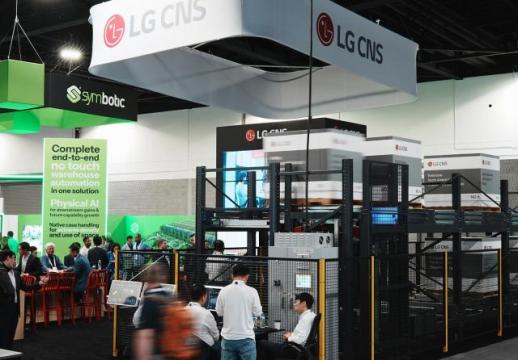 LG CNS unveils cold-chain logistics robot at U.S. trade show, eyes North American market SEOUL, April 15 (AJP) - LG CNS showcased a new warehouse automation robot capable of operating in sub-zero freezer environments at a major North American logistics trade show, as the South Korean IT services firm pushes to expand its footprint in the United States. The company unveiled its "Mobile Shuttle" system at Modex 2026 on Monday (local time) in Atlanta, where the robot was highlighted for its ability to function continuously at temperatures as low as minus 26 degrees Celsius — a threshold that covers most industrial cold-chain and frozen food storage facilities. The robot has received UL certification, a mandatory safety standard for electrical and mechanical equipment in the United States. Each shuttle unit can carry loads of up to 1,500 kilograms and travels at 1.5 meters per second along warehouse racks. The system uses a four-way directional structure — moving forward, backward, sideways, and vertically — to minimize routing constraints and boost storage density by more than 30 percent compared with conventional two-directional warehouse setups. LG CNS has equipped the system with an AI agent that allows warehouse workers to issue commands in natural language through a chatbot interface, including for emergency dispatch situations. The AI component also diagnoses malfunctions and proposes corrective actions in real time, the company said. "We have expanded the scope of logistics automation to cover refrigerated and frozen environments," said Lee Jun-ho, executive vice president of LG CNS' smart logistics and city business division. "We will continue to grow our global business on the strength of our differentiated capabilities in high-density, high-efficiency logistics operations." 2026-04-15 10:50:14
 -
 Lotte Biologics to Present SoluFlex Link ADC Platform Data at AACR 2026 Lotte Biologics said Tuesday it will present research results on its antibody-drug conjugate, or ADC, platform technology, SoluFlex Link, at the American Association for Cancer Research meeting, AACR 2026, to be held April 17-22 in San Diego. At the conference, the company will disclose results from an evaluation of the structural stability of an ADC using SoluFlex Link technology co-developed with Kanaph Therapeutics. According to Lotte Biologics, an analysis of aggregate changes over time found that a control group without the SoluFlex linker showed increasing aggregation as time passed, while the group using the SoluFlex linker showed markedly suppressed aggregation and maintained high stability. The company said the technology could help keep product quality stable during distribution and storage. In cell tests targeting multiple markers, including epidermal growth factor receptor (EGFR) and trophoblast cell surface antigen 2 (TROP-2), the SoluFlex Link group showed stronger anticancer effects at lower concentrations than the non-applied group, the company said. It also showed strong efficacy in triple-negative breast cancer cells. Lotte Biologics said animal studies showed improved in vivo pharmacokinetics, or PK, based on high stability. The company said the findings support SoluFlex Link as a platform technology not limited to a specific antibody, with potential to improve anticancer efficacy and pharmacokinetic properties. A Lotte Biologics official said SoluFlex Link is a differentiated platform that goes beyond the limits of existing technologies, adding that the company will provide solutions to help partners and customers develop next-generation ADCs. AACR is considered one of the world’s three major cancer meetings, along with the American Society of Clinical Oncology (ASCO) and the European Society for Medical Oncology (ESMO). It brings together cancer researchers and industry representatives to discuss cancer treatments and new drug development. * This article has been translated by AI. 2026-04-15 10:45:00
 -
 Choi Yeon-su, Daughter of Chef Choi Hyun-seok, Says Baby Kicks Feel Like They Could Break Her Ribs Model and actor Choi Yeon-su, the daughter of chef Choi Hyun-seok, said she is in pain as she nears childbirth. On the 14th, Choi wrote on social media, "The fetal movement is so strong it feels like my ribs could break." A day earlier, during a Q&A session titled "Ask Me Anything," she said she had gained 15 kilograms and complained about changes to her appearance, adding that her body had changed "to the point it's hard to handle." Choi became known after appearing on Channel A's "Dog Food Man Season 2" and also competed on Mnet's "Produce 48" in 2018. She married DickPunks' Kim Tae-hyun, who is 12 years older, in September last year. She announced her pregnancy that December and is due to give birth in June. * This article has been translated by AI. 2026-04-15 10:24:15
 -
 Startup Upstage becomes South Korea's first AI unicorn after raising more funds SEOUL, April 15 (AJP) - Artificial intelligence (AI) startup Upstage has raised about 180 billion Korean won (about US$120 million) in its latest funding round, the company said on Wednesday. With the funding, Upstage, now valued at more than 1 trillion won, became South Korea's first unicorn among generative AI companies. According to Upstage, the fresh fund was raised in a round led by Sage Partners, a Silicon Valley-based global venture capital and early investor that has continued to back the company through previous rounds, reaffirming its confidence in Upstage's technology and future growth. New investors include KB Securities, InterVest, Mirae Asset Venture Investment, Premier Partners, Shinhan Venture Investment as well as global equity investment firm Axiom Asia. Upstage, which provides industry-focused AI solutions built on its in-house large language model Solar and its document-processing AI Document Parse, said its revenue has grown by more than 130 percent annually since its founding in 2020. Last year, it was selected as the lead company for a government-led initiative to develop sovereign AI technology, further strengthening its position as one of the most promising AI developers in South Korea. Upstage's cumulative funding has reached about 400 billion won including 31.6 billion won in 2021, 100 billion won in 2024, and 62 billion won last year. It will use the funds to expand its graphics processing unit (GPU) infrastructure to advance AI models, while recruiting top talent both at home and overseas to expand into overseas markets. "The latest funding goes beyond simple fundraising and shows the market's confidence in Upstage's journey and achievements as an AI developer," said CEO Kim Seong-hun, adding, "We will advance our proprietary AI models to compete not only in Korea but also globally, and become a company that proves itself through revenue, not just valuation." 2026-04-15 10:21:52
 -
 South Korea jobs rise in March, but youth outlook worsens *Updated with additional information SEOUL, April 15 (AJP) -South Korea's headline jobs market maintained resilience in March as the impact of the Gulf war remained peripheral for now, but data pointed to worsening conditions for youth, signaling a structural job cliff for young people. The number of employed people rose by 206,000 from a year earlier to 28.795 million, easing slightly from a 234,000 increase in February, according to data released by the Data and Statistics Wednesday. The employment rate for those aged 15 to 64 — the OECD-comparable benchmark — stood at 69.7 percent, up 0.4 percentage points from a year earlier, supported by strong gains among those aged 60 and older. The younger cohort remained in the doldrums. The employment rate for those aged 15 to 29 fell 0.9 percentage points year-on-year to 43.6 percent, while their unemployment rate edged up 0.1 percentage point to 7.6 percent. The overall unemployment rate, in contrast, edged down 0.1 percentage point to 3.0 percent. Job losses were concentrated among those in their 20s, down 167,000, while those in their 40s — typically prime working years — also shed 5,000. Employment gains were largely seen among those in their 40s and 50s. By gender, employment declined among men in their 20s and 30s, while women posted gains in their 30s and 40s. The trend has raised concerns that the downturn reflects not only a cyclical slowdown but also a structural shift driven by AI. Entry-level hiring has weakened, while routine junior tasks — such as basic coding, data research and drafting — are increasingly being automated. A Bank of Korea report released in October last year found that youth employment declined across key industries in the three years following the launch of ChatGPT (July 2022 to July 2025). Jobs for those aged 15 to 29 fell by 11.2 percent in computer programming and system integration, 20.4 percent in publishing, 8.8 percent in professional services, and 23.8 percent in information services, underscoring growing exposure to AI-driven disruption. By industry, weakness persisted in manufacturing and construction. Employment in the wholesale and retail trade sector fell by 18,000 (0.6 percent), marking the first decline in 11 months since April last year, while accommodation and food services shed 2,000 jobs (0.1 percent), extending declines to a fifth consecutive month. Manufacturing employment also dropped by 42,000 (1.0 percent), extending its downturn to 21 consecutive months, while construction lost 16,000 jobs (0.8 percent), marking a 23rd straight month of decline. In contrast, gains were driven by the services sector, with employment rising by 294,000 (9.4 percent) in health and social welfare services, 75,000 (4.5 percent) in transportation and storage, and 44,000 (8.4 percent) in arts, sports and leisure-related services. Meanwhile, the number of people who reported they were simply “taking a break” — not seeking work despite being capable — increased, particularly among older age groups. Those aged 60 and above who were resting rose 8.6 percent from a year earlier. 2026-04-15 09:51:42
 -
 Trump hints at another round of talks with Iran 'over the next two days' SEOUL, April 15 (AJP) - U.S. President Donald Trump on Tuesday hinted at additional peace talks between the U.S. and Iran could take place in Pakistan within the next few days. Trump said in an interview with The New York Post, "You should stay there, really, because something could be happening over the next two days." "We are more inclined to go there. It's more likely, you know why? Because the field marshal is doing a great job," he added, referring to Pakistan's field marshal Asim Munir, one of the key negotiators pushing talks between the two countries. His remarks suggest the two sides may soon meet again in Islamabad, Pakistan after the first round of talks ended without a deal last weekend. Among the key issues is the U.S. demand that Iran should not have nuclear weapons at all, as Trump earlier said he was "not happy" with reports that Washington had called on Tehran to suspend uranium enrichment for two decades during marathon talks in Islamabad last Saturday and Sunday. "I've been saying they can't have nuclear weapons" he said, "So I don't like the 20 years." As Trump has increased pressure on Iran by imposing a naval blockade on its ports in the Strait of Hormuz, it remains uncertain whether both sides can narrow their differences and reach a breakthrough before their two-week ceasefire expires on April 22. 2026-04-15 09:26:19
 -
 South Korea recruits foreign influencers as Seoul seeks to move beyond K-pop SEOUL, April 15 (AJP) - A group of 120 international content creators is set to fan out across the South Korean provinces this year, part of an aggressive push by the Ministry of Culture, Sports and Tourism to diversify the national brand, the ministry said Wednesday. Starting April 17 in the traditional stronghold of Jeonju, the project marks a calculated attempt to steer global attention away from the neon-lit aesthetics of K-pop and toward the historical substance of the rural interior. This strategic pivot reflects a maturing of the Korean Wave. While music and television dramas remain dominant, the government is betting that sustainable soft power requires a shift toward physical immersion in the country's traditional landscapes and regional traditions. By enlisting foreign residents as digital ambassadors, the ministry is decentralizing its cultural narrative, allowing a more organic view of life outside the capital to reach global social media feeds. The itinerary for the "2026 Senses of K-Culture" program covers six three-day expeditions through November. Participants will visit a shrine in Jeonju before moving to the Hantan River in Pocheon and the mountain retreat of Beopjusa Temple in Boeun for a period of Buddhist temple stays. The autumn schedule includes the fire festivals of Andong and Yeongju, coastal fishing in Dangjin, and the heavily fortified landscape of the demilitarized zone in Goseong and Sokcho. "Through this project, I hope people around the world will discover the diverse local cultures and hidden charms of Korea beyond 'K-pop' and 'K-dramas,'" a ministry policy official said. "The vivid experiences of foreign content creators residing in Korea and collaborations with overseas media will serve as an opportunity to effectively convey the specialness of 'K-culture.'" 2026-04-15 09:22:16
 -
 KLPGA Holds Youth Golf Volunteer Clinic With 2025 Money Leader Hong Jeong-min The Korea Ladies Professional Golf Association, or KLPGA, said it held its volunteer talent-sharing program, "KLPGA with YOU," on April 14 at Gamsung Elementary School in Sejong City with Hong Jeong-min, last season’s money leader. KLPGA with YOU is run for schools that received support through the KLPGA’s "Youth Golf Environment Project," which helps establish practice facilities and provides donated golf equipment. Hong, who won three titles on the 2025 KLPGA regular tour and finished as both the money leader and co-leader in wins, gave a special lesson to 20 students at the event. "At first I was nervous and worried because I was thinking about teaching youth students who are the future of Korean golf," Hong said. "They followed what I taught well and learned with passion, so I had a great time. I hope today helps them become more interested in golf. I will attend these meaningful events more often." The KLPGA said it is also working to broaden youth participation through programs including the "KLPGA Volunteer Talent Group," the "KLPGA Kidz Golf Camp" and the "Youth Golf Environment Project." It also said it is helping identify promising players by hosting events such as the "KLPGA President’s Cup Women’s Amateur Golf Championship" and the "KLPGA-Samchully Together Dream Tree Tournament."* This article has been translated by AI. 2026-04-15 09:21:00
 -
 Korea Tourism Organization to Pilot K League Train-and-Stay Travel Packages in May The Korea Tourism Organization said Tuesday it will pilot a stay-style travel product tied to professional soccer matches, called 'K League Trip Day,' in May with Korail Tourism Development and the Korea Professional Football League. The program is designed to encourage fans to travel by train as high fuel prices raise the cost of driving, and to turn large-scale matchday travel into longer stays that support local businesses. A same-day package aimed at away fans will be offered around Daejeon Hana Citizen home matches. For the May 5 match against Incheon United and the May 16 match against FC Seoul, trains will run from Yongsan Station to Seodaejeon Station. Two ITX cars will be set aside for away supporters, with cheering backdrops and team-character souvenirs to create a road-game atmosphere. The itinerary also includes visits to local shopping areas, including a bakery tour, to increase time spent in the region and local spending. Each trip will take 120 people on a first-come, first-served basis, for a total of 240. With discounts of up to 50,000 won per person, the price starts in the 80,000-won range. A flexible overnight package will also be sold for home fans who live outside the area. It will cover May home matches for clubs with strong KTX connections: Jeonbuk Hyundai, Ulsan HD, Daejeon Hana Citizen and Gangwon FC. The package includes round-trip KTX travel from Seoul, lodging and premium match tickets. Train schedules are set to allow time for local sightseeing before and after the game, and the program includes sports-focused options such as a player high-five event and a stadium tour. Customers can buy up to four tickets per person. Reservations and detailed schedules are available on the 'Korea Everywhere' website and the Korail Tourism Development website. Kang Yu-young, a team leader in the organization's regional tourism development unit, said the program is a new attempt to link match attendance with longer stays and spending at local businesses. She said the agency will expand similar stay-style travel projects that combine tourism with activities such as running trips and community sports.* This article has been translated by AI. 2026-04-15 09:12:27