
Journalist

Lee Hugh
=
-
 South Korea emerges as top travel destination for spring SEOUL, April 9 (AJP) - With the growing popularity of the Korean Wave, more travelers are choosing South Korea as their spring destination to enjoy cherry blossoms and other attractions, shifting from the long-standing tradition of visiting Japan. According to figures released by online travel agency Trip.com on Thursday, Seoul ranked first among global cities in flight bookings for the spring travel period from March 20 to May 3. Bookings for flights to Seoul jumped 83 percent, compared to the same period of last year, outpacing growth in Japan's major cities like Tokyo and Osaka. Asian markets led bookings, with Japan ranking first, followed by Thailand and China, while German travelers to South Korea increased by about 142 percent over the past year, reflecting growing interest from Europe. Foreign visitors are also increasingly traveling beyond Seoul to provincial areas. Cheongju, North Chungcheong Province saw the fastest growth in inbound arrivals, rising 962 percent from a year earlier, followed by the southern porty city of Busan (131 percent) and the southern resort island of Jeju (129 percent). Bookings by domestic travelers to southern provincial cities such as Gunsan and Jinju also increased during the same period, which is peak season for spring flowers. "South Korea has become an ideal global destination for enjoying spring," said Hong Jong-min, head of Trip.com's office in Seoul. "Rising demand for inbound flights through regional airports, along with growing arrivals from Western countries, are encouraging indicators for the travel industry," he added. 2026-04-09 14:37:27
 -
 Korea Sports Council Earns Top Ratings in Two 2025 Digital Governance Reviews The Korea Sports Council said Thursday it received “excellent” ratings in two recently released government reviews of its digital and data operations: the 2025 Public Data Provision and Operations Assessment and the 2025 Cultural Informatization Level Assessment. In the public data review led by the Ministry of the Interior and Safety, which covered 684 organizations including central government agencies, local governments and public institutions, the council said its score rose sharply from the previous year, earning an “excellent” grade. The council said its score was well above the average for other public institutions, 57.4 points, which was rated “insufficient.” It posted year-on-year improvements across three areas: opening and use of public data, public data quality, and management systems. The council also earned an “excellent” grade for a third straight year in the 2025 Cultural Informatization Level Assessment, which evaluated 49 affiliated and public organizations under the Ministry of Culture, Sports and Tourism. That assessment broadly reviews how institutions run their information and digital operations. The council said it was recognized for efforts including its commitment to pursuing digital innovation. Chairman Yoo Seung-min said the results reflected the council’s push for digital innovation in sports administration. “We will continue to innovate digital administration and strengthen the opening of public data to help lead the digital transformation of sports,” he said.* This article has been translated by AI. 2026-04-09 14:36:00
 -
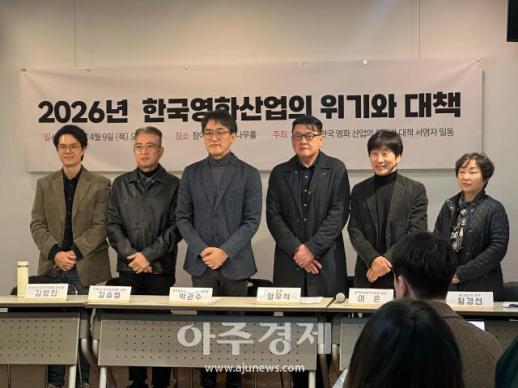 Korean Film Groups Urge Rethink of Holdback Law, Propose 20% Cap on Screen Concentration 영화계 주요 13개 단체가 참여한 영화단체연대회의가 더불어민주당 임오경 의원이 대표 발의한 '영화 및 비디오물 진흥에 관한 법률' 일부 개정안의 철회를 요구하고 나섰다. The coalition said the current downturn cannot be explained only by the pandemic and the spread of global streaming platforms, arguing it reflects accumulated structural problems including an oligopolistic theater market, vertical integration and screen concentration. At a policy proposal news conference held Thursday morning at the People’s Solidarity for Participatory Democracy’s Neutinamu Hall in Seoul, participants including Korea Scenario Writers Association Chairman Kim Byeong-in, Nainus Entertainment CEO Kim Seung-beom, attorney Park Kyung-shin, Korea Film Producers Association Vice President Park Kwan-su, director Yang Woo-seok, Korea Film Producers Association Chairman Lee Eun and animation producer Hwang Kyung-sun said the industry faces a structural crisis and needs institutional reform and investment support. Kim said that in 2025 South Korea released fewer than 30 commercial films with net production costs exceeding 3 billion won. “It’s hard to even recall the early-to-mid 2000s, when we made more than 100 films and achieved a renaissance,” he said, adding, “It feels like watching the collapse of Hong Kong’s film industry in the late 1990s.” Yang said the crisis is often attributed to the roughly two-year pandemic period starting in 2020 and Netflix’s push into home viewing, but he argued South Korea’s weak recovery compared with other countries stems from a fragile industrial structure. He said admissions fell from about 230 million in 2019 to 106 million as of the end of 2025, or 46% of the earlier level. The coalition also opposed a controversial proposal to legislate a “holdback” period. The amendment sponsored by Democratic Party lawmaker Lim Oh-kyung would allow films to be released on follow-on platforms such as IPTV and OTT services only after six months have passed since the end of their theatrical run. Speakers argued that a six-month gap between theaters and IPTV is not a holdback but effectively a blackout. Park said the news conference was not held to support Lim’s bill. “This amendment should be fully withdrawn. It’s not a normal holdback bill; it’s a blackout bill,” he said. Park said protecting a film’s theatrical run matters, and argued it could be achieved by introducing limits on screen concentration. As an alternative, the coalition proposed a system to prevent theater chains from allocating an excessive share of seats to one or two films. It said a single film’s share of screens should be capped at 20%. The group said that if such a system takes hold, more films would remain in theaters longer and holdback periods between platforms could normalize naturally. It also said film profitability could improve and, over time, theater revenue could recover. Park said theaters’ worsening revenue is not due to holdbacks but to market concentration and vertical integration that have led to consumers and business partners being treated poorly. He said theaters should start by lowering ticket prices and screening a wider range of films, adding that distributors and producers would have less reason to rush films to other platforms if they are performing well in theaters. The coalition said holdbacks should apply only when theaters show a willingness to keep films on screens and should serve as a rule that protects that effort. It said Lim’s amendment should be scrapped because it reflects the views of major theater chains without collecting opinions from the broader film industry. Lee said Lim’s intent in proposing the amendment appeared positive, but he argued it was drafted without a close look at the industry and should be discarded. On the proposed 20% cap, Lee said that in the past it was considered desirable for a film not to exceed 30%, but the coalition is now calling for 20%, adding that the figure should be adjusted through discussions that include theaters and distributors. Citing overseas examples, Lee pointed to Japan to argue for a long-run screening structure. He said it took more than six months for “Kokuhou” to draw 10 million moviegoers in Japan, while “The Man Who Lives With the King” surpassed 10 million in four weeks. Lee said theaters are focused on boosting revenue by reducing other films’ shares, warning that without reasonable limits on screen concentration, irreversible situations could repeat. Speakers also called for expanding investment alongside institutional reforms. They said that with average production costs for commercial films exceeding 10 billion won, there is an urgent need to create large funds in the 100 billion won range as well as mid-sized funds. They said film funds backed only by the government’s fund-of-funds have limits, and proposed that the government act as an anchor investor and provide tax benefits to attract private capital. The coalition said the industry’s slump reflects not only falling admissions but broader structural problems, and argued that limits on screen concentration and expanded financing should be discussed before legislating holdbacks. It urged the government and the National Assembly to consider the proposals in future legislative and policy discussions.* This article has been translated by AI. 2026-04-09 14:27:09
 -
 Choi Hwan-hee to Serve as Wedding Host for Sister Choi Jun-hee’s May Ceremony The late actress Choi Jin-sil’s son, Choi Hwan-hee, will serve as the wedding host for his younger sister, Choi Jun-hee, ahead of her upcoming ceremony. On April 8, Choi Jun-hee posted a photo on social media with the caption, “Here to get the wedding host’s suit fitted.” The image shows Choi Hwan-hee having his measurements taken for a suit. Choi Jun-hee is set to marry a non-celebrity man who is 11 years older on May 16 at a location in Seoul, according to the post. In February, she wrote on social media, “Family was never an easy word for me,” adding that after “a childhood that was only depressing,” she had long vowed to build “a warm fence” of her own. She said she now hopes to live “a stronger and warmer life” as “someone’s wife,” with the new family she plans to build.* This article has been translated by AI. 2026-04-09 14:12:16
 -
 Comedian Lee Jin-ho Hospitalized in ICU After Brain Hemorrhage, Agency Says Comedian Lee Jin-ho has been hospitalized in an intensive care unit after collapsing from a brain hemorrhage, his agency said. SM C&C said on the 9th that Lee is receiving treatment in the ICU and that his condition is not life-threatening. Lee has suspended activities since last year amid allegations of illegal gambling and drunk driving. He was sent to the Seoul Central District Prosecutors Office without detention in September last year on allegations he repeatedly gambled using illegal online gambling sites. That same month, he was also referred to prosecutors on suspicion of driving under the influence for about 100 kilometers from Incheon to his home in Yangpyeong County, Gyeonggi Province, in violation of the Road Traffic Act. 2026-04-09 13:36:15
 -
 OPINION: Governance question lingers behind Korea's market rollercoaster Market volatility has become the norm in 2026. The KOSPI index is liable to shoot up and down any moment, as global analysts watch for hints of supply chains either being freed or tied up amid the conflict in the Middle East. Just before the fighting started, Korean stocks were riding an unprecedented surge. Airstrikes on Iran began in same week that an artificial intelligence boom helped the KOSPI cross the 6,000 level for the first time ever, just 250 days after surpassing 3,000. But market swings such as these do not change long-term fundamentals. If Korea wants to fully realize its investment potential, stronger corporate governance must become a central pillar of growth. For years, global investors have spoken of the “Korea discount.” This term does not refer to short-term market swings. It reflects long-standing concerns about governance — especially the gap between control rights and cash-flow rights. In many Korean companies, controlling shareholders hold decision-making power that exceeds their share of economic ownership. Concentrated ownership is not unique to Korea, and it is not inherently negative. In fact, it has helped build some of the country’s most successful companies. The tension arises when control and economic interest are not clearly aligned. Investors factor in a practical risk that during major Korean corporate actions they may be treated unfairly. These moments include contested merger ratios, spin-offs that shift value, dilutive capital raises, related-party transactions, and succession-related restructurings. Markets also discount silence. When a “no-failure” culture delays bad news, investors price the same risk they associate with weak governance: that problems will be disclosed only after value has already been impaired. Even if such events are rare, the possibility affects confidence and valuation. Addressing these concerns is complex. Korea’s corporate structure is deeply shaped by family ownership. Breaking apart these structures would carry economic and social costs. The more constructive question is how to preserve the benefits of long-term ownership while strengthening protections for minority shareholders and reinforcing trust in the market. We propose a Structure–Discipline–Dialogue framework to help meet that challenge — focusing on how authority is organized, how capital allocation decisions are governed, and how companies engage with investors. The goal is not to copy any single foreign model, but to combine lessons from global markets in ways that fit Korea’s corporate realities. The Nordic model demonstrates that transparency and strong minority protections can coexist with concentrated ownership — and that such systems can attract global capital. The United States demonstrates the importance of enforceable fiduciary duties and active stewardship. Japan illustrates that steady, incremental reform can raise standards over time. Across these examples, one principle stands out: concentrated ownership becomes investable when checks and balances ensure that control is exercised in line with per-share value, and when investors can trust the transparency of corporate performance. Structure focuses on how control and oversight are organized. Simplifying ownership chains and clarifying decision-making authority reduces opacity. Boards elected at the annual general meeting should be mandated to represent all shareholders equally, not only controlling owners. Clear mandates, genuine independence, and relevant expertise help boards function as effective oversight bodies. This approach does not weaken ownership or voting rights. Instead, it embeds accountability within the company’s governance structure. When authority is transparent and oversight is credible, there is less need for outside intervention. Discipline addresses how control is exercised, particularly in capital allocation. This is often the most challenging pillar. Governance structures and investor relations can be improved over time. Capital allocation decisions, by contrast, are measurable and irreversible. Dividends, buybacks, mergers and acquisitions, spin-offs, and restructurings directly test whether incentives are aligned. As a practical example from recent news, consider a spin-off where the parent retains control while minority shareholders absorb dilution. Once these decisions are made, their consequences cannot be undone. That is why capital allocation discipline is central to governance credibility. Clear policies on dividends, reinvestment, and major transactions reduce discretion and make outcomes more predictable. Stronger minority protections in conflicted transactions limit the risk of control rights overriding economic fairness. In practical terms, this means accepting some limits on unilateral decision-making. That trade-off may be uncomfortable, but markets reward consistency and predictability. Enforcement credibility is equally important. Governance reform is not only about introducing new rules. It is about ensuring that rules carry consistent consequences. Investors respond to outcomes, not intentions. If protections are bypassed or applied unevenly, confidence weakens and valuation gaps persist. For that reason, one of the most impactful reforms would be to strengthen the enforceability of fiduciary duties in conflicted transactions. Mergers, spin-offs, and related-party deals are precisely the situations where control incentives can diverge most from per-share value. Clear standards and consistent enforcement in these areas would directly address investor concerns. Dialogue is the third pillar. High-quality disclosure and regular, structured engagement with investors reduce information gaps. Dialogue does not mean surrendering control to activists or focusing only on short-term performance. It means ensuring that decisions are clearly explained and open to scrutiny through established processes. Over time, consistent engagement builds trust. Investors are more willing to support long-term strategies when governance systems are transparent and predictable. Together, structure, discipline, and dialogue form a governance system that aligns control with per-share value. It allows Korea to strengthen governance without dismantling concentrated ownership. Control remains intact, but it operates within clearer structures, stronger discipline, and more open communication. In practice, governance quality increasingly determines strategic flexibility. Companies that demonstrate disciplined capital allocation and credible oversight gain greater freedom to pursue acquisitions, partnerships, and long-term investments because investors trust how decisions will be made. The objective is not to change who owns Korean companies. It is to ensure that control is exercised in a way that is transparent, accountable, and aligned with economic ownership. International experience shows that markets reward governance systems that constrain discretion, strengthen oversight, and protect minority shareholders. Korea does not need dramatic upheaval to improve. As Japan’s experience suggests, steady and cumulative reforms can gradually raise expectations and build credibility. When enforcement is consistent and capital allocation is disciplined, concentrated ownership can coexist with strong investor confidence. Given the upheaval and uncertainty in global capital markets, there is a window of opportunity now. Global investors are looking for alternatives. Sustaining interest in the Korean market will require more than favorable market conditions or momentum in specific sectors. Stronger governance can help transform the Korea discount from a persistent concern into a lesson from the past, supporting a more resilient, competitive, and globally trusted equity market. On the level of individual corporations, executives who proactively strengthen governance credibility will gain earlier access to global capital and strategic partnerships. *The author is the founding CEO of Reddal. About the author: Formerly at McKinsey & Company and Accenture, Stenius has over 20 years of experience in science, management consulting, venture capital, startups, and operative management. He has an M.A. in Economics and a Ph.D. in Electrical Engineering from the University of California, Santa Barbara, and an M.Sc. Electrical Engineering from Helsinki University of Technology. He is a Visiting Professor at Yonsei University, Graduate School of Business. 2026-04-09 13:24:41
 -
 Seoul advised to seek risk-free energy sourcing at first NEAC meeting SEOUL, April 09 (AJP) -South Korean President Lee Jae Myung admitted Thursday that the escalating Middle East conflict will deliver near-term economic damage while forcing a longer-term overhaul of the country’s industrial and energy structure. Speaking at the first plenary session of the National Economic Advisory Council at Cheong Wa Dae, Lee said the crisis is unfolding on two fronts — an immediate energy supply disruption and a broader erosion of industrial competitiveness. “In the short term, the Middle East war is exerting considerable pressure on our economy,” Lee said. “In the long run, the time has come for a fundamental transformation of South Korea’s economic system.” The remarks came as uncertainty deepens around the Strait of Hormuz, a critical artery for global oil flows, with supply conditions remaining unstable despite a temporary ceasefire announcement by Donald Trump. Reports of renewed disruptions have underscored the fragility of any near-term normalization. Lee said the nature of the current crisis differs from past oil shocks, noting that infrastructure damage across parts of the region could prolong disruptions for years rather than months. He also pointed to unresolved nuclear tensions and the risk of unilateral military action as factors sustaining volatility. “Crises are inevitable in life and society,” he said. “Even today, there are reports of attacks despite a ceasefire. It is difficult to predict when this situation will be resolved.” The meeting — Lee’s first full session as chair since taking office — brought together around 50 participants, including Vice Chair Kim Sung-sik, Deputy Prime Minister Koo Yun-cheol and other senior officials and civilian advisors. Discussions focused on immediate response measures and longer-term structural reforms to strengthen economic resilience. Lee urged a coordinated policy response across time horizons, stressing that the current “window” created by the ceasefire should be treated as a critical opportunity to secure energy supplies. “If we prepare well, we can turn this crisis into an opportunity to build a new system for renewed growth,” he said. Policy discussions outlined a broad package of measures centered on energy security, industrial adaptation and market stabilization. In the near term, officials emphasized the need to maximize crude procurement during any reopening of Hormuz, including immediate deployment of tankers, while maintaining price controls such as fuel caps to stabilize domestic markets. Authorities are also considering adjustments to nuclear power plant maintenance schedules to maximize winter electricity generation. To cushion households, proposals included targeted fiscal support for energy costs, expanded supplementary budget allocations for small businesses, and even temporary public transport subsidies modeled on overseas cases. Over the medium to long term, the focus shifts to restructuring supply chains and reducing reliance on Middle Eastern crude. Options under review include diversifying import routes via Southeast Asia and Australia, enhancing refinery flexibility, and expanding overseas resource development into higher value-added partnerships. Park Won-joo, head of the macroeconomy team at the council, called for a more aggressive push into overseas resource development to secure alternative, lower-risk energy routes that bypass Middle East chokepoints. The discussions also highlighted the need for stronger policy coordination under a centralized presidential control tower, alongside more transparent and predictable regulatory frameworks to support private investment. Lee framed the crisis as a potential inflection point, drawing parallels to how Japan’s export restrictions helped catalyze South Korea’s materials and components sector. “The crisis can become a turning point,” he said, “to reorganize our energy supply chain and move toward a more proactive economic structure.” 2026-04-09 11:55:54
 -
 Asian markets retreat after truce rally; Kospi slips by Samsung block sale SEOUL, April 09 (AJP) - Asian markets opened broadly lower on Thursday, giving back some of the previous session's sharp gains after the United States and Iran effectively agreed to a Pakistan-mediated two-week truce. As investors monitored the course of Washington-Tehran negotiations, South Korean stocks were weighed by profit-taking following Wednesday’s sharp jump and a large block sale of Samsung Electronics shares. The main index fell 0.99 percent to 5,814.40, and the tech-heavy KOSDAQ declined 0.96 percent to 1,079.36 as of 11:10 a.m. Samsung Electronics fell more than 3 percent in early trading on Thursday, following a large block sale by the late chairman Lee Kun-hee's widow Hong Ra-hee. Hong, mother of Samsung Group chief Lee Jae-yong sold 15 million shares worth about 3.08 trillion won ($2.3 billion) at a 2.5 percent discount to the previous close to complete the inheritance tax following the patriarch's death in 2020. Shares were down 3.33 percent at 203,500 won in the morning trade. Shares of SK Hynix also declined, falling 2.81 percent to 1,004,000 won, with the two heavyweights weighing on the broader KOSPI. Among other large caps, battery shares were mixed, with LG Energy Solution rising 2.59 percent to 416,500 won and Samsung SDI gaining 2.65 percent to 484,000 won. Defense and industrial names were weaker, with Hanwha Aerospace dropping 2.43 percent to 1,448,000 won and HD Hyundai Heavy Industries slipping 0.67 percent to 481,250 won. Automakers were mixed, as Hyundai Motor fell 1.38 percent to 501,000 won, while Kia edged up 0.75 percent to 160,400 won. Financial shares were mixed, with KB Financial Group rising 0.77 percent to 157,200 won and Shinhan Financial Group gaining 1.76 percent to 98,400 won, while Samsung Life Insurance slid 5.24 percent to 226,000 won. Elsewhere in Asia, Japan's Nikkei 225 fell 0.77 percent to 55,873.60 after recent gains, Hong Kong's Hang Seng Index declined 0.88 percent to 25,665.20. Chinese stocks also traded lower, with the Shanghai Composite Index falling 0.70 percent to 3,966.90. The dollar edged up to 1,481.90 won, compared with 1,470.6 won at the previous close. 2026-04-09 11:30:34
 -
 Jon Rahm Tops Golf Earnings List With $102 Million Over Past Year, Sportico Says Over the past year, Spain’s Jon Rahm led all professional golfers worldwide in earnings, according to a ranking released by U.S. sports business outlet Sportico. Sportico said Thursday that Rahm made $102 million over the period, the most in golf. Much of Rahm’s earnings were tied to his move to LIV Golf. The 2021 U.S. Open and 2023 Masters champion switched tours in December 2023. Sportico reported that he signed a $300 million contract as part of the move and was believed to have received 50% upfront. Rahm won twice on LIV Golf in 2024 and also captured the LIV Golf Hong Kong event in March. He earned $92 million in prize money and $10 million off the course. Rory McIlroy of Northern Ireland ranked second at $84 million, including $29 million in prize money and $55 million off the course. World No. 1 Scottie Scheffler of the United States was third at $81 million. Tiger Woods, long the top earner off the course, posted $54 million in off-course income in the survey, trailing McIlroy in that category. Woods ranked fifth overall. Three LIV Golf players made Sportico’s top 10: Rahm, Bryson DeChambeau at No. 4 with $65 million, and Joaquin Niemann at No. 7 with $41 million. Among Asian players, Japan’s Hideki Matsuyama was the highest-ranked at No. 8 with $31 million.* This article has been translated by AI. 2026-04-09 11:27:00
 -
 Dongwha Pharm Names Shin Yong-jae Head of Jungseon Pharma’s Ho Chi Minh Office Dongwha Pharm said April 9 it has appointed Executive Director Shin Yong-jae as head of the Ho Chi Minh City office of Jungseon Pharma, a major pharmacy chain in Vietnam. Shin will oversee operations of the Ho Chi Minh City branch and lead the company’s new business efforts in Vietnam, the company said, as it seeks to strengthen its foothold in Southeast Asia. Shin joined Samsung Group through its 2006 open recruitment and worked in Hotel Shilla’s finance and management teams. He later served as chief financial officer at Hotel Shilla’s China unit and at a joint venture between Hotel Shilla and Hongtong Sun Art Retail Group, handling global business and operations. At joint ventures involving SK On and China’s Beijing Automotive and EVE Energy, he worked as CFO and chief executive officer, overseeing investment, finance and overall business operations. Shin said he would “build a foundation for Jungseon Pharma’s expansion in the Southeast Asian market, strengthen competitiveness and maintain a stable growth trajectory.”* This article has been translated by AI. 2026-04-09 11:21:00