
Journalist

Lee Hugh
=
-
 Jon Rahm Tops Golf Earnings List With $102 Million Over Past Year, Sportico Says Over the past year, Spain’s Jon Rahm led all professional golfers worldwide in earnings, according to a ranking released by U.S. sports business outlet Sportico. Sportico said Thursday that Rahm made $102 million over the period, the most in golf. Much of Rahm’s earnings were tied to his move to LIV Golf. The 2021 U.S. Open and 2023 Masters champion switched tours in December 2023. Sportico reported that he signed a $300 million contract as part of the move and was believed to have received 50% upfront. Rahm won twice on LIV Golf in 2024 and also captured the LIV Golf Hong Kong event in March. He earned $92 million in prize money and $10 million off the course. Rory McIlroy of Northern Ireland ranked second at $84 million, including $29 million in prize money and $55 million off the course. World No. 1 Scottie Scheffler of the United States was third at $81 million. Tiger Woods, long the top earner off the course, posted $54 million in off-course income in the survey, trailing McIlroy in that category. Woods ranked fifth overall. Three LIV Golf players made Sportico’s top 10: Rahm, Bryson DeChambeau at No. 4 with $65 million, and Joaquin Niemann at No. 7 with $41 million. Among Asian players, Japan’s Hideki Matsuyama was the highest-ranked at No. 8 with $31 million.* This article has been translated by AI. 2026-04-09 11:27:00
 -
 Dongwha Pharm Names Shin Yong-jae Head of Jungseon Pharma’s Ho Chi Minh Office Dongwha Pharm said April 9 it has appointed Executive Director Shin Yong-jae as head of the Ho Chi Minh City office of Jungseon Pharma, a major pharmacy chain in Vietnam. Shin will oversee operations of the Ho Chi Minh City branch and lead the company’s new business efforts in Vietnam, the company said, as it seeks to strengthen its foothold in Southeast Asia. Shin joined Samsung Group through its 2006 open recruitment and worked in Hotel Shilla’s finance and management teams. He later served as chief financial officer at Hotel Shilla’s China unit and at a joint venture between Hotel Shilla and Hongtong Sun Art Retail Group, handling global business and operations. At joint ventures involving SK On and China’s Beijing Automotive and EVE Energy, he worked as CFO and chief executive officer, overseeing investment, finance and overall business operations. Shin said he would “build a foundation for Jungseon Pharma’s expansion in the Southeast Asian market, strengthen competitiveness and maintain a stable growth trajectory.”* This article has been translated by AI. 2026-04-09 11:21:00
 -
 JW Pharmaceutical Signs Deal to Bring China’s Biweekly Obesity Drug Candidate to South Korea JW Pharmaceutical said April 9 it signed an exclusive licensing agreement with China’s Gan & Lee Pharmaceuticals to bring in bofanglutide (development code GZR18), a glucagon-like peptide-1 (GLP-1) receptor agonist drug candidate. Under the deal, JW Pharmaceutical secured exclusive rights in South Korea covering development, regulatory approval, marketing and commercialization. The total contract value is $81.10 million (about 110 billion won), with sales-based royalties to be paid separately. The agreement also includes rights for four indications: Type 2 diabetes, obesity, obstructive sleep apnea (OSA) and metabolic dysfunction-associated steatohepatitis (MASH). Bofanglutide is a synthetic peptide being developed as a subcutaneous injection given once every two weeks. The company said it works by stimulating insulin secretion and slowing gastric emptying to help maintain satiety, reducing appetite and body weight. In a Phase 2a trial, average body weight fell 17.29% after 30 weeks of dosing every two weeks. JW Pharmaceutical plans to launch Phase 3 trials in South Korea in the second half of this year for obesity and Type 2 diabetes at the same time. CEO Shin Young-seop said, “Based on our proven development capabilities, we will successfully advance the commercialization of bofanglutide in Korea and provide patients with metabolic diseases an innovative treatment option.”* This article has been translated by AI. 2026-04-09 11:15:00
 -
 Battery makers expected to post Q1 losses, but optimism remains on ESS demand SEOUL, April 9 (AJP) - South Korea's three major battery makers are expected to post weak first-quarter results amid slowing demand for electric vehicles. According to data compiled by financial information provider FnGuide, Samsung SDI, SK On, and LG Energy Solution are projected to post operating losses for the first three months of this year. Samsung SDI is estimated to have posted an operating loss of 263.5 billion won ($196 million), while SK On is expected to report a loss of around 300 billion won. LG Energy Solution, in a preliminary report earlier this week, recorded an operating loss of 207.8 billion won. These losses reflect a triple whammy for the sector, driven by slowing global EV demand, automakers' inventory adjustments, and falling raw material prices. In particular, LG Energy Solution's operating loss would widen to around 400 billion won if the Advanced Manufacturing Production Credit (AMPC), a U.S. tax incentive under the Inflation Reduction Act, is excluded. Samsung SDI is also believed to have seen a sharp decline in profitability, while SK On is expected to continue its streak of quarterly losses. The slowdown is also reflected in global market data. According to SNE Research, an energy market research firm specializing in batteries, total battery usage in electric vehicles (EVs), plug-in hybrid vehicles (PHEVs), and hybrid vehicles (HEVs) reached 134.9 gigawatt-hours (GWh) during the peiod, rising just 4.4 percent from a year earlier. The combined global market share of the three battery makers fell to 15 percent, down 2.2 percentage points year-on-year. A sharp 29.8-percent drop in U.S. EV sales led to declining battery usage across all three companies. LG Energy Solution recorded 11.8 GWh (-2.7 percent), SK On 5.2 GWh (-12.9 percent), and Samsung SDI 3.3 GWh (-21.9 percent), marking the steepest decline among major players. But the losses are widely seen as reflecting ongoing investment rather than a structural downturn, as the three battery makers expand their production capacity in the U.S. to secure a foothold in the North American market. With such aggressive investment in North America, a gradual recovery is expected in the second half of the year as more affordable EVs and energy storage systems (ESS) would gain traction. LG Energy Solution is expanding its U.S. footprint including its joint venture Ultium Cells with General Motors, one of the largest U.S. automakers, and plans to begin mass production of ESS batteries in the second quarter. Samsung SDI is also preparing ESS battery production through its joint venture with Stellantis, formed through the merger of Fiat Chrysler Automobiles and PSA Group. Earlier this year, it secured a large battery deal in the U.S. and followed it up with a 1.5 trillion won ($1.1 billion) ESS contract last month, extending its order momentum. SK On operates a plant in Georgia and is building additional facilities through its equally held venture with Ford Motor Company to produce EV batteries in the U.S. It recently suspended operations at its first Georgia plant and shifted production to the second plant to improve efficiency. The company also signed a 2 trillion won ESS supply deal with Flatiron Energy Development, an ESS developer founded in 2021. Such front-loaded investments are expected to lay the groundwork for a recovery in earnings, as higher utilization rates would allow U.S. subsidies under the Advanced Manufacturing Production Credit (AMPC) to be more fully reflected in results. These front-loaded investments are expected to lay the groundwork for a recovery in earnings, as higher utilization rates would allow U.S. subsidies the AMPC. SK On is also boosting efficiency at its operations in Hungary, supported by steady growth in the European market. Its second plant in Komárom is operating at around 80-percent utilization rates and supplies nickel-cobalt-manganese (NCM) batteries, a high-performance EV battery chemistry, to Volkswagen Group and Ford Motor Company including for models such as the ID.4 and ID.7. Automakers are set to launch more affordable EVs in the US$20,000–$30,000 range, which could revive delayed demand and boost battery shipments. The expansion of the energy storage system (ESS) market could be another positive factor. Surging power demand from artificial intelligence (AI) data centers is driving growth in large-scale energy storage, as battery makers expand beyond EV-focused portfolios and position ESS as a key growth engine. Meanwhile, shares of LG Energy Solution and Samsung SDI were up 2.34 percent from the previous session as of Thursday morning. 2026-04-09 11:12:15
 -
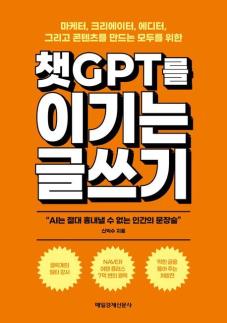 New Book Says Identity Is the One Thing ChatGPT Can’t Copy In an era when generative AI can draft text in seconds, a new book asks where human writing should go next. Maeil Business Newspaper Publishing (Saenggakjeonggeojang) will publish “Writing That Beats ChatGPT” on the 17th for content creators such as marketers, creators and editors. Rather than focusing on “good writing” alone, the book lays out a vision and practical methods for producing copy that prompts an immediate response — writing that gets clicked. ◆ ‘Dopamine writing’ that wins in 0.017 seconds The book argues that in today’s “dopamine era,” writers must design stimuli that seize attention in just 0.017 seconds. Author Shin Ik-su, a travel reporter at Maeil Business Newspaper, said, “If you can’t get clicks, you’ll be discarded — even by ChatGPT,” as he introduces a formula tailored to readers’ “dopamine brains,” which react to stimulation first. It describes a new reader behavior sequence: stimulus, click and understanding. In a mobile-first environment where instinct often beats reason, it urges creators to move past the assumption that quality alone is enough and to sharpen hooking strategies that draw the initial click. ◆ A human ‘identity’ AI can’t imitate Shin writes that while ChatGPT may appear to threaten human writing, what ultimately holds attention and opens wallets remains a distinctly human domain. AI can produce smooth, polished sentences instantly, he argues, but writing that grasps desire and psychology and moves people is finished by human hands. He compares dopamine-driven readers to “picky eaters” who consume only what suits their tastes, warning that mediocre content will be ignored without hesitation. As the one weapon to overcome that, he points to “identity” rooted in lived experience — vivid, firsthand experience that ChatGPT cannot replicate, he says. ◆ A platform-by-platform practical guide The book presents field-ready techniques, not just theory. It analyzes how writing rules differ across YouTube, blogs and Instagram, and organizes practical formulas aimed at boosting views. It includes guidance on designing titles and thumbnails, opening strategies to increase time spent, building product detail pages that drive purchases, and copywriting that leads to sales. Shin, whose earlier book “Writing That Brings 1 Million Clicks” drew attention, compiles more than a decade of on-the-job know-how in prompting reader clicks.* This article has been translated by AI. 2026-04-09 11:06:18
 -
 Seoul unveils new measures to fend off inflation, sees stabler FX market SEOUL, April 9 (AJP) —South Korea will reimpose a cap on retail fuel prices to contain a renewed surge in gasoline costs triggered by the prolonged blockade of the Strait of Hormuz, while signaling potential upside for the battered won through parallel market-stabilization measures. Deputy Prime Minister and Finance Minister Koo Yun-cheol said Thursday the government will unveil a third round of emergency price ceilings on petroleum products at 7 p.m., with the new caps to take effect from midnight Friday. Final levels will be set after inter-agency consultations, factoring in global crude trends and the burden on households. At an emergency price meeting, Koo stressed that earlier caps had functioned as an effective “safety net,” cushioning logistics costs and easing pressure on consumers, and pledged to act decisively against renewed energy-driven inflation. On financial markets, he said volatility is showing early signs of easing, pointing to foreign inflows into Korean government bonds following the country’s inclusion in the World Government Bond Index (WGBI). Offshore investors have bought a net 6.8 trillion won ($4.6 billion) in sovereign debt, helping stabilize sentiment. Koo also highlighted structural support for the currency. More than 114,000 accounts have been opened under the Reshoring Investment Account (RIA) scheme, which offers tax incentives for repatriated funds, while the National Pension Service’s new investment framework — aimed at recalibrating currency hedging and offshore allocation — is expected to further ease pressure on the foreign exchange market. The government also flagged emerging inflation in consumer electronics, as a spike in memory chip prices — driven by the expansion of high-bandwidth memory (HBM) production — has lifted general DRAM costs. Prices of personal computers and laptops have risen by more than 10 percent over the past seven months. To cushion the impact, authorities plan to recycle used PCs from central government agencies for vulnerable groups and expand financial support for low-income students purchasing new devices, backed by 4.8 trillion won in additional local education grants from the supplementary budget. Despite elevated geopolitical risks, officials assessed that core service prices — including courier and moving costs — as well as daily necessities remain broadly stable. To guard against market distortion, the government will maintain strict bans on hoarding of petroleum products and urea solution, with contingency measures ready should price volatility intensify. 2026-04-09 10:50:07
 -
 BTS franchise in incessant motion: on screen and stage, and off stage SEOUL, April 07 (AJP) -BTS franchise is in incessant motion since its March 21 comeback. As the world tour opens in Goyang on Thursday, the group has been releasing weekly viral music videos, amplifying global fan excitement. Off-stage activations have been just as intense, turning Seoul into a citywide extension of the BTS universe. The “BTS THE CITY ARIRANG SEOUL” project has kicked off across the capital, drawing strong response to its fan-participation programs. The project celebrates the release of BTS’ fifth full-length album ARIRANG and its accompanying world tour, offering immersive, citywide experiences built around the group’s music and message. At Dongdaemun Design Plaza (DDP), the “ARMY Madang” program is being held at Exhibition Hall 1. The program runs eight sessions per day, with about 400 participants per session. While free of charge, participation is limited to those who make advance reservations via Weverse. According to organizers, all sessions, held from 1 p.m. to 9 p.m., have sold out, underscoring surging demand. On-site activities include T-shirt and light stick customization, love song writing and photo card production, alongside a HYBE experience zone and other linked programs. “ARMY Madang” runs from April 6 to April 12. Across the city, the project extends into themed installations, pop-up stores and interactive zones, effectively mapping BTS onto Seoul’s urban landscape. Key landmarks have been reimagined as fan destinations, blending music, design and digital engagement. Nighttime light shows, projection mapping and curated playlists further transform public spaces into shared fan arenas. Retail and hospitality sectors are also participating, with limited-edition merchandise, themed menus and hotel packages tailored to visiting fans. The initiative is driving a measurable uptick in foot traffic in major districts, signaling the group’s continued pull as both a cultural and economic force. Taken together, the project illustrates how BTS’ comeback is not confined to charts or stages, but unfolds as a coordinated, multi-platform experience — one that fuses fandom, commerce and city branding into a single, continuously evolving narrative. 2026-04-09 10:42:02
 -
 OPINION: Hormuz and the hidden logic of Iran's strategy The airstrikes have paused - for now. But wars rarely end when the shooting stops. They evolve. Language replaces firepower, and interpretation becomes a battlefield of its own. The two-week ceasefire between the United States and Iran appears, on the surface, to signal de-escalation. In reality, it looks more like the opening move of a more calibrated contest. Within hours of the agreement, both sides accused each other of violations, while sending conflicting signals over the reopening of the Strait of Hormuz — a reminder that the truce rests on contested assumptions, not shared understanding. Washington’s message is clear: compliance is conditional, and consequences remain on the table. The structure of the deal — simultaneous ceasefire and negotiation — leaves room for rapid re-escalation if Iran deviates. Tehran, however, operates on a different logic. It frames Israeli strikes in Lebanon as violations of the truce and signals that continued pressure could justify re-closing Hormuz. The same agreement, two incompatible interpretations. At the core lies a fundamental disagreement over scope. The United States treats the ceasefire as confined to direct confrontation with Iran, separating it from Israel’s operations against Hezbollah. Iran does not. It views the so-called “axis of resistance” as a single strategic theater. Lebanon is not peripheral — it is integral. This is not a technical gap. It is a structural divergence in how war itself is defined. To understand Iran’s posture, it is not enough to see it as a modern nation-state. Tehran’s strategic thinking is shaped by a far longer arc — one that stretches from the Achaemenid Empire to the Silk Road. The unifying principle across that history is not territorial expansion, but control of corridors. Persia historically mastered flows, not just land. The Royal Road was not infrastructure — it was power. Trade routes were not passive channels but instruments of influence, allowing Persia to shape prices, information and access between East and West. The lesson endured: those who control the flow shape the order. Today, the Strait of Hormuz is the modern expression of that logic. A narrow maritime chokepoint through which a significant share of global energy passes, it gives Iran leverage that extends far beyond conventional military power. Full closure is not required. The mere threat of disruption is enough to move oil prices, currencies and risk sentiment. It is a strategy of pressure without direct confrontation — a contemporary echo of Silk Road leverage. Yet Hormuz is only the visible layer. Beneath it lies the deeper fault line: Iran’s nuclear capability. For Washington, the ultimate concern is not maritime disruption but strategic breakout risk. Tehran insists uranium enrichment is a sovereign right; the United States sees capability as intent. This is not a technical dispute — it is a clash over the rules of the system itself. In that context, the ceasefire is best understood as a time-buying mechanism. Both sides are operating in what classical strategy would define as the pre-kinetic phase — testing intentions, probing leverage, avoiding full-scale conflict while shaping the terms of it. Iran’s approach reflects strategic patience. It avoids decisive escalation, sustains tension and waits for the opponent to absorb costs — a posture closer to attrition through pressure than confrontation through force. Hormuz can be tightened or loosened. Negotiations can be advanced or stalled. The flexibility itself is the strategy. Will the truce hold? In the short term, likely yes. Neither Washington nor Tehran has an interest in immediate full-scale war. The United States seeks to contain its Middle East exposure, while Iran must weigh economic strain and sanctions fatigue. But beyond that, the truce looks inherently unstable. Without agreement on scope, even limited clashes — particularly in Lebanon — can quickly unravel the framework. Israel’s continued operations against Hezbollah remain the most immediate trigger point. What Washington views as separate, Tehran sees as central. That gap is not easily bridged. For South Korea, this is not a distant geopolitical episode. Instability in Hormuz feeds directly into energy prices, inflation pressure and financial market volatility. It is not simply a foreign policy issue, but a structural economic risk. Ultimately, what is unfolding is not just a military standoff. It is a contest over corridors — and over the rules that govern them. Who controls the flow, who depends on it, and who can weaponize it without crossing the threshold into war. Iran understands this logic deeply, shaped by centuries of experience. But the system it operates in has changed. Supply chains are more diversified, information moves instantly, and power is more diffuse. Historical instinct remains an asset — but also a potential blind spot. The two-week pause may prove little more than a tactical breath. What follows is likely to be a longer negotiation — and a deeper confrontation — over the architecture of order itself. The real question is not whether the ceasefire holds. It is who ultimately controls the flow. *The author is a columnist for AJP. 2026-04-09 10:24:27
 -
 Samsung widow sells over 3 trillion won in Samsung shares to settle inheritance taxes SEOUL, April 9 (AJP) - Hong Ra-hee, the widow of the late Samsung chief Lee Kun-hee, has sold some of her stocks in Samsung Electronics worth more than 3 trillion Korean won (about US$2 billion) to settle inheritance taxes on the family's vast fortune. According to financial insiders, Hong sold 15 million Samsung Electronics shares, about a 0.25 percent stake, through an after-hours block trade on Thursday, which typically occurs after stock market hours close, allowing large transactions without disrupting regular trading. The shares were priced at 205,237 won each, reflecting a 2.5 percent discount to the previous day’s closing price of 210,500 won. The sell-off totaled about 3.08 trillion won, reducing her stake from 1.49 percent to 1.24 percent. Hong and her family members including current Samsung chief Lee Jae-yong, have been paying inheritance taxes of roughly 12 trillion won over five years. They took out hundreds of billions of won in bank loans and other resources to cover the taxes after their patriarch's death in 2020, with full payment expected this month. 2026-04-09 10:22:55
 -
 Lotte Cinema to Exclusively Screen LE SSERAFIM’s First VR Concert Film 롯데시네마가 르세라핌(LE SSERAFIM)의 첫 VR 콘서트 ‘르세라핌 브이알 콘서트 : 인비테이션(LE SSERAFIM VR CONCERT : INVITATION)’을 단독 개봉한다. 롯데시네마는 르세라핌의 퍼포먼스를 VR 기술로 구현한 이번 작품을 월드타워에서 단독 상영한다고 밝혔다. 관객들은 현실과 환상이 교차하는 세계관 속에서 르세라핌의 무대를 새로운 방식으로 만나볼 수 있다. 롯데시네마는 오는 4월 15일부터 월드타워 3관을 ‘르세라핌 VR 전용 상영관’으로 운영한다. 상영관뿐 아니라 월드타워 곳곳도 르세라핌 비주얼로 꾸며 관람 전부터 몰입감을 높일 예정이다. 공식 머치도 선보인다. 롯데시네마는 VR 콘서트 최초로 극장 내에서 공식 상품을 단독 출시하고, 월드타워 스위트샵에서 뷰파인더와 렌티큘러 포토카드팩 등을 판매할 계획이다. 관람객을 위한 이벤트도 진행된다. 기본 특전에 더해 매주 다른 주차별 특전이 선착순으로 제공된다. 자세한 내용은 롯데시네마 공식 홈페이지와 애플리케이션에서 확인할 수 있다. 롯데시네마 관계자는 “이번 르세라핌 VR 콘서트는 전용 상영관을 마련해 공간 전체가 하나의 콘텐츠가 되도록 기획했다”며 “공식 머치 출시와 특전 등 다양한 현장 이벤트를 통해 극장에서 더욱 특별한 경험을 하길 바란다”고 말했다.* This article has been translated by AI. 2026-04-09 10:09:19