
Journalist

Lee Hugh
=
-
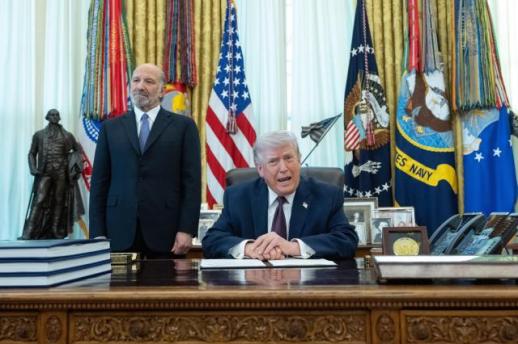 S.Korea to announce major US investment project within weeks, US official says SEOUL, April 04 (AJP) - South Korea is finalizing a major investment plan for the United States, a senior Trump administration official said, as Washington rolls out a new wave of tariffs on metals and pharmaceuticals. During a telephone briefing on Thursday, the senior U.S. official stated that Seoul is expected to unveil a significant investment project in the U.S. within the coming weeks. The official's remarks came after highlighting recent investment commitments from Japan, which include natural gas facilities in Ohio, artificial diamond production, and small modular reactors (SMRs) in Tennessee and Alabama. Seoul and Washington are currently in the final stages of coordinating the details of the investment. While the U.S. has reportedly requested investments in a liquefied natural gas (LNG) export terminal in Louisiana, the South Korean government is leaning toward sectors such as artificial intelligence (AI) data centers and nuclear power plant construction, citing stronger business viability and existing expertise. The upcoming investment announcement coincides with President Donald Trump signing an executive order that revises the imposition of tariffs under Section 232 of the Trade Expansion Act. Under the new rules taking effect on April 6, a blanket 25 percent tariff will be applied to derivative products containing more than 15 percent of steel, aluminum, or copper. The administration maintains a 50 percent tariff on the raw materials themselves. The official explained that this streamlined process will make it easier for companies to handle administrative work, noting that the previous system failed to generate the expected tariff revenue. Additionally, the executive order introduces a new 100 percent tariff on pharmaceutical products. However, South Korea, Japan, the European Union, and Switzerland will be subject to a reduced rate of 15 percent, while the U.K. will face a 10 percent rate. The U.S. official noted that these allied nations are granted lower rates because they have broader trade agreements with Washington, allowing them to maintain their domestic production facilities. 2026-04-04 13:42:10
 -
 Flutist Jihee Han's musical journey: A culmination of heritage and artistry SEOUL, April 04 (AJP) - In the world of classical music, a debut album often serves as an introduction to a young artist's potential. However, flutist Jihee Han’s recently released album under the prestigious Deutsche Grammophon label feels more like a profound culmination of a lifelong dedication to her craft. Han’s artistic foundation was deeply influenced by her family environment. Her late father, Sang-bum Han, a respected senior executive at Korean Air, was known for his integrity and the deep trust he cultivated. This profound trust was evident when the late Yang-ho Cho personally arranged for him to receive medical treatment in the United States after his cancer diagnosis. Raised in a household anchored by her father's values and her mother, In-gyeom Kim, who ran a French restaurant and managed the home with grace, Han grew up in an atmosphere where discipline, art, and warmth coexisted. Her musical journey spans across continents—from studying the Viennese tradition in Vienna to mastering the elegant French school of flute in Paris. She later attended the Oberlin Conservatory under the tutelage of Michel Debost, a defining figure in the French lineage. Returning to Seoul, she earned her doctorate from Seoul National University, establishing herself as both a performer and a scholar. Her Deutsche Grammophon debut, The Flute Works of Carl Reinecke, firmly situates her on the international stage. Collaborating with the Royal Philharmonic Orchestra under Vasily Petrenko and world-renowned pianist Lang Lang for the Sonata Undine, Han’s distinct, clear, and assured voice shines through. Rather than relying on mere display, her performance offers a transparent and deeply interpretive musical experience. As she has noted, her connection to Reinecke’s work dates back to her youth, making her performances a genuine reflection of her long-standing passion. Beyond the stage, Jihee Han balances her artistic career with her life as the wife of Yong-jin Chung, Chairman of Shinsegae Group, raising a family within the orbit of one of Korea's most prominent business conglomerates. The equilibrium she maintains between her prominent public role and her art is a testament to her composed nature. Ultimately, Han's music is not just a display of technical mastery. Her flute carries the legacy of her family, translating time, memory, and dedication into an enduring sound. 2026-04-04 12:19:37
 -
 BTS’ ‘ARIRANG’ Tops Spotify Weekly Global Charts for Second Straight Week BTS’ new release, “ARIRANG,” held the top spot on Spotify for a second consecutive week. Spotify’s latest weekly charts covering March 27 to April 2 showed BTS again leading the global rankings for Weekly Top Albums, Weekly Top Songs and Weekly Top Artists. The group also ranked No. 1 for 14 straight days, from March 20 through April 2, on the Daily Top Artists Global and Daily Top Songs Global charts. According to the group’s agency, the title track “SWIM” also topped YouTube Music’s weekly charts, ranking No. 1 on both the global and U.S. Weekly Top Songs lists with about 83 million and 6.2 million weekly streams, respectively. BTS also posted strong results on major charts in Europe and Australia. Australia’s ARIA charts released April 3 showed “ARIRANG” again at No. 1 on the Top 50 Albums chart, marking a second straight week at the top. On Germany’s official music charts, “ARIRANG” and “SWIM” placed No. 2 on the albums chart and No. 3 on the singles chart. In France, the National Syndicate of Phonographic Publishing (SNEP) Top Albums chart listed “ARIRANG” at No. 2.* This article has been translated by AI. 2026-04-04 11:21:15
 -
 S.Korea's diversified LNG supply chain mitigates risks amid Australia's potential export limits SEOUL, April 04 (AJP) - South Korea is facing potential supply chain disruptions for liquefied natural gas (LNG) as Australia, its largest LNG supplier, considers prioritizing domestic demand amid growing global uncertainties driven by the Middle East conflict. While the government expects limited near-term impacts, broader concerns over global energy supply stability remain. In response, proactive measures by South Korean private energy firms, such as SK Innovation E&S and POSCO International, to diversify their supply chains are highlighting the country's crisis resilience. Earlier this year, SK Innovation E&S began directly importing LNG from Australia's Barossa gas field, establishing a long-term supply base. Following a 1.6 trillion won equity investment, the company secured an annual supply of 1.3 million tons for the next 20 years, which accounts for about 3 percent of South Korea's total annual LNG imports. This marks the first instance of a South Korean private firm independently managing the entire LNG value chain, from exploration to import. POSCO International is also expanding its long-term supply base, primarily focusing on North America. In 2024, the company secured a combined 1.1 million tons annually through 20-year contracts signed with Mexico Pacific (700,000 tons) and Cheniere Energy (400,000 tons). Deliveries from Cheniere, utilizing POSCO's dedicated LNG carrier, will begin in the second half of this year. Furthermore, POSCO is strengthening its global LNG value chain. The firm invested 926 billion won in 2024 for the phase 4 development of a Myanmar gas field, which allocates 80 percent of its output to China. In Australia, Senex Energy—acquired by POSCO in 2022 for about 400 billion won—recently increased its annual output to 1.2 million tons. This shift toward diversified private procurement is restructuring South Korea's LNG market. Currently, private companies handle about 30 percent of the country's 45 million tons of annual LNG imports, mostly for their own power generation, while the state-run Korea Gas Corp. handles the remaining 70 percent. Industry officials note that compared to past structures reliant solely on state-run enterprises, this diversification shields South Korea from policy shifts in major supplier countries like Australia and Qatar. An industry official emphasized that for heavily import-dependent countries like South Korea, "early investments and expanded direct imports by private companies are becoming increasingly crucial in times of crisis." * This article, published by Aju Business Daily, was translated by AI and edited by AJP. 2026-04-04 10:25:22
 -
 Macron Visits Pompidou Center Hanwha in Seoul, Calls It a Bridge Between France and Korea Hanwha Foundation said Friday that French President Emmanuel Macron visited Pompidou Center Hanwha in Seoul’s Yeouido district on Thursday during his state visit to South Korea. The visit was arranged to highlight cultural cooperation between the two countries ahead of the museum’s planned opening in June, marking the 140th anniversary of diplomatic ties between South Korea and France. Macron and his wife, Brigitte Macron, toured major areas of the museum with Catherine Pégard, France’s minister of culture; Philippe Bertoux, France’s ambassador to South Korea; and Laurent Le Bon, president of the Pompidou Center, along with other French government and cultural figures. They were joined by Lee Seong-su, chairman of the Hanwha Foundation, and Kim Dong-won, CEO of Hanwha Life. Pompidou Center Hanwha was created by remodeling an annex of the 63 Building in Yeouido. It was designed by French architect Jean-Michel Wilmotte and built as a four-story museum with a total area of 11,000 square meters. Macron also met with South Korean artists, including internationally recognized figures Kimsooja and Lee Bae, as well as emerging artists such as Kim Heecheon and Yoo Jun-young. “Pompidou Center Hanwha will serve as a bridge between France and Korea and become a platform that leads dialogue between the art communities of both countries,” Macron said. He added that he hoped the two sides would expand artist exchanges and residency programs to build a closer creative partnership. Lee said the visit “once again confirms the meaning of cooperation the two countries have built through culture and the arts” as they mark 140 years of diplomatic ties. He said Pompidou Center Hanwha will work as a cultural platform linking South Korea and France and will broaden international cultural exchanges through a range of programs.* This article has been translated by AI. 2026-04-04 09:54:17
 -
 Mortgage Rates Hit 7% in South Korea, Raising Repayment Pressure for Borrowers After moving in step with expectations of U.S. rate cuts, the broader downtrend in interest rates has been jolted by the unexpected shock of the Iran war. With hopes fading for policy-rate cuts by central banks at home and abroad, and market rates — a key benchmark for lending — rising quickly, borrowers are facing tougher choices. As of Thursday, five-year fixed-rate mortgage loans at South Korea’s five major commercial banks — KB Kookmin, Shinhan, Hana, Woori and NH NongHyup — were quoted at annual rates of 4.42% to 7.02%, according to the financial industry on April 3. The top end of the fixed-rate range rising above 7% marks the first time since October 2022, about three years and five months ago. Compared with mid-January (4.13% to 6.29%), the upper bound is up 0.72 percentage points and the lower bound up 0.29 points. Experts say the upswing is unlikely to reverse sharply in the near term and advise consumers to adjust their financial plans accordingly. With interest burdens rising, managing debt to reduce repayment pressure is emerging as the immediate priority. Borrowers who bought homes in 2020 and 2021 by maximizing loans in a low-rate environment — and who are now renewing five-year fixed-rate mortgages — are entering a period of full rate resets starting this year. In many cases, monthly interest payments are expected to rise by hundreds of thousands of won or more. Borrowers should consider using the right to request a rate cut when their circumstances qualify. Those whose loans are more than three years old may also want to use rules that waive early repayment fees, allowing them to respond more quickly as market rates move. When choosing between fixed and variable rates, borrowers should factor in the possibility that rates may stay elevated rather than fall. For customers with heavy principal-and-interest payments or high debt relative to income, a fixed rate may be more stable by reducing exposure to rate swings. By contrast, higher-income borrowers with smaller loans and a strong likelihood of early repayment may find a variable rate — with a lower initial burden — more practical. “If the war drags on and oil prices stay above $100, the Fed could raise its policy rate, and the Bank of Korea could respond with hikes,” said Choi Ji-hoon, a gold private banker team leader at Hana Bank’s Club1 Hannam PB Center. “If the policy rate rises, loan rates have no choice but to rise as well.”* This article has been translated by AI. 2026-04-04 07:03:40
 -
 Review: Kim Young-ha’s ‘What Happened to the Man Stuck in the Elevator?’ ‘Even now, I still wonder. What on earth happened to him.’ Twenty-seven years after it was published, no one knows what became of him — the man who, in 1999, got stuck in an apartment elevator in Kim Young-ha’s short story, ‘What Happened to the Man Stuck in the Elevator?’ Though I read it more than 20 years ago, several scenes remain vivid, like a film: the man wedged at the fifth floor with his upper body caught between the doors, his feet dangling outside. The narrator, a resident of the same building, sees the man on the way to work and decides to report it rather than pull him free — worried about being late. But he has no cellphone. The security guard is out on patrol, and no one will lend a phone. The day only gets stranger: the commuter bus crashes, the narrator is mistaken for a sex offender, and at work he ends up trapped in an elevator. He is rescued much later, but his suit is ruined, he is late, and an important meeting ends in disappointment. By the time he gets off work, he still has not been able to report what he saw. Back home, he asks the building manager and neighbors what happened to the man — but no one knows. More than that, no one even seems to know such an incident occurred. The shock I felt then came from how chillingly real the story made “indifference” feel. The lingering anger came, too, from the author’s refusal to provide an ending. Kim, even now, has never offered an epilogue about the man’s fate. When I first read the story, I resented the neighbors, bus passengers and co-workers who piled hardship onto the narrator. A scene in which employees debate how many squares of toilet paper to allow for bodily waste, to save supplies, felt absurd. The narrator’s helplessness also seemed pathetic. Looking back now, I see the narrator differently: timid, perhaps, but in his own way admirable — the kind of worker who keeps showing up, enduring the long years, no matter what derails the day. Over time, my irritation at the bystanders has faded, replaced by a renewed respect for the many office workers who quietly withstand routine and then absorb sudden crises, solve them and move on. Kim, who was just over 30 when he wrote the story, may have been driven by irritation at people who pride themselves on being expressionless, detached and narrowly focused on their own tasks. Whether he still thinks that way is unclear. Now nearing 60, Kim met audiences on the 1st at a matinee concert that paired music and storytelling. The program placed the author’s commentary between performances of opera arias and film music. There, Kim reflected on ‘Cinema Paradiso,’ screened at a commemorative film festival marking the 30th anniversary of his literary debut. “I used to see it as a story about having to leave,” he said, “but watching it again, I realized it was about understanding the past and the community that made you.” He also said that in spring, more people wander without a destination, and “in that process, love shows on their faces.” The sharp edges in the author’s aura seem to have softened. So have mine. With time and experience, I have come to understand more of people’s smallness — and to value compassion more. I also find myself hoping that the story’s narrator, now surely older, would do something, anything, for a stranger in danger. * Leftover Review: A review of the impressions that remain after the main takeaways from cultural content are set aside.* This article has been translated by AI. 2026-04-03 18:45:18
 -
 Shinhan Bank Sells $600 Million in Global Bonds After Drawing $7 Billion in Orders Shinhan Bank said it issued $600 million (about 9.05 trillion won) in global senior foreign-currency bonds on April 1. The deal marked the first overseas foreign-currency bond sale by a major South Korean commercial bank since tensions in the Middle East rose following the war between the United States and Iran. Investor demand totaled about $7 billion (about 10.563 trillion won), the bank said. The bonds were issued as development finance notes, aimed at creating social and economic value by supporting climate-change response, expanding financial inclusion and backing small and midsize businesses. The offering was split evenly between a $300 million, three-year floating-rate note and a $300 million, five-year fixed-rate note. The spread on the three-year FRN was set at 0.58 percentage points over SOFR, a U.S. risk-free benchmark rate. The five-year fixed-rate note was priced at 0.43 percentage points over the yield on a U.S. Treasury of the same maturity. A Shinhan Bank official said the bank achieved a stable result by broadening its investor base and maintaining communication despite continued volatility in global markets. The official said the bank will pursue sustainable growth based on trust with global investors.* This article has been translated by AI. 2026-04-03 17:36:00
 -
 Korean stocks rebound as Hormuz risks recede, foreign inflows return SEOUL, April 03 (AJP) - Asian markets swung mostly higher Friday as governments from the Middle East to Europe scramble to reopen the Strait of Hormuz. The benchmark KOSPI led gains, closing up 2.7 percent at 5,377.3, as foreign and institutional investors returned to net buying. The won strengthened to 1,507.9 per dollar. The move followed reports that Iran is working with Oman on a maritime protocol to manage transit through the Strait of Hormuz, a route that handles roughly 20 million barrels of oil per day. The development eased immediate concerns over prolonged supply disruptions, though tensions remain elevated. Foreign investors bought a net 808.5 billion won ($536 million) of stocks, while institutions added 723.8 billion won. Retail investors sold 2.09 trillion won, indicating profit-taking into the rebound. Energy-linked sectors led the rally. Equipment and services firms surged 12.35 percent, shipbuilders rose 6.6 percent and trading companies gained 6.7 percent, reflecting continued positioning around energy security and logistics risks. Semiconductors also drove gains. Samsung Electronics climbed 4.4 percent to 186,200 won, while SK hynix advanced 5.5 percent to 876,000 won, tracking steady U.S. tech performance. By contrast, rate-sensitive heavyweights lagged. LG Energy Solution fell 1.5 percent to 398,500 won and Samsung Biologics declined 2.0 percent to 1,554,000 won, pointing to lingering caution. The KOSDAQ rose 0.7 percent to 1,063.8, giving up part of its earlier gains after hitting an intraday high of 1,083.24. Foreign and institutional investors sold a combined 413.8 billion won, while retail investors bought 406.0 billion won, signaling weaker conviction in smaller, growth-oriented stocks. In currency markets, the won gained 0.34 percent against the dollar, while the dollar index edged down 0.07 percent to 99.95. The VIX fell 2.7 percent to 23.9, indicating easing near-term volatility. Still, oil prices held above $110 per barrel, suggesting that risks tied to Hormuz are not fully priced out. Japan’s Nikkei 225 rose 1.3 percent, while China’s Shanghai Composite fell 1.0 percent and Hong Kong’s Hang Seng slipped 0.7 percent. 2026-04-03 17:31:54
 -
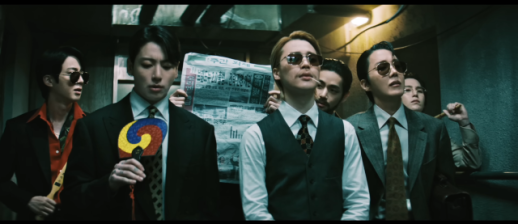 BTS '2.0' MV channels Oldboy noir as cinematic callbacks spark global buzz SEOUL, April 03 (AJP) - A few Korean films have left a deeper imprint on global cinema than Oldboy (2003), the brutal, operatic noir that propelled director Park Chan-wook onto the world stage — with a Cannes Grand Prix and admiration from filmmakers including Quentin Tarantino. Its side-scrolling corridor fight, shot in a single take, has since become one of the most imitated sequences in modern cinema. Now, that visual language has found an unlikely new interpreter: BTS. The music video for “2.0,” from the group’s comeback album Arirang, has surged across global platforms, drawing immediate attention for its striking parallels to Park’s signature style. Released Tuesday via Hybe Labels’ YouTube channel, the video surpassed 16 million views within 24 hours and topped YouTube’s trending music chart. The album’s title track “Swim” posted around 30 million views on its first day. The video opens with RM, Jin, Suga, J-Hope, Jimin, Jungkook and V stepping into a stylized past — retro hair, vintage tailoring, mustaches and beards — before moving into a dimly lit corridor staged for confrontation. What follows is a clear visual homage. In Oldboy, Choi Min-sik’s protagonist battles waves of attackers in a claustrophobic hallway, captured in a lateral tracking shot that has since become iconic. BTS mirrors the composition: the members advance in formation as the camera glides sideways, flanked by opponents, blending choreography with cinematic tension. The sequence adopts a one-take structure, placing multiple figures within a compressed horizontal frame. Everyday objects — from newspapers to back scratchers — are used as props, injecting a note of absurdity into an otherwise controlled, high-stakes setting, a tonal contrast long associated with Park’s direction. The references extend further. Later scenes unfold in an office setting closely resembling a key location from the film, while visible newspaper headlines — including “Brand New 2.0 Launch” and “Hidden Code Discovered” — fold the narrative back into the track’s thematic frame. Released in 2003, Oldboy drew more than 3 million viewers in South Korea and went on to win the Grand Prix at the 2004 Cannes Film Festival. Its corridor sequence, staged in a confined space and executed in a lateral one-take composition, remains one of the most recognizable images in Korean noir. Online, the parallels have not gone unnoticed. Social media users have circulated side-by-side comparisons, with one post on X reading, “This is literally the Oldboy hallway scene but BTS version,” while another described it as “not an ‘Old’ boy — brand new Oldboy,” underscoring how viewers are decoding the visual references in real time. The track itself debuted at No. 50 on the Billboard Hot 100, adding commercial weight to the artistic conversation. More broadly, the video reflects a shift in K-pop production, where music videos increasingly draw on established cinematic language — particularly from Korean film — to construct globally legible narratives beyond performance-driven formats. In a separate development, BTS also announced a new single, “Come Over,” set for release as part of a deluxe vinyl edition of Arirang, extending the group’s promotional cycle following their return after nearly four years. 2026-04-03 17:31:44