
Journalist

Ryu Yuna
Julia37@ajupress.com
-
 Inside Korea’s Curated Singles Parties: Dating as Risk Management “Even in a crowd, there’s one person who stands out. Here, that feeling can even lead to marriage.” “I hesitated at first, but now it feels like I’ve walked onto a TV set. I’ve already sent a ‘signal’ to two people.” Lines that sound like they belong on a hit dating show were heard one April afternoon at a lounge party in Seoul’s Samseong-dong. In a room where dozens of men and women circulated, one couple said a few words were enough to set the direction of their relationship. A mid-30s professional identified by the surname Lim and a late-30s senior researcher at a major company identified by the surname Kim said they had avoided dating apps and casual meetups because of busy schedules. Over a glass of wine, they talked about everyday life and were drawn to each other’s approach to living. Without going to a second venue, they set a dinner date for the next day. The relationship has continued for a year. “We realized how efficient it is to meet someone who’s been vetted,” the couple said. As “natural” encounters become harder to come by, many young South Koreans are shifting their search for partners from screens to curated, in-person events. Nearly 3 in 4 men in their early 30s are unmarried The push toward “designed” meetings is backed by stark numbers. According to the National Data Portal’s population and housing census, as of 2024 the unmarried rate for ages 30-34 was 74.7% for men and 58% for women. For ages 35-39, it was 46.8% for men and 29.9% for women. The unmarried rate for men ages 40-44 was 30.1%. Participants said the challenge has moved beyond simply marrying later to the difficulty of forming relationships at all. Several told reporters that in ordinary daily life, the odds of meeting a partner feel as remote as winning the lottery, making it a waste of time to wait for chance. Introverts said they are not exempt. A man surnamed Park, who described himself as extremely introverted and works at a state-run company, said organizers introduced him to a freelance announcer surnamed Choi and they became a couple. “If I hadn’t come here, I would never have met the person next to me in my lifetime,” he said. A 36-year-old participant identified by the surname Lee said she came for “trust” and “naturalness,” contrasting the experience with a marriage matchmaking company. “At those companies, you sit for an hour introducing yourself. It felt like an interview,” she said. “You end up evaluating conditions, and you think, ‘I might meet someone with better conditions tomorrow,’ so your expectations rise and it’s hard to focus on the relationship.” Lee said she once had as many as seven blind dates scheduled in a week, a structure she said turns people into “comparisons” rather than partners. At curated parties, she said, basic qualifications are checked but what matters is the feel of meeting in person. “If you dress up once and meet 20 people, you realize who you’re actually drawn to,” she said. “When you meet people who’ve built results, you feel, in the intellectual depth of conversation, ‘This person is different.’” She said the rotation format also lowers pressure. “On a one-on-one date, if you’re asked questions you have to keep answering, which is stressful. Here, if an uncomfortable question comes up, you can naturally move on,” she said. “If matchmaking felt like homework, this feels like getting to know people more naturally, so you can see a more genuine side.” From TV ‘signals’ to real life A similar scene played out on a rooftop in Yeongdeungpo, where about 40 men and women in a black-and-white dress code talked with wine glasses in hand. A participant identified as LDJ, 35, called it a “real-life Heart Signal.” “It’s highly satisfying because people with great jobs who are hard to meet privately gather here,” he said, giving it a perfect 10. Shin Hye-rin, a professor of media studies at Korea University, said the comparison is more than a metaphor. “The structure of observing multiple candidates at once, comparing chemistry and strategically exchanging interest looks a lot like the program format,” she said. She added that as dating shows present romance as something to be interpreted, participants can internalize that evaluative gaze and try to read and judge others. Shin said dating reality shows can also function as a kind of script. “For today’s generation, the awareness that ‘someone is always watching, or I am posting and showing myself’ is deeply internalized,” she said, adding that the process of signaling among multiple potential partners can take on aspects of performance. Shin described the trend as “defensive realism”: In an uncertain environment, weighing practical factors such as education, job and finances becomes an adaptation strategy to reduce the chance of failure. “It’s not that young people don’t know the contradictions of these standards,” she said. “They feel society still operates on traditional criteria, so they choose to maximize usefulness within that system.” She also framed the appeal of rotation-style dating as an “emotional portfolio” approach: reducing the risk of placing all expectations on one person by spreading emotional investment across multiple possibilities, lowering the psychological blow of rejection or failure. The premium social club that runs the events, The Grace Club, says it relies on strict verification and screening. A government ID and proof of employment are required, and applicants must pass a pre-screening of photos for appearance described as “above average.” About 65% of attendees were born in the 1990s, and many work in professional fields such as medicine and law or at major companies including Samsung Electronics, Hyundai Motor and Kakao. Organizers said the rules are meant to reduce the chance of disappointment and prevent wasted time. They said word-of-mouth has spread to the point that about six cast members from the dating show “I Am Solo” have passed through, making it a perceived must-stop in the marriage market. A man in his 30s using the nickname “Chic” said, “People who focused on studying or work have fewer chances to build connections, and gatherings like this help break through blocked social networks.” The club also kept operating during the pandemic through remote formats. It used KakaoTalk group chats in an “online rotation” system in which identities were revealed only when a match was made. Organizers said online tools could not fully convey atmosphere or emotional exchange. They added that as the AI era advances, the value of meeting in person and feeling another person’s presence is growing. After distancing rules eased, they said, offline applications surged, with a noticeable increase among women in their 30s seeking serious relationships. Shin said the trend reflects fatigue with dating apps combined with a desire for face-to-face contact. “The form is offline, but the operating logic still carries the platform optimization mindset,” she said. Instead of an app algorithm, organizers’ screening and verification act as the filter, while participants still compare multiple candidates and make choices. By 10 p.m. in Yeongdeungpo, as wine glasses clinked, some attendees were already setting their next plans. 2026-04-29 11:14:44
 -
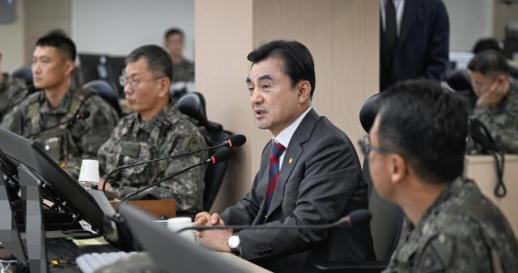 Robots to take over GOPs in Korea but computing power poses setback SEOUL, April 28 (AJP) - Robots will take over general outposts (GOPs) along the heavily fortified border with North Korea as South Korea grapples with shrinking troop numbers due to depopulation. But maintaining a robotic fleet comes with a catch — massive computing power. The Ministry of National Defense said Tuesday it is reviewing a plan to gradually reduce troops stationed at front-line GOPs and transition to an AI-enabled surveillance system. “The ministry is reviewing a plan to transform GOPs into an AI-based border security system combining manned and unmanned operations, and to pursue related force restructuring,” a ministry spokesperson said. Troop levels at GOPs could be reduced from about 22,000 to around 6,000. The ministry emphasized that the move is not simply about cutting troop numbers, but part of a broader restructuring driven by long-term demographic pressures. “GOP guard forces would be shifted to the Forward Edge of the Battle Area (FEBA), allowing troops to focus on training and preparing for combat while maintaining rapid response capabilities in emergencies,” the spokesperson said. The military is refining a roadmap for phased mid- to long-term pilot programs and complementary measures to ensure readiness during the transition. The plan, however, faces a significant infrastructure shortfall. The military estimates it will need about 50,000 graphics processing units (GPUs) to implement AI systems, but currently operates only around 500 across major defense data facilities, including the Defense Integrated Data Center, battlefield data centers and the Agency for Defense Development. The challenge extends beyond equipment shortages. Even if additional GPUs are secured, constraints in power supply, cooling systems and rack space could limit further expansion. The Agency for Defense Development, which holds roughly 480 GPUs, had planned to add another 320 last year but scrapped the plan due to insufficient installation space. Outsourcing GPU management to commercial cloud providers such as Naver Cloud and Kakao is not an option under National Intelligence Service security guidelines, which restrict such use in defense. Without new data centers, additional GPUs would be difficult to deploy, risking delays to broader military AI adoption. Given national security requirements, any new military data center would likely need to be built underground and hardened against chemical, biological and electromagnetic pulse (EMP) threats, with costs expected to exceed 2 trillion won ($1.4 billion). There are growing calls to build a facility capable of housing large volumes of GPUs, similar to one planned by the Ministry of Science and ICT. The ministry aims to invest 2 trillion won by 2028 to establish a National AI Computing Center with 50,000 GPUs. Separately, the ministry signed a memorandum of understanding Monday with Demis Hassabis, co-founder and chief executive of Google DeepMind, to cooperate on joint research in science, technology and AI, as well as talent development and the responsible use of AI. 2026-04-28 17:56:42
 -
 KOSPI extends record-setting rally as chip halo trickles down SEOUL, April 28 (AJP) — The KOSPI extended record-setting rally Tuesday with eyes on the 7,000 milestone, shrugging off the stalemate in U.S.-Iran talks even as the conflict nears the 60-day mark this week. As of 11:00 a.m., the benchmark index rose 0.65 percent to 6,658.25, as foreign and institutional investors continued buying despite retail profit-taking. Market breadth remained tight, with gainers narrowly outpacing losers 424 to 409. Investor sentiment was buoyed by expectations that strong earnings from U.S. technology heavyweights would reinforce momentum in Korea’s semiconductor- and IT-led market. With a substantial share of S&P 500 firms already reporting solid first-quarter results, attention has shifted to earnings from five “Magnificent Seven” companies. Microsoft, Alphabet, Amazon and Meta are due Wednesday, followed by Apple a day later. In U.S. trading, Nvidia surged 4 percent to a fresh intraday high on earnings optimism, while Alphabet gained 1.72 percent. Microsoft added 0.05 percent and Meta rose 0.53 percent, with Tesla up 0.63 percent. Apple slipped 1.27 percent. The strength spilled over into Korean chipmakers. SK hynix climbed 2.55 percent to 1,325,000 won, hitting a 52-week high, while Samsung Electronics edged up 0.22 percent to 225,000 won. South Korea’s broader rally has also lifted its global standing. Total market capitalization has surged more than 45 percent this year to about $4.04 trillion, overtaking the U.K. to rank as the world’s eighth-largest equity market, supported by global inflows into AI and semiconductor stocks. Cyclicals joined the advance. Hyundai Motor jumped 7.06 percent to 561,000 won, while Kia rose 3.41 percent to 157,800 won. Battery makers were also firm, with Samsung SDI gaining 4.72 percent and LG Energy Solution up 0.97 percent. Power equipment shares also remained firm, with Hyosung Heavy Industries up 0.96 percent at 3,979,000 won, extending gains since April 22 and continuing a run of successive record highs on expectations tied to AI infrastructure expansion and North American grid replacement demand. Financial and industrial shares edged higher, with KB Financial Group and Samsung C&T both up 0.64 percent. Losses were limited, though defense and shipbuilding stocks came under pressure. Hanwha Aerospace fell 1.10 percent, while HD Hyundai Heavy Industries slipped 0.74 percent. On the KOSDAQ, the index dropped 0.84 percent to 1,215.87 as foreigners and institutions sold a combined 458.6 billion won, offsetting net buying of 461.3 billion won by retail investors. Biotech stocks led declines, with AblBio plunging 19.86 percent, while Samchundang Pharm and LigaChem Biosciences also fell. Battery-related shares bucked the trend, with EcoPro rising 3.07 percent and EcoPro BM gaining 2.17 percent. In currency markets, the Korean won weakened slightly to 1,474.50 per dollar from 1,472.50 previously. Elsewhere, Japan’s Nikkei 225 fell 0.54 percent to 60,211.50, retreating from a record high as investors positioned ahead of the Bank of Japan’s policy decision. Chip-related stocks led declines, with Advantest down 4.51 percent and SoftBank Group tumbling 7.14 percent. Hong Kong’s Hang Seng Index slipped 0.52 percent, while China’s Shanghai Composite edged down 0.22 percent. Regional markets face a shortened trading week, with Japan closed Wednesday and South Korea, China, Hong Kong and Taiwan shut Friday for Labor Day. 2026-04-28 11:30:59
 -
 Korea moves to lock in tourism windfall as regional travel shifts boost arrivals SEOUL, April 27 (AJP) - South Korea is moving to lock in a tourism windfall as shifting regional travel patterns and stronger visitor spending drive a surge in foreign arrivals ahead of a holiday-packed May. The country welcomed a record 4.76 million foreign visitors in the first quarter, up 23 percent from a year earlier, with 2.06 million arriving in March alone, according to the Ministry of Culture, Sports and Tourism. The March spike was partly driven by the full-member comeback performance of BTS in Gwanghwamun, which drew global fans and boosted visits to nearby cultural sites such as Gyeongbokgung Palace. Beyond headline numbers, officials say the recovery is becoming more structural. Arrivals through regional airports rose nearly 50 percent in the first quarter, while 34.5 percent of visitors traveled outside Seoul — signaling a broader geographic spread in tourism demand. Visitors are also staying longer and spending more. Overnight stays in non-capital regions rose 36.2 percent, while foreign card spending increased 23 percent to 3.21 trillion won. Overall visitor satisfaction reached 90.8 points. Booking data reinforces the trend. Trip.com ranked Seoul as the world’s top destination for spring flight bookings, with reservations up 83 percent from a year earlier, outpacing Tokyo and Osaka. The spillover is increasingly visible beyond the capital. Cheongju, about 120 kilometers south of Seoul, recorded a 962 percent jump in visitors, followed by Busan with 131 percent and Jeju with 129 percent. Local governments are moving quickly to extend the momentum. Busan has launched a rail-linked tourism campaign with Korail, offering discounts of up to 50 percent on high-speed KTX fares through September. The promotion bundles transport with major events such as the Haeundae Sand Festival in May, the Busan Port Festival in June, and large-scale exhibitions including G-STAR 2026. Officials say the goal is to spread demand beyond peak seasons and encourage longer stays. Growth has been broad-based across major markets. China remained the largest source of visitors, with arrivals rising 29 percent to 1.45 million, followed by Japan at 940,915 visitors, up 20.2 percent. Taiwan posted the fastest growth at 37.7 percent, while arrivals from the Americas and Europe rose 17.1 percent. Cruise traffic also rebounded, with calls at ports including Jeju, Busan and Incheon reaching 338, up 52.9 percent from a year earlier. Momentum is expected to continue into the second quarter. Japan’s Golden Week and China’s May Day holiday are likely to bring another wave of visitors, with H.I.S. ranking Seoul as the top overseas destination for the period. Data from Airbnb showed South Korea ranked first in global destination searches for the May Day holiday, with interest rising fivefold from a year earlier. Part of the surge may reflect shifting regional travel dynamics. China’s Global Times reported that about 45 percent of scheduled flights from mainland China to Japan during the five-day holiday period had been canceled. Data from the Japan National Tourism Organization showed Chinese arrivals to Japan fell 55.9 percent in March, marking a fourth straight monthly decline. The shift is increasingly redirecting demand toward Korea, reinforcing its position as a key alternative destination in Northeast Asia. 2026-04-27 17:04:01
 -
 Seoul and Tokyo benchmarks touch new highs as tech rally overrides Gulf jitters SEOUL, April 27 (AJP) - Seoul's main KOSPI touched a new ceiling at 6,600 on institutional buying early Monday, brushing aside weekend incidents — the stalemated U.S.-Iran peace talks and a shooting incident during the White House Correspondents’ Dinner attended by U.S. President Donald Trump. Both the KOSPI and junior KOSDAQ gained nearly 2 percent, pushing their combined market capitalization above 6,000 trillion won, up nearly 40 percent from the beginning of the year. As of 11:00 a.m., the KOSPI was up 1.96 percent at 6,602.44, while the KOSDAQ rose 1.76 percent to 1,222.90. Semiconductor shares led the advance, with SK hynix hitting another 52-week high Monday, extending gains on expectations of a semiconductor supercycle. Shares rose 4.83 percent to 1,281,000 won. Support also came from expectations that the current memory upcycle may be stronger than in previous cycles, with investors watching this week’s results from global NAND suppliers for guidance that could lift consensus forecasts for SK hynix’s NAND business. Gains spread across the broader semiconductor sector, with Samsung Electronics rising 1.59 percent to 223,000 won. Autos were mostly firmer, with Hyundai Motor Company surging 3.12 percent to 529,000 won and affiliate Kia edging up 0.13 percent to 153,600 won. Industrial and defense shares were mixed, with HD Hyundai Heavy Industries up 1.04 percent at 678,000 won and Doosan Enerbility adding 0.87 percent to 128,200 won, while Hanwha Aerospace slipped 0.68 percent to 1,453,000 won. Battery names came under pressure, with LG Energy Solution down 3.17 percent to 465,750 won and Samsung SDI dropping 1.72 percent to 630,000 won. The KOSDAQ was lifted by strength in biotech and robotics shares, with nearly all of the top components trading higher. Rainbow Robotics jumped 11.44 percent to 682,000 won, while ABL Bio climbed 8.97 percent to 171,300 won and Samchundang Pharm rose 8.38 percent to 446,000 won. Alteogen added 4.20 percent to 384,500 won, while HLB gained 4.15 percent to 62,700 won. Leeno Industrial — a semiconductor testing equipment maker — was the only decliner among major components, falling 14.63 percent to 106,200 won. The dollar sharply eased on renewed foreign buying, trading at 1,474.30 won compared with the previous close of 1,484.50 won. Japan’s Nikkei 225 rose 1.23 percent to a fresh intraday high of 60,351.95 in morning trade, led by semiconductor-related shares. Advantest climbed 1.24 percent and SoftBank Group added 0.89 percent, as investors positioned ahead of the Bank of Japan’s policy decision due Tuesday. Hong Kong’s Hang Seng Index slipped 0.08 percent to 25,957.25, while China’s Shanghai Composite Index eased 0.02 percent to 4,079.00. Japan’s markets are set to close Wednesday, while South Korea, China, Hong Kong and Taiwan will be shut Friday for Labor Day. Meanwhile, market focus will turn to how earnings from megacap technology firms shape volatility this week, with Microsoft, Alphabet, Amazon and Meta due to report first-quarter results on Wednesday, followed by Apple on Thursday. 2026-04-27 11:15:28
 -
 Big-tech layoffs: a prelude to AI replacement? SEOUL, April 24 (AJP) - What has long been feared is beginning to take shape. From May 20, Meta plans to cut about 8,000 jobs — roughly 10 percent of its workforce — while leaving 6,000 roles unfilled, even as it raises capital spending to as much as $135 billion this year for AI data centers and infrastructure. “We’re starting to see projects that used to require big teams now be accomplished by a single very talented person,” Mark Zuckerberg said during an earnings call, outlining plans to develop a so-called CEO agent. Microsoft has also offered voluntary buyouts to about 8,750 U.S. employees, even as it accelerates investment in artificial intelligence. Its chief executive, Satya Nadella, has repeatedly highlighted internal AI adoption, saying it has driven significant productivity gains. In April 2025, he said AI was already handling as much as 30 percent of the company’s coding work. In short, the very companies that once led a hiring boom to secure programming talent are now making room for AI. Kim Jin-young, a professor of economics at Korea University, describes the shift as deeply ironic. “Some programmers are rewarded in proportion to how much they use AI tools,” he said. “It creates a system where people work harder to build the weapon that could replace them.” Still, he cautions against overestimating the speed of disruption. “There is an assumption that AI can quickly replace labor, but in reality there are many hurdles to overcome, and that transition is likely to take considerable time,” he said. The scale of the shift is already visible. According to Crunchbase News, about 127,000 jobs were cut at U.S.-based technology companies in 2025, following 95,667 in 2024 and more than 191,000 in 2023. Among individual firms, Intel recorded the largest cuts in 2025 with more than 27,000 job losses, followed by Microsoft, Verizon and Amazon. The clearest signs of strain are emerging at the entry level. A 2023 study by GitHub and Microsoft found developers using GitHub Copilot completed coding tasks 55.8 percent faster on average, raising concerns that generative AI is absorbing routine work — coding, debugging, testing and documentation — traditionally assigned to junior engineers. The so-called “entry-level squeeze” is already evident in the United States. According to reporting by The Washington Post, computer programming jobs fell 27.5 percent over two years, while software developer employment remained largely flat. By 2025 and into 2026, major tech firms including Google and Meta have scaled back aggressive new-graduate hiring, shifting focus toward experienced engineers who can leverage AI tools more effectively. South Korea is showing similar signs. According to the Ministry of Data and Statistics, employment in professional, scientific and technical services fell by 105,000 on year to 1.373 million last month — the sharpest decline since the industrial classification system was revised in 2017. Employment in information and communications also dropped by 42,000, marking a second straight monthly decline. The impact is particularly acute among younger workers. Employment among people in their 20s fell by 163,000 to 3.262 million, the lowest level since records began in 1982 — the only age group to post a decline. Job placement data for computer science graduates tell a similar story. Placement rates have dropped across major universities, including Seoul National University, KAIST and Hanyang University. The shift is also reflected in hiring demand. According to the Korea Labor Institute, the share of entry-level openings in software developer job postings fell to 37.4 percent in 2024 from 53.5 percent in 2022. This coincides with the rapid adoption of generative AI. A survey by McKinsey & Company found the share of companies using generative AI in at least one business function jumped to 65 percent in 2024 from 33 percent a year earlier. As AI becomes standard in the workplace, companies are increasingly favoring experienced workers who can deploy these tools effectively, rather than hiring juniors for repetitive tasks. That does not mean software development is disappearing. The U.S. Bureau of Labor Statistics projects employment for software developers will grow 15 percent from 2024 to 2034. Rather, the nature of the work is shifting. Demand is weakening for routine coding, while rising for higher-skilled developers who can design systems, validate models and integrate AI into products. International institutions point in the same direction. The International Monetary Fund estimates about 40 percent of global employment — and up to 60 percent in advanced economies — is exposed to AI, while the World Economic Forum projects the technology could create 11 million jobs by 2030 while displacing 9 million. The implication is less about wholesale job destruction than a reconfiguration of work — unbundling tasks, automating some, and raising the value of others. Kim Geun-tae, a professor of public sociology at Korea University, says education must adapt accordingly. “Computer science students should also be taking humanities and social science courses,” he said, noting that future competitiveness will hinge on combining technical skills with human judgment. He pointed to renewed interest in philosophy departments at top universities as employers place greater value on reasoning, ethics and interpretive skills that are harder to automate. Even hiring practices are evolving. Companies such as KT Corporation are incorporating AI-assisted problem-solving into recruitment, asking applicants to use AI tools during interviews. Yet the two professors agree the current correction does not signal the end of human labor. “The essential things are not easily replaced,” Kim said. 2026-04-24 17:52:45
 -
 Asian stocks wobble into weekly close amid entrenched Gulf uncertainties SEOUL, April 24 (AJP) - Asian markets traded mixed Friday with little sign of diplomatic breakthrough after U.S. President Donald Trump unilaterally declared an indefinite extension to the ceasefire with Iran while continuing with naval blockade of the Strait of Hormuz. Japan's Nikkei 225 rose 0.70 percent to 59,554.99, aided by spillover from overnight gains in U.S. semiconductor shares, with Advantest climbing 1.56 percent to 28,335 yen and SoftBank Group adding 1.42 percent to 5,920 yen. Hong Kong’s Hang Seng Index fell 0.94 percent to 25,672.48 and China’s Shanghai Composite Index fell 0.57 percent to 4,069.88 In Seoul, the KOSPI pulled back after closing at a fresh record high in the previous session, fluctuating near the 6,500 mark in early trading as foreign selling weighed on sentiment. Pressure also came as Samsung Electronics and SK hynix retreated from record highs. As of 11:20 a.m., the main index stood at 6,458.15, down 0.22 percent. Leading the decline, Samsung Electronics fell 2.45 percent to 219,000 won, and SK hynix slipped 0.49 percent to 1,219,000 won. Hyundai Motor dropped 3.57 percent to 513,000 won, and affiliate Kia also declined 2.84 percent to 153,900 won. Gains were seen in select industrial and defense-related names, with defense shares supported by renewed geopolitical risks in the Middle East surrounding the war overnight. HD Hyundai Heavy Industries rose 3.12 percent to 661,000 won, while Hanwha Aerospace advanced 2.74 percent to 1,464,000 won. Doosan Enerbility also gained 2.20 percent to 125,300 won, supported by optimism over expanding nuclear and gas turbine orders and potential opportunities tied to Vietnam’s nuclear plans following an MOU between South Korea and Vietnam. The stock has risen about 63 percent this year and ranks as the top foreign net-buying stock, with net purchases totaling 2.26 trillion won. The junior KOSDAQ moved higher, rising 1.26 percent to 1,189.08, with foreign and institutional buying supporting sentiment. Gains were led by biotech and technology names. Peptron jumped 10.28 percent to 279,000 won, while Samchundang Pharm surged 5.00 percent to 399,000 won. Alteogen rose 3.08 percent to 368,500 won, and Eotechonics gained 1.55 percent to 492,000 won. On the downside, Ecopro fell 1.46 percent to 154,900 won, and Rainbow Robotics slipped 0.50 percent to 597,000 won. HLB edged down 0.50 percent to 59,600 won, and Koongtook Sujin declined 0.45 percent to 99,650 won. In the currency market, the Korean won weakened slightly, with the dollar trading at 1,482.80 won, compared with the previous close of 1,481.0 won. Overnight on Wall Street, stocks closed lower as renewed geopolitical tensions in the Middle East, a surge in oil prices and weakness in software shares weighed on sentiment. The S&P 500 fell 0.41 percent, while the Nasdaq dropped 0.89 percent and the Dow Jones Industrial Average slipped 0.36 percent. The Philadelphia Semiconductor Index, however, bucked the broader downturn, rising 1.71 percent, highlighting continued resilience in chip shares. 2026-04-24 11:27:17
 -
 Chip rally, GDP surprise drive KOSPI to fresh record high SEOUL, April 23 (AJP) - Geopolitical uncertainty failed to derail South Korea’s stock rally, with the KOSPI closing at a fresh all-time high Thursday as strong chip earnings and an upside GDP surprise lifted investor sentiment. The benchmark index closed at 6,475.81, up 0.90 percent, while the KOSDAQ ended at 1,174.31, down 0.58 percent. The Bank of Korea said first-quarter real GDP expanded 1.7 percent from the previous quarter, nearly double its February forecast of 0.9 percent and the fastest growth in five and a half years, supported by stronger-than-expected semiconductor demand. Semiconductor shares extended gains after Samsung Electronics marked a record closing high, gaining 3.22 percent to close at 224,500 won ($151.5). Meanwhile, SK hynix reported record first-quarter earnings, reinforcing expectations for robust AI-driven memory demand, while its shares rose 0.16 percent to 1,225,000 won. However, battery shares retreated after a sharp recent rally driven by expectations that Middle East tensions would strengthen demand for electric vehicles and U.S. energy storage systems. Shares of LG Energy Solution fell 3.72 percent to close at 466,500 won. Samsung SDI, which had gained for six straight sessions, declined 4.40 percent to 630,000 won. Auto shares also weakened. Shares of Hyundai Motor swung between gains and losses before closing lower, down 1.66 percent to 532,000, as investors weighed record revenue against a sharp drop in profitability. The company said on Thursday that its first-quarter consolidated operating profit fell 30.8 percent from a year earlier to 2.51 trillion won, with more than 1 trillion won in profit decline driven by U.S. auto tariffs, higher warranty provisions tied to exchange-rate volatility and weaker global demand amid the Iran war. Revenue, however, rose 3.4 percent year-on-year to a record 45.94 trillion won for a first quarter, supported by strong hybrid vehicle sales and improved performance in its financing business. Its operating margin stood at 5.5 percent. Affiliate Kia also slipped 1.00 percent to 158,400 won. Meanwhile, energy and industrial names outperformed, with Doosan Enerbility jumping 5.78 percent to 122,600 won. The gains came after a memorandum of understanding (MOU) signed during Tuesday’s South Korea-Vietnam summit between Korea Electric Power Corp. and PetroVietnam, Vietnam’s National Oil and Gas Group to explore the feasibility of cooperation in nuclear power development. Samsung C&T also advanced 6.31 percent to close at 320,000 won and HD Hyundai Electric rose 3.58 percent to 1,129,000 won. The KOSDAQ traded lower through much of the session, briefly falling below 1,153 at midday before trimming losses to close down 0.58 percent at 1,174.31, pressured by foreign and institutional selling. Declines were led by battery stocks, with EcoPro falling 4.32 percent to 157,200 won, EcoPro BM sliding 5.73 percent to 205,500 won and biopharma stock Alteogen edging down 0.56 percent to 357,500 won. In the currency market, the Korean won weakened slightly, with the dollar trading at 1,480.30 won, compared with the previous close of 1,476.0 won. Markets elsewhere in Asia closed lower, with Japan’s Nikkei 225 closing at 59,140.23, down 0.75 percent, China’s Shanghai Composite ending at 4,093.25, down 0.32 percent, and Hong Kong’s Hang Seng Index closing down 0.99 percent at 25,904.09. Investor sentiment weakened as renewed military tensions, including reports of air defenses activated in parts of Tehran, fueled concerns over broader conflict escalation, while oil prices surged toward $97 a barrel. 2026-04-23 17:29:23
 -
 INTERVIEW: Malaysia has a key role in Korea's post-Gulf energy redesign: envoy SEOUL, April 23 (AJP) - The Global South is moving to the center of South Korea’s strategic calculus, underscored by this week’s presidential visits to India and Vietnam, as Malaysia seeks to harness the momentum to leverage complementary strengths — not just to mitigate Gulf-driven disruptions, but also to redesign energy security, its top envoy to Seoul said. Energy security will serve as the starting point for deeper alignment, with Malaysia’s LNG exports and South Korea’s downstream industrial capacity forming “mutual dependability,” Malaysia’s ambassador to South Korea, Dato’ Mohd Zamruni Khalid, told AJP in an interview on Wednesday. “The carbon dioxide can be transported to Malaysia and injected into depleted reservoirs for long-term storage,” he said, pointing to cross-border carbon management as one of the most tangible new pillars of bilateral cooperation. The push comes as Seoul steps up engagement with emerging economies across Asia, with President Lee Jae Myung’s visits underscoring a strategic pivot toward Global South partners as geopolitical shocks reshape trade and energy flows. The urgency has intensified since the Feb. 28 outbreak of war and disruptions around the Strait of Hormuz, a chokepoint through which more than 20 percent of global oil and LNG shipments pass. According to the United Nations Conference on Trade and Development, vessel traffic plunged roughly 95 percent, from an average of 129 ships a day in February to about six in March. The shock has sharpened concerns over South Korea’s supply concentration risks while elevating Malaysia’s strategic relevance. Australia accounted for 31.4 percent of South Korea’s LNG imports last year, followed by Malaysia at 16.1 percent and Qatar at 14.9 percent, underscoring Kuala Lumpur’s position as a key energy supplier. Trade patterns suggest diversification is already underway. According to Korea International Trade Association data, South Korea’s imports of Malaysian crude surged 140 percent in March from a year earlier, while imports from seven Middle Eastern countries fell 18.3 percent, lowering their share to 62.9 percent from 73 percent a year earlier. Malaysia’s estimated 2.7 billion barrels of proven oil reserves, ranking around 29th globally, reinforce its positioning not only as an LNG supplier but as part of a broader hedging strategy against geopolitical concentration risk. Khalid said the relationship is already anchored on a broad foundation. Bilateral ties are “very strong, increasingly strategic,” extending beyond politics into economic, technological and defense cooperation, with supply chains, semiconductors and energy security at the core. Bilateral trade reached about $27.4 billion in 2025, remaining well above the $20 billion mark for several years — a level he said underscores the scale of progress already achieved. “At the first level of partnership, we had already achieved over US$20 billion more than five years ago. This is quite significant,” he said. That vision is increasingly reflected in policy and industrial strategy. Malaysia’s New Industrial Master Plan 2030 — aimed at shifting the economy toward high-value manufacturing — places advanced manufacturing, digitalization, Industry 4.0 and the green transition at the core of its growth agenda. The government’s semiconductor push further highlights its role in global packaging and testing. According to Malaysia’s Ministry of Investment, Trade and Industry and the Malaysian Investment Development Authority, the country accounts for about 13 percent of the global semiconductor assembly, testing and packaging market and ranks as the world’s sixth-largest semiconductor exporter, offering Korean chipmakers a base for supply chain diversification in Southeast Asia. Khalid said these priorities align closely with Korea’s industrial strengths. He pointed to high-end semiconductor manufacturing, digital transformation, Industry 4.0 and the green energy transition, while also naming EV batteries, green hydrogen, CCUS, medical devices, machinery, automation, e-commerce, fintech and artificial intelligence as promising areas for collaboration. These sectors reflect both countries’ push to move up the value chain while responding to demand for resilient supply chains and low-carbon technologies. “Effectively aligning Korea's technology maturity and also Malaysia's aggressive net zero targets and resource availability,” he said. The envoy stressed Malaysia’s carbon capture initiatives under its broader CCUS framework. While South Korea primarily focuses on carbon capture and storage (CCS), Malaysia adopts a wider approach. “We use ‘CCUS’ — because we, after capturing the carbon, we want to reutilize, and then also to be used in the storage. So that’s why ‘U’ is quite important for us,” he said. CCUS — carbon capture, utilization and storage — incorporates reuse before permanent storage, reflecting Malaysia’s push to maximize economic value from decarbonization. Khalid said Malaysia’s regulatory framework has strengthened the case for cooperation. “When the Malaysian Parliament approved the CCUS Act, this landmark legislation, along with the establishment of the Malaysia CCUS Agency, provided a comprehensive framework covering capture, transportation and permanent storage,” he said. He added the legal clarity provides Korean investors with a clearer pathway to participate in cross-border CO₂ transport, allowing emitters in South Korea to capture carbon domestically and ship it to Malaysia for offshore storage. As of 2026, the primary gateway is Petronas. Khalid noted Petronas is already working with several South Korean firms, including Samsung Engineering and the Korea National Oil Corporation, on cross-border CCUS value chains. “These partnerships offer a unique opportunity to act both as technology providers and as end users of low-carbon molecules, securing long-term energy supplies for Korea’s domestic hydrogen economy goals,” he said. He added that last year’s legislation would enable further cooperation, noting South Korea’s strong interest in participating in the CCUS platform. Malaysia’s CCUS Act 2025 took effect on Oct. 1, 2025, providing the basis for the country’s first offshore assessment permit, with authorities positioning it as a key pillar of the low-carbon transition. Beyond energy, Malaysia is also seeking to combine Korea’s consumer strengths with its halal ecosystem. Anchored by the Department of Islamic Development Malaysia (JAKIM), which oversees halal certification, the country offers a “complete halal value chain,” positioning Malaysia as an ideal base for Korean companies seeking halal-certified production and regional distribution. He noted strong potential in halal beauty and derma products, combining Korea’s innovation with Malaysia’s certification credibility and market access. Malaysia has developed comprehensive infrastructure — including halal-certified restaurants, prayer facilities and accommodation — making it one of the top destinations for Muslim travelers and an ideal production and distribution base. With Malaysian visitor numbers to South Korea exceeding 300,000 in 2025, Khalid said both countries could deepen cooperation in catering to Muslim tourists. Improving Muslim-friendly infrastructure in South Korea — including better access to prayer facilities and halal food — would support further growth, he said. “Malaysia can help the ROK in this in the tourism sector, catering for Muslim tourists.” He added that “both Malaysia and South Korea can work together in the halal industry across food, cosmetics and tourism sector.” The tourism argument runs both ways. Malaysia is pushing its Visit Malaysia 2026 campaign after welcoming more than 25 million international visitors in 2024, leveraging food, culture and education-linked travel. Khalid said Korean visitors are particularly drawn to Malaysia’s culinary diversity, tied to its long-running “Malaysia Truly Asia” branding. He also pointed to strong cultural pull factors, with more Malaysians learning Korean through K-pop, dramas and food. According to the Korea Foundation for International Cultural Exchange’s 2025 survey, about 70.2 percent of Malaysian respondents said their perception of Korea improved after consuming Korean cultural content, underscoring the strong influence of Korean media, particularly among younger audiences. 2026-04-23 08:49:30
 -
 Malaysia Envoy Proposes Korea Energy Security Partnership Beyond Gulf Risks As President Lee Jae-myung’s trip to India and Vietnam helps accelerate South Korea’s “Global South” diplomacy, Malaysia has proposed energy security cooperation with South Korea as a new strategic pillar. Citing supply shocks tied to the Middle East, the idea is to redesign energy supply chains by combining the two countries’ strengths. Mohamed Zamruni bin Khalid, Malaysia’s ambassador to South Korea, said in an interview Tuesday with Ajou Economy and AJP that “energy security is the starting point for strategic cooperation between our two countries.” He said Malaysia’s liquefied natural gas supply capacity, paired with South Korea’s industrial competitiveness in energy use, could create “an interdependent but complementary structure.” He pointed to carbon capture, utilization and storage, or CCUS, as the most practical area for near-term cooperation. “A representative model we can pursue immediately is storing carbon dioxide captured in Korea in Malaysia’s depleted reservoirs,” he said, adding that a cross-border carbon value chain could be built. The proposal comes as Asia’s energy vulnerability has been exposed after the Strait of Hormuz was effectively blocked following a war in the Middle East. With the strait — through which more than 20% of global oil and LNG cargo volumes pass — shut, the need to diversify regional sourcing has surged. Shifts are also being seen in South Korea’s import mix. Last year, Australia accounted for the largest share of South Korea’s LNG imports at 31.4%, followed by Malaysia at 16.1% and Qatar at 14.9%. For crude oil, imports from Malaysia jumped 140% in March from a year earlier, while imports from seven Middle Eastern countries fell 18.3%, according to the Korea International Trade Association. As a result, the Middle East share declined to 62.9% from 73%. Malaysia, which has proven reserves of about 2.7 billion barrels, is emerging as an alternative energy supplier that could help spread geopolitical risk, beyond its role as an LNG provider. Khalid said bilateral ties already rest on a broad base centered on supply chains, semiconductors and energy security, and could evolve into a more strategic relationship if cooperation expands into the economy, technology and defense industries. Two-way trade totaled about $27.4 billion in 2025, staying above $20 billion for several years. “It is a meaningful achievement that it has already exceeded $20 billion in the early stage of the partnership,” he said. Malaysia’s industrial strategy is also widening points of contact with South Korea. Through the New Industrial Master Plan 2030, the government has set advanced manufacturing, digital transformation, smart factories and a transition to cleaner energy as key growth pillars. In semiconductors, Malaysia is increasing its presence in global supply chains. The Ministry of Investment, Trade and Industry and the Malaysian Investment Development Authority said Malaysia accounts for about 13% of the global market for semiconductor assembly, testing and packaging, and ranks sixth in exports. Khalid said the strategy aligns with South Korea’s strengths, naming advanced semiconductor manufacturing, digital transformation, smart manufacturing and clean energy as core areas for cooperation. He also cited electric vehicle batteries, green hydrogen, CCUS, medical devices, automation, e-commerce, fintech and artificial intelligence as promising fields. He said the approach combines South Korea’s technological maturity with Malaysia’s net-zero goals and resource availability, creating momentum for both countries to move into higher value-added industries. On CCUS, he said Malaysia emphasizes “utilization,” distinguishing it from South Korea’s focus on carbon capture and storage, or CCS. “Because we link utilization with storage, the ‘U’ is important,” he said. Malaysia has also moved quickly to build a policy framework, recently passing a CCUS law and establishing a dedicated agency to set regulations covering capture, transport and permanent storage. The steps are expected to expand opportunities for South Korean companies. Petronas, Malaysia’s state energy company, is the main channel for cooperation, with South Korean firms including Samsung Engineering and the Korea National Oil Corp. participating. Khalid said the cooperation offers South Korean companies a chance to take part both as technology suppliers and as demanders of low-carbon fuels, and could contribute over the long term to securing energy supply chains linked to South Korea’s hydrogen economy. He also said there is room to expand cooperation in tourism and the halal industry. More than 300,000 Malaysian tourists visited South Korea last year. He said access should be improved not only to prayer rooms but also to washing facilities for wudu, the ritual cleansing performed before prayer, and that cooperation is possible in halal industries spanning food, cosmetics and tourism. Malaysia attracted more than 25 million foreign tourists last year and is promoting its “Visit Malaysia 2026” campaign. Khalid said the multicultural appeal highlighted by the “Malaysia Truly Asia” slogan could also be competitive in drawing South Korean visitors. Cultural exchanges linked to the Korean Wave are also expanding. According to a 2025 survey by the Korea Foundation for International Cultural Exchange, 70.2% of respondents in Malaysia said their perception of South Korea improved after exposure to Korean cultural content. Khalid, a career diplomat who previously served as ambassador to France, took up his post in South Korea in 2024. “The past two years in Seoul have been a very enjoyable experience,” he said, expressing expectations for broader cooperation. 2026-04-23 08:48:23