

Journalist

CHUNG SUNG JOO
ajucsj@ajunews.com
-
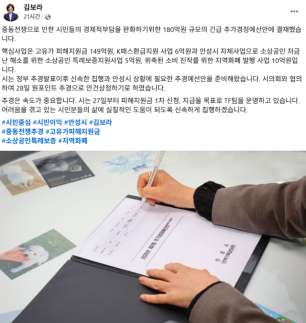 Anseong Mayor Kim Bo-ra Says Speed Matters as City Drafts 18 Billion Won Emergency Budget Gyeonggi Province’s Anseong city has drafted an emergency 18 billion won supplementary budget to ease residents’ financial strain from high fuel prices, inflation and the prolonged Middle East war. The city submitted the proposal to the Anseong City Council on April 20 in line with the central government’s measures to stabilize livelihoods. The one-time budget focuses on urgent issues tied to the war’s spillover effects and is expected to be put to a final vote at the council’s 239th extraordinary session on April 28 after prior consultations and schedule coordination. The centerpiece is 14.9 billion won in high fuel price relief payments. The city plans to begin paying up to 550,000 won per household starting April 27 to basic livelihood recipients, near-poor households and households in the bottom 70% by income. The plan also includes 600 million won for K-Pass rebate support to respond to the fuel-price shock, encourage public transit use and improve mobility. Another 900 million won was set aside to hire temporary workers for a special farmland survey aimed at creating public-sector jobs. To help residents and small businesses hit by high prices, the budget includes 500 million won for a special credit guarantee program for small merchants and 1 billion won to support issuance of local currency to boost consumption. Mayor Kim Bo-ra said on social media on April 20 that she had approved the 18 billion won emergency budget, adding that the city had prepared a plan tailored to local needs and aimed at rapid execution after the government announced its own supplementary budget. “Speed matters with a supplementary budget,” Kim said. “The city is operating a task force team with the goal of starting the first round of applications and payments for relief funds from April 27. We will execute it quickly so it provides real help to residents who are struggling.” The city said it will begin spending as soon as the council approves the budget and will focus its administrative resources on ensuring there are no disruptions in applications and payments. An Anseong city official said the emergency budget was designed to prioritize stable daily life for residents and support the local economy, adding that the city will push detailed policies and swift execution to help overcome the current crisis.* This article has been translated by AI. 2026-04-21 16:14:06
 -
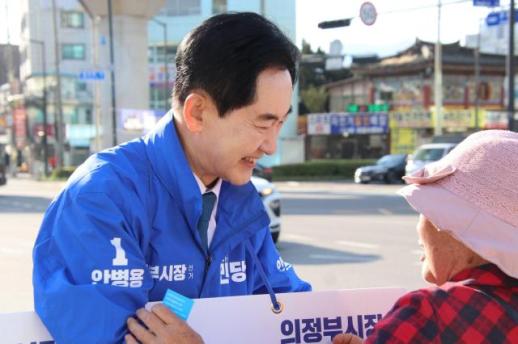 Uijeongbu mayoral hopeful Ahn Byeong-yong urges policy debate, warns against 'blind' runoff The Democratic Party’s primary for Uijeongbu mayor has narrowed to a runoff between preliminary candidates Kim Won-gi and Ahn Byeong-yong, with Ahn on Monday formally proposing a one-on-one policy debate and calling for a contest focused on issues. The party’s Gyeonggi provincial chapter said no candidate won a majority in voting held April 19-20, sending the top two finishers to a runoff. The final vote is scheduled for April 25-26. “Having reached the runoff with strong support from citizens and party members, it is time to prove, confidently and in front of the public, who is best suited to solve Uijeongbu’s many pending issues,” Ahn said in explaining the proposal. Ahn cited major local challenges including development of returned U.S. military base sites, attracting large companies, the proposed GTX-G line and an extension of Seoul Subway Line 8. He said the runoff should not become a “blind primary” driven by organizational mobilization, and argued that sharply testing candidates’ visions and policy capacity is the minimum owed to citizens and party members. Ahn said he would follow Kim’s side on practical details such as the debate format, time and venue. Transportation has been a central theme for Ahn and has also emerged in broader regional policy coordination. On April 20, Ahn signed a joint policy agreement with Kim Han-jung, a preliminary candidate for Namyangju mayor, calling for the extension of Line 8 — currently ending at Byeollae in Namyangju — to Uijeongbu’s Tapseok, Minrak and Gosan areas, and for the plan to be prioritized in the 5th National Rail Network Construction Plan. They also agreed to pursue a new GTX-G route linking Pocheon, Uijeongbu, Namyangju, Guri and Seoul; strengthen connections between the Seoul Metropolitan Area’s First and Second Ring Expressways; and build an advanced industry and economic belt connecting Uijeongbu’s returned base sites with Namyangju’s Wangsuk new town. At the time, Ahn said the large-scale national project to bring Line 8 into Uijeongbu “cannot be achieved by the strength of any one city alone,” and would require two local governments to unite and persistently persuade the government and the Ministry of Land, Infrastructure and Transport. Ahn has also emphasized economic recovery in the runoff. On April 20, he campaigned under the banner of “reviving Uijeongbu’s economy” at the underground shopping arcade at Uijeongbu Station with actor Lee Ki-young and Ahn Jin-geol, head of the People’s Livelihood Economy Institute. Earlier, he held a policy meeting with small business owners, pledging expanded issuance of local currency, tailored support by commercial district, and a regular channel for communication. “The essence of this election is ultimately a serious economic election asking, ‘Who will revive Uijeongbu’s stagnant economy and help citizens put food on the table?’” Ahn said. In a message to Kim, Ahn said, “Let’s proudly show citizens how healthy and capable our Democratic Party is,” adding that he hopes for Kim’s “generous and forward-looking” acceptance of the debate proposal. The party’s Uijeongbu primary, now in its runoff phase, could shift from a test of organization to a policy showdown over transportation, the economy and urban development solutions.* This article has been translated by AI. 2026-04-21 13:40:59
 -
 Gyeonggi education superintendent hopeful Ahn Min-seok proposes training 100,000 AI, semiconductor students Ahn Min-seok, a preliminary candidate for Gyeonggi Province superintendent of education, on Monday unveiled a plan to shift Gyeonggi education to an artificial intelligence-centered system, marking Science Day. “AI is more than a simple technology; it is the infrastructure of our time that supports children’s dreams,” Ahn said, vowing to secure leadership in Gyeonggi education and make it a center for training South Korea’s future technology workforce. He said AI would be used to “substantially guarantee the rights of everyone in education,” citing data-based student growth records to narrow gaps in basic academic skills and administrative reforms to free teachers to focus more on students and instruction. Ahn said the core philosophy of his AI education system is people-centered AI education focused on “dignity and growth.” He pledged to pursue “training 100,000 Gyeonggi AI future talents,” build an AI and semiconductor talent belt, establish new AI and semiconductor high schools in northern Gyeonggi, and push to attract a KAIST northern campus to make the province a hub for future technology talent. As on-the-ground measures, he proposed operating AI-focused schools; building a “Gyeonggi-style AI curriculum” linking classes, elective subjects and assessment; project-based classes tied to universities and companies; school labs equipped with the latest devices; AI literacy training for all teachers and training specialist teachers; an AI-based career history system; and shifting vocational high schools toward an AI-convergence vocational education system. For teachers, Ahn promised to introduce an “AI administrative secretary system” to cut routine work and create conditions that allow educators to concentrate on teaching. The announcement follows a proposal Ahn made in February, when he called AI and semiconductor talent development “a future growth engine and a matter of survival” for South Korea. At the time, he presented a plan to establish 15 semiconductor future schools and a roadmap to train 100,000 people. He also said in February he would build a talent belt connecting elementary, middle and high schools with universities, companies and local communities, and that Gyeonggi education would take the lead in training 100,000 semiconductor workers. Monday’s Science Day pledge again highlighted AI and semiconductors as core industry and education priorities for Gyeonggi education. Ahn also included measures for vulnerable students, saying he would use AI as a “warm tool” for those left out. He pledged learning support for students from immigrant backgrounds through AI translation; distribution of customized assistive technology devices and AI programs for special education students; and an AI-based remote learning system and stronger learning-history management for students facing long-term hospitalization, including pediatric cancer patients. “For South Korea’s future survival, Gyeonggi education must become the center of the talent supply,” Ahn said, adding that every child in the province should be able to develop their abilities on an equal foundation of public education regardless of family background or where they live. He said he would not spare support for AI and science and technology education so that children raised in Gyeonggi can compete confidently on the global stage.* This article has been translated by AI. 2026-04-21 13:06:17