
Journalist

Abraham Kwak
candicekim1121@ajupress.com
-
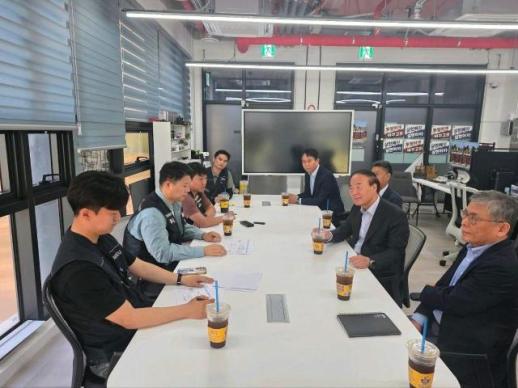 No breakthrough for Samsung Elec despite 11th-hour C-suite visit to union SEOUL, May 15 (AJP) - Top executives of Samsung Electronics failed Friday in an eleventh-hour attempt to avert a looming general strike after visiting the labor union office of the world’s largest memory chipmaker, whose exports alone account for roughly one-fifth of South Korea’s total outbound shipments. Mindful of the government’s determination to prevent a strike at a company whose production disruption could cost billions of dollars in economic losses and tax revenues, Samsung’s C-suite moved directly to engage union leaders after government-mediated wage talks collapsed earlier this week. The delegation, led by Vice Chairman and Device Solutions (DS) chief Jun Young-hyun, arrived at the office of the National Samsung Electronics Union (NSEU) at the company’s Pyeongtaek campus Friday afternoon. The executive team also included Foundry Business head Han Jin-man and System LSI chief Park Yong-in. Shares of Samsung Electronics plunged 7.8 percent Friday to close at 270,700 won after nearing the 300,000-won milestone in the previous session, as investor sentiment deteriorated on disappointment over the labor impasse. The visit followed a rare public apology issued by Samsung’s board of presidents earlier in the day, expressing “heavy responsibility” for the burden the prolonged labor dispute has placed on shareholders and the public. Management said it remained willing to engage the union with an “unconditional” and “open” mindset and urged labor representatives to return to negotiations as soon as possible, raising hopes for a potential breakthrough. Samsung emphasized that semiconductor manufacturing operates on a continuous 24-hour production cycle, warning that any work stoppage could inflict lasting damage on the company’s credibility and “trust assets” with global customers. Despite the conciliatory tone and unusual high-level visit, the meeting ended on a negative note as both sides remained firmly entrenched ahead of the union’s planned strike beginning May 21. Union leader Choi Seung-ho reportedly maintained a hard-line stance even after the government signaled it could consider invoking rarely used emergency mediation authority to prevent a strike viewed as harmful to the national economy. “Employees have lost trust in management,” Choi reportedly told executives during the meeting, adding that the union would only consider returning to formal negotiations if Samsung presents a concrete agenda addressing its core demands regarding compensation and performance bonuses. Choi also suggested that renegotiation could only resume after June 7, signaling the union’s determination to proceed with its planned 18-day strike beginning May 21. The union estimates that as many as 50,000 workers could participate. The standoff comes at a sensitive moment for Samsung as the company attempts to regain momentum in the intensifying global AI semiconductor race. Industry analysts warned that prolonged disruptions could carry risks extending beyond short-term production losses. “Samsung Electronics is at a vital moment where it still has the opportunity to solidify its position as a top global leader,” a semiconductor industry analyst said. “With global tech companies such as Apple, Tesla and NVIDIA among its key customers, failing to meet orders because of an internal strike could become a lost opportunity that permanently damages its competitive standing.” The government has also increased pressure on both sides to reach a compromise, warning that a large-scale disruption at Samsung could ripple through South Korea’s export-dependent economy at a time of heightened market volatility and geopolitical uncertainty. With the union’s strike deadline approaching and no compromise in sight, the standoff between Samsung management and labor is expected to continue through the weekend as both sides weigh the economic and strategic consequences of a full-scale production disruption. 2026-05-15 17:30:08
 -
 Government signals emergency powers as Samsung strike clock ticks SEOUL, May 15 (AJP) - Samsung Electronics and its overarching labor union are waging a war of nerves to settle their dispute on their own under competing deadlines, as the government signals it may invoke a rarely used emergency strike suspension authority. The National Samsung Electronics Union (NSEU), the company’s largest labor group, sent an official letter to Vice Chairman and Device Solutions chief Jun Young-hyun on Thursday, giving management until 10 a.m. Friday to present an acceptable proposal on the company’s reward system. The union demanded concrete measures to improve transparency in the Overall Performance Incentive (OPI) system, remove payout caps and institutionalize clearer compensation standards. It warned that failure to provide a specific response by the deadline would lead to a lawful general strike scheduled for May 21. Samsung management has maintained a relatively calm public posture while internally emphasizing operational discipline and production stability. According to industry sources, Jun recently warned executives against complacency, describing the current AI-driven semiconductor upcycle as the company’s “last golden time” to restore fundamental competitiveness. Rather than relying on strong first-quarter earnings, Jun reportedly urged executives to maintain a humble “super supplier” mindset to preserve long-term customer trust. He is also understood to have stressed the need for uninterrupted chip production and stable operations regardless of external uncertainties, including the looming strike threat. With the deadline quickly approaching, attention is focused on whether Samsung management will offer a last-minute compromise to prevent what could become the company’s most disruptive labor action in decades. The government has meanwhile escalated its rhetoric amid concerns over broader economic fallout. Trade, Industry and Energy Minister Kim Jung-kwan issued one of the strongest warnings yet late Thursday, saying emergency mediation could become unavoidable if the union proceeds with its planned strike. “Samsung Electronics’ importance to the Korean economy cannot be overstated,” Kim wrote on X, describing the company’s semiconductor business as a strategic national asset. He warned that disruptions to continuous wafer-processing lines could cause as much as 100 trillion won ($74 billion) in economic damage, affecting roughly 1,700 partner firms and inflicting potentially irreversible disruption on global supply chains. “As industry minister, I believe emergency adjustment measures would become inevitable if a strike occurs,” Kim said. Emergency mediation is a rarely used government intervention that can suspend strike action for up to 30 days if authorities determine a labor dispute poses a serious threat to the national economy or public welfare. Kim’s remarks drew particular attention because they were noticeably more forceful than those of Prime Minister Kim Min-seok and Deputy Prime Minister and Finance Minister Koo Yun-cheol, both of whom have stressed dialogue while warning that “a strike must never happen.” The dispute is increasingly being viewed as more than a conventional wage negotiation, emerging instead as a critical test of labor stability at South Korea’s largest company during a pivotal moment in the global AI semiconductor race. Share prices fell 1.6 percent to 291,250 won amid waning sign of breakthrough. 2026-05-15 10:28:25
 -
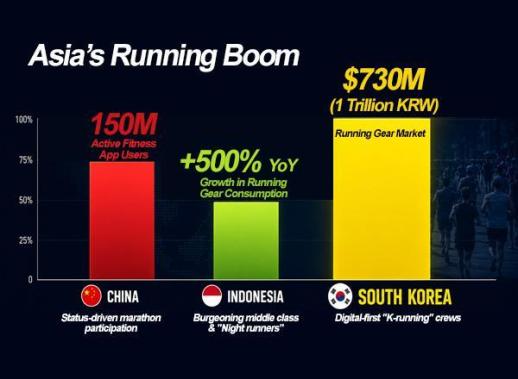 How Korea's jogging craze became Samsung's Asian health gambit SEOUL, May 14 (AJP) - South Koreans are lacing up in record numbers — and they're taking their smartwatches with them. Walk through Seoul on any weekend morning and the evidence is everywhere: colour-coordinated running crews streaming through Han River parks, Strava segments being contested with the intensity of corporate quarterly targets, and, at every major sports retailer, empty shelves. "During marathon season, running attire and gear are completely sold out on and offline," a Lululemon Korea representative told AJP. "High-performance gear across all major brands becomes nearly impossible to find, even for those willing to pay a premium." The numbers behind the scene are striking. South Korea's running participation rate jumped from 4.8 percent in 2024 to 7.7 percent in 2025. One in three Korean adults now wears a smartwatch. The domestic running gear market has surpassed 1 trillion won ($730 million). What began during the COVID-19 pandemic as an escape from shuttered gyms has evolved into something far more elaborate: a data-intensive, socially networked lifestyle sport with its own aesthetic codes, digital rituals, and — inevitably — growing pains. The phenomenon even has its own villain arc. "Nuisance running," or minpye — where large organised crews block pedestrian pathways — has become a fixture of local media debate. Korea's running boom, it turns out, is social enough to cause traffic. Samsung is paying close attention to all of it. At a media briefing in Seoul on Thursday, the company revealed that its Samsung Health platform has reached 77 million monthly active users globally. The pitch from Samsung's MX Business Digital Health Team was pointed: the winner of Asia's health technology war will not be the brand that tracks the fastest kilometre split. It will be the one that understands the runner's entire life. "Running is merely one component of our broader goal," said Choi Jun-il, Vice President at Samsung's Digital Health Team. "Because we manage everything from sleep and diet to mental health, stress measurement, and heart health, we believe we have a clear point of differentiation from competitors like Apple or Garmin." The strategy is anchored in holistic data rather than athletic performance alone — a distinction that matters in a market where elite runners have shifted their priorities accordingly. Eun-ju Kwon, a former national marathon record holder and Samsung Health ambassador, put it plainly: "Instead of just focusing on my pace, what matters most to me now is whether I slept well. I check my sleep and energy scores every morning." Korea, in Samsung's view, is the testbed. The rest of Asia is the market. And that market is vast and wildly varied. China has over 150 million active fitness app users, where marathon participation has become a premier status symbol among the urban professional class. Indonesia is experiencing something closer to an explosion: regional e-commerce data shows running gear consumption surged more than 500 percent year-on-year, driven by a growing middle class and a distinctive "night runner" culture shaped by the country's tropical climate. Samsung's Galaxy Watch BioActive sensor — tracking six advanced running metrics including ground contact time and vertical oscillation — is designed to adapt to each of these local cultures rather than impose a single template. The logic extends well beyond sport. Biometric data from hundreds of millions of daily users, aggregated and analysed at scale, is among the most valuable datasets an AI-era technology company can hold. Samsung's running play is, at its core, a data accumulation strategy dressed in moisture-wicking fabric. Korea exported its pop culture. It exported its cinema. Now it is attempting to export its running culture — and the digital infrastructure that comes with it. The shoes may be Korean. The ambition is continental. 2026-05-14 16:46:27
 -
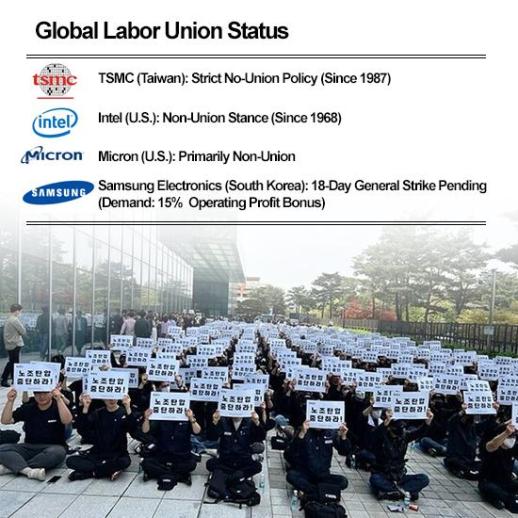 AJP Eye: Samsung's AI ambitions face 'Opex trap' as labor dispute threatens crucial Capex SEOUL, May 14 (AJP) - Samsung Electronics, riding on the AI boom to join the exclusive $1 trillion valuation club, is caught in a squeeze that no chip roadmap can solve: a labor dispute forcing it to choose between rewarding its workers today and funding the factories that will determine its place in the AI memory hierarchy tomorrow. The Opex (operational expenditure)-versus-Capex (capital expenditure) tension is now acute. Following a 17-hour marathon mediation session that collapsed Wednesday, the National Labor Relations Commission has urged both sides to resume talks Saturday. The central friction is performance bonuses. The union is demanding a legally guaranteed pool equal to 15 percent of annual operating profit; the commission has proposed 12 percent as a compromise. The union has rejected it. The arithmetic of a prolonged standoff is stark. Industry analysts estimate a full shutdown of Samsung's production lines would cost approximately 1 trillion won ($670 million) per day in direct losses. Should the union proceed with its threatened 18-day general strike, total damages could reach 30 trillion won — a figure that would dwarf any bonus settlement and land squarely on the capex budget Samsung needs most right now. That budget pressure is the real story. Samsung is competing in an AI memory race where capital deployment speed is the primary variable. TSMC, which has maintained a no-union policy since its founding in 1987, has guided 2026 capital expenditure at $52–56 billion, up to 40 percent above 2025 levels, with 70–80 percent earmarked for advanced process nodes at 2-nanometer and 3-nanometer. Micron, also operating without unions, has revised its fiscal 2026 capex forecast above $25 billion after spending $5 billion in its second fiscal quarter alone. Neither company is negotiating bonus pools. Both are building fabs. The structural contrast is not incidental. The global semiconductor industry runs almost entirely on a non-union model, for reasons embedded in the physics of the business. Chip fabrication requires continuous 24-hour cleanroom operation; any strike-induced halt triggers contamination protocols, yield losses, and recovery timelines measured in weeks, not days. The workforce is composed overwhelmingly of engineers and R&D specialists compensated through stock options and merit pay rather than collective agreements. The Wall Street Journal has described union friction as a potential "obstacle" to semiconductor industry competitiveness. TSMC founder Morris Chang has drawn an explicit parallel to the United Auto Workers, arguing that while unions may secure near-term wage gains, they erode the long-term productivity on which innovation depends. Samsung's situation is more complicated than its rivals' by design. It is a sprawling conglomerate with a large unionized manufacturing base — a structure that served it well in earlier industrial eras but creates friction in a business where uninterrupted capital deployment is existential. The company must now navigate that friction at precisely the moment when HBM4 qualification, new fab capacity, and Nvidia supply contracts are all in play simultaneously. Global investors are watching the Saturday mediation closely. If Samsung cannot contain its opex commitments, it risks ceding the capex window to rivals, who face no such constraint. In a memory supercycle where supply is already sold out and AI demand is accelerating, lost ground won't easily be recovered. — AJP Eye is AJP's business and markets commentary column. 2026-05-14 15:42:55
 -
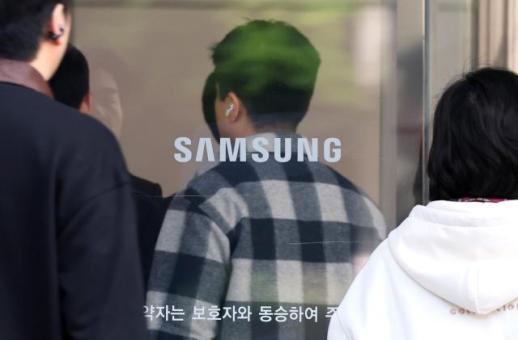 Samsung Elec adjusting output ahead of threatened strike SEOUL, May 14 (AJP) - Samsung Electronics has started scaling back wafer output at its chip facilities in a preemptive move to protect quality integrity, as the company braces for a union walkout that could begin as early as Thursday, a source close to the matter told AJP. The production cutback marks the first tangible operational impact of the labor dispute on Samsung's critical chip manufacturing operations. Talks have reached an impasse. The representative union has rejected a call from the National Labor Relations Commission to continue dialogue over the weekend, saying it has no intention to engage "unless the management presents a proper proposal." Samsung is the world's largest memory chip supplier, and any yield disruption at its fabs risks aggravating a market already stretched thin by surging AI demand. 2026-05-14 15:29:01
 -
 Gov't, Samsung management jointly pressure union after wage talks collapse SEOUL, May 13 (AJP) - The South Korean government and Samsung Electronics management ratcheted up pressure on the labor union ahead of a planned monthlong strike next week after marathon government-mediated talks over a profit-linked bonus system collapsed early Wednesday. “A strike must never happen under any circumstances,” Deputy Prime Minister and Finance Minister Koo Yun-cheol wrote on X on Wednesday, pledging to continue mediation to keep the dialogue momentum alive. Samsung Electronics, which so far has stayed muted over the union activities issued a strongest-yet statement expressing “deep regret” over the union’s decision to declare negotiations deadlocked after a 17-hour mediation session at the National Labor Relations Commission in Sejong ended around 3 a.m. “It is deeply regrettable that the government’s post-mediation efforts were nullified by the union’s declaration of a breakdown,” the company said. “The union’s decision is causing significant concern and anxiety not only for the company but also for employees awaiting a settlement, as well as shareholders and the public.” The National Samsung Electronics Union (NSEU) announced the talks had “finally broken down,” rejecting the latest mediation proposal as a step backward from previous discussions. According to Samsung, the government attempted to facilitate compromise by presenting multiple proposals based on the positions of both labor and management, but the union ultimately walked away from the negotiations. Samsung also accused the union of insisting on a rigid institutionalization of the bonus system while rejecting management’s proposal for a more flexible compensation structure tied to business performance. The core dispute centers on the union’s demand to formalize a compensation scheme allocating 15 percent of operating profit to employee bonuses and abolish the existing bonus ceiling. Management wants to maintain the current Excess Profit Incentive (OPI) framework, which caps bonuses at 50 percent of monthly salary. “The company will continue efforts to prevent the worst-case scenario through sincere dialogue until the end,” Samsung said, while thanking government officials and mediators involved in the process. The government has also intensified calls for compromise amid concerns over the broader economic fallout of a strike at the country’s largest corporation. Koo said earlier this week that Samsung’s record earnings were tied not only to corporate efforts but also to public infrastructure investment and the support of hundreds of subcontractors across the semiconductor supply chain. The union has warned it could launch a full-scale strike as early as May 21 if negotiations remain stalled. While the government has legal authority to invoke emergency arbitration that could suspend industrial action for up to 30 days, officials at the labor commission said the measure is not currently under active review. Samsung Electronics shares that been rallying around historic highs fell 2.4 percent upon the breakdown news Wednesday. 2026-05-13 10:26:30
 -
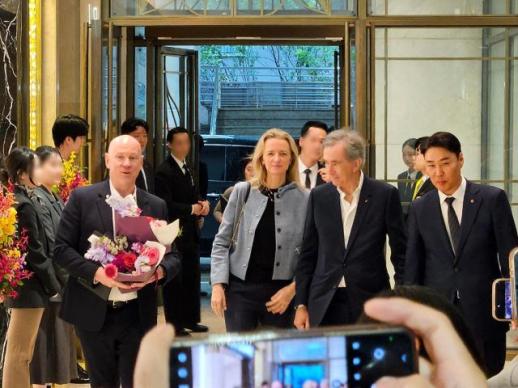 Arnault Seoul tour signals Dior reckoning in split luxury market SEOUL, May 12 (AJP) - Just 30 centimeters behind LVMH Chairman Bernard Arnault during his closely watched Seoul tour walked the executive many luxury insiders believed was carrying the real assignment of the trip: Delphine Arnault, tasked with reassessing Christian Dior’s position in one of the world’s most influential — and increasingly polarized — luxury markets. While cameras followed the world’s most powerful luxury executive through Seoul’s flagship department stores and high-end retail districts, industry attention centered on whether Dior could regain footing in South Korea after losing momentum in a market that once symbolized the global luxury boom. Korea remains the world’s highest per-capita spender on personal luxury goods, with consumers spending roughly $325 annually per person on luxury products, according to Morgan Stanley — higher than consumers in the United States or China. Morgan Stanley analysts noted that “South Korean buyers' demand for luxury goods is due to both an increase in purchasing power and an external desire to show off their social status.” The country’s luxury market, valued at more than $16 billion, has become strategically indispensable for global brands not only because of spending power but because Seoul increasingly functions as a trend laboratory for younger Asian consumers. Yet beneath the headline figures, the Korean luxury market has undergone a sharp structural shift. “Brand performance remained highly polarized in 2025,” Bain & Company noted in a recent global luxury report, adding that “the absolute luxury tier continued to hold strong,” while aspirational luxury demand weakened amid deteriorating consumer sentiment. That polarization has become especially pronounced in South Korea. Luxury spending has increasingly split into a two-speed market: recession-resistant VVIP consumers continue concentrating purchases on heritage houses such as Hermès, Chanel and Louis Vuitton, while younger buyers in their 20s and 30s — once the engine of Korea’s luxury boom — are retreating under high interest rates, inflation, weak wage growth and a housing market that has drifted out of reach. Nam Sung-hyun, an analyst at IBK Investment & Securities, described the widening divide bluntly: “While lower-income brackets see reduced spending power, the upper classes, who can increase income through assets, have even greater spending capacity.” That divergence has created clear winners and losers across the luxury sector. While ultra-premium houses continued posting record sales growth in Korea, brands positioned closer to aspirational luxury have struggled to maintain momentum as discretionary spending weakens. Industry analysts say Dior became particularly exposed because of its aggressive expansion among Korea’s MZ generation — millennials and Gen Z — through celebrity ambassadors, social media marketing and entry-level luxury products. The strategy thrived during the post-pandemic “flex” consumption boom. But the same younger consumers who fueled Korea’s luxury surge have now become the most vulnerable to economic pressure. Higher borrowing costs, slowing growth and mounting household burdens have begun eroding aspirational consumption, leaving brands dependent on trend-sensitive younger buyers increasingly exposed. Meanwhile, wealthy VVIP consumers have consolidated spending further toward the most established heritage houses with the strongest exclusivity and resale value. Against that backdrop, Delphine Arnault’s detailed inspection of Seoul department stores and flagship operations drew outsized industry attention. As CEO of Dior Couture and a central figure in the future leadership of LVMH, her visit was widely interpreted within the industry as more than ceremonial succession optics. Instead, it was viewed as part of a broader strategic reassessment of how Dior positions itself in Korea at a time when the market increasingly rewards ultra-premium exclusivity over mass aspirational desirability. For global luxury groups, South Korea is increasingly serving as an early indicator of broader shifts likely to spread across Asia: younger consumers remain culturally influential and digitally powerful, but sustaining luxury demand now requires balancing social-media-driven accessibility with the exclusivity demanded by high-net-worth clientele. In that sense, the Seoul trip was not simply about Korea. It was about the future direction of the global luxury industry itself. 2026-05-12 13:57:58
 -
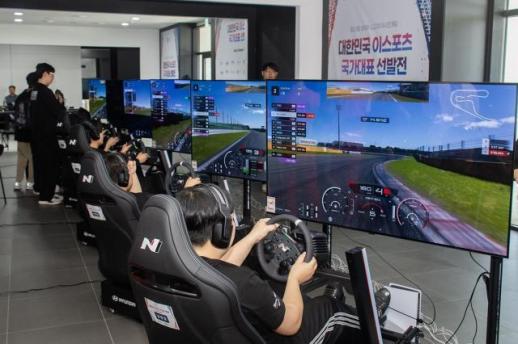 LG Electronics to supply OLED monitors for Hyundai's N racing simulators SEOUL, May 11 (AJP) - LG Electronics (LGE) announced Monday it will supply high-end OLED monitors for Hyundai Motor’s high-performance "Hyundai N Racing Simulator," expanding its display business into the virtual driving sector. Under the partnership, LG will provide the 65-inch LG OLED Pro monitor for the "Pro" simulator model and 65-inch OLED TVs for the "Racer" model. The professional-grade OLED Pro features 4K resolution and a specialized interface designed to transmit high-capacity data without compression, ensuring stable performance for high-definition virtual environments. The monitors are equipped with self-calibration tools and optimization features that maintain uniform brightness and color accuracy, according to the company. While LG’s OLED Pro series has primarily been utilized in broadcasting and film production, this collaboration marks a strategic push to diversify its client base into the simulation market. The move aligns with LGE's broader strategy to leverage its OLED and signage competitiveness to secure bespoke business opportunities across various industrial fields. 2026-05-11 16:46:57
 -
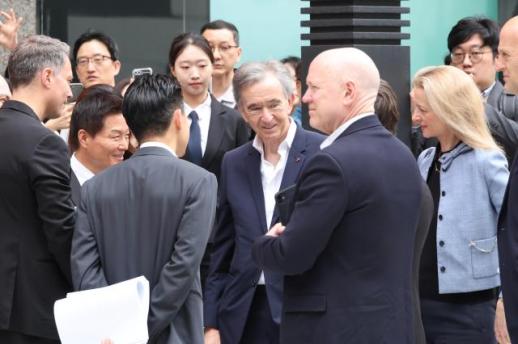 LVMH chair inspects shops in Korea amid weakening sales SEOUL, May 11 (AJP) - Bernard Arnault, chairman and CEO of French luxury titan LVMH, arrived in Seoul on Monday for an intensive inspection of the South Korean market as the world’s largest luxury group faces slowing global momentum and weaker growth in Korea relative to rival luxury houses despite the country’s continued luxury boom. Accompanied by his eldest daughter, Delphine Arnault, CEO of Christian Dior Couture, the LVMH chief’s visit comes at a pivotal moment when the group’s global sales have stagnated amid softening demand in China and the United States. The visit began at Shinsegae Department Store’s flagship store in central Seoul at 12:30 p.m., where Arnault was greeted by Shinsegae CEO Park Joo-hyung. Although the department store was closed for its regular holiday, Arnault spent time closely inspecting the exterior and storefront displays of “Louis Vuitton Visionary Journeys Seoul,” the six-story experiential complex that serves as the brand’s largest retail location globally. Rather than focusing solely on retail traffic or VIP lounges, Arnault’s attention centered on the physical presentation and experiential environment of the flagship, underscoring LVMH’s push toward “destination retail” that blends architecture, exhibitions, dining and brand storytelling. Arnault’s direct oversight of the Seoul flagship highlights the strategic importance LVMH places on South Korea, one of the few luxury markets still posting robust growth despite mounting concerns over a global sector slowdown. While LVMH’s global sales growth slowed to 1 percent last year, Louis Vuitton Korea posted record revenue of 1.85 trillion won ($1.36 billion) in 2025, up 6.1 percent from a year earlier, while operating profit surged 35 percent to 525.6 billion won. Yet LVMH’s Korean growth has increasingly lagged behind some rival luxury houses that continue to post stronger momentum in the country’s polarized luxury market. Chanel Korea surpassed the 2 trillion won revenue mark for the first time last year, with sales rising 9 percent to 2.01 trillion won and operating profit climbing 25 percent to 336 billion won. Hermès Korea also reported standout growth, with revenue increasing 16.7 percent to 1.13 trillion won and operating profit rising 14.6 percent to 305.5 billion won. The contrast has become even more pronounced within LVMH’s own portfolio, particularly at Dior, once grouped among Korea’s so-called “EruSha” trio of Hermès, Louis Vuitton and Chanel. According to regulatory filings, Christian Dior Couture Korea posted revenue of 773.9 billion won last year, down 18.1 percent from a year earlier, while operating profit plunged 43 percent to 129.2 billion won. The brand had already suffered declines in 2024, marking two consecutive years of falling sales and earnings while competitors continued delivering record performances. Arnault plans to make stops at Lotte Department Store, and luxury industry will be closely watching whether Seoul will further shape LVMH’s evolving blueprint for experiential retail in one of the world’s most competitive and polarized luxury markets. 2026-05-11 15:16:56
 -
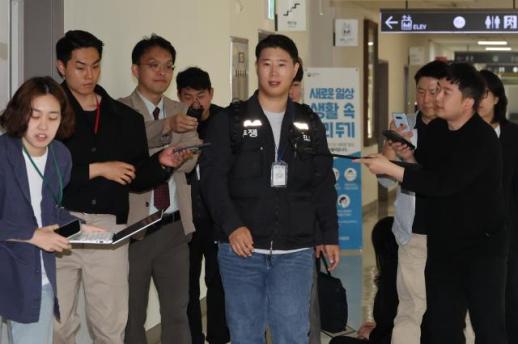 Samsung Electronics labor talks begin under government mediation SEOUL, May 11 (AJP) - Samsung Electronics and its union began two days of intensive talks Monday under government mediation in a bid to avert a full-scale strike planned for next week, though prospects for a breakthrough remained uncertain as both sides held firm on bonus demands tied to the semiconductor boom. Speaking before a post-mediation session at the National Labor Relations Commission in central Seoul, SELU Chairman Choi Seung-ho said the union stood by its demand to allocate 15 percent of Samsung Electronics’ operating profit to employee bonuses and abolish bonus caps through a formalized system. “We continue to demand a 15 percent operating profit-based bonus system and the abolition of the ceiling,” Choi told reporters. “If the company has no position on institutionalizing this, we believe mediation will not be possible even today.” Choi accused management of failing to honor previous promises to reserve earnings during profitable years and use them to cushion compensation during downturns. “The company previously said it would accumulate profits during good years and use them to support workers during deficit periods, but it failed to keep that promise,” he said. “Simple written wording is no longer enough for us to trust. We are looking for a clearly institutionalized framework.” At the same time, Choi signaled limited room for compromise, saying the union would consider its stance if the company presents a “forward-looking change.” The union also reaffirmed that it would not discuss creating a company-wide shared bonus pool for non-semiconductor divisions during the current negotiations, despite rising internal tensions over widening compensation gaps between chip workers and employees in other business units. Asked whether disagreements within the labor coalition over the issue had been resolved, Choi said the union could not reverse a position already jointly agreed upon by the three participating labor groups. “We do not want to create controversy over insincere bargaining,” he said. “Our direction remains unchanged.” He added that the union, now legally recognized as Samsung Electronics’ majority labor organization, plans to actively review the broader shared-fund issue next year. The SELU, which has more than 40,000 members, has threatened an 18-day general strike beginning May 21 after wage negotiations broke down over bonuses tied to the AI-driven semiconductor supercycle. The standoff comes as Samsung Electronics races to narrow the gap with rival SK hynix in high-bandwidth memory chips used in artificial intelligence servers, heightening concerns that any disruption at semiconductor fabrication lines could hit output at a sensitive moment for the global AI supply chain. 2026-05-11 11:30:14