
Journalist

Kim Dong Young
davekim0807@ajupress.com
-
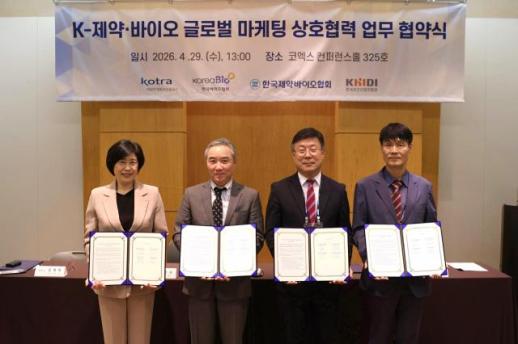 Four Korean pharma, bio bodies forge 'one team' to accelerate global push SEOUL, April 29 (AJP) - Four of South Korea's leading pharmaceutical and biotechnology organizations signed a memorandum of understanding to consolidate their fragmented overseas-support programs under a single coordinated framework, dubbed the "K-Pharma Bio One Team." The Korea Pharmaceutical and Bio-Pharma Manufacturers Association (KPBMA), the Korea Health Industry Development Institute, the Korea Biotechnology Industry Organization and the Korea Trade-Investment Promotion Agency inked the agreement at COEX in Seoul Wednesday, establishing a joint support structure for domestic firms seeking to expand abroad. Under the MOU, the four bodies will pool resources to conduct shared market analysis, identify and resolve export bottlenecks, gather overseas market intelligence, and coordinate marketing efforts at international trade events — replacing what had previously been a patchwork of institution-by-institution programs. The alliance plans to kick off operations in earnest at BIO International Convention, set for June in San Diego, California. More than 250 South Korean companies are expected to attend the event this year, making Korea the second-largest national contingent after the United States. The four organizations will jointly support Korean exhibitors at BIO USA and co-host a consolidated "Korea Night" reception expected to draw more than 600 industry officials, investors and potential partners. "This MOU marks a significant step forward in upgrading the support framework for the global expansion of Korea's pharmaceutical and biotech industry," said KPBMA president Noh Yun-hong, adding that the alliance would work to sharpen corporate competitiveness and raise the sector's international profile. 2026-04-29 15:12:41
 -
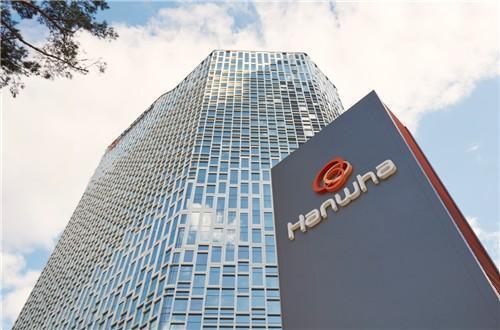 Hanwha Solutions swings to profit in Q1 on solar gains, chemical recovery SEOUL, April 28 (AJP) - Hanwha Solutions posted a sharp earnings recovery in the first quarter of 2026, with operating profit surging more than threefold as its solar and chemical units both returned to the black amid easing U.S. trade headwinds and internal restructuring efforts. The South Korean conglomerate reported Tuesday through regulatory filings consolidated revenue of 3.88 trillion won ($2.63 billion) for the January to March period, up 25.4 percent from a year earlier, while operating profit climbed 205.5% year-on-year to 92.6 billion won — marking its first profitable quarter since the second quarter of 2025. The renewable energy division, operating under the Qcells division, led the charge with revenue of 2.111 trillion won and operating profit of 62.2 billion won. The unit logged its second consecutive quarter above the 2-trillion-won revenue threshold, even during a traditionally slow season, as U.S. factory output normalized following the resolution of a customs clearance backlog on cell shipments that had weighed on output late last year. The chemicals division returned to profit for the first time in about two and a half years, posting revenue of 1.340 trillion won and operating profit of 34.1 billion won. The unit shed loss-making businesses, streamlined production lines, and expanded sales of high-margin products such as ultra-high-voltage cable materials. "We expect performance to improve steadily through year-end, and anticipate that the Cartersville plant's cell line will enter mass production from the third quarter, driving solid earnings momentum in the renewable energy division," co-CEOs Park Seung-deok and Nam Jung-woon said in a statement. Shares of Hanwha Solution ended at 50,800 won per stock, 1.2 percent higher than a day ago. 2026-04-28 18:08:49
 -
 Jipyeong Soju expands offline retail reach with Lotte Mart listing SEOUL, April 28 (AJP) - Jipyeong announced that its premium distilled spirit Jipyeong Soju has secured shelf space at Lotte Mart, expanding its offline retail footprint after an earlier listing at E-Mart. Unlike conventional rice-distilled spirits, the company explained that Jipyeong Soju blends three grains — rice, barley and sorghum — in what is described as an optimized ratio, yielding a layered flavor profile that balances the spice of sorghum, the nuttiness of barley and the clean finish of rice. The product has drawn strong interest among younger consumers, the company said, particularly for use in highballs — a cocktail format gaining traction in South Korea. "Through our entry into Lotte Mart, more consumers will be able to experience the depth of flavor that sets Jipy eong Soju apart," said a company spokesperson, adding that the brand aims to establish itself as one of the top three players in the domestic premium distilled spirits segment. 2026-04-28 12:01:05
 -
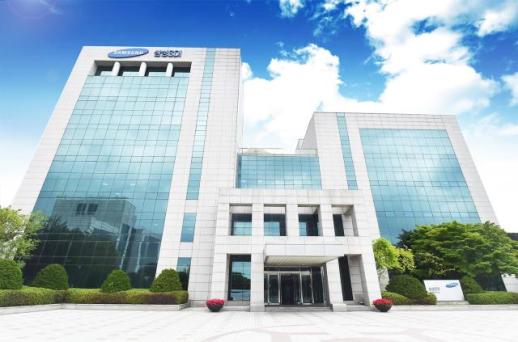 Samsung SDI narrows Q1 loss, eyes profit turnaround in H2 SEOUL, April 28 (AJP) - Samsung SDI reported an operating loss of 155.6 billion won ($105.5 million) for the first quarter of 2026, sharply narrowing its deficit from 434.1 billion won a year earlier. The South Korean battery maker disclosed Tuesday in a regulatory filing that revenue climbed 12.6 percent year-on-year to 3.576 trillion won, while net profit swung to a positive 56.1 billion won. The battery segment, which accounts for the bulk of revenue at 3.354 trillion won, cut its operating loss by 61 percent as demand recovered across energy storage systems, power tools and battery backup units. The electronics materials unit posted an operating profit of 21 billion won on revenue of 222 billion won, buoyed by resilient semiconductor materials sales and a rebound in display materials demand. Samsung SDI said it secured a multi-year supply agreement with Mercedes-Benz during the quarter, completing its lineup of all three major German premium automakers as clients. The company also unveiled its first pouch-type all-solid-state battery sample developed for physical AI applications. "Uncertainty in the global business environment is expected to persist into the second quarter," said a Samsung SDI spokesperson. "We will execute our response strategies by segment and work to achieve a quarterly profit turnaround in the second half." The company said it expects upstream demand to continue recovering through the rest of the year, with ESS battery sales in the United States set to expand alongside growth in AI data center construction, while European EV demand is projected to improve on the back of broader subsidy programs. Shares of Samsung SDI traded at 688,000 won per stock on 11:40 a.m., 8.35 percent higher than a day ago. 2026-04-28 11:44:12
 -
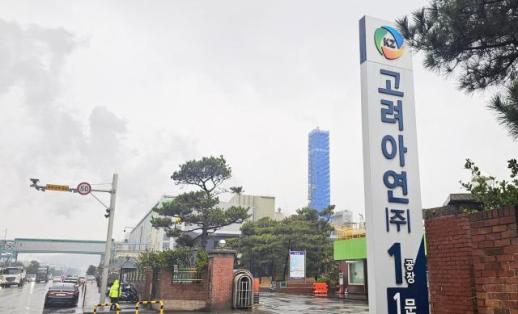 Korea Zinc's Tennessee smelter gains a rare fast-track federal greenlight SEOUL, April 27 (AJP) - Korea Zinc's $7.4 billion Tennessee smelter - largely funded by Washington - has been fast-tracked to expedite the first zinc refinery project in the United States since the 1970s. The company said Project Crucible, its planned non-ferrous metals complex in Clarksville, has been designated a covered project under FAST-41, a Washington program run by the Federal Permitting Improvement Steering Council (Permitting Council) that consolidates federal permitting reviews for major infrastructure and resource developments. "I am proud to welcome Project Crucible to FAST-41 coverage," said Emily Domenech, Permitting Council Executive Director on April 24. "As we continue to prioritize domestic mining, expanding domestic processing capacity is just as important for economic and national security." FAST-41 consolidates multi-agency reviews under a single schedule, typically shortening the path to a final decision by about 18 months. The designation follows a memorandum of understanding signed in February between the U.S. Department of the Interior and Tennessee to streamline permitting. Korea Zinc said the federal and state review tracks will now proceed in parallel. Only a handful of critical mineral projects have received such status, including South32’s Hermosa project in Arizona and Resolution Minerals’ Antimony Ridge in Alaska. Project Crucible stands out for its scale and scope. The planned complex in Clarksville will produce 13 non-ferrous metals — including 11 designated as critical by the U.S. — along with semiconductor-grade sulfuric acid. “This designation marks a key milestone in building a resilient critical minerals supply chain,” said Chairman Choi Yun-birm, adding the company will work closely with federal and state authorities. Korea Zinc recently acquired Nyrstar USA’s smelting assets to establish its local operating arm, Crucible Zinc. Construction is slated to begin in 2027, with operations targeted for 2029 and annual capacity of about 1.1 million tonnes. The project directly addresses a long-standing gap in U.S. metals processing capacity, which has eroded over decades amid refinery closures and a lack of new investment, leaving the country reliant on overseas — particularly Chinese — processing. Once completed, the roughly 7 million-square-foot facility will produce key inputs such as antimony, copper, gallium, germanium, indium, lead and zinc, alongside gold and high-purity sulfuric acid. The inclusion of gallium, germanium and indium positions the project at the core of semiconductor and advanced electronics supply chains, where processing remains heavily concentrated abroad. It also targets vulnerabilities exposed by recent disruptions in the Strait of Hormuz, a chokepoint for roughly half of global sulfur supply. By integrating sulfuric acid production domestically, the project aims to reduce exposure to geopolitical risks tied to Middle East-dependent supply chains. Shares of Korea Zinc on Monday edged up 0.43 percent to 1,649,000 ($1,121) won as of 2:20 p.m. Seoul. 2026-04-27 14:23:09
 -
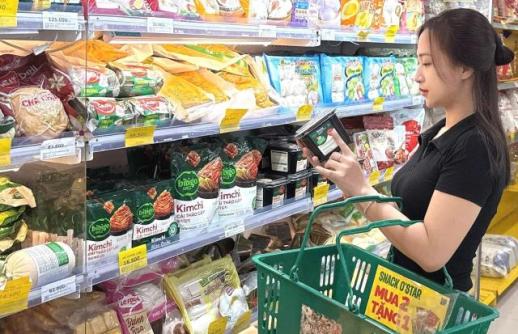 CJ CheilJedang deepens Vietnam retail partnership to boost K-food reach SEOUL, April 27 (AJP) - CJ CheilJedang is deepening its foothold in Vietnam's fast-growing processed food market through an expanded partnership with Bach Hoa Xanh, the country's largest supermarket chain. The company announced Monday it signed a memorandum of understanding with Bach Hoa Xanh, a subsidiary of Vietnam's largest retail group MWG, on April 23 in Hanoi to jointly develop processed food products, bolster cold-chain infrastructure and broaden consumer reach for its Bibigo brand across Vietnam. The signing ceremony, held alongside the Korea-Vietnam Business Forum, was attended by CJ CheilJedang's Asia-Pacific food division head Cho Jae-bom and MWG Chairman Nguyen Duc Tai, with trade ministers from both countries present. Under the agreement, the two companies will co-develop products tailored to Vietnamese consumption trends, invest in refrigerated and frozen logistics to strengthen food safety standards, and launch joint promotions including K-food festivals and a dedicated "CJ Zone" within Bach Hoa Xanh's mobile application. "The partnership with Bach Hoa Xanh, which is driving innovation in Vietnam's retail market, will serve as an important springboard for Bibigo to become a household brand in Vietnam," said a CJ CheilJedang spokesperson. 2026-04-27 09:29:35
 -
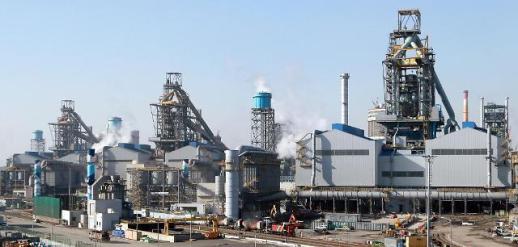 Hyundai Steel swings to Q1 operating profit on higher sales volume SEOUL, April 24 (AJP) - Hyundai Steel returned to the black in the first quarter of 2026, posting an operating profit of 15.7 billion won ($10.5 million) as rising sales volumes offset persistent cost pressures. The company reported consolidated revenue of 5.74 trillion won for the January to March period on Friday, up 3.2 percent from a year ago, buoyed by stronger product shipments. Operating profit, however, slid 63.7 percent quarter-on-quarter as exchange rate headwinds and elevated raw material costs weighed heavily on margins. Hyundai Steel said the surge in debt and its leverage ratio reflected capital injections into its U.S. steelworks and other growth-oriented expenditures, describing the increase as temporary. The company projected a gradual recovery in profitability from the second quarter onward, citing an expected easing in cheap import inflows and planned price increases for key products. "We will pre-empt new demand in the power infrastructure industry and actively respond to carbon-reduced steel demand through our combined electric arc and blast furnace process to achieve a recovery in profitability," said a Hyundai Steel Spokesperson. Shares of Hyundai steel traded at 42,100 won per stock on 3:00 p.m., 2.06 percent higher than a day ago. 2026-04-24 15:04:24
 -
 Hyundai Mobis posts steady Q1 gains amid global demand slump SEOUL, April 24 (AJP) - Hyundai Mobis reported resilient first-quarter earnings, logging revenue of 15.56 trillion won ($10.5 billion) and operating profit of 802.6 billion won as expanded supply of high-value electrification components and robust aftermarket demand offset a broader cooling in global vehicle sales. Revenue rose 5.5 percent from a year earlier while operating profit climbed 3.3 percent, the company said in a regulatory filing on Friday. Net profit came in at 883.1 billion won. The company attributed its growth to increase in shipments to overseas automakers and a favorable exchange rate bolstered the top line, with the aftermarket parts division riding sustained global demand. The module and core-parts manufacturing segment, however, remained in the red despite a modest 4.9 percent revenue increase. Hyundai Mobis said the shortfall came with ramp-up costs at new European plants — a powertrain-electrification facility in Slovakia that began mass production this quarter and a battery-system assembly plant in Spain set to come online later this year — compounded by softer worldwide vehicle demand. "Despite a challenging business environment, we plan to invest more than 2 trillion won in R&D this year for the first time, strengthening core competitiveness for the future mobility market," said a Hyundai Mobis spokesperson. "With our customers set to launch a range of new models this year, we expect earnings to improve gradually alongside company-wide profitability initiatives." Shares of Hyundai Mobis traded at 426,000 won per stock on 10:24 a.m., 3.73 percent lower than the day before. 2026-04-24 10:24:49
 -
 South Korea's foreign patient arrivals top 2 million for first time SEOUL, April 24 (AJP) - South Korea welcomed more than 2 million foreign patients last year, the first time the figure has breached that threshold since record-keeping began in 2009. The Ministry of Health and Welfare said Friday 2,011,822 patients from 201 countries sought treatment in 2025, capping a three-year streak of record highs after arrivals cratered to about 110,000 during the COVID-19 pandemic. Chinese nationals accounted for 30.8 percent of the total, overtaking Japanese patients for the first time to claim the top spot, followed by Taiwan, the United States and Thailand. Dermatology drove the surge, drawing 1.31 million patients — 62.9 percent of the total — while plastic surgery trailed at 11.2 percent, underscoring a pronounced tilt toward cosmetic procedures. Clinic-level facilities handled 87.7 percent of all visits, and dental clinics, though accounting for just 1.6 percent, posted the steepest year-on-year growth at 128.9 percent. Seoul absorbed 87.2 percent of the traffic, a concentration the ministry attributed to the capital's dense cluster of transport, tourism and medical infrastructure. Some 2,555 registered medical institutions — 62.5 percent of the national total — are based in the city. The Korea Institute for Industrial Economics and Trade estimated that the 2 million patients and their companions generated about 12.5 trillion won ($8.4 billion) in medical tourism spending, producing more than 10 trillion won in added economic value. "Now that more than one million patients a year are visiting from across Asia, we will build a sustainable industrial ecosystem," said Jung Eun-young, director-general of the ministry's mental health policy bureau. "We intend to pursue qualitative growth in foreign patient recruitment." 2026-04-24 09:49:21
 -
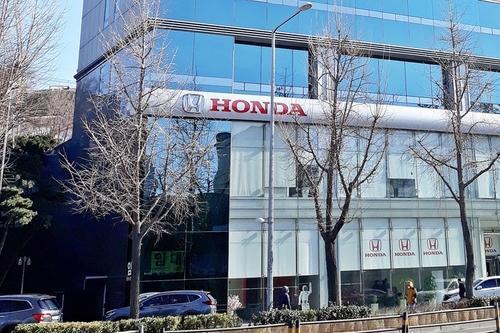 Honda Korea to exit car sales after two decades SEOUL, April 23 (AJP) - Honda Korea announced it will cease automobile sales in the country by the end of 2026, pulling the curtain on a presence that once crowned it the top-selling import brand but withered steadily over the past several years. Lee Ji-hong, CEO of Honda Korea, told a hastily convened press conference on Thursday at COEX in Seoul that the decision came after a thorough review of shifting market conditions and persistent currency headwinds. "We have comprehensively considered changes in the business environment and exchange rate fluctuations, and will terminate automobile sales operations in Korea by the end of 2026," Lee said. The retreat marks a stark reversal for a brand that in 2008 became the first import nameplate to sell more than 10,000 vehicles in a single year in South Korea. Annual sales have since cratered — from about 8,760 units in 2019 to 1,951 in 2025 — battered by what industry experts say is a relatively small portfolio strictly tied to internal combustion and hybrid powertrains in a market increasingly gravitating toward electrified alternatives. In February this year, Honda registered just 23 new vehicles, its lowest monthly tally on record and a mere 0.08 percent of all imported car registrations. Honda's Korean pullback comes as its Tokyo-based parent braces for potentially its first annual net loss since going public in 1957. Honda Motor said in March it expects to record losses of up to 2.5 trillion yen ($15.6 billion) in the fiscal year ending March 2026, driven by massive write-downs on scrapped electric vehicle programs in North America and deepening losses in China, where local EV makers have seized market share. The automaker has cancelled three battery-electric models that were months from production at its Ohio plant and slashed its global 2030 EV sales target from 30 percent to 20 percent. Honda Korea said it will continue to sell motorcycles and aim to strengthen product appeal, customer service and experiential marketing in the two-wheeler business going forward. 2026-04-23 16:11:56