
Journalist

Kim Dong-young, Im Yoon-seo
davekim0807@ajupress.com
-
 BTS comeback D-42: Seoul tells fans to travel light or risk missing the show SEOUL, February 07 (AJP) - With BTS's historic comeback concert at Gwanghwamun Square just six weeks away, Seoul authorities and transit operators are urging the hundreds of thousands of fans expected to descend on the capital to ditch their suitcases before heading to the venue. Organizers are expecting about 15,000 for the square, with an additional 13,000 to watch on large screens at Seoul Plaza. Industry observers, however, estimate that as many as 200,000 people could flood the surrounding area on March 21, when the septet takes the stage for the first time in nearly four years to celebrate the release of their fifth studio album, "Arirang." The Seoul Metropolitan Government is directing concertgoers — particularly those arriving from regional cities and abroad — to store bulky luggage at transit hubs such as Seoul Station, Suseo Station and Yongsan Station before making their way to the venue. Smart lockers at subway stations across the city can be reserved through the T Locker app, which covers more than 5,500 units at 269 stations on Lines 1 through 9, allowing users to check real-time availability, book and pay via mobile. Officials recommend that fans spread their belongings across nearby stations, including Jonggak, Seodaemun, Gyeongbokgung and Seoul City Hall, to avoid a rush on lockers closest to the square. Authorities warned that storage units at stations adjacent to the venue are likely to fill up early in the day. Reservations left unclaimed within two hours are automatically canceled without a refund, making last-minute booking essential. Staffed luggage counters operated by T Luggage at major rail terminals offer an alternative, though most close by 10 p.m. The concert, titled " THE COMEBACK LIVE: ARIRANG," will be livestreamed globally on Netflix to more than 190 countries starting at 8 p.m. Directed by Hamish Hamilton, who has helmed multiple Super Bowl halftime shows, the production will feature 50 dancers and 13 traditional musicians performing against the backdrop of the illuminated Gwanghwamun. Seoul's transit authority has not ruled out bypassing Gwanghwamun Station on Line 5 without stopping if passenger congestion reaches critical levels, a measure previously deployed during large-scale rallies in the capital. Fans are advised to consider alighting one stop early — at Jonggak, Seodaemun or Gyeongbokgung — and walking to the square to avoid bottlenecks underground. 2026-02-07 13:24:18
 -
 Coupang data breach victims file class action suit in New York seeking punitive damages SEOUL, February 07 (AJP) - Victims of a massive Coupang data breach filed a class action lawsuit in a New York federal court seeking punitive damages from the e-commerce giant and its founder Kim Bom-suk. The suit, filed in the U.S. District Court for the Eastern District of New York, alleges Coupang breached its duty to protect personal data and failed to implement adequate security measures. The data leak affected about 33.7 million customer accounts. Two Korean Americans surnamed Lee and Park serve as lead plaintiffs, represented by SJKP Law Firm LLP, a U.S. subsidiary of South Korea's Daeryun Law Firm. More than 7,000 data breach victims have contacted the law firm regarding the class action suit, an SJKP lawyer said. The lawsuit proceeds separately from litigation filed against Coupang in South Korean and California courts. In their complaint, the plaintiffs claim Coupang violated personal data protection obligations and breached implied contracts with customers. They argue the company profited unfairly by failing to implement proper security safeguards. The U.S. punitive damages system allows for substantial compensation awards against companies found to have committed gross negligence. T-Mobile paid $350 million in 2021 to settle a class action after personal data from more than 76.6 million users was exposed, setting a precedent for such cases. 2026-02-07 10:46:20
 -
 Bithumb accidentally sends 620,000 bitcoin to users in reward glitch SEOUL, February 07 (AJP) - South Korean cryptocurrency exchange Bithumb mistakenly distributed 620,000 bitcoin — worth about 244 trillion won ($170 billion) — to 249 users after an employee entered "bitcoin" instead of "won" while processing a promotional reward event. The exchange had intended to give out a total of 620,000 won ($423.5) through its "random box" event on Friday evening, with individual prizes ranging from 2,000 to 50,000 won. Instead, each recipient received an average of 2,490 bitcoin, valued at about 244 billion won per person based on the prevailing price of 98 million won per coin. Bithumb said it detected the error within 20 minutes and moved swiftly to freeze trading and withdrawals, completing the lockdown by 7:40 p.m. The exchange said it recovered 99.7 percent of the misallocated bitcoin, or 618,212 coins, almost immediately. Some recipients rushed to sell their windfall before the freeze took effect, briefly crashing bitcoin's price on the platform to 81.11 million won — a sharp drop from its market price. The exchange said the price recovered to normal levels within five minutes and that its automated safeguards prevented cascading liquidations. Bithumb said about 125 bitcoin worth of assets, totaling roughly 13.3 billion won, remained unrecovered as of Saturday morning, though it noted that no funds had been transferred to external wallets. "The mispayment incident is entirely unrelated to any external hacking or security breach, and there are no issues whatsoever with system security or customer asset management," the company said in a public apology. The mishap fueled speculation among market watchers, who questioned how Bithumb could distribute 620,000 bitcoin when it held only 42,619 coins in custody as of the end of the third quarter last year. The company pushed back, saying wallet balances are maintained in strict alignment with customer account records through rigorous accounting controls. South Korea's Financial Services Commission and the Financial Supervisory Service immediately launched an on-site inspection into the incident to examine its cause and assess whether any regulatory violations occurred. 2026-02-07 10:09:21
 -
 POSCO to deploy humanoid robots at steel mills in logistics push SEOUL, February 04 (AJP) - South Korean steel giant POSCO Group announced Wednesday it will introduce humanoid robots to handle logistics operations at its steel mills, marking a significant step in the conglomerate's push to bring physical artificial intelligence to heavy industry. POSCO signed a memorandum of understanding on Tuesday with the group's engineering service affiliate POSCO DX and corporate venture capital arm POSCO Investment, along with U.S. humanoid robot startup Persona AI, to jointly develop and deploy industrial robots tailored for steelmaking environments. Under the agreement, the partners will begin a proof-of-concept trial this month at POSCO's steel mills, where humanoid robots will assist workers in managing logistics for steel coils weighing between 20 and 40 tons. The robots will work alongside human operators to fasten crane belts onto massive rolled steel products during unloading operations, a task that currently poses significant safety risks and exposes workers to repetitive strain injuries. POSCO said the collaboration aims to create a safer working environment through human-robot cooperation at its facilities, which handle coils weighing up to several dozen tons. POSCO DX will design and build robot automation systems while co-developing steelworks-specific models. POSCO Investment will support the proof-of-concept process, and Persona AI will be responsible for developing the humanoid robot platform customized for industrial sites. Persona AI, founded in 2024 by prominent roboticists and industry veterans, is developing industrial humanoid robots capable of handling tasks ranging from delicate component assembly to heavy-load operations. The startup has incorporated hand technology from the U.S. National Aeronautics and Space Administration with its proprietary precision control systems. The memorandum of understanding comes just few months after the group announced a total of $3 million investment in the US-based industrial humanoid robot company. The group envisioned a physical AI implemented industrial site, with its AI technology guiding Persona AI's robotics technology. The conglomerate has been exploring humanoid robot applications for terminal logistics operations since 2024, considering the demanding conditions of its heavy industrial sites. 2026-02-04 10:45:01
 -
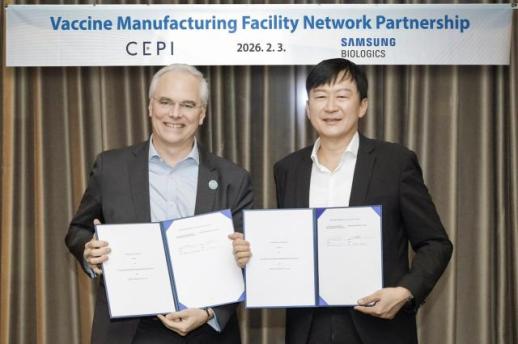 Samsung Biologics joins global vaccine network to bolster pandemic preparedness SEOUL, February 04 (AJP) - Samsung Biologics has signed a partnership agreement with the Coalition for Epidemic Preparedness Innovations (CEPI) to join the Vaccine Manufacturing Facility Network, positioning the South Korean drugmaker as a key player in global pandemic response efforts. Under the deal signed Tuesday, Samsung Biologics will serve as a "preferred" manufacturer for vaccines developed with CEPI support. The company will be capable of producing up to 50 million vaccine doses and drug substances convertible into 1 billion doses of finished vaccine products upon request during a pandemic outbreak. The partnership, backed by an initial investment of about $20 million, forms part of CEPI's "100 Day Mission" initiative, which aims to secure early vaccine approvals and large-scale manufacturing readiness within 100 days of a pandemic declaration. Samsung Biologics will also conduct simulation exercises assuming a wild-type H5 influenza outbreak to verify its rapid response capabilities. "This agreement reflects our commitment to supporting a reliable and agile vaccine supply ecosystem through continued innovation and strong collaboration. It also contributes to Korea's ability to secure timely access to vaccines during urgent public-health situations," said John Rim, CEO of Samsung Biologics. CEPI, headquartered in Norway, was launched at the 2017 World Economic Forum in Davos to develop vaccines against emerging infectious diseases. The coalition counts more than 30 governments, including South Korea, and numerous global pharmaceutical companies among its members. The agreement also stipulates that vaccines produced by Samsung Biologics will be supplied to South Korea on a priority basis at CEPI's request during a pandemic. The company previously demonstrated its manufacturing prowess in 2021 when it became the first in South Korea to produce Moderna's mRNA COVID-19 vaccine, delivering doses just five months after signing a contract. 2026-02-04 10:11:09
 -
 Vietnam to accept Korean language test for university admissions SEOUL, February 03 (AJP) - Vietnam will begin accepting scores from the Test of Proficiency in Korean (TOPIK) for university admissions starting this year, becoming the latest nation to formally recognize the language amid surging worldwide interest driven by employment opportunities and cultural exports. The Southeast Asian nation becomes the second country to adopt TOPIK results for higher education enrollment after Hong Kong in 2025, South Korea's Ministry of Education said Tuesday. Students who score at least Level 3 on TOPIK will be exempted from the foreign language section of Vietnam's national high school graduation examination, with their converted scores applied directly to university applications. Vietnam has progressively integrated Korean into its formal education system, designating it as a second foreign language in 2020 before elevating it to a first foreign language and graduation exam subject in 2021. The country ranked as the largest source of overseas TOPIK applicants last year, with 85,896 Vietnamese candidates accounting for 15.2 percent of the 566,665 total registrants worldwide. Vietnam also sent the second-highest number of international students to South Korea in 2025 at about 75,144, trailing only China by some 1,000 students. The surge in Korean language study is closely tied to employment prospects. South Korean corporate investment — firms including Hyundai Motor Company and POSCO — in Vietnam has created sustained demand for Korean-speaking workers in interpretation, sales, quality control, procurement and labor management roles. The broader appeal of Korean content has propelled the language to the world's sixth most-studied, behind English, Spanish, French, Japanese and German, according to language learning platform Duolingo. Korean is now taught in formal primary and secondary school curricula across 47 countries, with 24 nations designating it as a second foreign language and 11 incorporating it into university entrance requirements. "The adoption of TOPIK for university admissions abroad signifies the elevated status of the Korean language and the growing credibility of the test," Education Minister Choi Gyo-jin said. 2026-02-03 14:58:47
 -
 Korean millionaire exodus doubles on mounting tax burden SEOUL, February 03 (AJP) -South Korea saw the number of millionaires leaving the country double to 2,400 in 2025 from a year earlier, making it the world’s fourth-largest source of wealthy outflows, claimed a business lobby group to reiterate call for an overhaul of the notoriously-high inheritance tax payment system. The Korea Chamber of Commerce and Industry (KCCI) released a study Tuesday projecting that inheritance tax revenue would surge from 9.6 trillion won ($6.63 billion) in 2024 to 35.8 trillion won by 2072 if the current tax regime remains unchanged. The sharp rise is attributed to an aging population, the KCCI projected, with the number of deaths among those aged 70 and above expected to increase by 2.6 times from 264,000 in 2025 to 687,000 in 2072. Following the growth in elderly numbers, those subject to inheritance tax in Korea jumped roughly 13-fold to 21,193 in 2024 from 1,661 in 2002, while the tax share of total government revenue rose to 2.14 percent from 0.29 percent during the same period. The KCCI said this trend is transforming inheritance tax from a levy on the ultra-wealthy into one increasingly felt by middle-class households. The chamber cited data from British immigration consultancy Henley & Partners showing Korea's net outflow of wealthy individuals trailing only the United Kingdom, China and India. The United States and Canada are the most favored destinations among Korean millionaires seeking to relocate, according to the consultancy. "Inheritance tax rates reaching 50 to 60 percent could be a primary factor accelerating capital flight overseas," the KCCI said in its report. While ranking as the top 13th largest economy in the world by nominal GDP, South Korea's top rate of 50 percent is the second-highest after Japan's 55 percent, and can reach 60 percent when a surcharge on controlling stakes is applied. The chamber's analysis of domestic economic data from 1970 to 2024 found a negative correlation between the ratio of inheritance tax revenue to gross domestic product and economic growth rates. Under the current system, heirs of small and medium-sized enterprises engaged in family business succession can pay inheritance tax over a maximum of 20 years or defer payment for 10 years before beginning a 10-year installment plan. Individual taxpayers and large corporations, however, are limited to 10-year installments with no grace period. The KCCI characterized this disparity as creating unreasonable discrimination against ordinary citizens and most businesses, calling for diversified payment methods as a realistic alternative to minimize revenue losses while facilitating smoother business succession. To ease the burden on taxpayers without significantly reducing government revenue, the KCCI proposed extending the installment payment period for general inherited assets from the current 10 years to 20 years, or introducing a minimum five-year grace period. It also called for allowing in-kind tax payments using listed shares and extending the stock valuation period from two months to two or three years around the inheritance date. "Mounting inheritance tax obligations are dampening corporate investment, creating upward pressure on stock prices during succession and forcing some business owners to sell their management stakes," said Kang Seok-gu, head of the KCCI's research division "Flexible payment options for inheritance tax could boost business investment and revitalize the economy," Kang added. 2026-02-03 14:18:04
 -
 The birth of humanoid robots (3): the calculus of steel and flesh Editor's Note: This is the third installment in AJP's series on humanoid robotics, examining the anatomy, technologies and economic logic behind one of the most hyped industries of the decade. SEOUL, February 03 (AJP) - Humanoid robots are designed for work that is tedious, costly or dangerous for humans. To meet that purpose, their architecture does not merely imitate the human body — it often stretches beyond it, with joints capable of rotating 360 degrees to exceed natural human limits. Boston Dynamics captured the innovative mind from South Korea's DRC-HUBO robot — first showcased at the DARPA Robotics Challenge — into its Atlas humanoid. The machine features mechanical joints with 56 degrees of freedom, allowing a full range of motion that far surpasses human flexibility. As if to underscore its machine origins, Atlas's ocular head glows with light. The supply chain gap Beneath the gleaming promise of Korea's humanoid push, however, lies a structural vulnerability. A Jan. 26 report by the Korea International Trade Association estimates South Korea's localization rate for robot components at around 40 percent, underscoring the industry's heavy reliance on foreign parts. Nearly 88.8 percent of permanent magnets used in Korean robot motors are sourced from China, while precision reducers and servo motors are supplied largely by Japanese manufacturers. Japan, by contrast, has internalized rare-earth processing and core component production, exporting more than 70 percent of its robot output. Korea — despite leading the world in robot density at 1,012 units per 10,000 workers — exports just 28.8 percent. As Hyundai Motor Group moves to deploy Atlas, many of the actuators and sensors powering the machines may still bear Japanese and Chinese stamps. Building robots, it turns out, is not the same as building an industry. The price of progress Analysts say Atlas will not come cheap. Boston Dynamics has said pricing will be based on "investment recovery within two years," effectively placing the robot below roughly 200 million won ($130,000) — nearly equivalent to the labor cost of two U.S. auto workers earning $80,000 annually over that period. The figure is steep compared with rivals. Tesla has promised its Optimus humanoid for $20,000 to $30,000, while China's Unitree offers its H2 model starting at $29,900. Hyundai is betting that Atlas's superior specifications justify the premium: 56 degrees of freedom, a lifting capacity of 90 kilograms, and the ability to swap its own batteries — capabilities cheaper competitors have yet to match. The speed question Price alone, however, does not determine whether robots can replace workers. Speed and precision matter just as much. For now, humanoid deployments remain concentrated in logistics, simple handling and repetitive tasks — not high-precision assembly or work requiring human-level dexterity. Fine-motor control and tactile sensitivity remain in early stages, with significant gaps still evident, according to Bain & Company. So why pursue humanoids when industrial robots already dominate factory floors? "These bipedal robots can replace humans directly," said Kim Dong-wan, a project director at the Korea Planning & Evaluation Institute of Industrial Technology. "Most mobile robots rely on wheels, which are poorly suited to uneven terrain such as steel plants. Humanoids can walk over obstacles, press buttons — essentially performing the same tasks as human workers." Echoes of the Luddites The announcement of Atlas roaming factory grounds sent Hyundai's stock to an all-time high of 590,000 won on Jan. 22 — but also triggered resistance from an unexpected quarter: its own workers. That same day, Hyundai Motor's labor union declared that "not a single robot" would enter workplaces without labor-management agreement, warning of potential "employment shocks." "The introduction of AI robots aimed at cutting labor costs is becoming visible," the union said. "If you want to destroy labor-management relations, we will show you how it ends." The tidal wave approaches President Lee Jae Myung weighed in on Jan. 29, invoking the industrial upheavals of two centuries ago. "You cannot dodge an oncoming cart," Lee told senior aides. "If this world is coming anyway, we must prepare and brace for it." Lee compared the union's stance to the Luddite movement of early 19th-century Britain, when workers destroyed machines they feared would render them obsolete. "It's probably not serious — more a negotiating tactic," he said. "But ultimately, we need to adapt quickly." Both major umbrella unions told AJP that Hyundai's labor group may have gone too far in declaring opposition to "a single robot." "Robot integration into workplaces is nearly irreversible," said a spokesperson for the Federation of Korean Trade Unions. "Government, companies and labor all need to discuss how to coexist." The Korean Confederation of Trade Unions echoed that view but stressed concerns over unequal distribution of the benefits of humanoid technology. "This is a transitional moment," it said. "Shorter working hours and improved welfare are possible. But humanoids must benefit society broadly — not simply enrich executives while workers are laid off." The human factor Hyundai has sought to reassure employees, saying robots will focus on repetitive and dangerous tasks. Vice Chair Chang Jae-hoon said at CES 2026 that human workers will remain essential for maintaining and training robots. Yet the union's statement reflects a deeper anxiety: the surge in Hyundai's stock — fueled by investor expectations of reduced labor costs, though now slightly dampened — highlights precisely the threat workers perceive. "We estimate it will take many years before humanoids meet the standards required for high-precision tasks," Kim said. "Korea is pushing hard for that transition, but we cannot promise when bipedal robots will perform truly difficult work." The question is no longer whether humanoids will work alongside humans, but how soon — and on whose terms. The robots that stumbled at the DARPA challenge a decade ago are now walking factory floors. The workers who once cheered their failures now face them across the assembly line. 2026-02-03 13:01:06
 -
 Hyundai Mobis forms four-way alliance with European firms for holographic windshield display SEOUL, February 03 (AJP) - Hyundai Mobis said Tuesday it has forged a "Quad Alliance" with three European technology leaders to commercialize holographic windshield displays by 2029, marking a significant push into next-generation automotive display technology. The South Korean auto parts maker has joined forces with German optics giant Zeiss, German adhesive specialist Tesa, and France's Saint-Gobain Sekurit, Europe's largest automotive glass manufacturer, to bring the technology to mass production. The holographic windshield display transforms the entire front windshield into a large-format screen, projecting driving information directly into the driver's line of sight without requiring a separate physical display. The system uses a special holographic optical element film to deliver navigation data and infotainment images precisely to the eyes of both drivers and passengers. The technology has light transmittance exceeding 92 percent and brightness surpassing 10,000 nits, about twice that of outdoor LED screens, enabling clear visibility even under direct sunlight. The optical design also prevents drivers from viewing passenger-side content, allowing front-seat occupants to safely enjoy entertainment during travel. Under the alliance, Hyundai Mobis will oversee the overall system architecture and projector production, while Zeiss handles film design for optimal clarity. Tesa will mass-replicate the high-performance film, and Saint-Gobain Sekurit will manage the precision bonding process between film and glass. "We will deliver differentiated value to our customers through this technology that opens the future of automotive displays," said Jung Soo-kyung, head of Hyundai Mobis' automative electronics business unit. 2026-02-03 11:02:41
 -
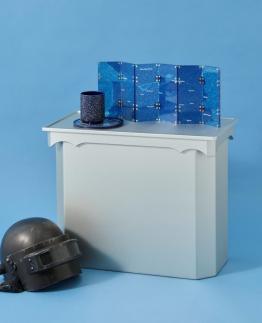 Krafton bridges PUBG universe with Korean traditional crafts SEOUL, February 02 (AJP) - Krafton unveiled Monday a collection merging its flagship battle royale IP "PUBG: Battlegrounds" with traditional Korean craftsmanship through a state-led cultural initiative. The project, hosted by the Ministry of Culture, Sports and Tourism and managed by the Korea Craft & Design Foundation, aims to reimagine traditional assets within modern industries. Design studio Superposition reinterpreted the game's iconic "Blue Zone" using "digital mother-of-pearl," transforming the strategic digital boundary into physical art pieces. Craft team Octique focused on lifestyle goods, blending the game's recognizable symbols with traditional artisan techniques. The lineup features chicken shaped amulets and mother-of-pearl frying pan designed hand mirrors, which marry the playful identity of PUBG with classical formative beauty. Regarding the project's goal, Krafton said the collaboration explores the practical utilization and industrial value of traditional culture through partnerships between creators and private enterprises. 2026-02-02 16:06:48