
Journalist
Kim Dong-young and Han Jun-gu
davekim0807@ajupress.com
-
 Hanwha Solutions trims capital raise to 1.8 trillion won after regulator pushback SEOUL, April 17 (AJP) - Hanwha Solutions announced it will scale back its planned rights offering to 1.8 trillion won ($1.21 billion) from an initial 2.4 trillion won, retreating from a contentious fundraising plan that drew a rare regulatory rebuke and sharp criticism from shareholders. The revised offering, approved by the company's board on Friday, comes just eight days after the Financial Supervisory Service ordered Hanwha Solutions to refile its securities registration, citing missing or unclear disclosures that could impair investor judgment. Under the amended plan disclosed through regulatory filing, funds earmarked for debt repayment will shrink to 907 billion won from 1.49 trillion won, while the roughly 908 billion won set aside for capital investment remains untouched. The issue size has been cut to 56 million new shares from 72 million, with the subscription price lowered to 32,400 won per share from 33,300 won. The allotment ratio for existing shareholders correspondingly drops to 0.2604 new shares per held share from 0.3348. The record date is May 14. The company has previously defended the move as a necessary measure against a credit-rating downgrade amid a prolonged downturn in the global solar and petrochemical sectors. "We sincerely reflect on and apologize for failing to adequately communicate the scale and rationale of the rights offering with shareholders and the market in its early stages," said Nam Jung-woon, head of the chemical division. The company said it will raise the remaining 600 billion won shortfall through asset monetization and capital-like financing, and pledged to refrain from additional equity offerings through 2030 while maintaining its shareholder return policy. 2026-04-17 17:01:59
 -
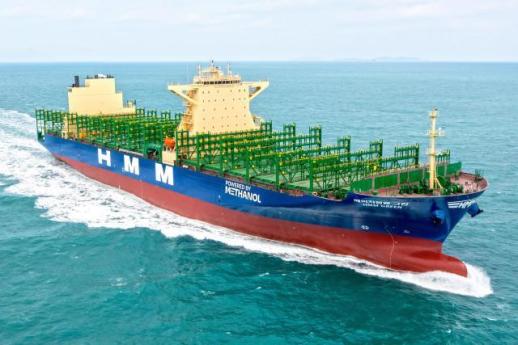 Hormuz crisis fuels air and sea charges, adding to input pressure in Korea SEOUL, April 17 (AJP) - South Korean shipping lines are introducing emergency bunker surcharges as the prolonged conflict between Iran and the U.S.-Israeli coalition drives up fuel costs, adding to input pressures and, ultimately, consumer prices. Sinokor Merchant Marine, one of Korea's largest container operators, said it will impose an emergency bunker surcharge of $100 per 20-foot equivalent unit (TEU) on export cargo bound for Southeast Asia, effective this month. Industry officials said other major container carriers are preparing similar measures, with surcharges ranging from $150 to $200 per TEU. The moves come as global shipping lines including Maersk and OOCL roll out their own emergency surcharges in response to the Middle East crisis. The latest fees mark another layer of cost escalation stemming from the 2026 Strait of Hormuz crisis, which began on Feb. 28 when the United States and Israel launched coordinated airstrikes on Iran under Operation Epic Fury. Iran retaliated by restricting passage through the strait, through which about 20 percent of global oil and a similar share of liquefied natural gas shipments normally pass. The disruption has hit marine fuel markets with particular force. Bunker C fuel oil, the heavy fuel that powers most commercial vessels, is typically produced from the residue of heavier crude grades. Middle Eastern crudes, generally heavier and higher in sulfur content than most benchmark grades, have long been a key feedstock for such fuels. With Hormuz shipments curtailed, bunker prices have climbed sharply, eroding the margin cushion carriers had relied on through the first quarter. Vessels stranded inside the strait are compounding the strain on ocean freight. A total of 26 Korean-flagged ships remain stuck in the Strait of Hormuz, 10 of them belonging to eight small and mid-sized carriers, according to data from the Korea Shipowners' Association. Those carriers are estimated to be losing about 580 million won ($392,086) a day from halted operations, higher fuel costs, war-risk insurance premiums and crew hazard pay. The pressure is spreading into air logistics, where jet fuel costs are tracking the same Middle East supply disruption through the Singapore benchmark widely used across Asia. Singapore Mean of Platts jet fuel averaged 511.21 cents per gallon for May, placing it in the top tier of Korea's 33-step fuel surcharge system, according to the aviation industry. It is the highest reading since the surcharge framework was introduced. Korean Air set its May international fuel surcharge at up to 150,000 won ($101.40) per round trip, depending on distance. The top-end charge is roughly five times the January level. With both sea and air freight costs rising in tandem, Korean exporters face the prospect of higher logistics bills feeding into consumer prices if the Hormuz disruption stretches further into the second quarter, industry officials said. According to preliminary export and import price data for March released by the Bank of Korea on Wednesday, import prices in won terms jumped 16.1 percent from the previous month, the steepest increase since a 17.8 percent surge in January 1998. From a year earlier, they rose 18.4 percent. Jet fuel import prices soared 67.1 percent quarter on quarter and 81.8 percent year on year. Import prices for raw materials jumped 40.2 percent from the previous month and 40.0 percent from a year earlier. Coal and petroleum product import prices rose 37.4 percent month on month and 31.3 percent year on year. Consumer prices rose 2.2 percent in March from a year earlier, still within the target range, but the Bank of Korea has warned that annual inflation could approach 3 percent if the war drags on. 2026-04-17 12:08:07
 -
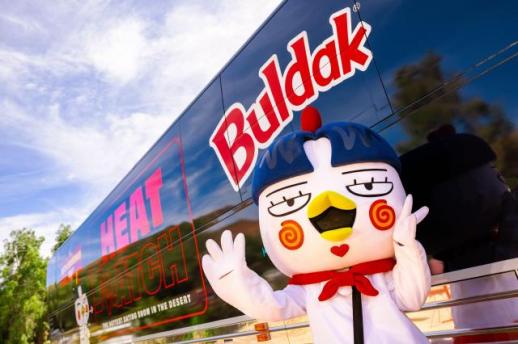 Samyang Foods' Buldak spice brand ventures into reality TV with dating show SEOUL, April 17 (AJP) - Samyang Foods has launched a reality dating show built around its Buldak spicy noodle brand, marking the company's latest push to embed the product into global youth culture beyond conventional food marketing. The South Korean food company announced Friday that it has partnered with U.S. media platform Nectar to produce "Heat Match," a dating show filmed against the backdrop of a major California music festival. The first episode aired April 11 on Nectar's official YouTube channel, with the finale set for release Saturday. The show features 10 single contestants board a Buldak-branded bus and travel to a desert party venue. A central conceit of the format is using Buldak's heat level as a compatibility test, with contestants gauging mutual tolerance for spice as a proxy for emotional chemistry. "This campaign is an elevation of the Buldak brand spirit into cultural entertainment," a Samyang Foods spokesperson said, adding that the company aims to offer young audiences worldwide a shared experience through the Buldak brand. Samyang said the initiative is part of a broader effort to position Buldak as a cultural icon woven into the lifestyles of young consumers globally. 2026-04-17 10:11:21
 -
 AI unsettles game workforce in Korea as industry peaks out SEOUL, April 16 (AJP) - The artificial intelligence scare has caught up with the game industry, once a top career choice for software programmers in South Korea, with as many as three in four feeling threatened by the new technology in a sector now past its heyday. A survey of 1,078 unionized employees at major publishers including Nexon, NC and Netmarble found that 77.3 percent were anxious about their jobs, according to results presented Wednesday at a National Assembly policy forum hosted by the ruling Democratic Party's game industry task force. The poll, conducted from March 27 to April 10 by the IT branch of the Korean Chemical Textile Food Workers' Union, underscores a growing disconnect between rapid AI adoption and limited institutional response. While 65.6 percent of respondents said they already use AI tools regularly at work and 80.3 percent acknowledged tangible efficiency gains, only 26.7 percent reported that formal discussions between management and labor had taken place. A majority — 82.3 percent — called for clear guidelines on how AI-driven productivity gains should be shared. Their anxiety stands in contrast to the industry's strong financial performance. Meritz Securities projected that the combined operating profit of the country's seven largest game publishers would reach about 937.2 billion won ($635.7 million) in the first quarter, exceeding market consensus by 20 percent and surging 64.1 percent from a year earlier. Combined revenue was estimated at 3.57 trillion won, up 33.7 percent. Still, publishers are aggressively trimming payroll. NC cut its workforce by 35.1 percent — from about 4,886 to 3,170 — between 2024 and late 2025 through voluntary retirement programs and spinoffs. Krafton accepted about 200 voluntary resignations since last November, while Nexon froze new hiring and reassigned developers in what industry observers describe as indirect restructuring. Research and development spending has also declined. NC's R&D outlays fell 22.9 percent to 325.1 billion won last year, with Netmarble, Pearl Abyss and Kakao Games also scaling back investment. Rising labor costs have accelerated the shift toward automation. Average annual pay at Krafton rose to 129 million won last year from 109 million won in 2024. Pearl Abyss saw its per-capita figure jump to 134.1 million won from 98.5 million won. Similar increases were recorded at NC, Netmarble and Kakao Games. At the same time, the domestic market is nearing saturation. Total industry revenue grew 3.9 percent to 23.85 trillion won in 2024, only a marginal improvement from 3.4 percent growth in 2023 and a sharp slowdown from the 21.3 percent surge recorded in 2020. Analysts say the AI-driven shift reflects a broader structural change across the IT sector. "Front-end interfaces once required large numbers of lower-skilled workers, while back-end systems relied on highly skilled engineers. Now, a client module can be handled by one or two senior engineers supported by AI," said Im Chung-jae, a professor of game software at Keimyung University. "From a company's standpoint, there is little reason to turn down a tool that delivers faster and more flexible results." President Lee Jae Myung echoed that view, urging labor leaders on April 10 to focus on adapting to technological change rather than resisting it. Even so, human creativity remains a critical variable as the industry evolves. "Games and animation have always been creative domains, so AI's impact is different from live-action production," Im said. "If AI produces flawed results, the issue is no longer the tool itself but the capability of the person designing the system and giving the commands." As development shifts beyond coding toward planning and creative direction, demand is likely to grow for talent that blends technical expertise with design and humanities-based thinking. 2026-04-16 15:20:43
 -
 South Korea's AI startups post strong growth under science ministry program SEOUL, April 16 (AJP) - South Korea's Ministry of Science and ICT announced that AI and digital companies backed by its K-Global Project program posted broad gains in revenue, investment and employment last year, as the initiative celebrated a decade of nurturing the country's startup ecosystem. According to its press release on Thursday, the ministry surveyed 397 firms that participated in the program, drawing responses from 290 companies. Combined headcount at the end of 2025 reached 10,221 employees, up 450 from the prior year, with about 65 percent of respondents reporting increase in hiring. Total revenue of the firms rose about 8.1 percent year on year to 1.86 trillion won($1.26 billion), outpacing the 6.7 percent average growth rate recorded by KOSDAQ-listed companies over the same period. Investment raised by participating firms surged 53.9 percent to 875.1 billion won, while patent applications climbed 12.8 percent to 4,106 filings. The K-Global Project, launched as an umbrella brand for the ministry's AI and digital support programs, has produced several high-profile success stories. Chipmakers Rebellions and Furiosa AI, both alumni of the program, have since reached unicorn status, while AI medical-imaging firm Vuno and AI compression specialist Nota AI have completed KOSDAQ listings. "AI and digital startups are emerging as the central drivers of industrial innovation, and the companies introduced today are prime examples of that," said Park Tae-wan, Director General of the ICT Industry Policy at the ministry. Park added that the government would refine the program based on industry feedback and work to ensure Korean firms can compete in global markets. 2026-04-16 14:39:28
 -
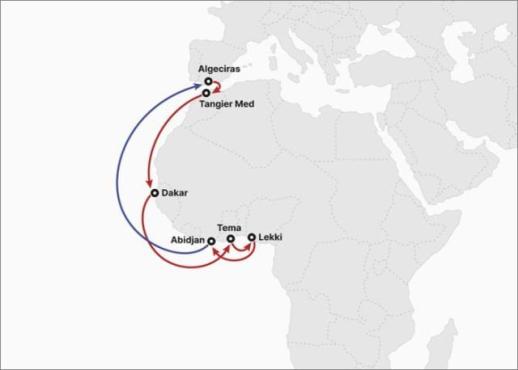 HMM to launch West Africa container service, expanding global network SEOUL, April 16 (AJP) - HMM will launch a new shipping route connecting Spain and West Africa in July, marking its first foray into the African continent as part of a broader push to extend its global reach. The new service announced Thursday, designated MA2 (Mediterranean West Africa), will operate out of Algeciras, Spain — a key Mediterranean hub — and call at ports in Morocco, Senegal, Ghana, Nigeria, and Cote d'Ivoire. The round voyage takes about 35 days and will deploy five container vessels of about 2,800 twenty-foot equivalent units (TEU) each. HMM will co-operate the service with Japan's Ocean Network Express, a fellow member of the Premier Alliance. Sailings are scheduled to begin in the second week of July from Algeciras. The MA2 route is the first tangible step under HMM's hub-and-spoke strategy, a central pillar of the carrier's 2030 long-term plan, in which large vessels handle major deep-sea trunk routes while smaller feeder ships branch out to secondary ports. The company said linking Africa — a market it had not previously served — would meaningfully broaden the services it can offer cargo shippers. "This MA2 service will serve as a starting gun for strengthening HMM's global network through the hub-and-spoke strategy," said an HMM spokesperson, adding the company plans to keep raising customer satisfaction through differentiated service offerings. To support the strategy, HMM has been steadily building up its feeder fleet. The company placed an order for 10 vessels of 2,800 TEU with HD Hyundai Heavy Industries in March, acquired two 1,900 TEU ships earlier this year, and in October 2025 ordered a combined 24 feeder vessels — securing about 24 feeders within a six-month span. 2026-04-16 09:56:47
 -
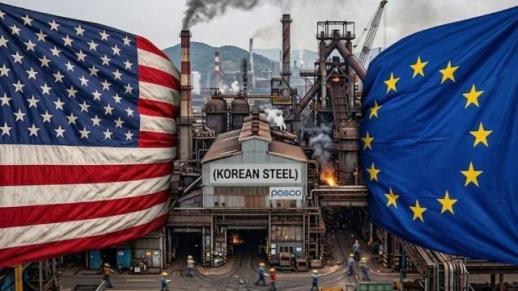 Double tariff whammy hits Korean steel as EU barriers pile on top of U.S. tariffs SEOUL, April 15 (AJP) - When it rains, it pours for South Korean steelmakers as they face collateral damage from higher trade tariffs in Europe on top of U.S. duties aimed at curbing cheap Chinese imports. The European Parliament and the Council of the EU hammered out a deal on Monday (local time) after late-night negotiations, setting tariff-free quotas at 18.3 million tons per year — nearly halved from about 35 million tons permitted under the current safeguard regime. Imports exceeding the cap will face a 50 percent duty, up from 25 percent. The measures, pending formal endorsement and a plenary vote expected in May, are set to take effect on July 1. The agreement also introduces a "melt and pour" traceability rule requiring importers to prove where raw steel was first smelted and cast — a provision targeting steel from overcapacity countries, chiefly China, routed through third-party processing. "We cannot afford to turn a blind eye to global overcapacity reaching critical levels," said EU Trade Commissioner Maros Sefcovic. Global steel overcapacity is projected to reach 721 million tons by 2027, more than five times the EU's annual consumption. Whether the target is primarily China, the blow nevertheless falls hard on South Korea. The EU bought $3.71 billion worth of South Korean steel in 2025, making it the country's largest export market — down from $4.48 billion in 2024, according to the Korea International Trade Association. South Korea shipped about 3.31 million tons to the bloc last year, of which about 2.58 million tons entered duty-free under country-specific quotas. EU posed as relief to the U.S. that has been imposing 50 percent levies on steel and aluminum imports from June last year. The new EU framework resets baseline quotas to 2013 import levels — well before the global oversupply cycle intensified — meaning Seoul's allocation is expected to shrink significantly. Korean steelmakers are still reeling from the U.S. blow. POSCO and Hyundai Steel, the country's two dominant producers, are estimated to have paid a combined $281 million in U.S. tariffs between March and December 2025. Korean steel exports to the United States have since plummeted after tariffs were doubled to 50 percent in June, with demand described by industry sources as "nearly depleted." The pressure compounds a longer-running squeeze from cheap Chinese steel flooding global markets. At home, Hyundai Steel ran two rounds of early retirement programs in 2025 and permanently closed half of its rebar capacity at its Incheon plant in January, shuttering a 90-ton electric furnace as the domestic construction slump deepened. In November 2025, the National Assembly passed the K-Steel Act, a 570 billion won support package to fund industry restructuring and bolster exports. But with the EU now confirming the tariff overhaul that had been under discussion since last October, pressure on Seoul to secure favorable quota terms has intensified. "Korean steel exports to the EU were already constrained within existing quotas, with limited room to expand," said Lee Jae-yoon, senior research associate at the Korea Institute for Industrial Economics and Trade. "With the U.S. market effectively shut and domestic demand still weak, the EU should have been a growth outlet — but these new protective measures, combined with the EU Carbon Border Adjustment Mechanism, are closing that window." The double tariff squeeze has nonetheless forced a strategic pivot toward the United States. POSCO acquired a 20 percent stake worth $582 million in Hyundai Steel's planned $5.8 billion electric arc furnace mill in Louisiana, with commercial production expected in 2029. POSCO has also signed a strategic partnership memorandum with Cleveland-Cliffs, the second-largest U.S. crude steel producer, though the company said in a March regulatory filing that no final decision on equity participation or investment size has been reached. The EU's move is driven by a broader structural strain. European steel capacity has shrunk by 65 million tons since 2007, with about half of that loss since 2018. The sector operates at around 67 percent capacity — well below the 80 percent considered healthy — while import penetration hit a record 29 percent in the third quarter of 2025. Lee said Korean steelmakers will ultimately need to pivot toward green steel to navigate the tightening trade environment. Building production facilities in Europe — unlike in the United States — holds little commercial appeal, given the continent's own supply glut. "The U.S. offers higher prices, high energy costs that keep out cheap imports, and insufficient domestic capacity — making it attractive for investment," Lee said. "Europe is the opposite. It already has overcapacity, so there is little merit in setting up local production just to avoid tariffs." The Korean government is also moving to cushion the blow. Seoul has been in continuous contact with Brussels since the European Commission first unveiled the proposal in October, and has maintained those channels since Monday's agreement. "We have been in constant dialogue with the EU since the initial proposal, and remain in close contact regarding the steel tariff and quota framework. No tangible agreement on Korea's specific allocation has been reached yet," a spokesperson for the Ministry of Trade, Industry and Energy said. 2026-04-15 14:36:45
 -
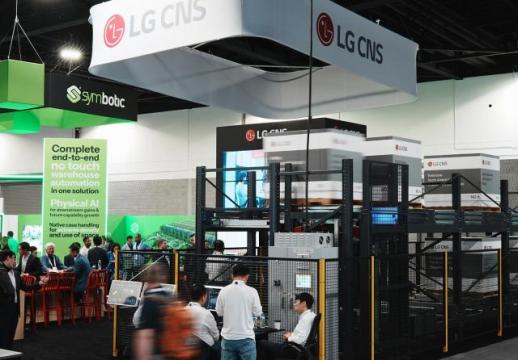 LG CNS unveils cold-chain logistics robot at U.S. trade show, eyes North American market SEOUL, April 15 (AJP) - LG CNS showcased a new warehouse automation robot capable of operating in sub-zero freezer environments at a major North American logistics trade show, as the South Korean IT services firm pushes to expand its footprint in the United States. The company unveiled its "Mobile Shuttle" system at Modex 2026 on Monday (local time) in Atlanta, where the robot was highlighted for its ability to function continuously at temperatures as low as minus 26 degrees Celsius — a threshold that covers most industrial cold-chain and frozen food storage facilities. The robot has received UL certification, a mandatory safety standard for electrical and mechanical equipment in the United States. Each shuttle unit can carry loads of up to 1,500 kilograms and travels at 1.5 meters per second along warehouse racks. The system uses a four-way directional structure — moving forward, backward, sideways, and vertically — to minimize routing constraints and boost storage density by more than 30 percent compared with conventional two-directional warehouse setups. LG CNS has equipped the system with an AI agent that allows warehouse workers to issue commands in natural language through a chatbot interface, including for emergency dispatch situations. The AI component also diagnoses malfunctions and proposes corrective actions in real time, the company said. "We have expanded the scope of logistics automation to cover refrigerated and frozen environments," said Lee Jun-ho, executive vice president of LG CNS' smart logistics and city business division. "We will continue to grow our global business on the strength of our differentiated capabilities in high-density, high-efficiency logistics operations." 2026-04-15 10:50:14
 -
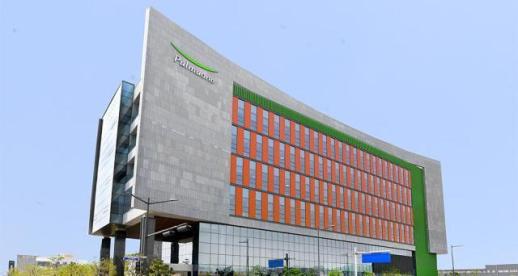 Pulmuone climbs to 3rd among global food firms in S&P sustainability ranking SEOUL, April 15 (AJP) - South Korean food maker Pulmuone announced it achieved its highest-ever ranking in S&P Global's Corporate Sustainability Assessment, climbing to third place among global food companies from fourth a year earlier. The result, based on the 2025 CSA and reflected in S&P Global's Sustainability Yearbook 2026 published in February, marks the third consecutive year Pulmuone has placed in the top five of the food products category. The assessment evaluated about 9,200 companies across 59 industries worldwide, with only 848 earning a place in the yearbook. In the food products segment, 241 companies underwent review. Pulmuone said it was the top-ranked South Korean food company among them, few points ahead of its domestic competitor CJ Cheiljedang, earning recognition for strengthened board independence, tighter environmental management and upgraded food safety systems. The company attributed the improvement to gains across all three ESG pillars. In governance, it bolstered independent oversight by raising the mandatory ratio of outside directors to one-third from one-quarter and linking board evaluations to executive compensation. On the environmental front, Pulmuone built a carbon footprint tracking system under the ISO 14067 standard and completed third-party verification for key products including tofu and udon noodles. Pulmuone has also pushed into food technology, entering the commercial verification stage for land-based seaweed aquaculture and developing a CRISPR-Cas-based diagnostic platform for pathogen detection, for which it has secured patents. "This result is an objective, global-level recognition of the sustainability efforts Pulmuone has pursued since its founding, rooted in our philosophy of love for neighbors and respect for life," said Lee Jung-eon, the company's head of sustainability management. "We will continue to advance Pulmuone's unique values into ESG management that meets global standards, under our mission of 'Creating a Healthy Tomorrow for People and the Earth through Wholesome Food,' and build an ever-stronger foundation for sustainable growth." 2026-04-15 08:37:09
 -
 Early adopters but slow system: Korea's AI gap widens SEOUL, April 14 (AJP) - South Koreans are among the world's fastest adopters of artificial intelligence and among the most prolific in patenting the technology, yet government and corporate support remains strikingly behind, a global comparative study found. The 2026 AI Index Report, released Tuesday by Stanford University's Institute for Human-Centered Artificial Intelligence, is a 423-page annual assessment widely regarded as one of the most authoritative gauges of global AI progress. South Korea registered 14.31 AI patents per 100,000 people in 2024 — far ahead of Luxembourg at 12.25, China at 6.95 and the United States at 4.68. Adoption is accelerating just as quickly. Generative AI usage rose from 25.9 percent in the first half of 2025 to 30.7 percent in the second half, the fastest increase among 30 regions surveyed. The gain pushed South Korea up seven places to 18th globally, though still well behind leaders such as the United Arab Emirates at 64 percent and Singapore at 60.9 percent. On paper, policy momentum is strong. South Korea enacted 17 AI-related laws between 2016 and 2025 — the second-highest among G20 nations after the United States. The report highlighted the AI Basic Act, which took effect this year, as a cornerstone framework aimed at fostering innovation while building public trust. The country also remains a significant player in model development, ranking third globally with five notable AI models launched in 2025, trailing only the United States and China. But beneath these headline gains, the gaps widen. Private AI investment totaled just $1.78 billion, placing South Korea 12th globally — a fraction of the $285.9 billion poured into the sector in the United States and $12.4 billion in China. Even with 59 newly funded AI firms, the ecosystem lacks the scale to match its innovation output. Structural weaknesses extend to the workforce. About 81.4 percent of South Korea's AI talent pool is male, one of the widest gender imbalances among surveyed countries, alongside Japan and Brazil. More critically, institutional support is lagging. South Korean employees gave their organizations some of the lowest marks globally for AI readiness. Workers in Japan, South Korea and Portugal reported the weakest support for AI literacy training and governance frameworks, with fewer than half saying their employers provide meaningful backing. In India, by contrast, roughly 85 to 90 percent reported strong institutional support. The disconnect between individual adoption and organizational readiness is not unique to Korea, but it is particularly pronounced. A McKinsey survey found 88 percent of organizations use AI in at least one business function, yet 60 percent say adoption remains stuck at the pilot stage — a gap increasingly described as "shadow AI," where employees deploy tools informally outside official systems. "South Korea is known to have a particularly high rate of shadow AI usage. Even though formal adoption through corporate channels remains limited, employees are quietly using these tools on their own," said Park Hyun-kyu, professor of management of technology at Sogang University. Globally, the expansion is rapid and uneven. Generative AI reached 53 percent population adoption within three years — faster than personal computers or the internet. Corporate investment surged 130 percent to $581.7 billion in 2025, with the United States dominating the field. For South Korea, the picture is clear: a country moving faster than most at the edge of adoption and innovation, but held back by hesitant institutions and underpowered capital. Until that gap closes, its AI momentum risks remaining diffuse — energetic, but not yet fully mobilized. 2026-04-14 13:48:26