

Journalist

Han Ji-hyun
hanji@ajunews.com
-
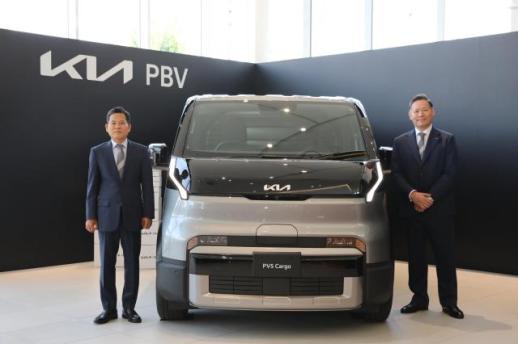 Hyundai Targets Japan and China for Global Expansion Hyundai Motor Group is set to re-enter the Japanese and Chinese markets. In Japan, facing severe labor shortages due to an aging population, the company will introduce purpose-built vehicles (PBVs). In China, where competition among local electric vehicle manufacturers is fierce, Hyundai plans to launch thoroughly localized electric vehicles under its "In China, For China" strategy. Unlike its successful foothold in the U.S. and Europe, and its emerging growth in India and Southeast Asia, Japan and China are considered challenging markets due to strong patriotic consumer culture, often referred to as the "graveyard of imported cars." Hyundai aims to strengthen its presence in Asia to become a global top-tier company. According to industry sources, Kia announced the launch of its first dedicated PBV model, the "PV5," on May 13 at its Tokyo-based Kia PBV Japan showroom. The PV5, tailored to meet the diverse business environments and lifestyles of local customers, features a customized vehicle structure and advanced technologies. Japan is grappling with various social issues, including labor shortages, logistics challenges, and increased gaps in regional transportation due to rapid aging. The PV5 aims to provide a new alternative in Japan's limited electric commercial vehicle market while addressing these social issues. The PV5 is equipped with V2L (Vehicle-to-Load) and V2H (Vehicle-to-Home) specifications, allowing it to serve as an emergency power source during disasters like earthquakes. It also incorporates the CHAdeMO charging method, enhancing usability for the Japanese market. The Japanese government plans for 30% of new car sales to be electric vehicles by 2030. In response to the growing demand for small and medium-sized electric vans, Kia will first launch passenger and cargo models of the PV5, followed by a wheelchair-accessible version (PV5 WAV), with plans to introduce a successor model, the PV7, by 2028 to boost local sales. To effectively penetrate the Japanese market, Kia has established a partnership with Sojitz Corporation, a prominent general trading company. As part of this collaboration, Kia PBV Japan was launched in April last year to develop PBV operations in Japan. Kia PBV Japan currently operates seven dealerships, including the Tokyo-based showroom, and 52 service centers, with plans to expand to 11 dealerships and 100 service centers by the end of the year. Kim Sang-dae, Vice President of Kia PBV Business Division, stated, "The launch of the PV5 in Japan is a significant milestone that showcases Kia's product competitiveness and brand trust. We aim to build long-term trust with Japanese customers and establish ourselves as a reliable partner supporting their transition to electrification." In China, Hyundai will introduce the Ioniq V, the first model developed specifically for the Chinese market. Moving away from the previous strategy of selling global models, the Ioniq V has been designed with a focus on local consumer preferences, featuring batteries from China's CATL, advanced driver-assistance systems (ADAS) from Momentus, AI voice recognition based on Baidu, and infotainment systems that reflect the lifestyle of Chinese consumers. Hyundai is also preparing to launch an extended-range electric vehicle (EREV) to cater to the rapidly growing market in China, which has been traditionally focused on pure electric vehicles. EREVs utilize an internal combustion engine to charge the battery, significantly extending driving range, which is expected to attract consumers in China's less developed regions where charging infrastructure is limited. Hyundai aims to complete a lineup of over 20 models, including six electric vehicles, by 2030, targeting annual sales of 500,000 units in China. Both China and Japan present significant challenges for Hyundai Motor Group due to high brand loyalty towards domestic manufacturers, including BYD, Xiaopeng, and Toyota, which have become global automotive leaders. China, in particular, is the world's largest automotive market, with an annual volume exceeding 30 million vehicles, more than double that of the U.S. It is also a battleground for electric vehicle battery and software technology development, making it essential for Hyundai to establish a foothold in this market. Japan is known as one of the most demanding automotive markets globally, and success there is seen as a testament to winning in quality and detail. If Korean cars, once viewed as alternatives to Japanese vehicles, gain acceptance among Japanese consumers, they could elevate to true premium brands in the global market, according to industry assessments. An industry insider remarked, "If Hyundai secures an advantage in the fiercely competitive local market in China and achieves success in Japan, which is the home ground of global leader Toyota, it would be as symbolic as its achievements in the U.S. or Europe. China and Japan are the final pieces of the puzzle for Hyundai to reach global leadership."* This article has been translated by AI. 2026-05-15 23:25:06
 -
 Chabi Reports Q1 Revenue of 20.7 Billion Won, 21% Growth Year-on-Year Chabi announced that its consolidated revenue for the first quarter reached 20.7 billion won, marking a 21% increase compared to the same period last year. The charging service segment recorded sales of 13.9 billion won, a 13% year-on-year growth, demonstrating stable growth. The charger manufacturing segment also saw a 41% increase in revenue, totaling 6.8 billion won compared to the previous year. Due to the seasonal nature of export volumes, which are concentrated in the fourth quarter, the company reported an operating loss of 9.7 billion won for the first quarter. However, the key performance indicator, EBITDA, improved by 17 percentage points year-on-year, reaching -2%, indicating that the company is nearing profitability, according to Chabi officials. A Chabi representative stated, "The increase in electric vehicle registrations and the rising utilization rate of chargers are driving revenue growth and improving profitability in the charging service sector." Chabi anticipates that demand for charging infrastructure will continue to grow alongside the expansion of the electric vehicle market. The charging service business is structured to expand revenue as the cumulative number of registered electric vehicles and charger utilization rates increase. Recent trends show a sharp rise in electric vehicle sales, which is expected to accelerate both the foundation for long-term growth and the pace of performance improvement. According to the Ministry of Trade, Industry and Energy's report on the automotive industry trends for March and the first quarter of 2026, domestic electric vehicle sales in the first quarter increased by 155.8% compared to the same period last year, with approximately one in four vehicles sold by April this year being electric. This trend suggests a rapid expansion in demand for fast charging services and charger utilization. Choi Young-hoon, CEO of Chabi, remarked, "The charging service sector is improving profitability to a level capable of generating its own cash flow, and the foundation for long-term growth is being further strengthened with the expansion of electric vehicle adoption. The manufacturing sector will also continue to improve annual performance, focusing on global export growth." Meanwhile, Chabi is pursuing various initiatives to expand charging infrastructure nationwide and lead the mobility ecosystem in the era of one million electric vehicles. Starting at the end of May, third-generation chargers equipped with NACS connectors will be fully operational at major living hubs and highway rest areas in Seoul and the metropolitan area, allowing Tesla users to conveniently access Chabi chargers. Recently, Chabi partnered with Hyundai to launch a dedicated electric vehicle charging subscription service for Hyundai customers, enhancing accessibility to charging infrastructure while reducing usage costs.* This article has been translated by AI. 2026-05-15 23:15:17
 -
 Thinkware Reports 1st Quarter Revenue of 119.7 Billion Won Amid Operating Loss Thinkware announced on May 15 that it recorded consolidated revenue of 119.7 billion won and an operating loss of 4.6 billion won for the first quarter of this year. Revenue decreased by 16% compared to the same period last year, and the company shifted from an operating profit of 400 million won in the first quarter of 2025 to a loss this year. A company representative explained, "The results were impacted by delays in the supply schedule of some products, rising prices of raw materials including semiconductor memory due to geopolitical risks, and the appreciation of the yuan." To overcome external uncertainties, Thinkware is securing long-term growth drivers through initiatives such as supplying black boxes exclusively for Mercedes-Benz Korea, launching ultra-compact black boxes for two-wheeled mobility, expanding online distribution of Xiaomi products, operating an AI-based taxi-hailing platform, and developing overseas digital twin projects. Recently, the company signed a supply contract worth approximately 40 billion won with BMW Global and is expanding its product lineup to include camcorders, smart audio devices, and switch controllers, aiming to become a global automotive electronics company. Notably, Thinkware has filed 2,765 intellectual property (IP) applications with the five major patent offices worldwide, holding over 1,580 registered patents. According to global patent analysis firm LexisNexis® PatentSight+™, Thinkware has been recognized as the only mid-sized company in South Korea to be listed among the top 10 applicants in the autonomous driving sector from 2019 to 2025. The company representative stated, "We will strengthen our technological and product competitiveness in the global market based on our IP portfolio. We are currently pursuing multiple IP monetization projects in IT, wearables, autonomous driving, connected cars, mobility, and drones, in partnership with specialized law firms and IP investment institutions to protect our rights and commercialize these projects, which we believe will grow into a core high-profit business in the long term." * This article has been translated by AI. 2026-05-15 21:58:14
 -
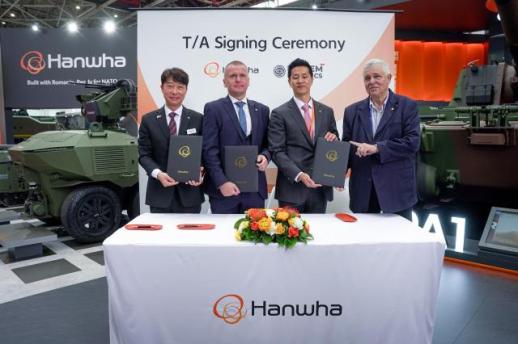 Hanwha Aerospace Partners with Milrem Robotics for Romanian UGV Project Hanwha Aerospace has announced a partnership with Milrem Robotics, a leading European unmanned systems company, to collaborate on unmanned ground vehicle (UGV) projects in Romania. This initiative aims to expand Hanwha's European portfolio, traditionally focused on firepower systems, into the unmanned systems sector, enhancing its competitive edge in future ground warfare markets. On May 14, during the BSDA 2026 international defense exhibition in Bucharest, Hanwha Aerospace signed a cooperation agreement with Milrem Robotics and Hanwha Aerospace Romania (HARO) to jointly participate in UGV projects. In response to evolving security dynamics in Europe, there is a growing demand among European and NATO member countries for versatile unmanned systems, with Romania also pursuing the introduction of next-generation UGVs. Hanwha Aerospace possesses independently developed wheeled UGV platforms, including the Arion-SMET and GRUNT. Milrem Robotics' tracked UGV platform, THeMIS, is recognized globally for its superior off-road mobility, hybrid propulsion system, and capability to integrate various mission equipment. The two companies are also developing a larger tracked UGV platform. Prior to this agreement, Hanwha Aerospace garnered significant interest from Romanian military officials by demonstrating the capabilities of the GRUNT and THeMIS in a manned-unmanned teaming (MUM-T) performance showcase in Romania. Kuldar Väärsi, CEO of Milrem Robotics, stated, "THeMIS is one of the first UGVs to enter mass production in Europe. We aim to contribute to expanding production capabilities in Romania and revitalizing the local defense ecosystem." Lim Kyung-wook, head of Hanwha Aerospace Romania, remarked, "Through this collaboration, we will provide solutions optimized for the Romanian operational environment while expanding our unmanned systems portfolio in the European and NATO markets." Hanwha Aerospace plans to establish local production and supply systems for next-generation unmanned solutions in Romania, thereby expanding its unmanned systems business in the European market. In February, the company broke ground on a local factory (H-ACE Europe) to produce K9 self-propelled howitzers and K10 ammunition supply vehicles, laying the foundation for local production in Europe. H-ACE Europe, located on a site of approximately 180,055 square meters (about 44.5 acres) in the Petresti area of Romania, features advanced assembly lines, performance and verification testing facilities, and a 1,751-meter-long driving test track. The factory is set to produce 54 K9 self-propelled howitzers and 36 K10 ammunition supply vehicles under a contract worth 1.38 trillion won, signed in July 2024. A Hanwha Aerospace official stated, "Through H-ACE Europe, we will establish a comprehensive life-cycle support system, including assembly, integration, testing, and maintenance, and aim to increase the localization rate in Europe to as high as 80% based on local industrial participation."* This article has been translated by AI. 2026-05-15 10:20:11
 -
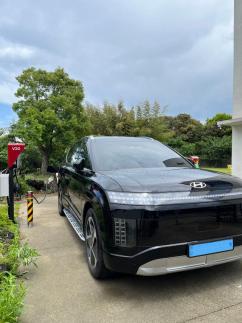 Hyundai Launches V2G Pilot Program for Electric Vehicles in Jeju Hyundai Motor Group announced on May 15 that it will officially launch a Vehicle-to-Grid (V2G) pilot program for general customers in Jeju Island. V2G technology connects electric vehicle (EV) batteries to the power grid, allowing for two-way energy exchange. This approach transforms electric vehicles from mere transportation into strategic assets for energy storage and distribution. The company has been operating a V2G pilot program in collaboration with the mobility platform SoCar since the second half of last year and is now expanding it to include local residents. Forty Jeju residents who own Hyundai's Ioniq 9 or Kia's EV9 and can install V2G bi-directional chargers at their homes or workplaces have been selected as participants. These participants are early adopters with a strong interest in the environmental benefits of V2G technology. Hyundai Group conducted field surveys to ensure a diverse representation of occupations and residences among the final participants. They will receive free installation of the bi-directional chargers and full coverage of EV charging fees during the pilot period. Participants will experience a new form of mobility, utilizing their electric vehicles not just for charging but as 'mobile energy storage systems' (ESS) that can store and supply power. The full implementation of V2G is expected to shift the energy industry from a supplier-centric model to a locally driven economic model. In Jeju, which has a high proportion of wind and solar energy, excess power generated during the day can be stored in electric vehicles and returned to the grid at night, maximizing the utilization and economic viability of renewable energy. Hyundai Motor Group plans to accelerate the development of the domestic V2G ecosystem and industry activation in collaboration with the government and local authorities through this pilot program expansion. A Hyundai Group official stated, "We expect the V2G pilot program, which involves direct participation from the residents of Jeju, to support the realization of local energy production and consumption. It will also play a significant role in achieving Jeju's carbon neutrality vision for 2035." Meanwhile, Jeju is serving as a testbed for carbon neutrality policies, aiming to achieve net-zero emissions by 2035, 15 years ahead of the national target. The island is pursuing various roadmaps to transition its energy production and consumption paradigms. By 2035, Jeju plans to expand its renewable energy generation capacity to 7GW, increasing its share of renewable energy to over 70%. It will also convert existing thermal power plants to hydrogen combustion and co-firing plants. Additionally, the island is testing technologies to promote distributed energy through regulations on new registrations of internal combustion vehicles and the transition of large buses and trucks to hydrogen vehicles, along with V2G initiatives.* This article has been translated by AI. 2026-05-15 09:08:04
 -
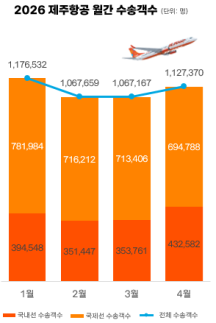 Jeju Air Surpasses 1 Million Passengers for Four Consecutive Months Jeju Air announced on May 14 that it has exceeded 1 million passengers for four consecutive months from January to April this year. According to the Ministry of Land, Infrastructure and Transport's aviation information portal, Jeju Air transported 1,127,370 passengers in April, a 20.3% increase from 936,899 during the same period last year. Domestic flights saw an increase from 387,429 to 432,582, a rise of 11.7%, while international flights grew from 549,470 to 694,788, marking a 26.4% increase. In particular, Jeju Air recorded 1,176,532 passengers in January, 1,067,659 in February, and 1,067,167 in March, making it the only South Korean low-cost carrier (LCC) to achieve over 1 million passengers each month. In April, Jeju Air accounted for 23.8% of the total passengers among nine domestic LCCs, with 25.3% on domestic routes and 23.1% on international routes. The airline's load factor also exceeded the LCC average, with an overall load factor of 91.9% in April, surpassing the LCC average of 89.5% by 2.4 percentage points. Domestic flights achieved a load factor of 97%, while international flights recorded 89.1%. Jeju Air is responding flexibly to travel demand through efficient route operations. Since the start of the winter schedule on October 26 last year, the airline has increased its Incheon-Osaka route from four to seven flights per day. Additionally, as part of a corporate merger remedy, it has utilized all slots allocated for the Gimpo-Jeju route, increasing service to four round trips daily starting March 29. On May 12, Jeju Air began trial operations on the Incheon-Jeju route with two flights per week. Starting June 11, it will launch a new route from Incheon to Kobe, further enhancing its competitiveness on Japanese routes. Jeju Air is accelerating its market share growth by expanding its domestic routes and focusing on medium-haul international flights. The airline plans to adjust its supply of medium-haul routes, which are popular during the summer vacation season, to actively attract passengers during peak periods. As competition among LCCs intensifies, Jeju Air aims to maximize its competitiveness through efficient fleet operations and rapid route restructuring. A Jeju Air official stated, "We are continuing flexible route operations to respond to changes in travel demand due to fluctuations in fuel prices and exchange rates, and we will strengthen our competitiveness through efficient route management even in a volatile market."* This article has been translated by AI. 2026-05-15 03:21:29
 -
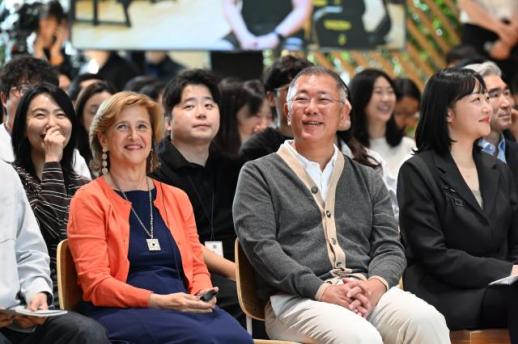 Hyundai's Chung Eui-sun: Labor Conflicts Must Consider National and Corporate Interests As labor unions across various industries, including semiconductors, shipbuilding, biotechnology, and automotive, demand a portion of operating profits as performance bonuses, Chung Eui-sun, Chairman of Hyundai Motor Group, stated that labor disputes should be evaluated considering multiple factors such as national development, shareholders, and the company's growth direction. Speaking to reporters before a renovation event at Hyundai's Yangjae headquarters on May 14, Chung remarked, "Labor and management have had a long-standing relationship. Despite ups and downs, I believe that choosing the right path is essential for the company's efficient growth. We must consider various elements, including shareholder and national development, in our decisions." The Hyundai labor union is demanding that 30% of last year's net profit be distributed as performance bonuses during this year's wage negotiations. They are also calling for a transition to a full monthly salary system instead of an hourly wage to accommodate reduced working hours due to robot implementation, as well as retirement age extensions and a 4.5-day workweek. Similarly, the Kia labor union is advocating for a 30% performance bonus, a 100 million won childbirth incentive, and retirement age extensions. Hyundai Mobis is seeking compensation proposals similar to Hyundai's, along with job security amid controversies surrounding the sale of its ramp division. In this context, demands for primary negotiations from newly established union sub-organizations are also increasing. Chung noted, "Our country has not experienced capitalism for long since the Korean War, so we are currently going through various challenges. I believe we are in a transitional period, and if we navigate this wisely, it could present opportunities for us to lead globally." Regarding robot development, Chung stated, "Hyundai has primarily focused on automobiles and has not ventured into robotics, so we are progressing while learning from our mistakes. Since software is crucial for robots, we are working to balance hardware, and it is essential that the emotional and cultural aspects of our employees are well integrated, which we are paying close attention to." He added, "It is our role as a company to create an environment where talented individuals from engineering and science fields can join and express their ideas. We aim to minimize trial and error and quickly overcome errors to deliver better products swiftly." Chung also expressed concerns about the prolonged conflict in the Middle East. Hyundai began construction of its Saudi Arabian production facility (HMMME) within the King Abdullah Economic City (KAEC) automotive industrial complex last year, aiming for operational readiness in the fourth quarter. Saudi Arabia, which accounts for 35% of total automotive sales in the Middle East, saw Hyundai closely pursue the local leader, Toyota Group, with 140,000 units sold last year. Chung remarked, "As the Iran conflict prolongs, the completion of our Saudi factory may be delayed. While we are worried about a potential decline in Middle Eastern sales, we will prepare thoroughly to ensure we can sell well once the war ends." He emphasized the importance of developing new technologies and improving corporate structure during this highly competitive global automotive market. "It is crucial for Hyundai to excel in developing new technologies and enhancing our capabilities. We will learn from any company that has something to teach us and strive to create products that provide greater customer satisfaction, ensuring we have confidence in the technologies we develop and improving their quality," he stated. Chung reiterated that safety would remain the top priority in the competition for autonomous driving technology. He acknowledged that companies like Tesla and Waymo are advancing rapidly in this area, stating, "Hyundai will also deploy 200 vehicles in Gwangju as a preliminary step. While we can address technological shortcomings, the most important factor is safety. We will focus on customer safety in our development, even if it means being a bit slower." * This article has been translated by AI. 2026-05-14 15:57:48
 -
 Hyundai Motor's Yangjae Headquarters Reopens as a Hub for Human-Robot Collaboration "Let’s collaborate more, lower barriers, and work in an open manner." Chung Eui-sun, Chairman of Hyundai Motor Group, made these remarks on May 14 during the 'Lobby Story Town Hall' event at the Yangjae headquarters. He noted that the lobby renovation stemmed from a desire to build on the experiences, achievements, and ideas accumulated at the Yangjae headquarters. "This initiative began with a goal to change our work environment to foster innovation, and I believe we have achieved a satisfactory result," he said. ◆ Renovated after nearly two years: An open plaza for employee communication Hyundai Motor Group's Yangjae headquarters has served as the group's control tower since 2000, symbolizing the foundation of its growth. The renovation, which began in May 2024 and took about two years to complete, centers on the philosophy of 'communication.' The lobby has been redesigned into an open plaza for employees, covering approximately 36,000 square meters, equivalent to the size of five soccer fields, spanning from the basement to the fourth floor. The event took place in the newly created tiered lounge, 'Agora,' where Chung and other key executives, including Vice Chairman Jang Jae-hoon and Presidents Seo Kang-hyun, Choi Jun-young, Sung Kim, and Park Min-woo, gathered with those involved in the lobby's design. Chung emphasized that "short conversations can lead to new ideas, and sharing information can facilitate better outcomes. I hope this project will change our working environment and, consequently, our working methods." Chung pointed out that 'Yangjae' means 'land where virtuous talents gather,' expressing hope that the talented individuals at the headquarters will naturally interact in the lobby and various spaces, leading to greater achievements. He added, "To better understand our customers, we need to be more flexible. Let’s collaborate more, lower barriers, and work in an open manner." ◆ Creating a people-centered plaza: Chung emphasizes the power of reflection The lobby renovation was undertaken by Studios Architecture, a global architecture and interior design firm. The core concept of the renovation is a 'plaza for freely exchanging ideas.' Hyundai Motor Group has restructured the space while preserving the essence and framework of the Yangjae headquarters, focusing on the values of connection and collaboration. The first-floor lobby features a tiered lounge called Agora, inspired by ancient Greek plazas, designed to encourage employees to gather naturally. Surrounding Agora are the 'Connect Lounge' for meetings and relaxation, an 'Open Stage' for exhibitions, and a café with an outdoor garden, all interconnected with seating and tables for communication. To create a bright and inviting atmosphere, the lobby utilizes a vertically open atrium from the first to the third floor, filled with plants and trees. Notably, the design includes harmonious indoor landscaping in collaboration with Professor Jung Young-sun, a pioneer in Korean landscape architecture, providing employees with a space to pause and reflect. In line with Hyundai Motor Group's goal to become a leader in human-centered physical AI, a robot station has been installed on the first floor, creating a high-tech lobby environment where employees and robots coexist. Robots such as the 'DAL-e Gardener' for landscaping, 'DAL-e Delivery' for deliveries, and 'SPOT' for protocol and security have been introduced. Alexandra Villegas Sanne, design director at Studios Architecture, explained, "Most companies ask for impressive lobbies that serve as brand showrooms, but Hyundai Motor Group wanted a space centered on people from the start. They desired a living plaza where people actually gather, meet, and share ideas, and we focused on that in our design." Chung concluded, "Brilliant ideas that enable innovation and change rarely emerge when confined to one place. Innovation often arises from brief conversations, chance encounters, or quiet moments of reflection. I hope this lobby renovation will facilitate more active collaboration on-site."* This article has been translated by AI. 2026-05-14 13:57:23
 -
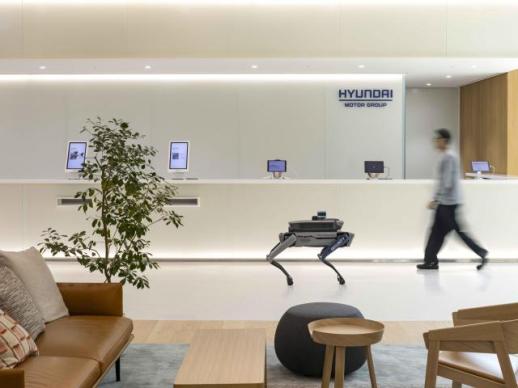 Hyundai Motor's Yangjae Office Transformed into Robot-Friendly Building The lobby, designed with a glass ceiling, resembles a vast "indoor garden." The vertical space from the first to the third floor is filled with large trees and plants, making it hard to distinguish whether it is an office or a park. This perfect landscaping is maintained by the watering robot "DAL-e." DAL-e travels throughout the expansive lobby, watering plants and automatically recharging in a designated rest area at scheduled times. When afternoon meetings begin, a delivery robot brings dozens of coffee cups to summoned employees. Meanwhile, Spot patrols the premises, monitoring for fire and security risks. This harmonious coexistence of humans and robots is part of Hyundai Motor Group's newly remodeled Yangjae office. Hyundai Motor and Kia announced on May 14 that they have redesigned their Yangjae office in Seoul into a robot-friendly building, launching three types of services: a watering robot, a delivery robot, and a security robot. The newly introduced robots include the watering robot "DAL-e Gardener," the delivery robot "DAL-e Delivery," and the security robot "Spot." The initiative reflects the companies' commitment to creating an environment where employees can coexist with robots while performing their daily tasks, advancing their goal of becoming a leader in physical AI. DAL-e Gardener assists in maintaining the landscaping by supplying water to various plants throughout the office. It uses multiple sensors to gather information and recognizes the space in three dimensions, distinguishing between plants, soil, and flower beds. The robot arm can move up and down and rotate in six axes to spray water accurately. If the water stored in the robot runs low, it communicates with the building's water supply system to automatically refill, while also draining any remaining water to maintain cleanliness, minimizing the need for human intervention. DAL-e Delivery also began operations, delivering beverages from the first-floor café to designated pickup zones on each floor. Employees can order drinks via a mobile app, and DAL-e retrieves the beverages and delivers them to the requested location. It can carry up to 16 drinks simultaneously and features a facial recognition system for accurate delivery. The robot autonomously navigates complex spaces, avoiding obstacles as it moves. The security robot Spot, developed by Boston Dynamics, has been equipped with an autonomous driving module created by Hyundai and Kia's Robotics Lab. This module allows Spot to recognize its surroundings and navigate autonomously, patrolling the building and performing security duties. The Yangjae office features a robot-friendly environment with dedicated waiting areas and elevators for robots. The three types of robots automatically recharge at a designated robot station on the first floor when their battery levels are low, and they can perform tasks independently while using the dedicated elevators to move between floors. In addition to the robots, Hyundai and Kia have implemented a facial recognition system called "Facey" throughout the building to streamline access security procedures. The delivery robot DAL-e Delivery is integrated with Facey to identify the orderer without requiring separate authentication. An integrated control system called "NARCHON" manages the various robots. Robot managers can access NARCHON via a web app from anywhere, allowing them to monitor the location, status, and charging information of registered robots in real time. They can also easily adjust robot schedules and control their locations, enabling efficient operation of multiple robots. Through these efforts, the Yangjae office has received technical verification from UL Solutions, a global safety certification organization, confirming its suitability as a robot-friendly building. Chung Euisun, chairman of Hyundai Motor Group, stated, "As a company that plans and produces various robots, we have deployed actual robots so that employees can naturally encounter them in their workspaces. I expect this will create a positive feedback loop that allows us to directly experience the changing world and enhance our group's robotic technology competitiveness, leading to better product development." He added, "In the future, the Yangjae office will serve as a testbed for improving the performance of more robots developed by Hyundai Motor Group, and I hope employees will gain inspiration for innovative ideas."* This article has been translated by AI. 2026-05-14 13:50:59
 -
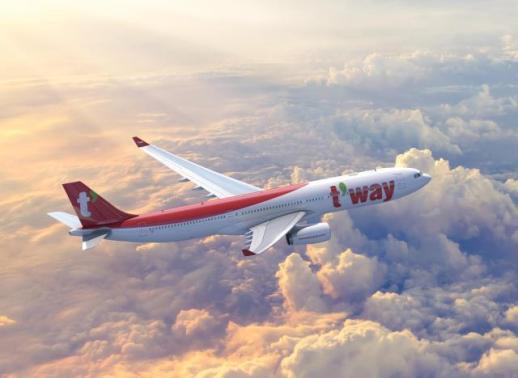 T'way Air returns to black in Q1, ending two years of losses SEOUL, May 13 (AJP) - Budget carrier T'way Air posted an operating profit of 19.9 billion Korean won (US$14 million) in the first quarter of this year, returning to the black for the first time in eight quarters. In a preliminary report released on Wednesday, the airline posted first-quarter revenue of 612.2 billion won, up about 37 percent from a year earlier, and an operating profit of 19.9 billion won, marking its first return to the black after eight consecutive quarters of losses. The airline attributed the turnaround to strong demand on domestic and short-haul routes linking cities in Japan and Taiwan, as well as increasing passenger numbers on longer-haul routes to Europe, Australia, and the Americas. T'way Air is also expanding its fleet. The airline, which currently operates 49 aircraft, added two Boeing 737-8 jets in the first quarter and plans to gradually acquire more fuel-efficient, lower-emission aircraft such as the Airbus A330-900neo later this year. Its cargo business is also growing, with total cargo volume reaching about 9,000 metric tons in the first three months of this year. The airline said the planned procurement of larger aircraft is expected to further expand cargo capacity. It also said it is making efforts to strengthen its safety and operations systems including the construction of its own aircraft maintenance facility and hangar at Incheon International Airport. "The acquisition by Sono Trinity Group helped us restructure our operations and sharpen our competitiveness," said a T'way Air spokesperson. "Safety would remain our top priority as we work to improve our services." Following the acquisition by the leisure and infrastructure company early last year, the airline recently agreed at a shareholders’ meeting to rename itself Trinity Airways. But its new name and logo will take effect only after approval from relevant aviation authorities. 2026-05-13 14:19:17