
Journalist

Joonha Yoo
joonhayoo94@ajupress.com
-
 Red Velvet's Irene to roll out first solo studio album 'Biggest Fan' SEOUL, March 30 (AJP) -Irene, the leader of K-pop girl group Red Velvet, will release her first full-length solo album "Biggest Fan" on Monday, her agency SM Entertainment said. The album will be released at 6 p.m. (0900 GMT) through major music platforms, along with the music video for the title track of the same name. Red Velvet is a five-member South Korean girl group that debuted in 2014 under SM Entertainment. The dance-pop band is widely regarded as one of the leading acts of K-pop’s third generation. Red Velvet gained mainstream popularity with songs such as "Russian Roulette," "Psycho," "Feel My Rhythm," and "Cosmic." Irene, born March 29, 1991, is the leader, eldest member, and main rapper of the group. The 10-track album is led by the title song "Biggest Fan," alongside tracks including "Don’t Wanna Get Up," "Wasteland," "Black Halo," and "Million Miles Away." Irene described the album as a statement of self-belief, saying, "I am my biggest fan." Ahead of the release, Irene will host a special live broadcast at 5 p.m. through her official YouTube and TikTok channels. 2026-03-30 17:31:28
 -
 Cliché or not, BTS "Arirang" rework delivers globally SEOUL, March 30 (AJP) - RM winces. When the first draft of “Body to Body” lands with a bold Arirang sample layered toward the end, the BTS leader isn’t convinced. It feels, he says, almost too obvious — like “mixing bread, pork cutlets and kimchi” into one plate, a blend leaning too heavily on sentiment. Jimin laughs it off. Strange as it sounds, he says, the mix “may taste very good.” J-Hope leans further in: if they’re going to borrow Arirang, why not go all the way? That tension — between subtlety and statement, between global polish and unmistakable roots — sat at the heart of BTS’ return, captured in a Netflix documentary released last Friday. The boys, now men after completing full military service, are shown grappling with a quieter anxiety: how they would be received after a nearly four-year hiatus. With ARIRANG, the K-pop juggernaut doesn’t just stage a comeback. It recalibrates. The idea of Arirang, Korea’s most enduring folk song, emerged during a creative bottleneck as the group camped in Los Angeles for two months, searching for direction. Its weight was immediate. One of the earliest known recordings dates back to 1896, when Korean students at Howard University etched the melody onto a wax cylinder. That moment resurfaces in the album’s animated teaser — those students now mirrored by a global audience listening to BTS sing in Korean more than a century later. Still, the debate lingered. Was it too nationalistic? Too deliberate? Hybe chairman Bang Si-hyuk pushed back. An act like BTS, he reminded them, comes once in decades — and there is no escaping identity. “You’re Korean,” he said, plainly. What emerges is less a nostalgic return than a layered reexamination. If “Body to Body” wears its Arirang sample openly, other tracks take a quieter route. In “Aliens,” RM invokes Kim Gu — the independence-era leader who envisioned Korea as a cultural power rather than a military one — not as a history lesson, but as a question. How would that vision read today? Even musically, tradition is reframed rather than reproduced. Elements of jungmori jangdan are woven into contemporary structures — not quoted, but translated. “Body to Body” itself operates on multiple levels. On the surface, it’s built for the stage — “I need the whole stadium to jump” — a call to collective movement. Beneath that, the imagery expands: bodies gathering, standing together, responding. References to “guns, knives and keyboards” blur physical conflict with digital confrontation, reflecting a world where connection — and tension — unfold both online and off. The song resists a fixed meaning, allowing contradictions to coexist. That duality shapes the album. At its center is the resonant toll of the Bell of King Seongdeok, dividing the record into two halves. The first leans outward — performance-driven, built for crowd response. The second turns inward, lingering in unresolved emotion. Tracks like “Body to Body,” “Hooligan” and “FYA” pulse with repetition and shared energy. Others — “SWIM,” “Merry Go Round,” “NORMAL” — resist resolution, allowing tension to remain. The contrast is deliberate. It traces the gap between performance — and what performance cannot resolve. The timing matters. During BTS’ hiatus, the global music landscape shifted. New acts emerged, and competition within K-pop intensified. Against that backdrop, ARIRANG does not attempt to reclaim old ground. It redraws it. Some critics see the album’s emphasis on Korean identity as a clearer articulation of origin in a global arena. Others view it as selective — a strategic layering rather than a constant thread. Even the visuals reflect that balance: a comeback staged at Gwanghwamun, a performance video filmed at a historic hanok once tied to the founding family of SK Group. Calculated — or simply intentional. On the charts, the response is unequivocal. ARIRANG debuts at No. 1 on the Billboard 200, marking BTS’ seventh chart-topper. The album opens with 641,000 equivalent units — the biggest week for a group in over a decade, including more than half a million in pure sales. For a group returning after years of individual pursuits and an industry that has moved on without them, the heritage-driven pivot appears to have paid off. 2026-03-30 15:55:09
 -
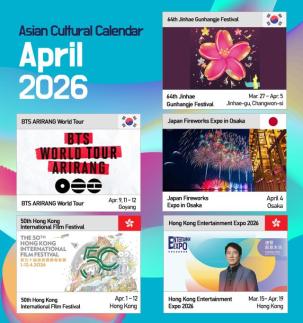 Asian Culture Calendar SEOUL, March 30 (AJP) - South Korea Mar. 27 - Apr. 5 64th Jinhae Gunhangje Festival Apr. 9, 11-12 BTS ARIRANG World Tour Apr. 3 - 7 Yeongdeungpo Yeouido Spring Flower Festival Apr. 4 - 12 Wangin Festa Apr. 30 - May. 6 Seoul Spring Festa Japan Apr. 4 Japan Fireworks Expo in Osaka Mar. 19 - Apr. 19 Nijo Castle Sakura Festival Apr. 1 - 5 Beppu Onsen Festival Apr. 9 - 17 Nagahama Hikiyama Festival Hong Kong Apr. 11 - 30 Global Sources Hong Kong Show Apr. 1 - 12 50th Hong Kong International Film Festival Mar. 15 - Apr. 19 Entertainment Expo 2026 Apr. 17 - 19 Hong Kong Sevens 2026 Singapore Apr. 22 - May. 2 Roald Dahl's THE BFG 2026-03-30 15:42:07
 -
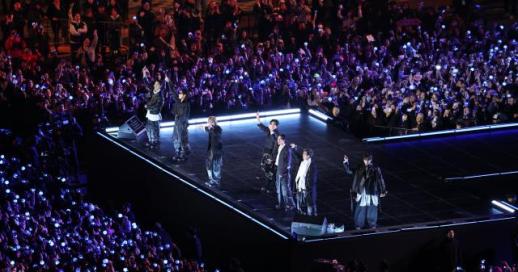 BTS returns to No. 1 on Billboard 200 With 'ARIRANG' SEOUL, March 30 (AJP) - BTS has claimed the top spot on the Billboard 200 with ARIRANG, the group's fifth studio album, earning 641,000 equivalent album units in its first week, the largest opening for a group album since the chart adopted unit-based tracking in December 2014, Billboard reported Sunday. The Billboard 200 ranks albums based on physical and digital sales, streaming activity converted into album units, and track-equivalent albums. Of that total, 532,000 came from pure album sales, the biggest sales week for a group in more than a decade. Physical sales accounted for 516,000 units, driven by a release configuration of 17 vinyl variants and nine CD editions. Vinyl alone tallied 208,000 units, the strongest vinyl sales week ever recorded for a group in the modern era. The achievement marks BTS's seventh No. 1 on the Billboard 200, extending a run that began in 2018 when LOVE YOURSELF Tear became the first K-pop album to top the chart. ARIRANG was released March 20 alongside a Netflix live special and lead single "SWIM." The group followed with back-to-back appearances on The Tonight Show Starring Jimmy Fallon on March 25 and 26. A supporting world tour opens April 9 in Goyang, South Korea, with the North American leg running from April 25 through Sept. 6. 2026-03-30 08:41:00
 -
 Asian stocks drift lower as Iran conflict drags on, AI memory jitters weigh SEOUL, March 27 (AJP) - Asian equities ended the week on a subdued note as the Iran conflict stretched into a month-long standoff, while fresh concerns over AI-driven memory demand added another layer of uncertainty for investors. Brent crude rose 1.5 percent to $109.5 per barrel and West Texas Intermediate gained 0.9 percent to $95.3, keeping pressure on energy-importing economies already strained by prolonged geopolitical risks. Regional markets moved in mixed directions. Japan’s Nikkei 225 fell 0.4 percent to 53,373.1, while China’s Shanghai Composite rose 0.6 percent to 3,913.8. Hong Kong’s Hang Seng Index gained 0.7 percent to 25,023.6, supported by improving economic signals from China and expectations of further policy support. Global risk sentiment remained fragile. The Philadelphia Semiconductor Index tumbled 4.8 percent, while the VIX jumped 8.3 percent to 27.4, underscoring elevated volatility. In Seoul, the benchmark KOSPI slipped 0.4 percent to close at 5,438.9, recovering from early losses that briefly pushed the index toward the 5,200 level. Retail investors helped cushion the decline despite heavy foreign outflows. Foreign investors sold 3.88 trillion won ($2.58 billion), extending their selling streak, while institutions and retail investors bought 777.7 billion won and 2.71 trillion won, respectively. Foreigners have offloaded nearly 30 trillion won so far this month, including more than 10 trillion won this week alone, highlighting persistent external pressure on Korean assets. Chipmakers remained under strain. Samsung Electronics edged down 0.2 percent to 179,700 won, while SK hynix fell 1.2 percent to 922,000 won, as concerns grew over emerging AI compression technologies that could dampen future memory demand. The latest trigger came from Google’s unveiling of “TurboQuant,” a data compression algorithm designed to significantly reduce the working memory requirements of AI systems without sacrificing performance. If widely adopted, the technology could challenge the growth trajectory of high-bandwidth memory chips that have driven recent earnings momentum for Korean chipmakers. By contrast, autos and battery shares showed resilience. Hyundai Motor rose 1 percent to 495,000 won, while LG Energy Solution gained 2.6 percent to 394,500 won on expectations of expanding demand beyond electric vehicles, particularly in energy storage systems. Over the week, the KOSPI swung sharply, rising from 5,405.75 on March 23 to 5,642.21 on March 25 before retreating to 5,460.46 on March 26 and ending at 5,438.9 on Friday. The tech-heavy KOSDAQ rose 0.4 percent to 1,141.5, rebounding from earlier losses. Foreign investors sold 234 billion won, while institutions and retail investors bought 50.7 billion won and 170.0 billion won, respectively. Biotech stocks led gains, though Samchundang Pharm fell more than 4 percent after recent rallies, closing at 1,111,000 won. The Korean won weakened, with the dollar closing at 1,505.3 won after briefly breaching the 1,510 level intraday, reflecting sustained external pressures tied to oil prices and capital outflows. 2026-03-27 17:14:15
 -
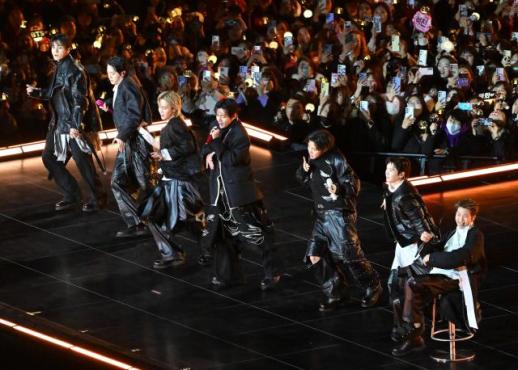 Foreign attendees account for 25% at BTS comeback show in Seoul SEOUL, March 27 (AJP) - About one in four attendees at BTS’ comeback performance in central Seoul on March 21 were foreign nationals, according to city data on Friday. The Seoul Metropolitan Government estimated that 75,927 people were present in the Gwanghwamun, Deoksugung and City Hall station areas between 8 p.m. (1100 GMT) and 9 p.m. during the concert, including 19,170 foreign nationals, or roughly 25 percent. By nationality, Thai nationals made up the largest group at 1,740, followed by Vietnamese (1,184), Indians (1,126) and Japanese (1,098). Among foreign nationals, long-term residents, defined as those staying in Korea for over 91 days, accounted for 13,889 people, outnumbering short-term visitors at 5,281. The figures were derived from the city’s "Living Population" dataset, which estimates the number of people in a given area using aggregated mobile network data in 250-square-meter units, combined with immigration records to assess the scale and nationality of foreign residents and visitors. Separate estimates from the city’s real-time urban data platform placed the number of people in the area at between 46,000 and 48,000 at around 8:30 p.m. on the day of the event. The real-time figures exclude foreign visitors not using roaming services and are therefore less comprehensive than the delayed living population dataset. 2026-03-27 10:58:50
 -
 Asian stocks fall on oil surge; Korea slides as "wartime" response fails to convince SEOUL, March 26 (AJP) — Asian equities fell across the board Thursday as oil prices hovered near the $100-per-barrel threshold and geopolitical tensions deepened, with Seoul markets brushing off the government’s so-called “wartime” response. Despite tentative talk of an endgame to the Middle East conflict, markets showed little conviction. Risk aversion held firm across the region. Japan’s Nikkei 225 slipped 0.3 percent to 53,603.7, China’s Shanghai Composite fell 1.1 percent to 3,889.1, Hong Kong’s Hang Seng dropped 2.1 percent to 24,804.8 and Taiwan’s TAIEX edged down 0.3 percent to 33,337.6. But the heaviest selling pressure landed in Seoul — a clear vote of no confidence in the government’s emergency package. The benchmark KOSPI plunged 3.2 percent to close at 5,460.5, after swinging between an intraday high of 5,598.4 and a low of 5,448.1, reflecting a familiar pattern of institutional and foreign selling met by retail dip-buying. Foreign investors dumped 3.09 trillion won ($2.10 billion), with institutions offloading an additional 339 billion won. Retail investors stepped in as the sole net buyers, purchasing 3.05 trillion won. The tech-heavy KOSDAQ fell 2.0 percent to 1,136.64, with foreigners selling 301.6 billion won and institutions shedding 134.1 billion won, while retail investors bought 484.9 billion won. Heavyweight tech names led the decline. Samsung Electronics dropped 4.7 percent to 180,100 won and SK hynix slid 6.2 percent to 933,000 won, as concerns mount over a slowdown in AI-driven investment. Hyundai Motor fell 2.2 percent and LG Energy Solution lost 2.4 percent. The government said it had deployed “all possible policy means and mix,” ranging from deeper fuel tax cuts to supplementary budgeting and bond market stabilization measures. Markets, however, were unconvinced — reading the package less as decisive intervention than as a sign policymakers are running short on options beyond short-term fixes. That skepticism was most visible in the bond market. The buyback offered only a modest lift to short-dated debt while triggering a selloff at the long end, effectively flipping the policy signal on its head. The two-year government bond yield fell 2.2 basis points to 3.489 percent, with the three-year largely unchanged at 3.552 percent. Further out the curve, yields surged: the 20-year rose 3.9 basis points to 3.880 percent and the 30-year climbed 4.6 basis points to 3.762 percent — a steepening move that signals investors are demanding higher long-term risk premiums despite near-term liquidity support. In effect, the market is pricing in persistent inflation and supply-side risks tied to the oil shock, even as authorities attempt to contain immediate volatility. The Korean won weakened to 1,507 per dollar, reinforcing the broader risk-off mood. 2026-03-26 18:14:36
 -
 BTS comeback detonates across screens, streets and systems within a week SEOUL, March 26 (AJP) — It has been barely a week since BTS dropped its first full-member studio album in six years and staged a comeback performance in downtown Seoul livestreamed to nearly 20 million viewers on Netflix — and the aftershock is already everywhere. The group has not paused for breath. Fans across the world are flooding platforms with dance challenges to the title track “SWIM,” its hypnotic hook now echoing from smartphones to city streets. What would normally take weeks to build has unfolded in days. Within that span, BTS cycled through a tightly orchestrated global rollout — a fan event in New York, real-time engagement on YouTube and a late-night television appearance — compressing what used to be a promotional arc into a continuous surge. Following their appearance on The Tonight Show Starring Jimmy Fallon, clips spread at viral velocity. The interview alone drew a combined 750,000 views within two hours, while performance videos surpassed 320,000 views and 90,000 likes in the same narrow window. The March 21 performance at Gwanghwamun Square entered Netflix’s weekly Top 10 in 80 countries, ranking No. 1 in 24, while generating 2.62 billion impressions across social media — a scale that underscores not just reach, but saturation. The numbers reveal something more structural beneath the frenzy. On music platforms, the album Arirang surpassed 4.06 million in sales within days. Streaming patterns show the lead track “SWIM” topping 68 million plays, while multiple B-sides followed closely, each pulling between roughly 29 million and 38 million streams — a distribution that suggests engagement is spreading across the album rather than concentrating on a single hit. Video platforms show a parallel dynamic. The official “SWIM” music video crossed 68 million views within six days, while a performance clip uploaded midweek added another 7 million in rapid succession. Together, the data points to a dual-track ecosystem — one driven by passive viewing, the other by active participation. That shift is already visible on the ground. “The choreography is everywhere right now. As soon as the performance video dropped, people started copying it,” said Kang Na-eun, a 29-year-old elementary school teacher in Seoul’s Mapo district. “I’ve never seen it spread this fast.” “Usually it takes time for something like this to circulate, but this time it feels instant. It’s not just something you watch — it’s something you feel pulled into,” she added. Even machines have joined the wave. AI-generated dance clips — from animated dogs to stylized avatars — are circulating alongside fan covers, some drawing over 1.5 million views within days. What began as imitation has quickly morphed into reinterpretation, with algorithms now reproducing and remixing choreography at a speed comparable to human fandom. The boundary between audience and creator is dissolving in real time. Geographically, the comeback has expanded just as rapidly. Less than 24 hours after the Gwanghwamun performance, BTS was airborne to the United States — moving from a public square in Seoul to a Spotify-hosted event in New York, and then to American late-night television. The sequence reads less like a tour and more like a synchronized relay across platforms and continents. Taken together, the rollout illustrates how K-pop releases are no longer singular events but engineered continuums — designed to sustain momentum across formats, time zones and modes of engagement. But the scale has also invited scrutiny. “From the moment the album took the name ‘Arirang,’ it carried expectations beyond music,” said critic Jang Jun-hwan. “Attention was focused as much on what it represents as on what it sounds like.” He added that while the production is expansive, cohesion is less certain. “The album is highly refined, but many tracks feel individually polished rather than fully integrated.” Music critic Kim Do-heon framed the shift more bluntly. “What this comeback shows is that the phenomenon surrounding the music — performance, scale, context — is becoming as important as the music itself,” he said. That phenomenon has spilled into the physical city. In central Seoul, the Gwanghwamun performance triggered traffic controls, safety installations and large-scale crowd management — temporarily reshaping how the capital functions. “When a cultural event begins to alter the operation of a city, it raises questions about public space itself,” Kim noted. In the span of a single week, BTS’s comeback has moved across screens, systems and streets — unfolding not as a moment, but as a rolling event that continues to expand even after the stage lights dim. 2026-03-26 18:14:28
 -
 Asian stocks climb as easing Middle East tensions push oil prices lower SEOUL, March 25 (AJP) - Asian stock markets rose broadly on Wednesday as tensions around the Strait of Hormuz were somewhat eased, pushing oil prices lower, lifting sentiment across the region. The move followed comments from U.S. President Donald Trump the previous day, signaling progress in peace negotiations with Iran, raising expectations for a possible end to the conflict in the Middle East and also reducing fears of disruptions to global energy supplies. Brent crude hovered near US$100 per barrel, while West Texas Intermediate traded around $93, providing relief to energy-importing economies. Across Asia, markets moved in tandem. Japan's Nikkei 225 surged 2.9 percent, Taiwan's TAIEX climbed 2.54 percent, while China's Shanghai Composite and Hong Kong's Hang Seng rose 1.3 percent and 0.6 percent, respectively, reflecting a renewed appetite for risk assets. In Seoul, the benchmark KOSPI rose 1.6 percent to close at 5,642.2 points, extending gains after fluctuations throughout the day's trading session. Institutional investors drove the rally, buying 2.32 trillion won ($1.5 billion), while foreign investors sold 1.29 trillion won and retail investors offloaded 1.33 trillion won. The divergence showed that offshore investors are still cautious, while domestic institutional investors supported the market, meaning the rebound was driven more by local liquidity than a full return of foreign investors. Technology shares showed mixed. Samsung Electronics slipped 0.4 percent to 189,000 won, while SK hynix edged up 0.9 percent to 995,000 won, supported by expectations of continued strength in AI-driven memory demand. Technology shares were mixed. Samsung Electronics slipped 0.4 percent to 189,000 won, while SK hynix edged up 0.9 percent to 995,000 won, supported by expectations of continued strength in artificial intelligence (AI)-driven memory demand. Autos and platform stocks moved higher, with Hyundai Motor rising 1.8 percent to 501,000 won, NAVER gaining 0.9 percent to 215,500 won and Kakao advancing 1.8 percent to 49,050 won. Battery maker LG Energy Solution added 0.4 percent. The tech-heavy KOSDAQ outperformed, jumping 3.4 percent to 1,159.6 after touching a high of 1,160.1. Foreign investors led buying on the secondary board, purchasing 373.4 billion won, as institutions added 12.3 billion won, while retail investors sold 381.1 billion won. Gains were concentrated in high-beta and growth-oriented names. Samchundang Pharm surged 19.3 percent on continued optimism over its oral insulin development, while Pearl Abyss jumped 23.3 percent following strong global sales momentum for its new releases. Hanwha Systems also rose 7.3 percent on expectations of expanding aerospace and defense cooperation. Despite the broad rally overall, underlying risks remained. The Korean won stayed near the 1,500 level against the dollar, while the VIX, a real-time market indicator that measures the market's expectation of 30-day forward-looking volatility, rose to 26.95, signaling elevated market volatility. Despite the broad rally overall, underlying risks remained. The Korean won stayed near the 1,500 level against the dollar. The VIX, a real-time indicator that measures the market's expectation of 30-day volatility, rose to 26.95, suggesting lingering geopolitical concerns and continued global uncertainty. 2026-03-25 17:29:23
 -
 BTS live return takes world by storm, album tests "creative mettle" SEOUL, March 25 (AJP) - The livestreamed BTS open-air stage performed before more than 100,000 people in Gwanghwamun for a comeback after a four-year hiatus drew 18.4 million viewers, according to Netflix, marking one of the largest synchronized global concert events to date as the group returned with its first studio album in six years Arirang,” described by The New York Times as “a raucous test of its creative mettle amid rapidly changing genre norms." The performance entered Netflix’s weekly Top 10 in 80 countries and ranked No. 1 in 24, with viewers across time zones tuning in simultaneously, turning the Seoul stage into a shared global broadcast. RM, Jin, SUGA, j-hope, Jimin, V and Jung Kook took the stage at “BTS THE COMEBACK LIVE | ARIRANG” in central Seoul before extending the momentum overseas and two days later headlined a second event at Pier 17 in New York. Held atop a rooftop venue overlooking the East River, the Pier 17 showcase gathered around 1,000 invited fans selected through Spotify streaming data — many already chanting lyrics and replicating choreography to songs released only days earlier. Online response scaled in parallel. The campaign generated more than 2.62 billion impressions across Netflix-owned channels, with related hashtags trending across the United States, South Korea and major markets in Asia, Europe and Latin America. The rollout highlights a shift in K-pop’s delivery model, combining large-scale physical concerts with streaming platforms and data-driven fan targeting to extend reach beyond geography. The music itself is drawing scrutiny alongside the scale. In a Critic’s Pick review, The New York Times described the album “Arirang” as “a raucous test of its creative mettle amid rapidly changing genre norms,” positioning the release as both a commercial milestone and an artistic checkpoint. The review notes the album’s maximalist structure and genre shifts, framing it as a project balancing experimentation with the demands of global success and the expectations surrounding BTS and its agency Hybe. Netflix is set to release a documentary, “BTS: THE RETURN,” offering a behind-the-scenes look at the reunion, album production and stage preparation, extending the narrative beyond the live performances. Ultimately, the comeback reflects both scale and uncertainty. As the New York Times review concludes, beneath the group’s vast commercial machinery may still lie “a work of odd and satisfying art” — suggesting BTS’ return is not only a global event, but also an open question about how far it can stretch creatively within its own success. 2026-03-25 09:11:47