
Journalist

Lee Nak-yeon
nakk@ajunews.com
-
 Hanwha Ocean Teams With Leidos’ Gibbs & Cox to Speed U.S. Naval Shipbuilding Push Hanwha Ocean is partnering with a U.S. defense contractor long associated with U.S. Navy ship design standards as it accelerates its push into the American naval shipbuilding market. Hanwha Ocean said it signed a memorandum of understanding with Leidos’ Gibbs & Cox on April 21 local time at SAS 2026 (Sea-Air-Space 2026) in Maryland. The company announced the agreement on April 22. Under the MOU, the two sides agreed to work on: designs tailored to U.S. Navy specifications; joint development of next-generation vessels; building a supply chain using production bases in the United States and South Korea; and advancing ship designs aimed at efficient production and long-term maintenance. Hanwha Ocean said the agreement creates a practical joint front with Gibbs & Cox to strengthen competitiveness in U.S. Navy shipbuilding programs and in global naval vessel projects. Gibbs & Cox, a key Leidos affiliate, has a leading position in naval design and has designed more than 70% of U.S. Navy surface combatants since World War II, Hanwha Ocean said. The company said Gibbs & Cox is regarded as a top partner because it understands and implements U.S. Navy operational requirements and technical specifications. Hanwha Ocean said it aims to build a success story in the United States that surpasses the example of Italy’s Fincantieri establishing itself in the market. Gibbs & Cox is known to have played a key role as a partner when Fincantieri entered the U.S. naval ship market. Hanwha Ocean said Fincantieri successfully settled into the market through cooperation with Gibbs & Cox while carrying out the Constellation-class frigate and Freedom-class littoral combat ship programs. Eo Seong-cheol, head of Hanwha Ocean’s special ship business division, said the agreement would help the company secure a firm technological advantage not only in the U.S. market but also worldwide. “Through cooperation with Leidos, a leading U.S. defense company, we will accelerate our entry into the global maritime defense market and deliver visible results,” Eo said. * This article has been translated by AI. 2026-04-22 09:00:56
 -
 South Korea closes gap with China in global shipbuilding orders SEOUL, April 6 (AJP) - Despite an overall decline in global ship orders, South Korea increased its share last month, narrowing the gap with China, according to data released by London-based Clarkson Research Services on Monday. In March, South Korea won orders totaling 1.59 million compensated gross tons (CGT) for 38 ships, accounting for about 39 percent of the global market, while China secured 2.15 million CGT for 84 ships, taking a 53 percent share. In February, South Korea's share was just 11 percent, compared with China's 80 percent. Global ship orders reached 4.06 million CGT for 135 vessels, down 36 percent from February's 6.38 million CGT, but up 31 percent from a year earlier. Clarkson's index measuring the cost of building new ships stood at 182.07 in March, down 0.07 percentage points from the previous month, but it is considered very high. By type of vessels, prices were $248.5 million for a liquefied natural gas (LNG) carrier, $129.5 million for a very large crude carrier, and $260 million for an ultra-large container ship. 2026-04-06 11:18:52
 -
 Seoul Debuts BTS Comeback Video Displays From Gwanghwamun to DDP BTS comeback videos and welcome messages appeared around Gwanghwamun Square at 7 p.m. on the 20th, one day before the group’s concert. The Seoul Metropolitan Government said it premiered BTS-related videos and Korean- and English-language welcome messages on 10 large outdoor screens on buildings near Gwanghwamun Square. The videos will run until midnight on the 21st, when the concert is scheduled. The newly released “BTS The City Arirang Seoul” is a two-minute video showing the members walking through major Seoul landmarks while holding lanterns. The video follows a day-to-night progression, starting at Sungnyemun and moving across the city. The video is broadcast on media facades at 10 sites: the Haechi Madang media wall, Atelier Gwanghwa, the National Museum of Korean Contemporary History, KT Square, Segwang Building, Dajeong Building, Ilmin Museum of Art, Koreana Hotel, The Dong-A Ilbo and Seoul Shinmun. It airs at 5, 25 and 45 minutes past each hour. The three public platforms — the Haechi Madang media wall, Atelier Gwanghwa and the National Museum of Korean Contemporary History — show silhouette-based graphics, while the other seven screens play live-action footage. Alongside the video, the message “서울 광화문광장에서 BTS 컴백을 환영합니다” and its English version, “Welcome back BTS at Gwanghwamun Square in Seoul,” is also displayed. Separately, Dongdaemun Design Plaza will host “DDP Music Light” from the 20th through April 12. Centered on the new album “Arirang,” the event links music and light with a media show of about three minutes, held daily from 7 p.m. to 10 p.m. at 30-minute intervals. Choi In-gyu, director general for design policy at the Seoul Metropolitan Government, said the city aims to develop Seoul’s nights into new cultural content that combines K-culture and urban culture, offering global fans “new experiences, emotion and enjoyment.” He said the BTS comeback show would be used as an opportunity to highlight Seoul to the world again.* This article has been translated by AI. 2026-03-20 19:36:19
 -
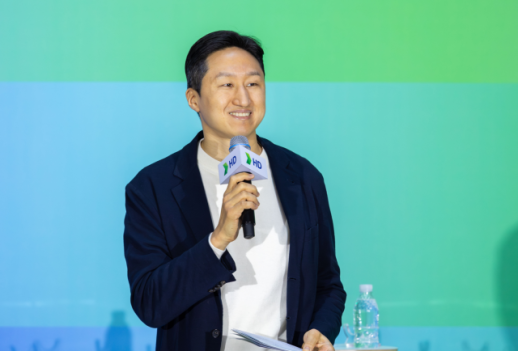 HD Hyundai Chairman Chung Ki-sun’s 2025 Pay Rises 5.3% to 2.39 Billion Won Chung Ki-sun, chairman of HD Hyundai, received about 2.39 billion won in compensation for 2025, the company’s business report disclosed on Thursday. According to the filing, Chung was paid 1.3 billion won by HD Hyundai and 1.09 billion won by HD Korea Shipbuilding & Offshore Engineering. That was up 5.3% from the 2.27 billion won he received in 2024 — 960 million won from HD Hyundai and 1.31 billion won from HD Korea Shipbuilding & Offshore Engineering. The report noted that the actual increase could differ if compensation not subject to disclosure is included. Chung is the eldest son of Chung Mong-joon, chairman of the Asan Foundation, and a third-generation member of the Hyundai founding family. He was promoted in October from executive vice chairman to chairman. Kwon Oh-gap, honorary chairman of HD Hyundai, received a total of 15.2509 billion won, including 11.6756 billion won in severance pay.* This article has been translated by AI. 2026-03-20 19:09:16
 -
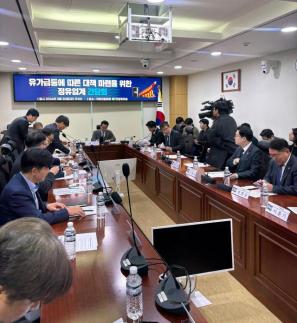 Refiners, Gas Stations Clash Over Fixes as Oil Prices Surge on U.S.-Iran War As oil prices surge amid the war between the United States and Iran, refiners and gas station operators say their business burdens are growing. Lawmakers convened an industry meeting at the National Assembly to discuss countermeasures, but the roughly hourlong session ended without agreement, underscoring the gap between the two sides. The Democratic Party’s Euljiro Committee held the meeting on March 20 at the National Assembly Members’ Office Building, citing rising household costs as international oil prices jump on Middle East risks. Attendees included the Korea Gas Station Association and representatives from SK Innovation, GS Caltex, HD Hyundai Oilbank and S-Oil. Gas station operators focused on what they called structural disadvantages in the retail market. Ahn Seung-bae, chairman of the Korea Gas Station Association, said stations do not set prices but sell at prices determined by refiners. When prices rise, he said, stations are blamed for profiteering despite lacking pricing power. Ahn urged refiners to address practices including all-volume purchasing, after-the-fact settlement, credit card fee burdens and what he described as prices being reflected in advance. He said many stations are effectively tied to buying nearly 100% of their fuel from a single refiner, and that paying before supply prices are finalized — followed by later settlement — increases financing pressure. Refiners said they shared the need to stabilize supply and ease consumer burdens but were cautious about offering specific solutions on distribution structure, citing limits on what companies can do as crude supply risks intensify. Lee Sang-yoon, a vice president at SK Innovation, said a blockade of the Strait of Hormuz has become the biggest variable for crude supply, and that any disruption would inevitably have a major impact on the domestic market. Ahn Young-mo, a managing director at GS Caltex, said the company is using all private inventories to supply petroleum but described the situation as severe. If the Strait of Hormuz blockade is not lifted, he said, “there could be a situation where even naphtha cannot be helped.” Refiners’ stockpiled volumes could be depleted as early as April, the article said. Additional supplies secured from outside the Middle East and through diplomatic efforts would not be enough to replace existing volumes. The refining industry is asking the government to release strategic reserves. However, even in a closed-door discussion after opening remarks, participants did not meaningfully address crude supply plans, which refiners consider the top issue. The meeting was seen as confirming the reality of supply uncertainty and the perception gap between refiners and gas stations, rather than producing detailed steps to respond to the price surge. The Democratic Party’s Euljiro Committee said it plans to form a social dialogue body as early as next week to begin fuller discussions.* This article has been translated by AI. 2026-03-20 15:55:01
 -
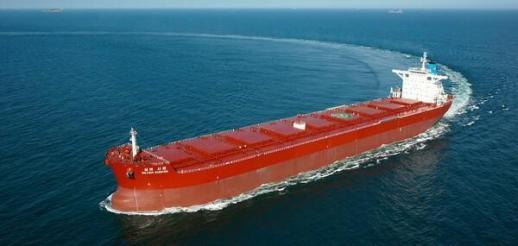 Janggeum Maritime to Hand Over 50% Stake to MSC, Reshaping VLCC Tanker Market Janggeum Maritime is moving to set up a joint management structure with MSC, the world’s largest shipping company. According to the shipping industry on the 20th, Janggeum Maritime recently signed a preliminary investment agreement to transfer more than 50% of its stake to MSC and begin joint management. Under the structure, MSC and Janggeum Shipping will each hold 50%, and the two sides will jointly run the company. Led by Vice Chairman Jeong Ga-hyeon, the son of Janggeum Shipping Chairman Jeong Tae-soon, Janggeum Maritime is a key affiliate responsible for the group’s tanker business. It has rapidly expanded its presence in the VLCC market through aggressive vessel purchases. The industry estimates Janggeum Shipping owns one out of every four VLCCs worldwide, and some analyses say it operates about 40% of the world’s VLCCs that are available for service. MSC’s move is widely seen as a strategic push to expand beyond its container-focused business into crude oil transport. MSC ranks No. 1 in the container ship market with about a 21% share by capacity. Industry officials said the transaction could go beyond a simple equity investment. With the top container carrier moving more directly into tankers, they expect shifts in freight-rate bargaining power and supply coordination in the VLCC market. The deal still requires approvals from regulators in multiple countries. Authorities in Greece and Cyprus have begun reviews, and the transaction must also clear competition scrutiny in major jurisdictions, including South Korea. Whether the deal could raise monopoly concerns as market power grows is expected to be a central issue.* This article has been translated by AI. 2026-03-20 14:03:10
 -
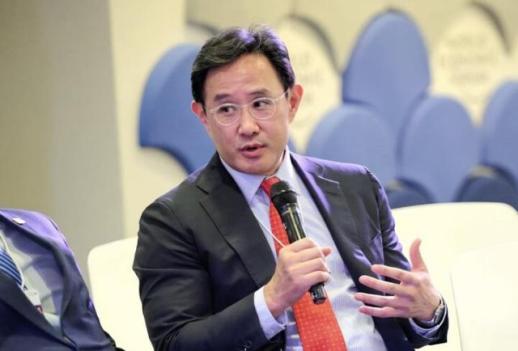 South Korea’s NPS Withholds Vote on Korea Zinc Chairman Choi’s Board Reappointment The National Pension Service, seen as a swing voter in Korea Zinc’s management-control dispute, has decided not to exercise its voting rights on a proposal to reappoint Chairman Choi Yun-beom as an inside director. The NPS fund’s Stewardship Responsibility Committee said on the 20th it made the decision at its fifth meeting the previous day, ahead of Korea Zinc’s shareholders meeting on the 24th. The committee decided not to vote on the company-backed director nominees Choi Yun-beom, Hwang Deok-nam and Park Byeong-uk. It also decided to vote against the election of audit committee members Kim Bo-young and Lee Min-ho. The NPS said the decision reflected that the nominees fall under those with a record of damaging corporate value or infringing on shareholder rights. On proposals to elect directors through cumulative voting — “Election of five directors” and “Election of six directors” — it decided to vote in favor. For voting rights allocated through cumulative voting, the NPS said it will split its votes evenly by proposal sponsor: half for candidates proposed by Young Poong, YPC and Korea Corporate Investment Holdings — Choi Yeon-seok (outside non-executive director), Choi Byeong-il and Lee Seon-suk (outside directors) — and half for Walter Field McLellan (outside non-executive director), proposed by Crucible JV. The NPS holds 5.20% of Korea Zinc and has been viewed as a key swing vote in the proxy fight. Choi and the Young Poong-MBK alliance are each reported to have secured friendly stakes of around 40%. In response, Korea Zinc said it respects the NPS’s “strategic direction” in exercising voting rights and will use the outcome as momentum for the company’s continued growth. Korea Zinc said the NPS recommended approval for most agenda items, including amendments to the articles of incorporation supported by the board and approval of the financial statements. It added that the NPS showed strong support by exercising half of its cumulative-voting rights for the Crucible JV nominee, which the company said carries symbolic meaning tied to its U.S. smelter project. The company said the decision reflects recognition that the U.S. smelter construction being pursued by current management and the board is significant for growth, corporate value and shareholder value, and described the NPS decision as balanced and neutral, taking into account factors including greater board diversity.* This article has been translated by AI. 2026-03-20 09:15:16
 -
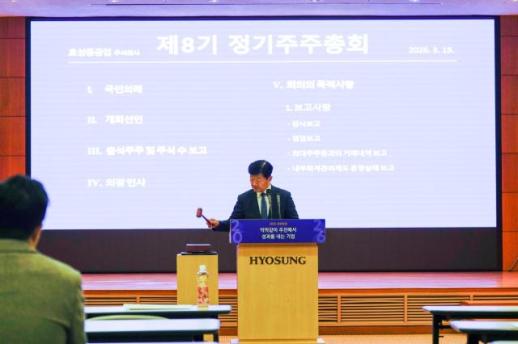 Hanwha Ocean, Hyosung Heavy Industries and Iljin Electric tout North America demand at annual meetings Hanwha Ocean, Hyosung Heavy Industries and Iljin Electric held annual shareholders meetings on March 19, outlining growth plans centered on North America and signaling expectations for more orders. Some agenda items were voted down, however, as the National Pension Service opposed proposals at several meetings, highlighting governance as a variable. Hanwha Ocean held its 26th annual meeting at Geoje Ocean Plaza and approved the reappointment of CEO Kim Hee-cheol as an inside director. Kim, who took office in September 2024, will lead the company for another three years. Kim is credited with driving a turnaround and restructuring after taking the lead on acquiring Philly Shipyard in the United States. The company also said its ability to respond to MASGA, a Korea-U.S. shipbuilding cooperation project, has strengthened. Hanwha Ocean posted an operating profit of 237.9 billion won in 2024, returning to the black. Last year, it reported operating profit of 1.1676 trillion won, up 391% from a year earlier. Kim said the company will focus on renewable energy. Hanwha Ocean created an energy plant division and previously signed an engineering, procurement and construction contract for the Sinan Ui offshore wind project. It is also pursuing construction and deployment of a wind turbine installation vessel. At Hyosung Heavy’s meeting, CEO Woo Tae-hee pointed to expanding demand for power infrastructure and expressed confidence in global growth. With investment rising in data centers and power grids, he said a transformer supply shortage is continuing and related orders are expected to keep increasing. “We strengthened order competitiveness and customer trust and expanded our presence in global markets,” Woo said. “Uncertainty remains this year, including global economic volatility, but we will further strengthen quality standards and production management capabilities and focus on improving the stability of global production bases and supply-chain operations.” Shareholders rejected a proposal to amend the company’s articles of incorporation to revise director qualification requirements. A proposal to appoint outside director Park Jong-bae was also scrapped. The industry attributed the outcome in part to the National Pension Service exercising voting rights under its stewardship code. The report said institutional investors have been more active in exercising shareholder rights as the government emphasizes a “value-up” policy, and the pension fund’s standards have become stricter. The National Pension Service has also voted against director appointments at meetings of Hyosung TNC, Iljin Electric and Lotte Chilsung Beverage. At Iljin Electric, the National Pension Service opposed the reappointment of CEO Yoo Sang-seok as an inside director and the appointment of outside director Cho Woong-ki, but both proposals passed. Iljin Electric will shift from a co-CEO structure under Hwang Soo and Yoo to a single-CEO system led by Yoo. LG Display also held its annual meeting and presented plans to upgrade its business structure and improve profitability. CEO Jeong Cheol-dong said the company will “maximize the results of upgrading our business structure and prepare future growth engines through cost innovation and securing technologies with a competitive edge.” LG Display said it has shifted its business toward organic light-emitting diode displays and posted operating profit of 517 billion won last year, returning to the black for the first time in four years. OLED’s share of sales rose to 61% last year from 32% in 2020, the company said.* This article has been translated by AI. 2026-03-19 18:36:47
 -
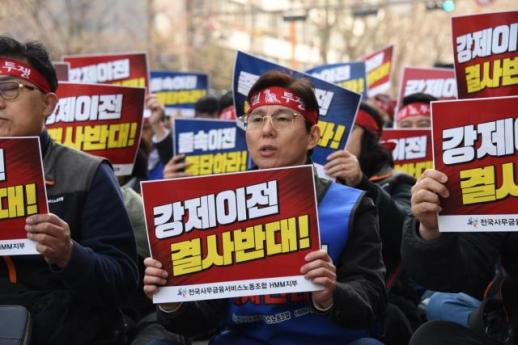 HMM Office Workers Union Calls Busan Headquarters Move Rushed, Plans Rally Near Blue House HMM’s office workers union has continued rallies outside the company’s Yeouido headquarters, reiterating opposition to a planned relocation of the headquarters to Busan. The HMM branch of the National Office and Financial Services Union said it held a second rally March 16, following an all-member rally March 11, calling for a halt to what it described as a rushed move and for guarantees of autonomous management at a private company. According to the industry on March 19, the union’s statement demanded an immediate stop to the relocation, opposition to any forced move, an end to unfair labor practices and protection of management autonomy. Branch chief Jeong Seong-cheol said in remarks that the Ministry of Oceans and Fisheries was pushing the relocation despite knowing there were legal issues, accusing the government of acting irresponsibly. Jeong also criticized the company’s leadership, saying management was staying silent despite recognizing the move’s unfairness and the expected drop in efficiency. He called it an evasion of responsibility and a lack of qualifications, and warned of legal action and accountability if the plan continues. Lee Nam-hyeon, vice chairman of the union, said the relocation could bring economic losses and weaken shipping competitiveness. He disputed the government’s argument that proximity to ports is decisive, saying global shipping hubs such as London and Singapore grew because of “shipping finance,” not ports. He added that HMM needs to maintain close cooperation in Seoul, where finance is developed, to protect its capabilities. The union said it plans a large rally near the Blue House on April 2 and will step up its campaign after the second rally.* This article has been translated by AI. 2026-03-19 17:54:07
 -
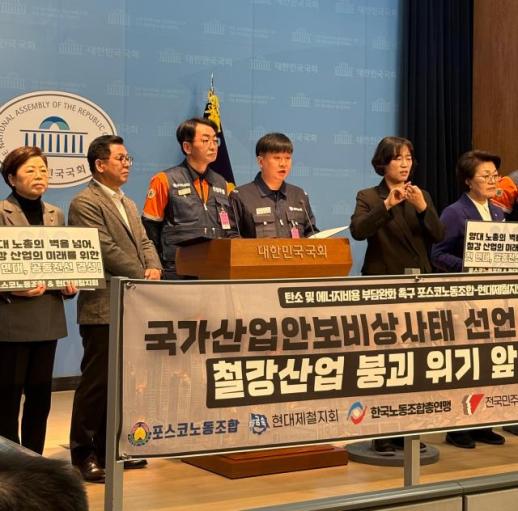 POSCO, Hyundai Steel unions urge relief on power and carbon costs, warn of industry crisis "South Korea’s steel industry is standing on the edge of a cliff. This is not a simple downturn. It is a national industrial security emergency." Labor unions at POSCO and Hyundai Steel held a joint news conference March 19 at the National Assembly press center, urging the government to ease the burden of industrial electricity rates and carbon-related costs. The unions called for measures including relief on industrial power bills, improvements to the carbon emissions-permit system and expanded financial and infrastructure support for shifting to cleaner processes such as hydrogen-based steelmaking. Kim Seong-ho, chair of the POSCO union under the FKTU-affiliated Korea Metal Workers’ Federation, said the industry is being squeezed by sharply worsening profitability, stronger protectionism in advanced economies and what he described as astronomical carbon-emissions costs. He said the government should step in with practical support. Kim said it was the first time in POSCO’s 57-year history that its union had joined Hyundai Steel in a coordinated response, underscoring the severity of the crisis. Song Jae-man, head of Hyundai Steel’s Pohang branch under the KCTU-affiliated Korean Metal Workers’ Union, said industrial electricity rates have risen about 85% over the past five years while steel output has dropped sharply, pushing the industry to its limits. He said plant downsizing and job insecurity are becoming reality and are weighing on local economies. The unions also cited added pressure from war risk involving Iran, saying the steel industry relies heavily on imported raw materials, making it vulnerable to higher oil prices and exchange-rate swings. A union official said even a small rise in the exchange rate can sharply increase fixed-cost burdens, and that weak market conditions combined with energy costs have pushed worksites to the brink. On the government’s recently announced electricity-rate overhaul, the unions said steelmaking is a continuous, 24-hour process and could be hit harder by higher nighttime rates than helped by lower daytime rates, limiting any real relief. Lawmakers attending the event included Rep. Lee Sang-hwi of the People Power Party, Rep. Kwon Hyang-yeop of the Democratic Party and independent lawmaker Kim Jong-min, who voiced support for a joint response to the steel industry’s challenges. 2026-03-19 13:27:20