
Journalist

Kim Bongcheol
nicebong@ajunews.com
-
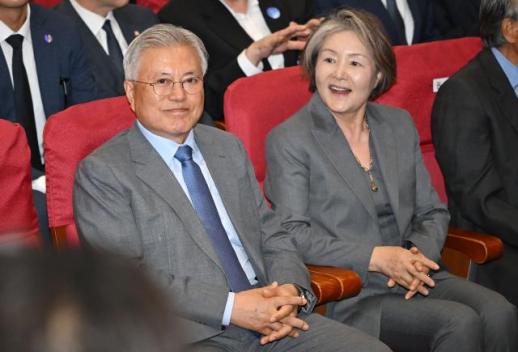 Moon Urges Kim Jong Un to Meet Boldly With Trump as Panmunjom Declaration Turns 8 Former President Moon Jae-in urged North Korean leader Kim Jong Un to “boldly sit down” with U.S. President Donald Trump, saying dialogue remains the quickest and safest way to break the current stalemate. Moon made the remarks in a commemorative speech on April 27 at the National Assembly Members’ Office Building during an event marking the eighth anniversary of the April 27 Panmunjom Declaration, hosted by the Democratic Government Korean Peninsula Peace Inheritance and Development Council and the Ministry of Unification. “True security cannot be guaranteed by building up military power and raising higher walls of isolation and severance,” Moon said. He said he hoped that, as eight years ago, improved inter-Korean ties could again serve as a bridge to U.S.-North Korea talks. “Inter-Korean dialogue will be the fastest and safest breakthrough to resolve the current deadlock,” he said. Moon also called on Trump to show “his unique decisiveness and wisdom” to bring North Korea back to the negotiating table. “Establishing peace on the Korean Peninsula is an especially difficult and arduous journey,” Moon said. But he argued that if the two Koreas overcome those challenges and build a “model of coexistence and peace” on the peninsula, it could become a major milestone for repairing a fractured world order. Moon said “the role of the Lee Jae-myung government is clear,” urging it to strengthen and carry forward past achievements while wisely overcoming earlier limits by starting a new “peace relay.” He said he “sincerely hopes” the stalled peace process will be restarted so the Korean Peninsula can become a place of sustainable peaceful coexistence and prosperity rather than confrontation. On April 27, 2018, Moon and Kim adopted the “Panmunjom Declaration for Peace, Prosperity and Unification of the Korean Peninsula” at an inter-Korean summit in Panmunjom, centered on improving inter-Korean relations and building a peace regime. * This article has been translated by AI. 2026-04-27 16:14:14
 -
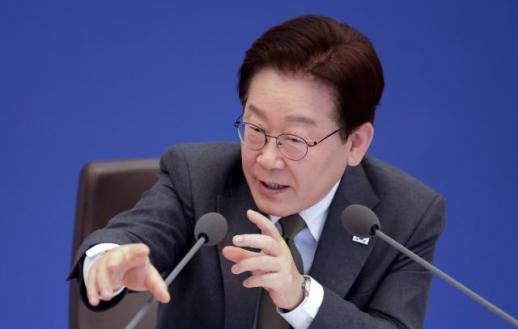 President Lee Jae-myung Vows Steady Push for Korean Peninsula Peaceful Coexistence Policy President Lee Jae-myung said Monday his government will "steadily push ahead" with its "peaceful coexistence policy on the Korean Peninsula." In a written congratulatory message read by Hong Ik-pyo, the presidential senior secretary for political affairs, at an event at the National Assembly Members' Office Building in Seoul marking the eighth anniversary of the April 27 Panmunjom Declaration, Lee said the government will "take the steps we can take first" to restore inter-Korean trust and advance peace. He added that he hopes North Korea will "trust the sincerity" of the government and respond. Lee said ending the war, establishing a permanent peace regime, and achieving coexistence and shared prosperity between the two Koreas are the declaration's core spirit and "the future we must pursue." He urged efforts to ensure uncertainty and anxiety in the international situation, driven by the war in the Middle East, do not spill over to the peninsula, and to build a path where all people on the peninsula can live without fear of war. He said the "people-sovereignty government" has made peaceful coexistence its top policy goal since taking office and has taken preemptive steps to rebuild trust. He said it has also made clear its principles of respecting the North's system, not pursuing unification by absorption, and refraining from any hostile acts. Hong said the government's peaceful coexistence policy presented in early February was based on those principles. "No matter how long the winter lasts, spring will come," Lee said, adding that if efforts toward peaceful coexistence and shared growth are built up "step by step," he firmly believes spring will return to the Korean Peninsula. * This article has been translated by AI. 2026-04-27 14:42:16
 -
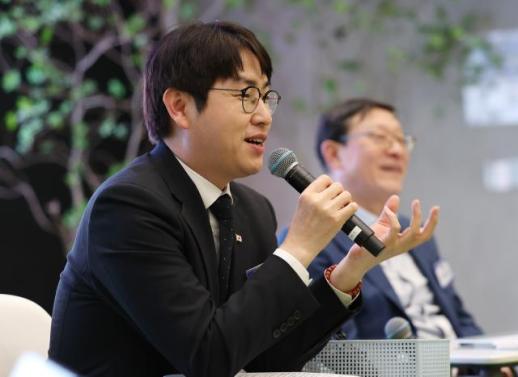 Ha Jung-woo Expected to Decide This Week on Running in Busan Buk-gap By-Election Ha Jung-woo, the presidential office’s senior secretary for AI (artificial intelligence) Future Planning, is expected to announce this week whether he will run in the National Assembly by-election in Busan’s Buk-gap district. The presidential office said Monday that Ha is likely to state his position soon after accompanying President Lee Jae-myung later in the day for talks at the presidential office with Demis Hassabis, co-founder and CEO of Google DeepMind. Ha is reported to be leaning toward entering the race after last-minute deliberations. Under the Public Official Election Act, a public official must resign by May 4 — 30 days before the vote — to run in the by-elections. Democratic Party leaders have repeatedly urged Ha to run in the Busan Buk-gap contest. Party leader Jung Cheong-rae met Ha the previous day and formally asked him to enter the race. Ha did not attend a sports event held by the alumni association of Gupo Elementary School in Busan’s Buk District, where other opposition-aligned contenders for the Buk-gap by-election were present, including Park Min-sik, a former minister of patriots and veterans affairs, and Han Dong-hoon, a former People Power Party leader. Separately, presidential spokesperson Jeon Eun-su is widely seen as the leading candidate for a strategic nomination in the by-election in Asan-eul, South Chungcheong Province. The seat became vacant in June last year when then-lawmaker Kang Hoon-sik was appointed presidential chief of staff as the Lee administration took office. Meanwhile, a Realmeter survey commissioned by Energy Economy Newspaper and conducted April 20-24 among 2,509 adults nationwide found Lee’s job approval rating at 62.2%, down 3.3 percentage points from the previous week. Realmeter said that despite positive signals such as outcomes from summits with India and Vietnam and the Kospi reaching a record high, the rating appeared to fall as the Middle East war pushed up oil prices and inflation, increasing pressure on household finances. The poll was conducted by automated response system (ARS) calls using randomly generated mobile numbers (100%). The response rate for the presidential job-approval question was 5.4%, with a margin of error of plus or minus 2 percentage points at the 95% confidence level. For party support, the response rate was 4.3%, with a margin of error of plus or minus 3.1 percentage points at the 95% confidence level. More details are available on the website of the National Election Survey Deliberation Commission.* This article has been translated by AI. 2026-04-27 09:57:16
 -
 Blue House swaps senior civil affairs and discipline aides; special inspection team moved The Blue House confirmed that its senior secretary for civil affairs and its senior secretary for public service discipline swapped posts on April 24. According to the Blue House, Lee Tae-hyeong, the senior secretary for civil affairs, and Jeon Chi-young, the senior secretary for public service discipline, began working in their new roles that day. The special inspection team, which had been under the public service discipline office, was also moved under the civil affairs office, officials said. The personnel switch within the same senior secretariat was seen as unusual. The Blue House did not disclose the reason for the changes. Separately, President Lee Jae-myung is set to meet Google DeepMind CEO Demis Hassabis at the Blue House on April 27 to discuss cooperation on artificial intelligence. Hassabis, a founder of Google DeepMind, oversaw the 2016 matches between Go champion Lee Sedol and the AI program AlphaGo. He also won the 2024 Nobel Prize in Chemistry for developing AlphaFold, an AI model that predicts protein structures. The Blue House said the meeting is part of the government’s broader push for global AI cooperation and is expected to help accelerate policy efforts through collaboration with a top-tier AI company.* This article has been translated by AI. 2026-04-25 00:33:17
 -
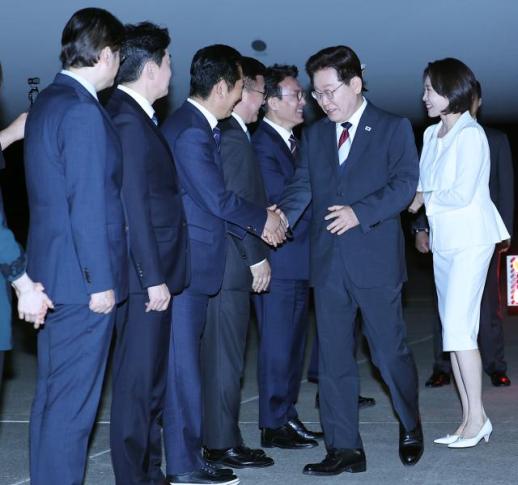 President Lee Jae-myung Returns to Seoul After State Visits to India and Vietnam President Lee Jae-myung returned to South Korea on April 24 after a six-day trip to India and Vietnam. Air Force One, carrying Lee, first lady Kim Hye-kyung and aides, arrived at Seoul Air Base in Seongnam, south of Seoul, at about 9:03 p.m. They were greeted by Democratic Party leader Jung Cheong-rae, Presidential Chief of Staff Kang Hoon-sik and Senior Presidential Secretary for Political Affairs Hong Ik-pyo. Prime Minister Kim Min-seok and Interior and Safety Minister Yoon Ho-jung also welcomed the couple. Lee and Kim stepped off the plane and shook hands with the officials. Lee began the trip in India on April 19, completing a two-night, three-day state visit. In talks with Indian Prime Minister Narendra Modi, the two sides agreed to expand cooperation in strategic industries including shipbuilding, artificial intelligence and defense. They also agreed to strengthen supply-chain cooperation by creating an industrial cooperation committee and speeding up negotiations to improve the Comprehensive Economic Partnership Agreement, and to continue coordination on global issues including the situation in the Middle East. From April 21, Lee made a state visit to Vietnam and held a summit with Communist Party General Secretary To Lam. They agreed to step up cooperation in future-oriented and strategic areas including trade and investment, energy and nuclear power, infrastructure, science and technology, and cultural and people-to-people exchanges. 2026-04-24 21:39:18
 -
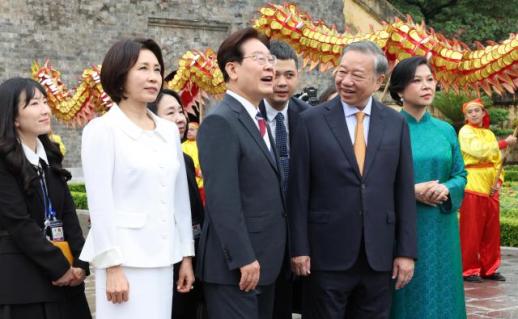
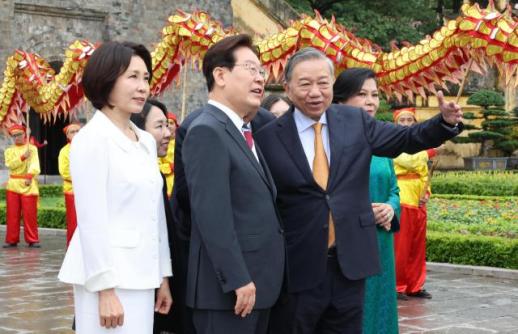 Lee Jae-myung Visits Hanoi’s Thang Long Imperial Citadel During Vietnam State Trip President Lee Jae-myung on April 24 (local time) visited Vietnam’s Thang Long Imperial Citadel, a cultural heritage site, with Vietnamese Communist Party chief and state president To Lam and his spouse as part of a friendship program. Lee, on a state visit to Vietnam, wore a tie featuring red and blue Taegeuk colors, while first lady Kim Hye-kyung wore a white two-piece outfit. The presidential office said the couple chose coordinated attire symbolizing a single Korean flag, expressing national pride and a desire to deepen friendship between the two countries. After arriving, Lee entered an artifacts exhibition hall, viewed traditional items and listened to explanations from citadel officials. He then moved with Lam to the rear garden of Kinh Thien Palace to watch performances, including a Vietnamese traditional lion dance troupe. In a briefing on April 23 at a hotel in downtown Hanoi, presidential office spokesperson Lee Kyu-yeon said the citadel, blending architectural styles from China, Vietnam and France, long symbolized Vietnam’s political center and was listed as a UNESCO World Cultural Heritage site in 2010.* This article has been translated by AI. 2026-04-24 14:07:27
 -
 Lee’s tailored gifts to India, Vietnam highlight cultural ties and promote K-culture President Lee Jae-myung used what his office called “tailored gift diplomacy” during state visits to India and Vietnam, selecting items reflecting each leader’s cultural background, personal preferences and governing priorities. The presidential office said the gifts were intended to go beyond protocol, signaling cultural links and promoting Korean beauty and cultural industries. The presidential office on April 24 (local time) disclosed the gifts Lee presented to Indian Prime Minister Narendra Modi, Indian President Droupadi Murmu, and Vietnamese Communist Party chief and President To Lam and his wife. For Modi, Lee gave a bronze model of a pensive bodhisattva and an ink painting of a tiger. The office said the bodhisattva symbolizes cultural ties because Buddhist thought originated in India and later developed in Silla Korea, and it said Modi’s contemplative, philosophical reputation was considered. The tiger painting was chosen for symbolism shared by Korea and India, the office said. In Korea, the tiger represents authority, protection and good fortune, and in Hindu tradition it is also seen as a sacred protector. The office also cited India’s tiger conservation policy under “Project Tiger,” launched in 1973. Murmu received a Korean traditional meditation set and herbal skin care products. Citing her preference for meditation, the office said it selected a large cushion in the style of traditional patchwork cloth and hanji paper featuring a modern interpretation of dancheong patterns. The herbal skin care products were meant to showcase K-beauty, the office said, noting India’s growth potential as an emerging beauty market. In Vietnam, Lee presented Lam with a folk painting combining a haetae and a pine tree, along with a custom-made music frame. The office said the haetae symbolizes judging right from wrong and driving out injustice, while the pine represents strength and steadfast integrity, reflecting Lam’s governing emphasis on anti-corruption and clean government. The music frame is a speaker built into a picture frame featuring a caricature of Lam and his wife. It was specially made with Lam’s preference for classical music in mind, the office said. For Ngo Phuong Ly, Lee gave a set of National Museum of Korea goods, Korean beauty devices and a mother-of-pearl box decorated with butterfly and arabesque motifs. The office said it reflected her strong interest in official museum goods when she visited the museum during a state visit to South Korea in August last year. The mother-of-pearl box features butterflies symbolizing marital harmony and arabesque patterns symbolizing prosperity, the office said, adding it conveyed wishes for the couple’s health and happiness. The presidential office said it took special care in selecting the gifts to express friendship and trust between leaders. In a briefing at a hotel in Hanoi, presidential spokesperson Lee Kyu-yeon said, “On this trip as well, we expressed friendship and trust through thoughtful gifts for the leaders,” adding, “We prepared them with meaning, considering each leader’s disposition and governing priorities.”* This article has been translated by AI. 2026-04-24 12:57:20
 -
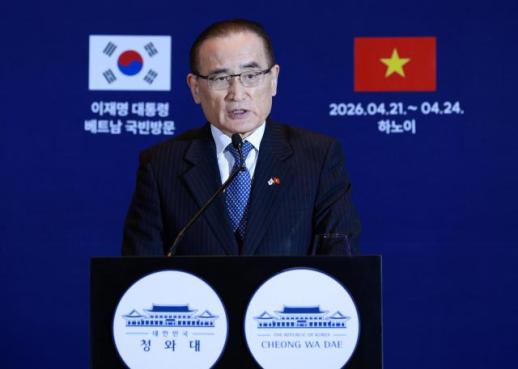 South Korea seeks quick return to normal U.S. cooperation after minister’s North Korea nuclear remarks Cheong Wa Dae said it is consulting with the United States to “return as soon as possible to a normal state of cooperation” following remarks by Unification Minister Jeong Dong-young about North Korean nuclear facilities. Wi, the national security office director, made the comments April 23 (local time) at a press center in Hanoi while meeting with the traveling press corps covering President Lee Jae-myung’s trip to India and Vietnam. Asked about the U.S. reaction to Jeong’s remarks, Wi said it could take time but the two sides should “sort out the current situation through communication.” Jeong said at a National Assembly Foreign Affairs and Unification Committee meeting on March 6 that North Korea is advancing its nuclear program and pointed to three locations — Yongbyon, Kangson and Kusong — as areas where uranium enrichment facilities are operating. The government and the International Atomic Energy Agency have officially confirmed Yongbyon in North Pyongan province and Kangson in Nampo, but Jeong also mentioned Kusong in North Pyongan. It has been reported that the United States viewed Jeong’s remarks as based on U.S.-provided intelligence and, in protest, partially suspended sharing satellite intelligence on North Korea. Lee defended Jeong in a post on X on April 20, calling the information “already widely known facts.” The main opposition People Power Party has said it will submit a motion recommending Jeong’s dismissal unless he is removed. Wi said Jeong has communicated directly with the United States and that he has also been in ongoing contact. He warned that if the issue becomes an excessive domestic controversy and political flashpoint, it could create obstacles to quickly stabilizing the situation and returning to the previous state. Wi described the dispute as a difference in perception. “The United States thinks he spoke using information they provided, and Minister Jeong says he obtained it from other open sources,” Wi said. He added that excessive controversy would not help and that it was important to consult, adjust and find a way forward. Still, Wi said coordination is necessary. “Some compare an alliance to a garden,” he said. “An alliance is a very close relationship, but it must be carefully coordinated and managed.” He again stressed that managing the U.S.-South Korea alliance requires avoiding turning issues into political disputes. Wi said Lee’s social media message was meant to reject arguments and debate based on the premise that Jeong “leaked information received from the United States.” Asked about limits on intelligence exchanges between the two countries after Jeong’s remarks, Wi said it was difficult to confirm or deny. Wi also suggested media coverage contributed to the issue escalating. He said the matter “became a big issue” after recent reporting, which drew political attention and prompted further statements, complicating the situation. Jeong, speaking to reporters after visiting Park In-jun, head of the Korean Conference of Religions for Peace, at Cheondogyo’s Suun Hall in Seoul’s Jongno district, criticized what he called the “intent” of those who “caused the problem.” He called it political maneuvering that harms the national interest. On the reported U.S. step to limit intelligence sharing on North Korea, Jeong said similar things had happened intermittently in the past without becoming public. “That’s the national interest — why stir up conflict?” he said. He did not identify who he meant by “those who caused the problem.” Wi also addressed a letter from 54 Republican U.S. lawmakers to Ambassador Kang Kyung-wha in Washington urging the South Korean government to stop what they called “discriminatory measures” against U.S. companies such as Coupang. Wi said it is true the Coupang issue is affecting security consultations between South Korea and the United States. He said the government has told the United States it will proceed on the Coupang matter “according to legal procedures” while advancing security negotiations separately. He added that security talks should resume quickly because the dispute does not help the alliance. Wi dismissed comments by the commander of U.S. Forces Korea and the Combined Forces Command about transferring wartime operational control by before the first quarter of 2029, calling them the commander’s personal view. Gen. Xavier Brunson told the U.S. House Armed Services Committee on April 22 (local time) that, in response to a question, “We submitted to the Department of Defense a roadmap to achieve those conditions before the second quarter of fiscal year 2029 (first quarter of 2029 by Korean standards)." On the timing of the transfer of wartime operational control, Wi said military considerations cannot be ignored but the transfer is ultimately a political decision. He said the leaders of both governments will decide and that South Korea will make its best efforts to complete the transfer as soon as possible without damaging the bilateral coordination framework. * This article has been translated by AI. 2026-04-24 12:06:30
 -
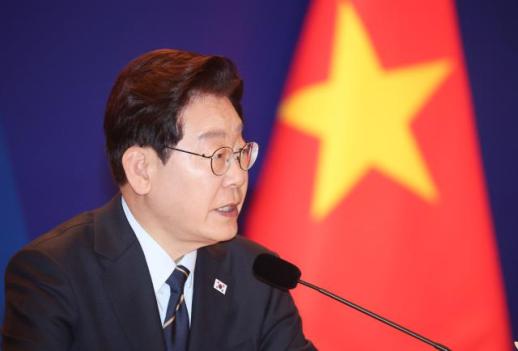 President Lee Calls Daejang-dong Coverage ‘Fabricated,’ Urges Korea Newspaper Award Revocation President Lee Jae-myung on April 24 called for revoking a Korea Newspaper Award given for reporting three years ago on the Daejang-dong development allegations, saying the work was not fact-finding but “massive fabrication.” Lee, on a state visit to Vietnam, wrote on X that the award jury said it honored the coverage because it “consistently uncovered powerful facts” in reporting on the Daejang-dong issue. He argued that the reporting “created” a reference to “that person, Lee Jae-myung” that was not in the Daejang-dong recordings, and claimed it helped defeat the Democratic Party’s presidential candidate in the last election and “changed the course of Korean history.” Lee said the country “moved backward,” people suffered “tremendous pain,” and the fallout continues. He said the outlet should return the award, apologize and correct the report, adding that there must never again be an attempt to change history through election manipulation by state power agencies and the media. The Korea Newspaper Association previously selected the DongA Ilbo legal affairs team’s “Daejang-dong development and illegal campaign funds allegations” as the 2023 winner in the news reporting category. The jury said at the time that the series “consistently uncovered powerful facts” in covering the Daejang-dong issue.* This article has been translated by AI. 2026-04-24 11:45:17
 -
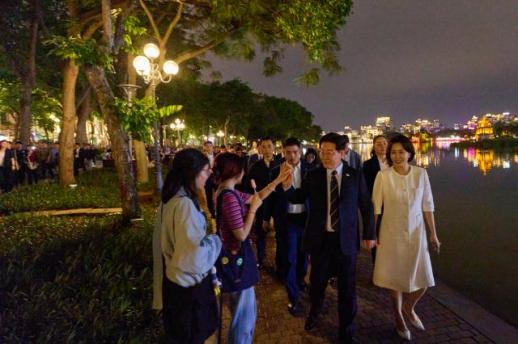 South Korea’s Lee Jae-myung and first lady take surprise walk in Hanoi, greet locals President Lee Jae-myung took a walk through central Hanoi and met Vietnamese residents, later stopping at a local restaurant with first lady Kim Hye-kyung for dinner of pho and fried rice. Lee, who is on a state visit to Vietnam, posted photos on Instagram from April 23 (local time) showing the couple walking the streets of Hanoi and greeting people. “Hanoi’s evening was truly beautiful, and as we walked around Hoan Kiem Lake and the alleys of the Old Quarter, we exchanged warm greetings with Vietnamese people,” Lee wrote. “It was even more meaningful because we could meet in everyday spaces, not in a formal schedule.” Hoan Kiem Lake is a major landmark in central Hanoi where residents relax and spend leisure time. Vietnamese residents welcomed the couple by calling out “Hello” and “Nice to meet you,” presidential office deputy spokesperson Ahn Gwi-ryeong said in a written briefing. Lee and Kim responded in Vietnamese, saying “Xin chao.” Lee patted the head of a Korean student attending elementary school in Vietnam and offered encouragement, while Kim said she was pleased to see a Korean-language sign posted on a shop wall. Lee sampled pork skewers and a sugarcane drink sold on the street and said they were “very delicious.” Kim described the sugarcane drink as “refreshing and impressive,” Ahn said. The couple also bought durian and shared it with aides. They then moved to a nearby restaurant for dinner. Ahn said Kim showed strong interest in local food culture, asking about ingredients after a vegetable similar to Korea’s dried radish greens was served with the fried rice. Posting a photo of the couple dining, Lee wrote, “They say you can’t go wrong at any restaurant in Vietnam, and that turned out to be true. Thanks to that, we’re enjoying a delicious dinner.” Lee added that the visit reminded him “hearts can connect even across different languages and cultures,” and said he would long remember the smiles and greetings they received. He said he hoped the two countries would continue building friendship and trust and expand exchanges. * This article has been translated by AI. 2026-04-24 11:04:07