
Journalist

John Na
ruizhi@ajunews.com
-
 First meeting on next year's minimum wage to be held next week SEOUL, April 15 (AJP) - This year's first meeting of a committee responsible for setting next year's minimum wage is scheduled to be held next week. The committee, consisting of members from labor, employer and government representatives under the Ministry of Employment and Labor, will gather for talks at the government complex in the administrative city of Sejong on April 21. With the committee's chair remaining vacant, members in attendance are expected to elect a new chair during the meeting, which will be presided over by Labor Minister Kim Yong-hoon. They are also expected to discuss plans and schedules for subsequent sessions to continue wage deliberations. However, tough confrontations are already expected, as labor representatives are likely to propose a higher increase from this year's minimum wage of 10,320 Korean won, up just 2.9 percent, or 290 won, from a year ago, while employers are expected to push for a freeze amid the prolonged conflict in the Middle East. One of the contentious issues between the two sides will be discussions on whether to apply the minimum wage to platform workers including delivery workers and riders, a long-standing demand from labor groups. Kim earlier said such talks would be held for the first time, citing the need to consider a separate minimum wage or similar arrangements for contract-based workers and other laborers if it is deemed inappropriate to set wages on an hourly, daily, weekly, or monthly basis. The committee is required to make a final decision within 90 days from the date the Labor Minister requests a review, which falls on June 29 this year. However, this deadline is largely advisory in nature, and in practice the decision is often delayed until around mid-July due to usual differences between both sides. 2026-04-15 11:28:55
 -
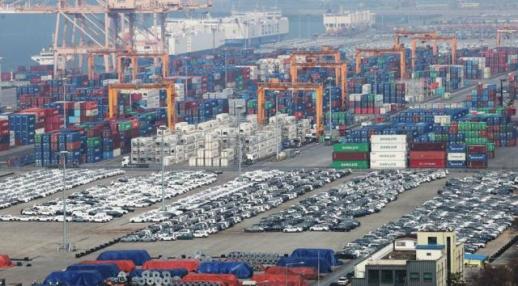 South Korea posts record early-April exports despite Middle East crisis SEOUL, April 13 (AJP) - Despite geopolitical risks amid the prolonged conflict in the Middle East, South Korea posted its highest-ever exports for the first 10 days of this month, driven by strong demand for semiconductor chips. According to data from the Korea Customs Service (KCS) released on Monday, exports during the period from the first day of April to last Friday totaled US$25.21 billion, up 36.7 percent from a year earlier, surpassing the previous record for the same period, set just a month earlier at $21.70 billion. Average daily outbound shipments rose 36.7 percent to $2.97 billion. By product, semiconductor chips surged 152.5 percent from a year earlier to $8.57 billion, the highest amount ever recorded for the period and well above last month's record of $7.6 billion, accounting for 34 percent of total exports, up 15.6 percentage points from a year earlier. Exports of computer peripherals rose 134.9 percent, petroleum products 38.6 percent, and ships 26.6 percent, while home appliances fell 26 percent and passenger cars declined 6.7 percent. By destination, exports to China climbed 63.8 percent to US$5.73 billion, while shipments to Taiwan rose 68.3 percent. Exports to the U.S. and Viet Nam also increased 24 percent and 66.6 percent, respectively. Meanwhile, imports rose 12.7 percent to $22.11 billion. Semiconductor imports increased 29.7 percent, crude oil 8.7 percent and semiconductor manufacturing equipment 77.9 percent, while machinery imports fell 7.4 percent. Total energy imports including crude oil, gas and coal rose 13.1 percent, which the KCS attributed to rising global energy prices due to the Middle East conflict. Imports increased from China by 13.6 percent, the U.S. by 39.3 percent, the European Union by 38.0 percent and Taiwan by 24.6 percent. With exports exceeding imports, the trade balance recorded a surplus of $3.10 billion. 2026-04-13 11:01:31
 -
 Exports in February soar to record high on AI chip demand SEOUL, February 23 (AJP) - Exports in February have hit a record high, fueled by strong demand for semiconductor chips. According to preliminary data released by the Korea Customs Service on Monday, outbound shipments for the first 20 days of this month stood at US$43.52 billion, up 23.5 percent from a year earlier, the highest for the period. The previous record was $43 billion, set during the same period in December last year. Semiconductors led the increase as artificial intelligence (AI)-related demand continued to grow. Chip exports surged 134.1 percent to $15.12 billion, accounting for 34.7 percent of total exports, up 16.4 percentage points from a year earlier. Exports rose for petroleum products, computer peripherals, ships, and wireless communications equipment, but fell for passenger cars, auto parts, and precision instruments. By destination, shipments rose to China (up 30.8 percent), the U.S. (up 21.9 percent), Viet Nam (up 17.6 percent), the EU (up 11.4 percent) and Taiwan (up 76.4 percent). Imports during the period totaled $38.57 billion, up 11.7 percent, led by semiconductors, crude oil, semiconductor manufacturing equipment and gas. Imports rose from China, the EU, Taiwan and Viet Nam, but declined from Japan and the U.S. With exports surpassing imports, South Korea posted a trade surplus of $4.95 billion for the period. 2026-02-23 11:17:49
 -
 Seoul assesses impact and uncertainty after US tariff ruling SEOUL, February 23 (AJP) - South Korea will continue discussions with the U.S. on tariff-related issues "in an amicable manner," Trade, Industry and Energy Minister Kim Jeong-gwan said on Monday. The trade chief said the government will ensure that the terms of a tariff deal finalized late last year are not undermined, after U.S. President Donald Trump threatened a new temporary global tariff of 15 percent following the U.S. Supreme Court's nullification of reciprocal tariffs. Kim's remarks came during an emergency meeting at the Korea Chamber of Commerce and Industry in Seoul, attended by relevant government ministries and agencies, as well as business groups. The meeting was convened after the U.S. Supreme Court struck down the use of the International Emergency Economic Powers Act (IEEPA) for tariffs, prompting Trump to announce follow-up measures including global tariffs under Section 122 of the Trade Act and a Section 301 investigation. Participants assessed the potential impact on South Korea's industries and exports and discussed possible response measures. Kim added that the government will work with relevant agencies and industry groups to keep companies informed amid global trade uncertainty. "We will unwaveringly pursue policies to strengthen the competitiveness of companies and diversify export channels in response to potential changes in trade conditions," he said. 2026-02-23 10:24:43
 -
 South Korean trade minister urges swift passage of US investment bill SEOUL, February 05 (AJP) - South Korea’s trade minister Yeo Han-koo on Thursday urged swift passage of a special law to support investment in the United States, warning that delays in the National Assembly risk being misinterpreted in Washington as a lack of commitment. Speaking after returning from Washington, Yeo said progress on the bill has slowed, raising concerns that the United States could see this as reluctance by Seoul to carry out agreed tariff measures. During his visit, Yeo said he stressed that South Korea intends to implement the tariff agreement “faithfully and swiftly,” adding it would be undesirable for Seoul’s good-faith efforts to lead to higher tariffs. He called for closer coordination with lawmakers to speed passage while ensuring U.S. officials understand South Korea is working sincerely to meet its commitments. The situation must be managed carefully to prevent bilateral friction, he added. Yeo said he did not meet U.S. Trade Representative Jamieson Greer during the trip but held three rounds of talks with senior officials. He said he has spoken with Greer five times in recent weeks and plans further consultations. Asked whether Washington could withdraw or delay planned tariff increases, Yeo said U.S. decisions are hard to predict but stressed the need for continued consultations even after the law is passed to avoid misunderstandings. U.S. President Donald Trump said on Jan. 26 that tariffs on South Korean cars, lumber, pharmaceuticals and other goods could rise to 25 percent from 15 percent, citing slow legislative progress on the investment bill. Following Trump’s remarks, ruling and opposition parties agreed Tuesday to form a special parliamentary committee to speed passage of the legislation. * This article, published by Aju Business Daily, was translated by AI and edited by AJP. 2026-02-05 08:40:41
 -
 Trade chief vows to find 'mutually beneficial' tariff solution with US SEOUL, February 4 (AJP) - Officials from South Korea and the United States have been working closely to come up with a "reasonable solution" to tariff-related issues after U.S. President Donald Trump's abrupt threat last week to raise tariffs, Minister of Trade, Industry and Resources Yeo Han-koo said on Wednesday. While wrapping up his weeklong trip to Washington, D.C., Yeo told reporters that he met with numerous U.S. government officials including representatives from the Office of the U.S. Trade Representative, as well as members of Congress and business groups such as the U.S. Chamber of Commerce, to figure out what lies behind Trump's threat. Trump warned last week that he would raise reciprocal tariffs on Seoul from 15 percent back to 25 percent, citing delays in implementing a broader deal between the two allies reached in October last year, which includes Seoul's massive investment pledges to the U.S. Expressing concern over the potential impact of tariff increases on businesses and industries, the minister conveyed Seoul's commitment to implementing the agreement. Yeo further explained that he met with about 20 U.S. lawmakers to address their concerns and clarify any misunderstandings related to the deal, discussing necessary legislative or administrative procedures to facilitate the agreement. "We will continue discussions with the U.S. to find a mutually beneficial solution," he said. Yeo returns home on Thursday. 2026-02-04 14:43:19
 -
 South Korea to Fund 70 New Energy R&D Projects Worth 136.9 Billion Won The Ministry of Climate, Energy and Environment said it will post its “2026 Energy Technology Development Implementation Plan” and a first round of 70 new energy technology development projects totaling 136.9 billion won on the ministry website and the Korea Institute of Energy Technology Evaluation and Planning website on Wednesday. The ministry said it plans to support 201.4 billion won this year for new energy technology R&D projects to respond to the climate crisis and advance a sustainable energy transition. It said the program will focus on securing key components for an “energy expressway,” developing next-generation renewable energy technologies, and building the foundation for carbon-neutral R&D. For the “energy expressway,” the ministry said it will provide 12.9 billion won for technology development, including securing key components such as transformers and establishing AI-based systems to operate distributed power grids. To develop next-generation renewable energy technologies, it said it will invest 61.1 billion won in projects including narrowing essential technology gaps related to commercial-area tandem solar modules and offshore wind turbine blades, as well as expanding agrivoltaics. To accelerate carbon neutrality, the ministry said it will support 98.2 billion won for technology development including large-capacity heat pumps, building a clean hydrogen ecosystem, advancing core technologies across the nuclear power life cycle, and securing domestically developed carbon capture, utilization and storage, or CCUS, technologies. It also said it will invest 29.2 billion won to strengthen the energy R&D foundation by expanding advanced workforce training and bolstering follow-up support for strong research outcomes. A ministry official said additional announcements for new projects tied to international joint research and technology commercialization will come later after required procedures, including consultations with partner countries. The official said briefings for interested companies and researchers will be held on Feb. 5 in Seoul and Feb. 12 in Daejeon.* This article has been translated by AI. 2026-01-29 06:03:00
 -
 Seoul confirms plan to construct two nuclear reactors by late 2030s SEOUL, January 26 (AJP) - South Korea will proceed with plans to build two new nuclear reactors by 2037-38, the government said on Monday, reviving a project that had effectively been on hold and paving the way for site selection to begin. Climate, Energy and Environment Minister Kim Sung-hwan said construction of the reactors, included in the current national power plan, would move ahead as scheduled after public consultations showed broad support. “New nuclear power plant construction under the 11th Basic Plan for Electricity Supply and Demand will proceed as planned,” Kim told reporters at the government complex in Sejong. Finalized early last year, the 11th plan calls for the construction of two large-scale reactors with a combined capacity of 2.8 gigawatts, targeted to come online in 2037–2038. Kim said reducing carbon emissions across the economy was unavoidable in responding to climate change and that emissions cuts in the power sector would require scaling back coal and liquefied natural gas generation. The electricity system, he said, would need to rely primarily on renewable energy and nuclear power. Following a change in government, debate emerged over whether the nuclear construction plan should be reconsidered or deferred to the 12th basic plan, prompting two public forums and opinion polls conducted late last year and earlier this year. In the surveys, respondents who said the nuclear construction plan “must proceed” accounted for 32.5 percent in a Gallup Korea poll and 43.1 percent in a Realmeter poll. Those who said it “should preferably proceed” made up 37 percent and 18.8 percent, respectively, meaning more than 60 percent supported moving forward. Opposition was lower, with 5.3 percent and 13.5 percent saying the plan “must be halted,” and 17.3 percent in both surveys saying it “should preferably be halted.” When asked which energy source should be expanded most, the largest share of respondents selected renewable energy — 48.9 percent in the Gallup Korea poll and 43.1 percent in the Realmeter survey — followed by nuclear power at 38 percent and 41.9 percent. Citing the results, the government said it would place renewed emphasis on nuclear power while expanding renewables. Kim said intermittency in renewable generation would be addressed through energy storage systems and pumped-storage hydropower, while nuclear power’s operational inflexibility would be mitigated through more flexible plant operations. The new nuclear build is also expected to be a key assumption in the upcoming 12th electricity basic plan, covering 2026–2040. A working-level draft is due in the third quarter after meetings of expert committees, followed by a strategic environmental impact assessment, a public hearing, a report to a National Assembly standing committee and a review by the Electricity Policy Deliberation Committee. Final approval is expected by year-end. The ministry said the next plan would reflect rising electricity demand driven by artificial intelligence and broader electric-vehicle adoption, alongside targets for carbon neutrality and the expansion of a distributed power grid. However, the 11th plan assumes a construction period of about 167 months — nearly 14 years — for large reactors, making early site selection essential to meet the target completion date. Accordingly, Korea Hydro & Nuclear Power is expected to begin a site solicitation process soon, followed by five to six months of evaluation and selection. The aim is to secure construction permits in the early 2030s and complete the reactors by 2037–2038. * This article, published by Aju Business Daily, was translated by AI and edited by AJP. 2026-01-26 10:53:44
 -
 Vietnam stays South Korea's No. 3 trading partner for fourth year SEOUL, January 26 (AJP) - Vietnam remained South Korea’s third-largest trading partner for a fourth consecutive year as South Korean exports topped $700 billion for the first time last year, according to government and industry data released on Monday. Vietnam also generated South Korea’s second-largest trade surplus, after the United States. South Korea’s exports to Vietnam rose 7.6 percent from a year earlier to $62.8 billion in 2025, data from the Ministry of Trade, Industry and Energy and the Korea International Trade Association (KITA) showed. Imports from Vietnam increased 11.7 percent to $31.8 billion, lifting total bilateral trade 9 percent to $94.5 billion from $86.8 billion a year earlier. By trade volume, Vietnam ranked third among South Korea’s trading partners, behind China at $272.7 billion and the United States at $196.2 billion. Vietnam overtook Japan in 2022 to become South Korea’s third-largest trading partner and has held that position for four straight years. Its export growth rate of 7.6 percent ranked second among major destinations, behind Taiwan’s 44.4 percent, which officials attributed to Taiwan’s role as a hub for artificial intelligence semiconductor production. South Korea recorded a $31 billion trade surplus with Vietnam last year, its second-largest after a $49.5 billion surplus with the United States. Vietnam briefly became South Korea’s top surplus market in 2022, with $34.2 billion, and has ranked second for the past three years. Officials said the expansion was driven largely by strong semiconductor exports. South Korea’s semiconductor shipments to Vietnam surged 36.7 percent from a year earlier to $24.7 billion, supported by growing global investment in artificial intelligence and data centers. Trade between South Korea and Vietnam has expanded sharply since the two countries established diplomatic relations in 1992. Two-way trade has increased about 190-fold from roughly $500 million, with the trade structure shifting from labour-intensive goods such as textiles and apparel to higher-value products including semiconductors and wireless communications equipment. Following the signing of a bilateral free trade agreement in 2014, trade more than tripled from around $30 billion to $94.5 billion. Exports of consumer goods linked to the Korean Wave, including cosmetics and food products, have also risen. South Korea is also a key trading partner for Vietnam. Based on Vietnam Customs data analysed by KITA, South Korea ranked as Vietnam’s second-largest source of imports and fourth-largest export destination from January through November last year. * This article, published by Aju Business Daily, was translated by AI and edited by AJP. 2026-01-26 09:24:40
 -
 Polls show strong support in South Korea for new nuclear plants SEOUL, January 21 (AJP) - A majority of South Koreans support building new nuclear power plants as electricity demand surges with the expansion of artificial intelligence, two public opinion polls showed, adding pressure on the government to reconsider its energy policy stance. The Ministry of Climate, Energy and Environment said on Wednesday it had conducted nationwide surveys last week on a new-reactor plan. The ministry commissioned Korea Gallup and Realmeter to survey 1,519 and 1,505 respondents, respectively, using proportional allocation by gender, age and region. In the Gallup poll, 69.6 percent of respondents said the plan to build new nuclear reactors should proceed, compared with 22.5 percent who said it should be halted. In the Realmeter survey, 61.9 percent supported moving ahead, while 30.8 percent opposed the plan. Support for nuclear power more broadly was also strong. In the Gallup poll, 89.5 percent said nuclear power is necessary, while 82 percent said the same in the Realmeter poll. On safety, about 60 percent of respondents in both surveys said nuclear power is safe, outnumbering those who viewed it as dangerous. When asked which power sources should be expanded, respondents most frequently cited renewable energy and nuclear power. In the Gallup poll, renewables ranked first at 48.9 percent, followed by nuclear at 38 percent and liquefied natural gas at 5.6 percent. In the Realmeter poll, renewables accounted for 43.1 percent and nuclear for 41.9 percent. The results are expected to serve as a key reference as the government weighs whether to proceed with plans for two new large-scale reactors and small modular reactors (SMRs). Those plans were previously finalized but later put on hold after the government decided to reopen public deliberations. Climate Minister Kim Sung-hwan has said since taking office that the new-reactor plan would be reviewed “from scratch,” citing insufficient public input during the drafting of the Lee Jae Myung administration's electricity plan. President Lee has previously expressed skepticism about expanding nuclear power, noting at a September news conference that nuclear plant construction typically takes more than 15 years and that suitable sites are limited. He has argued that solar and wind power, which can be built within one to two years, should be expanded on a large scale. More recently, however, growing electricity demand from AI development has prompted renewed calls within and outside government for stable baseload power. At a New Year’s news conference on Wednesday, Lee said that global trends point to “enormous energy demand” and acknowledged that renewable energy faces intermittency challenges. He said the government should keep an open mind and assess whether new reactors are needed, whether they are safe and what the public wants. A day earlier, he told a Cabinet meeting that public opinion “overwhelmingly” supports expanding nuclear power to address electricity supply concerns. The ministry said it will review whether to pursue new nuclear construction by considering the poll results alongside policy discussions. A ministry official said the government is examining “realistic” power supply options that take into account growth in advanced industries such as AI and semiconductors, as well as carbon-neutrality goals. 2026-01-21 15:31:30