
Journalist

Shin Dong-kun
sdk6425@ajunews.com
-
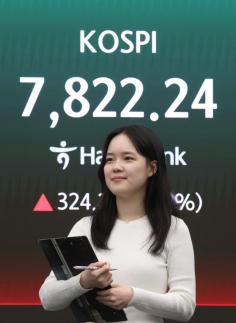 KOSPI Hits Record High Amid Semiconductor Surge, Deepening 'K-Shaped' Market The KOSPI has once again reached an all-time high, driven by a rally in major semiconductor stocks, particularly Samsung Electronics and SK Hynix, as the index approaches the 7,900 mark. However, the surge is concentrated on these two large-cap semiconductor companies, exacerbating the 'K-shaped' market phenomenon where performance varies significantly among different sectors. On this day, the KOSPI closed at 7,822.24, marking a record high with an increase of 324.24 points (4.32%) from the previous trading day, which closed at 7,498.00. The index has surged over 54% since the end of March, when it stood at 5,052.46. Compared to the closing figure of 4,214.17 at the end of last year, the KOSPI has risen by 85.62% this year. Market analysts are optimistic, with domestic brokerages suggesting that the KOSPI could surpass 8,000 and even reach 9,000. Foreign investment bank JP Morgan has projected that the index could exceed 10,000. The recent upward trend is largely attributed to the semiconductor sector. On this day, Samsung Electronics and SK Hynix saw their shares rise by 6% and 13%, respectively, fueled by growing expectations for increased demand for AI semiconductors. However, the concentration of gains in the semiconductor sector raises concerns. The recent rise in the domestic stock market has increasingly focused on Samsung Electronics and SK Hynix. On this day, the combined market capitalization of Samsung Electronics (including preferred shares), SK Hynix, and SK Square accounted for 52% of the KOSPI's total market cap. Among the 34 KRX indices calculated by the Korea Exchange, all nine indices with the highest recent gains included Samsung Electronics and SK Hynix. The semiconductor index topped the list with a 22.98% increase, followed by the value-up index at 22.16%. The average increase for indices that included these two stocks was 19.45%, while the average for other indices without them was only 0.27%. This indicates a market where returns are heavily influenced by the inclusion of major semiconductor stocks. The trend of concentration is also evident in trading volumes. The average daily trading volume of the KOSPI this month reached 48.4982 trillion won, a 64.1% increase from last month's 29.555 trillion won. In contrast, the average daily trading volume decreased from 947.18 million shares to 773.96 million shares, reflecting a decline in the number of traded stocks but a surge in trading volume for specific large-cap stocks. So far this month, the average daily trading volume for Samsung Electronics and SK Hynix combined has reached 74.5353 trillion won, accounting for 37% of the total KOSPI trading volume. Including Samsung Electronics' preferred shares and SK Square, the combined share of these four stocks rises to 42%, up from 34.6% last month, indicating a deepening concentration trend. Market experts believe there is still potential for further KOSPI gains. Analysts suggest that while the current concentration in the semiconductor sector may continue for some time, there is also a possibility that market momentum could gradually spread to other sectors. Kim Jong-min, a researcher at Samsung Securities, noted in a recent report, "Behind the explosive rise lies extreme polarization in returns. In the future, we are likely to see a rotation of investments toward semiconductor materials, alternative energy, and physical AI beneficiaries." He added, "A gradual rotation following extreme concentration could serve as a stepping stone for the KOSPI's resurgence."* This article has been translated by AI. 2026-05-11 16:59:49
 -
 SK Hynix Hits 1.9 Million Won as Samsung Electronics Surges 7% SK Hynix reached a record high of 1.9 million won during trading, driven by strong demand expectations for artificial intelligence (AI) semiconductors, attracting significant foreign and institutional investment. According to the Korea Exchange, as of 10:58 a.m. on May 11, SK Hynix shares rose by 209,000 won (12.40%) to 1,895,000 won. The stock briefly touched the 1.9 million won mark, setting a new all-time high. Its market capitalization surged to approximately 1,350.57 trillion won. Market analysts suggest that ongoing investments in high-bandwidth memory (HBM) for AI semiconductors are fueling optimism about earnings. The competition among global tech giants to invest in AI infrastructure has led to increased buying interest in SK Hynix, a key player in Nvidia's supply chain. Investor sentiment also spread across major semiconductor stocks. At the same time, Samsung Electronics saw its shares rise by 7.26% to 288,000 won, with a market capitalization estimated at 1,683.73 trillion won. The combined market capitalization of Samsung Electronics and SK Hynix reached approximately 3,034 trillion won, highlighting their significant role in driving the domestic stock market's upward trend. Additionally, the day's gains appear to be influenced by the recent rise in the New York stock market over the weekend, driven by optimism surrounding a potential resolution to ongoing negotiations and better-than-expected employment figures. Last weekend, the tech-heavy Nasdaq index closed up 440.88 points (1.71%) at 26,247.08.* This article has been translated by AI. 2026-05-11 11:15:42
 -
Samsung Electronics and SK Hynix Surge Ahead in Pre-Market Trading On May 11, Samsung Electronics and SK Hynix, the two leading companies in the South Korean stock market, saw their shares rise sharply in pre-market trading, with increases of 6% to 7%, continuing their trend of hitting record highs. According to Next Trade, as of 8:06 a.m., Samsung Electronics was trading at 285,500 won, up 17,000 won (6.33%) from the previous trading day, bringing its market capitalization to approximately 1,669 trillion won. At the same time, SK Hynix's shares surged by 11,800 won (7.00%) to reach 1,804,000 won, with a market capitalization of around 1,285 trillion won. Combined, the market capitalizations of the two companies approached 2,954 trillion won. The strong buying interest in these semiconductor giants has heightened expectations for further gains in the KOSPI index. Market analysts attribute the rising stock prices of Samsung Electronics and SK Hynix to increased demand for high-bandwidth memory (HBM) and improving conditions in the memory chip sector. Notably, foreign investors and leveraged funds have concentrated their investments in these semiconductor leaders, intensifying the trend of trading volume being dominated by Samsung Electronics and SK Hynix. Additionally, the upward momentum in the stock prices appears to be influenced by the recent gains in the New York stock market over the weekend, driven by optimism surrounding a potential resolution to ongoing negotiations and better-than-expected employment data. The Dow Jones Industrial Average closed up 12.19 points (0.02%) at 49,609.16. The S&P 500 index rose by 61.82 points (0.84%) to finish at 7,398.93, while the tech-heavy Nasdaq composite gained 440.88 points (1.71%) to close at 26,247.08.* This article has been translated by AI. 2026-05-11 08:15:29
-
 Shinhan Securities Raises Lotte Wellfood's Target Price by 14% Amid Overseas Growth Shinhan Investment Corp. announced on May 11 that it has raised its target price for Lotte Wellfood from 140,000 won to 160,000 won, an increase of 14%, while maintaining its investment rating at 'Buy.' This adjustment is attributed to the company's improving performance driven by growth in overseas sales and cost efficiency in South Korea. Analyst Jo Sang-hoon from Shinhan Investment noted, "Despite ongoing cost pressures, Lotte Wellfood achieved surprising results in the first quarter due to increased domestic efficiency and rising overseas sales. It is particularly important to focus on the recovery of growth in overseas markets, especially in India and Kazakhstan." In the first quarter of this year, Lotte Wellfood reported consolidated sales of 1.027 trillion won, a 5.4% increase compared to the same period last year, while operating profit surged by 118.4% to 35.8 billion won, exceeding market consensus by 47%. Jo explained that domestic profitability improved significantly due to efforts to streamline low-margin SKUs and channels, enhance purchasing efficiency, and improve logistics. He added that overseas sales showed broad growth across all regions, driven by increased sales volume and price hikes. Looking ahead, Jo anticipates a reduction in cocoa price pressures. He stated, "Cocoa prices, which exceeded $10,000 per ton in the first half of last year, have dropped to around $3,200 this year. By the end of the second quarter, we expect the effects of improved margin spreads to be fully reflected in the results." He also expressed optimism about the company's operations in India, noting, "Following the merger of the frozen and dry food divisions last year, we expect synergy effects and increased efficiency. This will lead to expanded regional coverage and a strengthened Lotte brand image." Shinhan Investment forecasts that Lotte Wellfood's Indian subsidiary will achieve an average annual growth rate of 23% over the past five years, with a projected increase of 13.1% this year. The frozen food segment is expected to grow by 13.2%, while the dry food segment is anticipated to grow by 12.9%. 2026-05-11 07:57:18
 -
 Investors Split Strategies Amid Record KOSPI Surge and Derivative Trading Amid a record-breaking bull market, investors are divided in their strategies. As the KOSPI continues to hit all-time highs, funds in derivative trading accounts, margin trading balances, and investor deposits have surged to unprecedented levels, indicating a significant increase in long positions. Conversely, the amount of funds set aside for short selling has also reached record highs, reflecting a growing interest in short positions in anticipation of a market correction following the recent surge. According to the Korea Financial Investment Association, as of May 7, the balance of funds in derivative trading accounts reached 38.2567 trillion won, marking an all-time high. This represents an increase of over 6 trillion won compared to the previous week’s figure of 32.2335 trillion won on April 30. Compared to the 18.3986 trillion won recorded on the first trading day of the year, January 2, this amount has more than doubled in just four months. Funds in derivative trading accounts are reserved for investments in exchange-traded derivatives such as KOSPI 200 futures and options. Due to their higher volatility and frequent use of leverage, these funds are typically seen as indicators of aggressive investor sentiment. Analysts suggest that the recent sharp rise in the KOSPI has led to a significant influx of capital into the derivatives market as investors bet on further gains. The scale of margin trading, or borrowing to invest, is also nearing risky levels. The balance of margin trading loans surpassed 36 trillion won for the first time at the end of April and has remained around 35 trillion won since then. Margin trading represents the amount borrowed by investors from brokerage firms to invest in stocks, and it tends to increase rapidly when bullish sentiment is strong. Additionally, investor deposits, which serve as market liquidity, reached a record high of 137 trillion won on May 7, indicating a substantial increase in available capital for investment. However, concerns are growing regarding the relatively weak risk management capabilities of individual investors. Data shows that individual investors have incurred losses amounting to billions of won annually in derivative trading from 2020 to 2024. While high volatility and leverage can lead to significant profits in a rising market, they can also result in rapid losses if market conditions shift. At the same time, there is an increasing caution among market participants regarding potential volatility following the recent surge. The balance of funds set aside for short selling has recently surpassed 180 trillion won for the first time. As the stock market remains bullish, both long and short positions are being established as investors prepare for potential corrections after reaching new highs. Market analysts believe that corporate earnings will be a key factor in determining whether the KOSPI can continue its upward trajectory. Lee Kyung-min, a researcher at Daishin Securities, stated, "As long as the upward trend in leading earnings per share (EPS) remains intact, the likelihood of continued gains is high. We should keep the possibility of further increases open rather than hastily limiting the KOSPI's upside potential."* This article has been translated by AI. 2026-05-11 03:16:34
 -
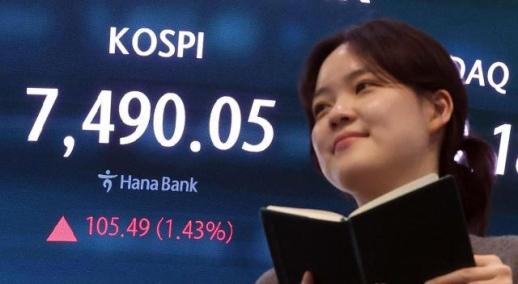 South Korea's Stock Market Surpasses Canada, Ranks Seventh Globally South Korea's stock market has risen to the seventh largest in the world by market capitalization, surpassing Canada. Just ten days after overtaking the UK for eighth place, the KOSPI index has climbed significantly, driven by gains from semiconductor giants Samsung Electronics and SK Hynix. According to Bloomberg, as of June 6, South Korea's market capitalization reached approximately $4.59 trillion, edging past Canada's $4.5 trillion. On April 27, the market capitalization was recorded at $4.04 trillion, allowing South Korea to surpass the UK. Only six countries now have larger market capitalizations than South Korea: the United States ($77.08 trillion), China ($15.27 trillion), Japan ($8.33 trillion), Hong Kong ($7.47 trillion), India ($5.1 trillion), and Taiwan ($4.67 trillion). The KOSPI index has surged 77.7% this year, exceeding last year's impressive growth of 75.5%. This marks the first time since the 1980s that the KOSPI has seen back-to-back years of over 70% growth. The surge in the KOSPI is largely attributed to the semiconductor sector. Since mid-April, Samsung Electronics and SK Hynix have consistently reached record highs, boosting the overall market capitalization. Expectations for further ranking improvements are rising. The KOSPI jumped 5.12% on May 4 and 6.45% on June 6, closing at a new high of 7,490.05. Samsung Electronics rose 2.07% to 271,500 won, while SK Hynix increased by 3.31% to 1,654,000 won. Together, these companies account for 45% of the KOSPI's total market capitalization, valued at 1,587 trillion won and 1,179 trillion won, respectively. Han Ji-young, a researcher at Kiwoom Securities, noted, "The pace of profit improvement is significantly outpacing stock price increases. The consensus for KOSPI's operating profit in 2026 is projected at 124.2%, exceeding the expected stock price growth during the same period." She added that with foreign investors recording net purchases of 6 trillion won since May, the momentum for further gains in the KOSPI, particularly in leading sectors like semiconductors, remains strong.* This article has been translated by AI. 2026-05-07 23:14:11
 -
 Pros’ CFD Buying Surges in Samsung Electronics, SK Hynix as Chip Stocks Rally Professional investors have been concentrating money in large semiconductor stocks that have been leading recent gains in South Korea’s market. Their buying has also been evident in contracts for difference, or CFD, positions, with Samsung Electronics and SK Hynix showing the clearest rise in balances. As of the end of April, both the number of shares and the value of CFD balances in Samsung Electronics and SK Hynix rose sharply among the top CFD holdings, according to the financial investment industry on May 7. CFDs are leveraged products that settle only price differences without owning the underlying shares, and they are available only to professional investors. Samsung Electronics posted the biggest jump. Its CFD balance increased by 296,277 shares from the end of March, up 38%. The balance value rose by 72.123 billion won, a 78% surge. SK Hynix also climbed: its CFD balance increased by 21,689 shares, up 9.9%, while the balance value expanded by 42.456 billion won, up 34%. The inflows were attributed to strong share prices amid expectations for AI semiconductors and high-bandwidth memory, or HBM. Outside semiconductors, Seojin System stood out. Over the past month, its CFD balance saw a net inflow of 1,378,511 shares, and the balance value increased by 69.512 billion won. By balance value, it rose from around the top 20 to about seventh. The move was linked to growth expectations tied to data centers and power infrastructure. Some growth stocks, however, showed profit-taking. APR’s CFD balance fell by 151,248 shares, while its balance value dropped by 28.839 billion won, declines of 37.68% and 38.95%, respectively. Market watchers said recent CFD flows reflect a leadership rally centered on AI and semiconductors. With professional investors rapidly increasing exposure to Samsung Electronics and SK Hynix, they said the concentration of demand in chip stocks could persist for some time. Brokerages have also argued that a re-rating of the memory cycle is still in its early stages, saying there is room for further gains even after Samsung Electronics and SK Hynix broke past record highs. SK Securities on May 7 raised its target price for Samsung Electronics to 500,000 won from 400,000 won a month earlier, about 87% above the current price. It also lifted its target for SK Hynix to 3,000,000 won from 2,000,000 won, implying about 87% upside from the current share price.* This article has been translated by AI. 2026-05-07 14:34:54
 -
 South Korea Stock Market Cap Rises to No. 7 Globally, Passing Canada " height="424" id="imgs_2924918" photo_no="2924918" src="/content/image/2026/05/07/20260507140527632879.jpg" width="640" /> South Korea’s stock market has climbed to seventh in the world by market capitalization, moving up another notch after passing the U.K. about 10 days earlier, Bloomberg data showed. As of the previous trading day, May 6, South Korea’s total market capitalization stood at about $4.59 trillion, topping Canada’s roughly $4.50 trillion, according to Bloomberg’s tally. South Korea now ranks behind the United States ($77.08 trillion), China ($15.27 trillion), Japan ($8.33 trillion), Hong Kong ($7.47 trillion), India ($5.01 trillion) and Taiwan ($4.67 trillion). It is followed by Canada, the U.K. ($4.0 trillion), France ($3.54 trillion), Germany ($3.11 trillion) and Switzerland ($2.66 trillion). As recently as April 27, South Korea’s market cap was $4.04 trillion, narrowly ahead of the U.K. in eighth place, while Canada and Taiwan were still above it. Since then, Samsung Electronics and SK Hynix have repeatedly set record highs, lifting the broader market’s value. The KOSPI jumped 5.12% on May 4 and 6.45% on May 6 to close at 7,384.56. The next target is Taiwan. On May 7, the KOSPI was up 0.63% at 7,433.34 as of about 2 p.m., another record. The index rose 75.5% last year; it is the first time since the late-1980s “three-lows” boom — 1986 (67%), 1987 (93%) and 1988 (73%) — that the KOSPI has posted gains of more than 70% for two consecutive years, the report said. Analysts said South Korea’s global ranking could rise further, arguing that earnings are improving faster than share prices. Han Ji-young, a researcher at Kiwoom Securities, said profit growth is “far outpacing” the market’s rise. “The KOSPI’s 2026 operating profit consensus is 124.2%, exceeding the KOSPI’s gain over the same period,” Han said. He added that with foreign investors posting net buying of about 6 trillion won since May and with earnings momentum improving, the KOSPI has room to extend gains led by bellwether stocks such as semiconductors. 2026-05-07 14:11:40
 -
 Samsung Electronics, SK Hynix jump again in premarket on ceasefire hopes Samsung Electronics and SK Hynix surged again in premarket trading, as stronger U.S. stocks, expectations of easing geopolitical risk in the Middle East and hopes for a reappraisal of the memory-chip cycle lifted sentiment. As of 8:16 a.m. on May 7, Samsung Electronics was up 17,000 won, or 6.39%, at 283,000 won on the Nextrade premarket. SK Hynix rose 93,000 won, or 5.81%, to 1,694,000 won. Overnight, U.S. markets advanced on expectations that an agreement on ceasefire talks between the United States and Iran was nearing. On May 6 (local time), the Dow Jones Industrial Average closed up 612.34 points, or 1.24%, at 49,910.59. The S&P 500 gained 105.88 points, or 1.46%, to 7,365.10, and the Nasdaq composite climbed 512.82 points, or 2.02%, to 25,838.94. The S&P 500 and Nasdaq both set fresh record highs. With AI semiconductor shares led by Nvidia extending gains, buying also flowed into South Korea’s large-cap chipmakers. Some analysts said the market’s reassessment of the memory sector is still in its early stages, arguing there is room for further gains even after Samsung Electronics and SK Hynix broke through record highs. SK Securities on May 7 raised its target price for Samsung Electronics to 500,000 won from 400,000 won a month earlier, about 87% above the current price. It also lifted its target for SK Hynix to 3 million won from 2 million won, implying about 87% upside from the current share price. * This article has been translated by AI. 2026-05-07 08:24:14
 -
 Shinhan raises Hyundai Department Store target, calls it world’s cheapest peer Shinhan Investment Corp. on 7th kept its “buy” rating on Hyundai Department Store and raised its target price 17% to 140,000 won. The brokerage said improving department store conditions should continue, supported by the government’s expansionary fiscal policy, a recovery in consumption and rising sales to foreign customers. Cho Sang-hoon, an analyst at Shinhan Investment, said the rebound in department store purchasing power that began in the third quarter is expected to last through 2026. He called Hyundai Department Store “the cheapest department store company in the world” and Shinhan’s top pick in the sector. Hyundai Department Store posted first-quarter consolidated revenue of 950.1 billion won, down 13.5% from a year earlier, and operating profit of 98.8 billion won, down 12.1%, in line with market expectations. Shinhan said weakness at Zinus persisted, but the core businesses — including department stores and duty-free — offset much of the drag. Excluding a one-off gain at Zinus in the first quarter of last year — a 16.7 billion won reversal of an anti-dumping duty provision — operating profit would have risen 3%, Shinhan said. The department store business continued to grow. Total sales rose 10%, and combined growth in April and May reached 15%. Large-format stores, including The Hyundai, and higher foreign-customer sales drove results. Sales to foreign customers rose 22% from a year earlier, lifting their share to 6.1%. Cho said all product categories were performing well, including high-margin fashion. He added that cost efficiencies and operating leverage from higher sales helped department store operating profit rise for a third straight quarter. Shinhan also cited valuation and shareholder returns. Cho said that despite a recent surge in the stock price, Hyundai Department Store’s projected 2026 price-to-earnings ratio is about 9, more than 30% below peers. He said total dividends are expected to increase from 30.6 billion won in 2024 to 46.4 billion won in 2025 and to more than 50.0 billion won in 2027. He added that the company has completed the cancellation of 4.7% of its treasury shares and plans to cancel another 1.1% bought this year within the year.* This article has been translated by AI. 2026-05-07 08:14:25