
Journalist

Yoo Na-hyun · Kim Yeon-jae
shooting@ajupress.com
-
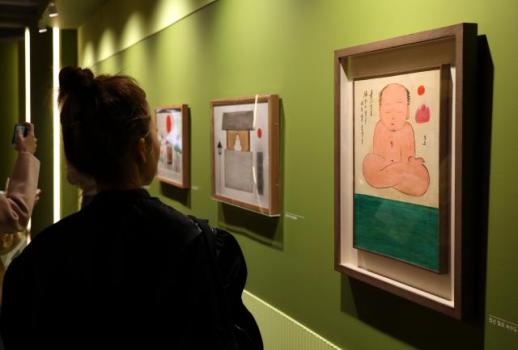 Exhibition in Seoul brings forgotten pioneer of etching and painting into spotlight SEOUL, March 31 (AJP) - A retrospective exhibition commemorating the 100th anniversary of South Korea's late artist Kim Sang-yu opened in Seoul on Wednesday. The exhibition, which runs at the Seoul Museum of Art until Aug. 17, features more than 150 works along with Kim's historical records including personal belongings such as his painting tools, offering a comprehensive overview of his five-decade career in chronological order with six-different themes. Known for his unique etchings and calligraphy-inspired paintings, the artist is regarded as a pioneer of copperplate printing in South Korea, credited with expanding the boundaries of modern art. Beginning with experiments in abstract work in the 1960s, he developed a distinctive visual language across multiple media including woodcuts and oil paintings. Unlike many exhibitions that focus on "star" artists, this exhibition takes a meaningful approach by featuring an artist who was once celebrated but has since faded from public attention. The exhibition comes after Kim has recently regained public interest after K-pop juggernaut BTS' member RM revealed in 2022 that he had purchased one of Kim's works, bringing renewed attention to the artist. 2026-04-01 18:09:41
 -
 Golden homecoming for 'K-Pop Demon Hunters' creators after Oscar win SEOUL, April 01 (AJP) -Fresh off their Oscar triumph, the creators of Netflix’s animated hit K-Pop Demon Hunters returned to Seoul to a warm, almost cinematic homecoming. The press event, held at CGV Yongsan I’Park Mall, brought together director Maggie Kang, co-director Chris Appelhans, singer-songwriter EJAE and producers Lee Yoo-han, Kwak Joong-kyu and Nam Hee-dong — the team behind a film that has blurred the lines between K-pop spectacle and supernatural fantasy. On stage, the mood was part victory lap, part reflection. Clips from the film — neon-lit performances, shadowy demons and high-energy choreography — played behind the creators, echoing the hybrid world they built: one where K-pop idols double as guardians of humanity. The film has become one of Netflix’s standout global titles, drawing attention for its bold fusion of Korean pop culture and fantasy storytelling. That blend carried it through an award season sweep, culminating in wins for best animated feature and best original song at the 98th Academy Awards, alongside honors from the Annie Awards, Critics Choice Awards, Golden Globes and Grammys. Speaking at the event, Appelhans said Korean identity would remain central in a potential sequel. “The Koreanness is the soul of the film,” he said. “We will expand the story based on that.” The filmmakers also credited global audiences for contributing to the film’s success. 2026-04-01 17:11:41
 -
 Tree-planting events begin nationwide ahead of Arbor Day Gyeonggi, March 31 (AJP) - A tree-planting event took place at a park in Suwon, Gyeonggi Province on Tuesday, about a week ahead of Arbor Day. The spring day, which falls on April 5 and marks the 81st anniversary this year, has been observed since 1946 to raise awareness of the importance of trees and forest resources, encouraging tree planting to restore devastated forests and create a more pleasant living environment. Although Arbor Day is no longer observed as a public holiday, having once been designated as such in 1949, central and provincial governments hold various events nationwide each year to highlight the value of forests and support efforts to tackle climate change. 2026-03-31 17:27:06
 -
 S. Korea braces for rain as spring temperature swings disrupt peninsula SEOUL, March 30 (AJP) - Morning air across the Korean Peninsula remained crisp Monday even as the state weather administration warned that a significant frontal system will bring heavy rain and volatile conditions through Tuesday. While Seoul and inland regions recorded morning lows as low as 4 degrees Celsius, daytime highs are expected to surge to 22 degrees, creating a 15-degree thermal gap that officials say poses a legitimate risk to public health and agricultural stability. The disruption marks a sharp transition from the dry, clear conditions of recent days, with clouds expected to thicken by the evening as a weather system strikes Jeju Island and the southern coast with the greatest intensity. The southern resort island of Jeju sits in the direct path of the most severe rainfall, with projections reaching 80 mm across the province and more than 120 mm in high-altitude mountainous regions. Further north, Jeolla and Gyeongsang provinces are bracing for 20 to 50 mm of rain, though coastal hubs including Busan and Ulsan could see totals exceeding 60 mm. Beyond the immediate precipitation, the primary concern for the interior remains the persistence of massive temperature fluctuations. Officials advised the public to take specific precautions to protect their health, noting that such 15-degree swings are particularly taxing on the respiratory system. 2026-03-30 17:37:32
 -
 Damien Hirst's first Seoul solo draws crowds in awe SEOUL, March 30 (AJP) - Damien Hirst (b. 1965) is one of the most influential — and controversial — figures in contemporary art. He rose to prominence in the late 1980s as a leading member of the Young British Artists (YBAs), a group known for pushing boundaries with shock, spectacle and conceptual rigor. His works grappling with death and mortality drew strong public interest in Seoul as visitors filled the National Museum of Modern and Contemporary Art, Seoul on a weekday afternoon, where the exhibition “Damien Hirst: Truth Is Not Absolute, Everything Is Possible” is on view. The exhibition, held at MMCA Seoul, feartures around 50 works spanning more than four decades. It is Hirst’s first solo exhibition in Asia and runs from March 20 to June 28. The show traces the artist’s practice from early experimental works to recent paintings. Major series on display include the Natural History series, featuring animals preserved in formaldehyde, spot paintings composed of repeated dots, and installations resembling medicine cabinets. Works such as a shark suspended in formaldehyde, rows of pharmaceutical objects and canvases filled with colored dots explore themes of life and death, desire and consumption. Inside the gallery, visitors are seen engaging with the works in different ways. Some pause to observe the artworks closely, while others take photographs. The coexistence of viewing and recording has become a common sight. This pattern has been observed in recent exhibitions as well. A similar scene appeared during last year’s exhibition of Ron Mueck, which attracted more than 530,000 visitors. Visitors are increasingly choosing their own pace and method of engagement. MMCA has also expanded its “Culture Day” program. Starting in April, MMCA Seoul and Deoksugung will offer free admission every Wednesday from 6 p.m. to 9 p.m. While Hirst’s works continue to address themes of mortality and contemporary society, audiences are engaging with them in varied ways. Some spend time contemplating the works, while others capture them as images. The exhibition reflects a broader shift in museum-going. Visitors from different generations and nationalities share the same space, each experiencing the exhibition differently. The show not only presents Hirst’s works, but also reveals how audiences interact with art today. 2026-03-30 15:32:28
 -
 Fine dust advisory issued as smog blankets Seoul SEOUL, March 27 (AJP) - An ultrafine dust advisory was issued for Seoul and surrounding areas on Friday, as heavy smog carried by northwesterly winds blanketed the capital, with fine dust levels exceeding 81 ㎍/㎥, according to the Korea Environment Corporation. Such an advisory is issued when PM2.5 concentrations exceed 75 ㎍/㎥ for more than two consecutive hours. The elderly, children, and those with respiratory or cardiovascular diseases are advised to refrain from outdoor activities. Even healthy adults are encouraged to limit time outdoors and wear masks when going outside. Ultrafine particles, roughly one-thirtieth the thickness of a human hair, can penetrate deep into the lungs without being filtered, posing serious health risks. 2026-03-27 15:22:11
 -
 South Korea marks 11th anniversary for fallen naval heroes SEOUL, March 27 (AJP) - A ceremony marking the 11th anniversary of a joint commemoration honoring victims of naval incidents in the West Sea was held in Daejeon on Friday. South Korea has observed the fourth Friday of March as a day of remembrance, holding annual ceremonies since 2016 to honor victims of naval incidents and skirmishes with North Korea including a naval battle near the border island of Yeonpyeong in June 2002, the sinking of the corvette Cheonan in March 2010, and the shelling of the same island in November 2010. About 1,500 people attended including President Lee Jae Myung, the bereaved families of the fallen sailors, their surviving crewmembers, military officials and war veterans as well as residents of five northernmost islands near the Northern Limit Line (NLL), a de facto maritime border with North Korea. In his speech, Lee vowed, "The sacrifices of those who died defending the country will not be forgotten." 2026-03-27 14:54:44
 -
 Nearly 800 cadets commissioned in Iksan Iksan, March 26 (AJP) - About 788 cadets were commissioned as non-commissioned officers (NCOs) at a ceremony at a military academy in Iksan, North Jeolla Province on Thursday, after completing about 12 weeks of training. According to the army, it was the largest class in the past five years. Of the 788 newly commissioned NCOs, 579 were selected through a civilian recruitment program including 232 women, while 209 were former enlisted soldiers. The Army attributed the increase to improved service conditions along with stronger efforts to recruit more cadets. They will undergo training tailored to their duties and responsibilities before being assigned to military units across the country including front-line positions. 2026-03-26 17:59:16
 -
 BTS may be offstage, but Seoul still hums SWIM SEOUL, March 26 (AJP) -The concert is over, but Seoul has yet to come down from the high of BTS. At the courtyard of MMCA Seoul, the “Love Quarter” still pulses with the afterglow of the group’s comeback, its energy spreading in gentle waves. Inside the blue “BTS Sound Cube,” BTS’ new song “SWIM” plays as ribbons flutter in the wind like water in motion. Stepping into the installation, visitors are invited to feel the music not just through sound, but through space and movement. The installation is part of the “BTS THE CITY ARIRANG SEOUL” stamp rally, an interactive program that connects BTS-linked sites across the city and encourages fans to complete missions along the way. While the comeback concert at Gwanghwamun Square ended on March 21, the “BTS Sound Cube” will stay open through April 19, allowing the city to hold on a little longer. 2026-03-26 17:00:46
 -
 Changdeokgung Palace opens doors and windows to usher in spring SEOUL, March 25 (AJP) - A two-week-long event to soak in the atmosphere of spring is underway at Changdeokgung Palace in central Seoul, welcoming visitors who want to enjoy the historic royal palace with flowers in bloom. According to the Korea Heritage Service, the event, under the banner of "Letting in Light and Breeze at Changdeokgung," which kicked off last Tuesday, runs until April 5 and opens "changho" or the traditional windows and doors of palace buildings, to visitors. Changhos were installed in windows and doors to allow access, and they also help preserve buildings by allowing light into interiors and ensuring proper air circulation. During the event, visitors can tour the palace's historic buildings with all windows and doors open. Daejojeon, a major hall at the palace that served as the main living quarters of the king and the queen's office, has also been opened following the recent completion of restoration work. 2026-03-25 17:50:19