

Journalist

Park Seungho
shpark0099@ajunews.com
-
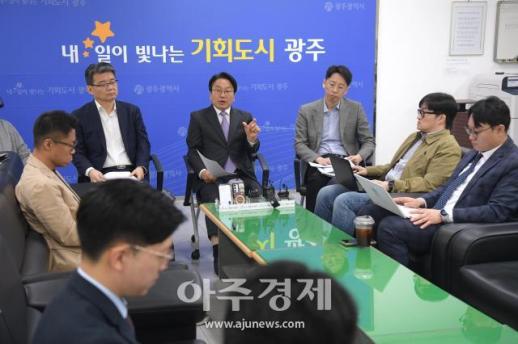 Gwangju Mayor Kang Ki-jung Vows to Wrap Up Remaining Work as City’s ‘Last Mayor’ Kang Ki-jung, mayor of Gwangju, said April 21 that he will work to properly wrap up the city’s remaining tasks as the “last mayor” of Gwangju Metropolitan City. Speaking with reporters over tea at City Hall, Kang said he had recently visited sites across Gwangju and South Jeolla Province and “once again felt the weight of integration.” He said he would closely review city affairs and “firmly bring Gwangju Metropolitan City’s history to a close.” Kang also laid out 10 key tasks he plans to pursue during the remainder of his term. They include a constitutional amendment related to May 18, finalizing subway station names, preparing to launch an integrated special city, and paying relief funds for damage tied to high oil prices. He also cited an AX demonstration valley, pilot operations for self-driving cars, attracting corporate investment, and accelerating preparations to relocate the military airport. Kang said he hopes to share “good news” with residents about a May 18 constitutional amendment alongside next month’s May 18 commemoration ceremony planned at May 18 Democracy Square and the reopening ceremony for the restored former South Jeolla Provincial Office building. He added that, with what he called an important moment approaching ahead of the nation’s first metropolitan-level integration, he would make sure necessary work is not overlooked. * This article has been translated by AI. 2026-04-21 16:42:43
 -
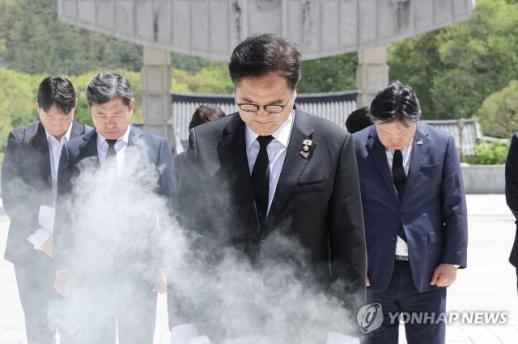 National Assembly Speaker Woo Won-shik urges PPP to back constitutional amendment on May 18 spirit National Assembly Speaker Woo Won-shik said the spirit of the May 18 movement left South Korea with a historic lesson that “no power can defeat the people,” and urged the People Power Party to join a parliamentary vote on a constitutional amendment reflecting that spirit. According to Yonhap News Agency, Woo visited the May 18 National Cemetery in Unjeong-dong, Buk-gu, Gwangju, on April 21 and reiterated that the May 18 spirit should be included in the preamble to the Constitution. On the National Assembly’s vote on the amendment, Woo said it was “regrettable” that the People Power Party opposes it as a party line. “They have all promised it, and they have come here and made countless pledges,” he said. “No matter how I think about it, there is absolutely no reason for the People Power Party to oppose it.” “This is no longer a time for promises, but a time for action,” Woo said, arguing the bill could pass if lawmakers are allowed a free vote. After laying flowers and burning incense at the cemetery, Woo visited the newly renovated former South Jeolla provincial government building in Dong-gu, Gwangju. “The restored provincial office is truly meaningful, and the intensity, devastation, resolve and anger of that time are etched into it as they were, leaving my heart heavy,” he said. “I look forward to the day the May 18 spirit is proudly written into the Constitution’s preamble.” Woo has repeatedly called for constitutional revision to include the May 18 spirit in the preamble and to strengthen National Assembly control over martial law. Leaders of six parties, excluding the People Power Party, submitted a constitutional amendment bill to the National Assembly on April 3 in the names of 187 lawmakers, including the provision on the May 18 spirit. Passage requires approval by at least two-thirds of the 295 sitting lawmakers, or 197 votes. That would require support from nine to 10 People Power Party lawmakers. To hold a national referendum on the amendment on the June 3 local election day, the bill must be approved by the National Assembly by May 10. * This article has been translated by AI. 2026-04-21 16:28:40