
Journalist

Choi Song-hee
solarchoi@ajunews.com
-
 LG Electronics Shares Surge Amid Optimism for AI and Robotics LG Electronics saw its shares hit the daily limit increase as investor optimism grew around its new robotics and artificial intelligence (AI) ventures. The company’s shift away from a traditional home appliance focus has renewed expectations for growth, significantly improving investor sentiment. On May 21, the Korea Exchange reported that LG Electronics' stock closed at 235,000 won, up 54,000 won (29.83%) from the previous trading day. The surge in buying interest is attributed to expectations surrounding the expansion of its physical AI-related businesses, including humanoid robots, industrial automation solutions, and AI-based smart home technologies. The company has been re-evaluated as a beneficiary of the global expansion in AI infrastructure investment, leading to a rapid influx of capital. Additionally, the recent perception of being undervalued has contributed to a rebound in buying activity. The influx of foreign and institutional investors has further amplified the upward momentum. Market analysts suggest that this sharp rise in LG Electronics' stock is not merely a short-term event but reflects broader expectations for structural changes in the company amid an AI transition. There are predictions that the expansion of its robotics and B2B (business-to-business) operations could lead to a long-term re-evaluation of its valuation. Earlier, Kim Min-kyung, a researcher at Hana Securities, noted, "Despite a challenging operating environment, the company has secured profit resilience through comprehensive cost structure improvements and efficient marketing spending. At the same time, it is aggressively pursuing new business opportunities in robotics, solidifying its future growth drivers." He added, "The rapid increase in new orders for data center cooling solutions, along with discussions for collaboration with NVIDIA on physical AI, AI data centers, and mobility, are creating strong momentum for the company's AI-related business initiatives."* This article has been translated by AI. 2026-05-21 21:01:13
 -
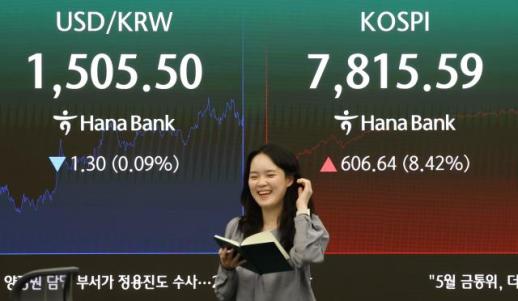 KOSPI Surges Above 7800 as Foreign Investors Continue Selling The KOSPI index surged above 7800 for the first time since April 1, climbing more than 8% amid easing geopolitical tensions in the Middle East, a resolution in labor negotiations at Samsung Electronics, and strong performance from Nvidia. According to the Korea Exchange, the KOSPI closed at 7815.59, up 606.64 points (8.42%) from the previous trading day, marking the largest single-day gain in history. Kang Jin-hyuk, an analyst at Shinhan Investment Corp, stated, "The resolution of uncertainties surrounding the Samsung Electronics strike, Middle East tensions, and Nvidia's earnings has boosted risk appetite, leading to a strong upward trend in the index. Most sectors, including secondary batteries, biotech, and robotics, rebounded significantly." Lee Kyung-min, an analyst at Daishin Securities, noted, "Increased institutional buying and a stabilization in foreign selling have expanded the gains. The negative pressures that had been weighing down the market have eased, resulting in a strong rebound." In the securities market, institutions purchased over 3.2 trillion won worth of stocks, driving prices higher, while individuals sold approximately 2.8 trillion won. Foreign investors continued their selling streak for the 11th consecutive trading day, offloading around 400 billion won in stocks. Notably, Samsung Electronics reached a record high, closing at 299,500 won, up 8.51%. SK Hynix also recovered, rising 11.17% to 1,940,000 won. In the KOSPI market, nearly all sectors rose, particularly semiconductors and automobiles. The electric and electronics sector increased by 9.69%, transportation equipment and parts by 9.10%, manufacturing by 8.96%, insurance by 8.63%, machinery and equipment by 8.50%, retail by 8.32%, securities by 7.51%, finance by 7.01%, construction by 6.30%, and electric and gas by 5.71%. Samsung affiliates saw significant gains, with Samsung Life rising 13.78%, Samsung Electro-Mechanics up 13.48%, and Samsung C&T increasing by 12.96%. Hyundai Motor Group stocks also surged, with Hyundai Mobis up 25.23%, Hyundai Motor rising 12.50%, and Kia increasing 12.38%. LG Electronics hit its upper limit, while LG Electronics preferred shares rose by over 26%. The KOSDAQ index closed at 1105.97, up 49.90 points (4.73%) from the previous trading day. In the KOSDAQ market, foreign investors purchased 160 billion won, and institutions bought 140 billion won, supporting the index, while individuals showed a selling trend of nearly 300 billion won. EcoPro BM, the top KOSDAQ stock by market capitalization, rose 10.36%, while Iot Technics surged 18.83%, Rainbow Robotics increased by 16.46%, and Wonik IPS rose by 11.97%.* This article has been translated by AI. 2026-05-21 18:46:50
 -
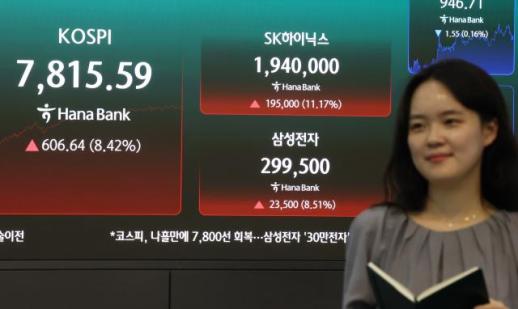 KOSPI Soars as Market Reacts to Positive Developments It was a day filled with positive news. Following a dramatic resolution in negotiations involving Samsung Electronics, strong earnings from Nvidia, and hopes for progress in the Middle East ceasefire, the stock market saw a significant rebound on May 21. The KOSPI index rose by 606 points, marking an increase of 8.42%, the highest since April 1. The total market capitalization of the KOSPI surged nearly 500 trillion won, from 5904 trillion won the previous day to 6396 trillion won today. The KOSPI opened at 7486.37, up 3.85%, and continued to climb throughout the day, reaching a peak of 7819.23. It closed at 7815.59, the highest level since May 14. The KOSDAQ also finished strong, up 49.90 points (4.73%) at 1105.97, after starting at 1085.30, a 2.77% increase, and peaking at 1115.66. The semiconductor sector showed remarkable strength. Early in the session, investor sentiment focused on major semiconductor stocks like Samsung Electronics and SK Hynix, prompting a trading halt due to excessive buying. Samsung Electronics recorded over 10 trillion won in trading volume, with foreign and institutional investors net buying more than 1 trillion and 773 billion won, respectively. SK Hynix saw institutional net purchases exceeding 1.4 trillion won. Samsung Electronics experienced a significant surge, closing at 299,500 won, an 8.51% increase from the previous day. In pre-market trading, it even reached 300,000 won, up 6.95%. The market interpreted the resolution of a potential strike, just hours before it was set to begin, as a relief for investors. SK Hynix also surged by over 11%, reaching 1,900,000 won. The rise of Samsung Electronics and SK Hynix positively impacted other stocks, including SK Square, Samsung Electronics preferred shares, Samsung Life Insurance, and Samsung C&T. LG Electronics benefited from the KOSPI's surge and expectations related to its robotics value chain, closing at the daily limit of 235,000 won. The market's rebound was attributed to a calming of U.S. Treasury yields and international oil prices, which mirrored the upward trend in the New York stock market. Additionally, U.S. President Donald Trump mentioned that negotiations with Iran are in the final stages, further easing geopolitical risks. Nvidia, a global leader in AI, reported earnings that exceeded market expectations, igniting a rally in tech stocks. Nvidia has set a new revenue record for 12 consecutive quarters, with adjusted earnings per share (EPS) of $1.87, surpassing Wall Street's consensus and reaffirming the momentum of AI growth. KOSDAQ leading stocks also saw gains. Among the top market cap stocks, EcoProBM rose by 10.36%, reclaiming the top position. EcoPro and Rainbow Robotics increased by 9.35% and 16.46%, respectively. Alteogen fell by 2.23%.* This article has been translated by AI. 2026-05-21 18:40:08
 -
 KOSPI Surges Past 7700 After Four Days of Decline, Driven by Samsung and SK Hynix Gains The KOSPI index, which fell below 7100 after initially surpassing 8000 on May 15, rebounded sharply after four days of decline, breaking through the 7700 mark. As of 12:49 PM on May 21, the KOSPI was up 7.66% from the previous trading day, reaching 7761.43. Early in the session, the index surged, triggering simultaneous buy-side circuit breakers for both KOSPI and KOSDAQ. Investor sentiment improved following a tentative wage agreement reached between labor and management at Samsung Electronics, coupled with Nvidia's earnings report that exceeded market expectations. Additionally, President Donald Trump indicated that negotiations with Iran were nearing completion, contributing to a decline in international oil prices and U.S. Treasury yields, which positively affected the stock market. In the securities market, institutional investors purchased over 1.4 trillion won in stocks, driving the index higher. Foreign investors sold about 1 trillion won, while individual investors sold around 400 billion won, realizing profits. Samsung Electronics, which resolved its labor negotiations dramatically the previous night, saw its shares soar by over 8%, touching 300,000 won early in the session. SK Hynix's stock rose 11.06% to 1,938,000 won. Samsung Electro-Mechanics also experienced a surge of over 12% after announcing a 1.5 trillion won supply contract for silicon capacitors with a global company. Samsung Life Insurance and Samsung C&T rose by 12% and 11%, respectively. Hyundai Motor Group stocks also performed well, with Hyundai Motor up 9% and Kia up over 11%. Kim Seok-hwan, a researcher at Mirae Asset Securities, noted, "The agreement at Samsung Electronics has led to a broad rally among its affiliates. The Hyundai Motor Group is also showing strength due to expectations surrounding its Atlas business roadmap and vertical integration into mass production." The KOSDAQ index opened 29.23 points (2.77%) higher at 1085.30 and, as of 12:49 PM, was up 5.07% at 1109.61 compared to the previous trading day. In the KOSDAQ market, foreign investors were net buyers of 130 billion won, while institutions bought 160 billion won. Individual investors sold over 280 billion won. Top KOSDAQ stocks also saw gains, including Alteogen (0.70%), EcoProBM (10.58%), EcoPro (10.36%), Rainbow Robotics (15.20%), Kolon TissueGene (3.56%), Samchundang Pharm (2.45%), Lino Biotech (6.15%), Rigakem Bio (3.62%), HLB (2.94%), and ABL Bio (4.70%). MakinaRax, which successfully debuted on the stock market with a "double-up" (quadrupling its initial public offering price), continued to rise by over 30%, reaching its upper limit today.* This article has been translated by AI. 2026-05-21 14:37:07
 -
 Samsung Electronics Shares Surge After Labor Agreement Samsung Electronics' stock has risen more than 6%. This surge follows a tentative wage agreement reached between management and labor unions, alleviating fears of a total strike and boosting investor sentiment. According to the Korea Exchange, as of 10:29 a.m. on May 20, Samsung's shares were trading at 293,000 won, up 6.16% from the previous day. During pre-market trading, the stock even touched 300,000 won. The sharp increase in Samsung's stock price is attributed to the tentative wage agreement reached late on May 21, after final negotiations mediated by Minister of Labor Kim Young-hoon. Previously, on May 14, Samsung's stock had approached the 300,000 won mark but dropped 6.76% due to prolonged disputes over performance bonuses and macroeconomic uncertainties. Notably, foreign investors sold off 7.8621 trillion won worth of Samsung shares between May 15 and 20. Han Ji-young, a researcher at Kiwoom Securities, stated, "The news of the tentative agreement in labor negotiations has eased strike risks, creating a positive supply-demand environment, particularly for semiconductor stocks." Analysts are optimistic about Samsung's performance, raising their target prices based on anticipated improvements in earnings and favorable memory market conditions. Shinhan Investment Corp. raised its target price by 83.3% to 550,000 won. Analyst Kim Hyung-tae noted, "The expected rise in memory prices, stable earnings visibility from long-term contracts, and expectations for enhanced shareholder returns have all contributed to this outlook, alongside the resolution of labor-related concerns." Mirae Asset Securities also increased its target price from 400,000 won to 480,000 won. Analyst Kim Young-gun highlighted that the growth rates for server and enterprise solid-state drives (SSDs) in May were 22.3% and 41.5%, respectively, showing additional growth compared to the previous month. On the same day, Korea Investment & Securities raised its target price to 570,000 won, the highest among brokerages, in light of expectations for a significant increase in memory prices in the second quarter. Chae Min-sook, a researcher at Korea Investment & Securities, stated, "We have revised our forecast for the average selling price increase of general-purpose DRAM from 30% to 60% for the second quarter, leading us to raise our operating profit estimates for Samsung Electronics to 377 trillion won and 573 trillion won for this year and next year, respectively."* This article has been translated by AI. 2026-05-21 12:15:00
 -
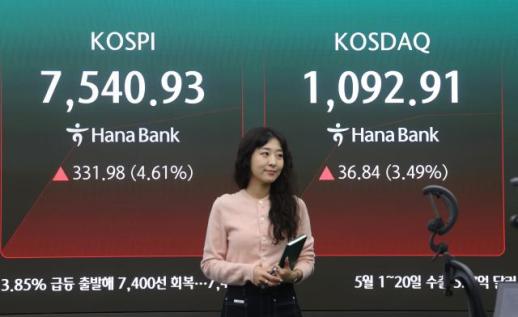 KOSPI Rebounds Above 7500 Amid U.S. Semiconductor Rally and Samsung Labor Agreement The KOSPI index surged over 4% in early trading on May 21, reclaiming the 7500 mark, driven by a strong performance in U.S. semiconductor stocks and positive results from NVIDIA. Optimism surrounding progress in negotiations between the U.S. and Iran contributed to stability in international oil prices and market interest rates, further enhancing investor sentiment in the semiconductor sector following the resolution of labor negotiations at Samsung Electronics. According to the Korea Exchange, as of 9:06 a.m., the KOSPI index rose by 321.19 points (4.46%) to reach 7530.14. The index opened at 7486.37, up 277.42 points (3.85%), and climbed as high as 7551.36, an increase of 342.41 points (4.75%). Seo Sang-young, a researcher at Mirae Asset Securities, stated, "The market has reaffirmed that expectations for growth in the artificial intelligence (AI) industry remain strong, as evidenced by NVIDIA's performance." However, he noted, "Concerns about the sustainability of capital expenditure increases among hyperscalers, which the market has consistently questioned, remain unresolved. Particularly, recent big tech companies are expanding investments in AI infrastructure through bond issuance despite a slowdown in free cash flow, making the monetization of AI services and verification of investment returns increasingly important going forward." In the securities market, foreign investors are net sellers, offloading 472.2 billion won, while individuals and institutions are net buyers, purchasing 459.1 billion won and 21.5 billion won, respectively. Among the top market capitalization stocks, Samsung Electro-Mechanics surged by 11.22%. Samsung Electronics, the largest company by market cap, rose 5.43% to 291,000 won, while SK Hynix, the second-largest, increased by 4.01% to 1,815,000 won. SK Square gained 6.41%, and Samsung Life Insurance rose 10.26%. Hyundai Motor climbed 4.73%, and Doosan Enerbility increased by 7.40%. LG Energy Solution rose 2.47%, while HD Hyundai Heavy Industries saw a modest increase of 0.63%. The KOSDAQ index also saw gains, rising 43.25 points (4.10%) to 1099.32. Individuals and foreigners were net buyers, purchasing 9.4 billion won and 6.2 billion won, respectively, while institutions were net sellers, offloading 12.8 billion won. Rainbow Robotics increased by 7.21%. ABL Bio and Samchundang Pharm also saw gains of 5.46% and 5.33%, respectively. MakinaRax, which successfully debuted on the stock market with a fourfold increase from its initial public offering price, continued its upward trend, hitting the upper limit early in the trading session.* This article has been translated by AI. 2026-05-21 10:18:33
 -
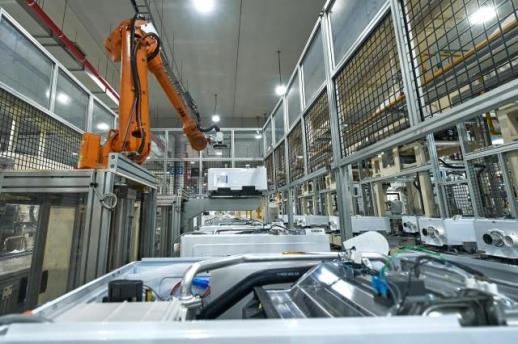 Shinhan Investment Corp. Projects Continued Profitability for Kyungdong Navien Shinhan Investment Corp. stated on May 21 that considering changes in tariff rates and related non-operating income, Kyungdong Navien's profitability is expected to improve continuously in the second quarter and throughout the year. The firm maintained its target stock price at 89,000 won and its investment recommendation at 'Buy.' Research analyst Heo Seong-kyu noted, "The strong performance in the first quarter of this year is different from the favorable results due to advance orders in the second quarter of last year. The primary reason for the increase in performance is attributed to the decline in the general tariff rate." He added, "In the second quarter of this year, a change in the implementation of tariffs on steel and aluminum is expected to result in an additional decrease of about 2-3% in tariff rates. The tariff changes are currently undergoing refund procedures for last year's implementation amounts, and additional contributions to non-operating income are anticipated." He emphasized that the company is expanding its residential HVAC (heating, ventilation, and air conditioning) product line, with significant sales activities underway in the second quarter. Heo explained, "The product lineup includes hydro furnaces, heat pumps, air conditioners, and air handlers. The average price of these products is similar to that of existing condensing water heaters, which means that the expanded product mix will positively impact consolidated profitability in the medium to long term." He also noted, "This gradual change is expected to reduce the seasonal volatility of quarterly performance associated with existing water heaters concentrated in winter." Additionally, Heo assessed that Kyungdong Navien is undervalued both relatively and absolutely. He stated, "There is no reason for a discount compared to competitors and historical figures, indicating that both relative and absolute valuations are low. There are factors that could lead to performance increases depending on profitability in the second half of the year."* This article has been translated by AI. 2026-05-21 08:39:28
 -
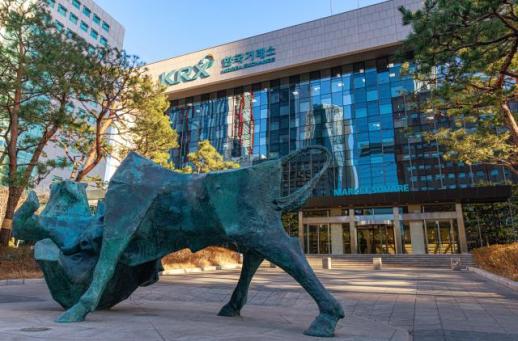 KOSPI Companies Report 175% Increase in Operating Profit, Excluding Samsung and SK Hynix This year, the KOSPI index has risen by 74%, driven by ample liquidity and the so-called "Samsung and SK Hynix effect." This trend is reflected in the earnings of KOSPI-listed companies. In the first quarter, the operating profit of KOSPI-listed companies increased by 175% compared to the same period last year. However, excluding Samsung Electronics and SK Hynix, the increase was only about 2%. According to the Korea Exchange's report on the first-quarter earnings of December fiscal year-end companies, the consolidated operating profit of 639 listed companies reached 156.3194 trillion won, marking a 175.83% increase year-on-year. Revenue was 927.5409 trillion won, and net profit rose by 141.4436 trillion won, reflecting increases of 19.49% and 177.82%, respectively. The consolidated operating profit margin improved to 16.85%, up 9.55 percentage points from the previous year, while the net profit margin rose to 15.25%, an increase of 8.69 percentage points. Samsung Electronics and SK Hynix continued to dominate, with their first-quarter revenue at 157 trillion won and operating profit at 84 trillion won, accounting for 31.73% of total revenue and 77% of operating profit. Excluding these two companies, the remaining listed firms saw revenue and operating profit increase by 2.36% and 2.05%, respectively. Among various sectors, 12 industries, including electronics and non-metallic minerals, reported increased operating profits, while eight sectors, including entertainment and culture, and paper and wood, experienced declines. The debt ratio of KOSPI-listed companies was 108.74%, a decrease of 1.64 percentage points compared to the end of last year. Among the 639 companies analyzed based on consolidated financial statements, 504 reported net profits, a 3.60% increase from the previous year. In the KOSDAQ market, six out of ten listed companies reported profits, with significant increases in operating and net profits. According to the Korea Exchange, the combined operating profit of 1,273 KOSDAQ companies reached 4.1284 trillion won, up 78.17% year-on-year. Revenue increased by 21.72% to 84.9461 trillion won, while net profit surged by 171.22% to 4.4342 trillion won. The operating profit margin and net profit margin improved to 4.86% and 5.22%, respectively, up 1.54 percentage points and 2.88 percentage points from the previous year. The debt ratio for the first quarter was 122.03%, an increase of 9.23 percentage points compared to the end of last year.* This article has been translated by AI. 2026-05-19 17:15:00
 -
 Hanwha Aerospace Shares Rise 5% Amid Canadian Military Vehicle Replacement News Shares of Hanwha Aerospace are on the rise, attributed to uncertainties surrounding the U.S.-Iran conflict and news of the Canadian Ministry of Defense's plans to replace aging armored vehicles. As of 2:12 PM on May 19, Hanwha Aerospace's stock was trading at 1,292,000 won, up 65,000 won (5.30%) from the previous trading day, according to the Korea Exchange. The surge in Hanwha Aerospace's stock appears to be influenced by recent reports that the Canadian Ministry of Defense is moving forward with a modernization program for its outdated tanks and armored vehicles. Local media in Canada reported that the ministry has issued a request for information (RFI) to major defense contractors. The Canadian next-generation tank program aims to enhance the performance of existing tanks and select a new main battle tank (MBT) model by 2030. The program targets achieving initial operational capability (IOC) by 2035 and full operational capability by 2037, with an estimated budget of $620 million (approximately 920 billion won). Jae-ho Seo, a researcher at DB Securities, noted, "Despite expectations for continued solid earnings growth, Hanwha Aerospace is entering a correction phase due to declining multiples among its European peers. However, with ongoing growth in orders from Rheinmetall through the first quarter, the K-defense premium is expected to stand out when production capacity is leveraged to fulfill these orders." Yong-jin Byun, a researcher at iM Securities, mentioned, "Following a collaboration agreement signed in February, we have established a partnership this month with Malem Robotics and Hanwha Aerospace Romania for joint participation in the unmanned ground vehicle (UGV) business at the BSDA in Romania. We anticipate actively responding to the increasing demand for unmanned systems from European and NATO countries in the post-war context."* This article has been translated by AI. 2026-05-19 15:04:30
 -
 TMC Secures $8.3 Million Contract for Fiber Optic Cables with U.S. Data Center TMC shares surged after the company announced a significant contract with a U.S. data center and artificial intelligence (AI) infrastructure firm for fiber optic cables. The news has positively influenced investor sentiment. According to the Korea Exchange, as of 10:14 a.m. on May 19, TMC's stock rose by 6,900 won (29.81%) to 30,050 won compared to the previous trading day. TMC confirmed that it has signed a supply contract worth 11 billion won (approximately $8.3 million) for fiber optic cables intended for data centers. The company stated, "This contract represents the largest single fiber optic cable supply agreement secured in the North American data center market." The supplied product is a single-mode MPO-8 backbone cable designed to enable long-distance, high-speed connections of 400G and above in AI and hyperscale data centers. It serves as a critical infrastructure material for ultra-fast data transmission between servers and switches within data centers, essential for next-generation AI training and inference traffic processing. A TMC representative noted, "The total supply volume amounts to 25,000 kilometers of fiber optic cable," adding that the client is a U.S. data center and AI infrastructure specialist, with the end user confirmed to be a global cloud and data center company.* This article has been translated by AI. 2026-05-19 11:48:22