
Journalist

Choi Song-hee
solarchoi@ajunews.com
-
 LS Securities Maintains Daewoo Engineering's Target Price at 45,000 Won LS Securities on May 19 expressed a positive outlook for Daewoo Engineering, citing its competitiveness in nuclear power and LNG, and maintained a target price of 45,000 won with an investment recommendation of 'buy.' Kim Se-ryun, a researcher at LS Securities, stated, "We are estimating the target price based on a sum-of-the-parts (SOTP) valuation, assuming long-term revenue generation from Daewoo Engineering's Team Korea order pipeline, divided into nuclear power and plant and construction sectors." He further analyzed that, assuming a gradual revenue realization from the Team Korea nuclear pipeline, Daewoo Engineering's peak revenue from nuclear power is projected for 2033. According to LS Securities, Daewoo Engineering reported an operating profit of 255.6 billion won in the first quarter, marking a 68.9% increase compared to the same period last year, significantly exceeding the consensus estimate of 116.5 billion won by 119.4%. Kim noted, "The significant turnaround in profits this quarter is primarily due to reflecting a big bath across all business units, including delays and write-offs from unsold properties at the end of last year." He added, "While one-time gains from settlement profits and scheduled cost adjustments also played a role, the rapid turnaround in margins for the housing and plant sectors is encouraging, indicating a recovery in profit strength. We expect strong performance to continue as we monitor margin recovery throughout the year." Kim also highlighted the potential for Team Korea's orders, stating, "With the expected construction contract for Daewoo Engineering's Dukovany nuclear power plant in the Czech Republic, the possibility of securing orders for the second phase of the Ninh Thuan nuclear power plant in Vietnam presents significant momentum for Daewoo Engineering." Additionally, he mentioned, "We are aiming for further orders in global LNG projects in Papua New Guinea, which is significant for enhancing expectations for entering the North American market, including Alaska LNG."* This article has been translated by AI. 2026-05-19 08:46:20
 -
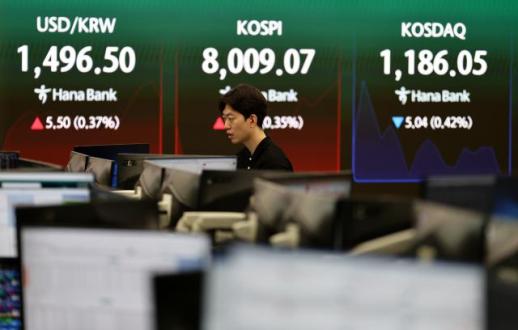 Short Selling Increases Despite Decrease in Short Positions Following the KOSPI's surge past the 8,000 mark, the volume of short selling transactions has risen to approximately 2.8 trillion won. However, during the same period, the balance of securities lending has significantly decreased, indicating a trend that diverges from simple bearish betting. According to the Korea Exchange, as of May 15, the total value of short selling transactions reached 28.558 trillion won, marking a consecutive two-day record above 28 trillion won, following 28.383 trillion won on May 14. The short selling volume had been around 24.597 trillion won on May 13 but showed an upward trend on the 14th and 15th. Foreign investors led the short selling activity, accounting for about 70% of the total with a transaction value of 19.298 trillion won on May 15. For four consecutive days from May 12 to 15, foreign short selling remained around 19 trillion won, indicating an increase in hedging transactions at high price levels. Institutional short selling also saw a resurgence. After a decline to 4.807 trillion won on May 13, institutional short selling values increased again to 8.240 trillion won on May 14 and 8.977 trillion won on May 15. Analysts suggest that this reflects adjustments in positions in anticipation of increased volatility following the KOSPI's rise above 8,000. However, the trend in securities lending appears different from typical early bearish market patterns. According to the Korea Financial Investment Association, the number of shares returned in securities lending on May 15 was 99.16 million, significantly exceeding the number of shares lent out, which was 39.51 million. Consequently, the balance of securities lending dropped from 182.4304 trillion won on May 14 to 170.2727 trillion won on May 15, a decrease of about 12 trillion won. Market analysts note that typically, when confidence in a market downturn strengthens, both short selling and securities lending balances increase. However, in this instance, while short selling has been active, the actual cumulative short positions have decreased, raising the possibility of profit-taking or short covering by existing short sellers. Looking ahead, market observers believe that the trends in foreign futures positions and securities lending balances will serve as additional variables. A securities industry official stated, "The current trend is more about responding to short-term volatility at high levels of the KOSPI rather than aggressive bearish betting. If the decline in securities lending continues, the possibility of a short covering rally cannot be ruled out."* This article has been translated by AI. 2026-05-18 20:10:23
 -
 SAMT Shares Surge on Optimism for AI Semiconductors and Automotive Memory Shares of SAMT have reached their daily limit due to growing expectations for its expansion into artificial intelligence (AI) semiconductors and automotive memory. According to the Korea Exchange, as of 1:47 PM on May 18, SAMT's stock was trading at 18,590 won, up 30.00% from the previous trading day. The stock price, which was in the 7,000 won range last month, has recently surged past the 18,000 won mark. As SAMT's stock price has shown a sharp increase this month, the exchange announced on May 15 that it would designate the company as an investment caution stock starting May 18. Founded in 1990, SAMT is an IT marketing specialist that supplies key electronic components to major global companies, including Samsung Electronics, for manufacturers of smartphones, OLED monitors, and TVs. The company was listed on the KOSDAQ market in 2000. Recently, SAMT has been expanding its business into high-value products such as CMOS image sensors (CIS), automotive memory, and AI semiconductors. The growth in automotive electrification, the AI industry, and the expansion of data centers appear to be driving expectations for future revenue growth and improved profitability. Additionally, as the AI industry expands and the semiconductor and automotive component markets continue to grow, investor sentiment toward SAMT, which operates in distribution and marketing related to these sectors, is also improving.* This article has been translated by AI. 2026-05-18 15:10:51
 -
 SpaceX IPO Schedule Accelerates, Boosting Related Stocks Shares of companies related to SpaceX have surged following news that the space firm, led by Elon Musk, is accelerating its initial public offering (IPO) schedule. As of 10:04 a.m. on May 18, Mirae Asset Venture Investment saw its stock rise by 14.21%, trading at 62,700 won, an increase of 7,800 won from the previous day. Sphere also experienced a jump, with shares up 3,300 won (7.86%) to 45,300 won, while Mirae Asset Securities rose by 0.86% (600 won) to 70,500 won. Earlier reports from Reuters and other international media indicated that SpaceX is expected to launch its IPO on June 12, which is earlier than market expectations that aligned the IPO with Musk's birthday on June 28. In light of this development, BlackRock, the world's largest asset management firm, is reportedly planning to invest up to $10 billion (approximately 15 trillion won) in SpaceX's IPO. On May 16, the U.S. tech publication The Information cited multiple sources stating that BlackRock is discussing a stake investment of between $5 billion and $10 billion through its $536 billion active fund during SpaceX's listing process. SpaceX is engaged in satellite-based internet services through its Starlink project and is developing the Starship spacecraft. Recently, Musk's acquisition of the AI startup xAI has also expanded the company's ventures into artificial intelligence.* This article has been translated by AI. 2026-05-18 12:37:52
 -
 Korea Investment & Securities Raises PSK Target Price by 21% Amid Strong Growth Korea Investment & Securities announced on May 18 that PSK is expected to experience strong performance growth momentum this year and in the medium to long term, as both top-line and bottom-line figures continue to grow. The firm raised its target price for PSK to 160,000 won, an increase of 21%, while maintaining a "buy" rating. Kim Yeon-jun, a researcher at Korea Investment & Securities, stated, "This year, we can expect benefits from the capital expenditures of Samsung Electronics, SK Hynix, and Micron, as well as the resumption of investments by China's CXMT." He added, "This trend is likely to lead to new fab investments, further strengthening PSK's performance growth momentum." Additionally, he noted, "As demand for AI inference spreads into the CPU market, Intel, which has been conservative with its capital expenditures, may increase its CapEx. Intel has signed a consulting contract with Tesla, which is pursuing a terafab, suggesting a strong connection between Intel's value chain and Tesla's terafab value chain." Kim also analyzed that, given PSK's long-standing partnership with Intel, the company is likely to seek additional opportunities through Intel. According to Korea Investment & Securities, PSK's revenue for the first quarter of this year was 156.6 billion won, with an operating profit of 47.2 billion won, exceeding consensus estimates by 19.8% and 46.5%, respectively. The operating profit margin reached 30.1%, an increase of 7.9 percentage points year-on-year and 14.8 percentage points quarter-on-quarter. Kim explained, "With steady orders from domestic and overseas clients, the top line has grown, and the proportion of high ASP clients in the U.S. and China has improved the operating profit margin. The share of overseas clients is expected to remain similar to that of the first quarter throughout the year, indicating that operating profit margins will continue to improve annually." He also stated, "This year, top-line growth is expected to exceed the average growth rate of 30% for the World Federation of Exchanges, along with improvements in profitability due to the increased share of overseas clients."* This article has been translated by AI. 2026-05-18 08:42:00
 -
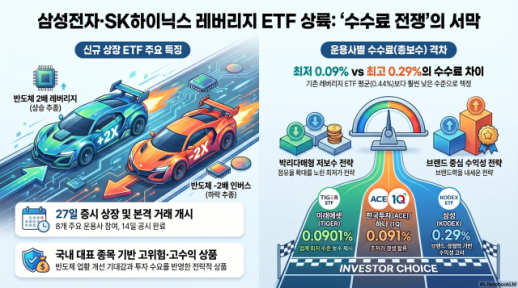 Samsung and SK Hynix Launch Leveraged ETFs Amid Fee Competition Single-stock leveraged and inverse exchange-traded funds (ETFs) based on Samsung Electronics and SK Hynix are set to launch at the end of this month. Major asset management firms are simultaneously introducing related products, intensifying fee competition in the ETF market. According to the financial investment industry on May 15, eight asset management companies, including Samsung, Mirae Asset, Korea Investment, KB, Shinhan, Hanwha, Kiwoom, and Hana Asset Management, completed disclosures for 16 single-stock leveraged and inverse ETFs on May 14. The products are scheduled to be listed on May 27. The upcoming ETFs include leveraged products that aim to double the daily stock price returns of Samsung Electronics and SK Hynix, as well as inverse ETFs that bet on a twofold decline in stock prices. This marks the introduction of high-risk, high-reward products based on leading semiconductor stocks in the domestic market. With similar products launching simultaneously, asset managers are emphasizing fees as a key competitive factor. The total expense ratios for these new products have been set lower than the average annual fee of 0.44% for existing listed equity leveraged ETFs. Mirae Asset Management has proposed the lowest fee, setting the total expense ratio for its TIGER ETF at 0.0901%. Korea Investment Trust Management's ACE ETF and Hana Asset Management's 1Q ETF have also joined the low-fee competition, each setting their fees at around 0.091%. In contrast, the industry leader, Samsung Asset Management, has set the total expense ratio for its KODEX ETF at 0.29%, which is nearly three times higher than the lowest fee offerings. Market analysts suggest that Samsung Asset Management is opting for a strategy focused on profitability, leveraging its market share and brand strength. The financial investment industry anticipates that the launch of these single-stock leveraged and inverse ETFs will intensify competition in the domestic ETF market. Given the recent optimism surrounding the semiconductor sector and increasing investor demand for Samsung Electronics and SK Hynix, interest in related ETFs is expected to grow.* This article has been translated by AI. 2026-05-15 23:12:55
 -
 Korea Financial Group Shares Decline Despite Strong Earnings as KOSPI Drops Shares of Korea Financial Group, which had shown strength earlier in the day, are now declining as the KOSPI index turns sharply downward. As of 2:51 PM on May 15, Korea Financial Group's stock was trading at 257,000 won, down 0.39% from the previous session. At one point, the stock had risen by more than 8%. The stock initially gained traction in the morning as the KOSPI index surpassed the 8,000 mark, buoyed by expectations of improved performance amid a favorable market. However, the KOSPI has since dropped to around 7,400. On May 14, Korea Financial Group reported that its consolidated operating profit for the first quarter of this year reached 1.1063 trillion won, marking a 108.9% increase compared to the same period last year. Revenue rose to 11.9966 trillion won, up 123.7%, while net profit climbed 99.6% to 916.7 billion won. Analysts have raised their target prices for Korea Financial Group. SK Securities increased its target from 399,000 won to 410,000 won, while Daol Investment & Securities and NH Investment & Securities adjusted theirs from 350,000 won and 340,000 won to 400,000 won, respectively. Meritz Securities raised its target from 335,000 won to 365,000 won, and Shinhan Investment Corp. increased its target from 320,000 won to 350,000 won. Samsung Securities also raised its target from 270,000 won to 320,000 won. Jang Young-im, a researcher at SK Securities, stated, "The bullish market is expected to continue into the second quarter, sustaining the growth in brokerage and asset management commission revenues. Korea Financial Group is poised to benefit across all sectors due to the strong stock market, demonstrating robust profit capacity." Yoon Yoo-dong, a researcher at NH Investment & Securities, noted, "While the overall strong performance in the securities industry has made it more challenging to differentiate stock prices, Korea Financial Group's diversified structure with multiple financial affiliates highlights its potential for continued earnings and stock price growth during prosperous periods."* This article has been translated by AI. 2026-05-15 15:18:21
 -
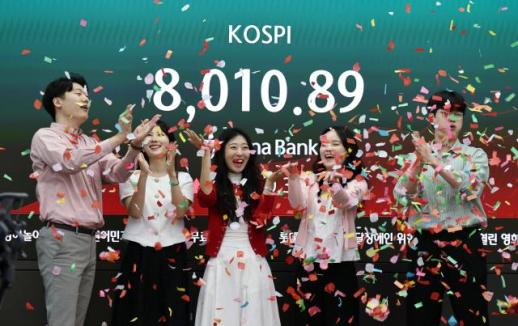 Korean Stock Market Surpasses 8000 Points, Eyes Global Top 5 The KOSPI index has crossed the 8000-point mark for the first time in history, marking a significant milestone for the South Korean stock market. Once labeled as 'Parkspi' due to its undervaluation, the market is now gaining recognition as a key player globally, driven by the semiconductor and artificial intelligence (AI) boom, along with an influx of foreign capital. According to the Korea Exchange, the KOSPI reached an intraday high of 8002.62 at 9:13 a.m. on May 15. The index opened at 7951.75, down 0.37% from the previous day, but managed to turn positive and surpass the 8000-point threshold. Historically, the South Korean stock market has been viewed as undervalued, trapped in a 'Korea Discount' structure. However, recent developments in the AI sector and expectations of a semiconductor supercycle have shifted the market's sentiment dramatically. Strong foreign buying, particularly in major companies like Samsung Electronics and SK Hynix, has propelled the index upward. Improvements in corporate earnings and a trend toward increased shareholder returns have also supported the market's reassessment. Analysts note that major listed companies are enhancing dividends and engaging in stock buybacks, boosting global investor confidence. The financial investment sector is now focusing on the potential for the South Korean stock market to join the ranks of global core markets following the KOSPI's breakthrough of 8000 points. There are expectations that it could rise to become one of the top five markets globally in terms of market capitalization and trading volume, alongside the U.S., China, and Japan. Recently, the market capitalization of the South Korean stock market surpassed that of Taiwan. As of May 11, the Korea Exchange reported a market capitalization of 7084 trillion won, which translates to approximately $4.81 trillion when using an exchange rate of 1472 won to the dollar. In contrast, Taiwan's market capitalization was about $4.34 trillion. However, concerns remain regarding valuation pressures due to the rapid rise, U.S. interest rate policies, and fears of a global economic slowdown. Despite these challenges, there is a prevailing sentiment that global investors are viewing the South Korean stock market more favorably than in the past. A financial industry insider stated, "The KOSPI's breakthrough of 8000 points signifies more than just a record; it indicates that the South Korean stock market is being re-evaluated as a global center rather than just an emerging market."* This article has been translated by AI. 2026-05-15 10:44:16
 -
 LG Electronics Shares Surge Over 15% Amid Robotics Business Hopes LG Electronics' stock price rose by over 15% in early trading, driven by optimism surrounding its new robotics business. According to the Korea Exchange, as of 9:46 a.m. on May 15, LG Electronics shares were trading at 249,000 won, up 14.75% or 32,000 won from the previous trading day. The company's stock has been on the rise since May 8, following a reassessment of its valuation related to the robotics initiative. With significant capital inflow into LG Electronics, shares of the broader LG Group also experienced gains. LG's stock was trading at 137,300 won, up 17.35% or 20,300 won. Additionally, LG Corp. shares rose by 10.53%, while LG Electronics preferred shares increased by 7.56%. Other LG affiliates, including LG CNS (up 6.74%), LG Innotek (up 7.11%), and LG Display (up 3.06%), also showed strong performance, contributing to a collective rise in LG Group stocks. Analysts expressed optimism about the potential expansion of LG Electronics' robotics business. Hana Financial Investment recently raised its target price for LG Electronics to 230,000 won, an increase from its previous estimate. Kim Min-kyung, an analyst at Hana Financial Investment, stated, "Despite the ongoing unfavorable business environment, LG Electronics is expected to secure profit resilience through company-wide cost structure improvements and efficient marketing spending, while aggressively pursuing growth in its robotics-related new business."* This article has been translated by AI. 2026-05-15 10:03:10
 -
 NH Investment & Securities Raises Target Price for Samsung Electro-Mechanics Amid MLCC Price Increases NH Investment & Securities announced on May 15 that it has raised its target price for Samsung Electro-Mechanics from 1 million won to 1.5 million won, a 50% increase, citing the beginning of a price increase cycle for multi-layer ceramic capacitors (MLCC). The firm maintained its "buy" rating on the stock. In a report released that day, analyst Hwang Ji-hyun stated, "With the price increases for some MLCC products starting, we have adjusted our earnings estimates upward." Hwang noted that Samsung Electro-Mechanics plans to raise prices for certain MLCC products aimed at distributors, adding, "Given the recent supply and demand situation, there is a high possibility that price increases will spread to other product lines in the future." She also highlighted that the shipment-to-order ratio (BB ratio) for Japanese companies Murata and Taiyo Yuden reached 1.36 and 1.31, respectively, in the first quarter of 2026, marking the highest levels in five years since 2021. Both companies reported strong ongoing demand for AI-related MLCCs, with operating rates expected to remain above 90% throughout the year. Hwang explained that AI servers are increasingly adopting Integrated VR (IVR) structures, which integrate power supply paths with CPUs and GPUs, or Vertical Power Delivery (VPD) structures that stack components vertically. "In their earnings announcements, Samsung Electro-Mechanics, Murata, and Taiyo Yuden all mentioned this trend," she said. She added, "This requires technologies to mount MLCCs in an array format on substrates or embed them internally. Unlike other MLCC manufacturers, Samsung Electro-Mechanics has a packaging division, which is expected to enhance its competitive edge through synergy."* This article has been translated by AI. 2026-05-15 08:50:17