
Journalist

Choi Song-hee
solarchoi@ajunews.com
-
 KOSPI Hits Record High Amid Surge in Short Selling Activity As the KOSPI continues its upward rally, funds betting on stock declines through short selling are rapidly increasing. The balance of stock lending transactions has surpassed 180 trillion won for the first time, indicating an unusual trend where short selling expands even amid a rising market. According to the Korea Financial Investment Association and the Korea Exchange, as of May 7, the balance of stock lending transactions reached 179.67 trillion won, and on May 6, it was recorded at 180.63 trillion won, marking the first time it exceeded 180 trillion won. Samsung Electronics and SK Hynix topped the list of the top 10 stocks with the highest lending balances, at 21.71 trillion won and 21.66 trillion won, respectively. The lending balance refers to the amount of stocks borrowed by investors for short selling or hedging that has not yet been repaid. It is typically interpreted as an indicator of funds waiting for short selling. Additionally, major stocks with significant short selling positions include Hyundai Motor, HD Hyundai Heavy Industries, and Hanmi Semiconductor. Hyundai Motor's short selling balance is approximately 1.68 trillion won, while HD Hyundai Heavy Industries has seen its balance nearly double to about 1.38 trillion won compared to the previous month. Hanmi Semiconductor also has a short selling balance of about 1.33 trillion won, making it a notable stock for short selling bets. The short selling balance represents the amount of actual short positions that have not yet been closed. While the lending balance indicates potential future short selling, the short selling balance reflects the actual bets against stock prices. Retail investors are also continuing to bet on declines using inverse exchange-traded funds (ETFs), which profit when the index falls. According to the exchange, the KODEX 200 Futures Inverse 2X ETF saw a net purchase of about 529.9 billion won by individual investors over the past month, placing it among the top ETFs for net purchases. The trading volume is also substantial. The recent monthly average trading value of the KODEX 200 Futures Inverse 2X ETF is approximately 5.06 trillion won, with a single-day trading volume of about 546 billion won on May 8. The trading volume has exceeded 4.2 billion shares, establishing it as a leading short-term trading stock in the domestic ETF market. However, as the KOSPI continues to rise, actual returns from these investments have been disappointing. The recent one-month return for the KODEX 200 Futures Inverse 2X ETF is around -43%, and over three months, it has shown a decline exceeding 66%. This reflects the inverse structure of the ETF, which moves in the opposite direction of the KOSPI's rise. Market analysts note that despite the ongoing rally, trading in inverse ETFs remains steady. This suggests a coexistence of investor demand for both expectations of index increases and preparations for potential short-term corrections, leading to a divergence between the spot market and the derivatives and ETF markets.* This article has been translated by AI. 2026-05-11 03:27:26
 -
 ETF Assets Surpass 450 Trillion Won, Stock ETFs Break 200 Trillion Won Barrier As the domestic stock market gains momentum, the net assets of stock-type exchange-traded funds (ETFs) have surpassed 200 trillion won for the first time. Overall net assets have also exceeded 450 trillion won. According to financial information provider FnGuide, as of May 7, the total net assets of all domestic ETFs reached 456 trillion won. Of this, the net assets of domestic stock-type ETFs, which invest in companies listed in South Korea, amounted to 212 trillion won, marking the first time this figure has exceeded 200 trillion won. Among the 1,099 ETFs available (including domestic stock, foreign stock, domestic bond, and mixed types), there are 413 domestic stock-type ETFs. The net assets of domestic stock-type ETFs were only around 40 trillion won at the end of 2024, but surged to 93 trillion won last year and have rapidly approached 200 trillion won in just about four months this year. The net assets of domestic stock-type ETFs account for 3.47% of the KOSPI market capitalization of 6,138 trillion won, reaching an all-time high. This proportion was only 1.99% at the end of 2023 and remained at 2.08% in December 2024, but has jumped by 0.81 percentage points this year alone after ending last year at 2.68%. Domestic stock-type ETFs represent 46.6% of all ETFs. As the KOSPI continues to set new all-time highs, funds have rapidly flowed back into domestic stock-type ETFs. This trend indicates a clear shift in investment demand from overseas assets to the domestic market. New investors, often referred to as 'stock beginners,' are actively entering the rising market through domestic stock-type ETFs, which are seen as more accessible due to their diversification benefits compared to individual stock investments. ETFs allow investors to participate in the overall market with a smaller amount of capital. As of the end of April, there were 302,669 investors under the age of 20 investing in ETFs through the five major securities firms, a 37% increase compared to the end of last year. This suggests that younger investors are opting for index and theme-based ETFs to capitalize on market uptrends rather than selecting individual stocks. The expansion of ETF investments in retirement markets, such as pension funds, also appears to be driving the increase in net assets. Additionally, the market is expected to grow further with the upcoming launch of single-stock leveraged ETFs on May 22. Park Woo-yeol, a researcher at Shinhan Investment Corp, stated, "With Samsung Electronics and SK Hynix 2x ETFs already listed and traded on overseas exchanges, we expect to address the outflow of leveraged investment demand caused by regulatory asymmetries."* This article has been translated by AI. 2026-05-11 03:14:04
 -
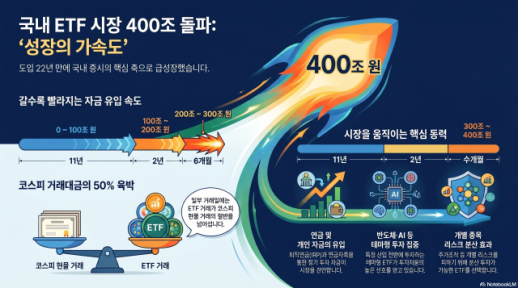 South Korea ETF Assets Top 400 Trillion Won as KOSPI Rally Fuels Shift From Stock Picking "We used to look for which stock would rise. Now we watch which ETF the money is flowing into." That line is increasingly common in Seoul’s Yeouido financial district as South Korean stocks extend a rally and the exchange-traded fund market expands quickly. Rather than picking individual names, more money is moving into ETFs that track indexes or broad sectors, shifting the market’s center of gravity. Industry officials say the domestic ETF market is accelerating even as external uncertainty, including war in the Middle East, persists. As of May 7, Korea Exchange data and other sources show domestic ETF net assets topped 400 trillion won last month. After ETFs were introduced in South Korea in 2002, it took 11 years for net assets to exceed 100 trillion won. It then took two years to reach 200 trillion won and six months to reach 300 trillion won. Net assets have now surpassed 400 trillion won within a few months, underscoring the faster pace of growth. ETF trading jumps with KOSPI rally Demand has risen as the KOSPI has repeatedly set record highs. Investors are increasingly favoring ETFs that provide exposure to the broader market and industries, rather than trying to manage volatility in individual stocks. A brokerage official said inflows are rising sharply as investors use ETFs to bet on the overall market trend in a rising market. Trading has also surged. On some sessions, ETF turnover has grown to more than half the value traded in the KOSPI cash market. Inflows have continued into semiconductor, artificial intelligence and secondary-battery ETFs, and trading has been active in leveraged ETFs that bet on bigger gains. Pensions and retail inflows reshape the market Retail investors and pension money are key drivers. ETF investing has expanded rapidly in individual retirement pension (IRP) and pension savings accounts, bringing steady long-term funds into the market. Analysts also point to financial regulators’ moves to strengthen responses to stock manipulation. As caution grows about risks tied to single-stock investing, some investors are leaning more toward ETFs for their diversification benefits. Competition among asset managers is intensifying. Major firms are rolling out a range of thematic ETFs, including semiconductors, AI, high-dividend and covered-call products, to capture demand. An industry official said ETFs have shifted from a supplementary tool to a core product for retail investors. "ETFs influence market direction" — and raise overheating concerns Some market participants say ETF inflows are now helping support the broader stock-market rise. A brokerage official said that when money enters ETFs, liquidity providers and authorized participants buy the underlying shares, improving supply-and-demand conditions in the cash market. Still, some warn about crowding into certain thematic ETFs. A sharp rise in leveraged and inverse ETF trading could increase market volatility. Even so, industry officials expect the ETF market’s growth to continue for the time being alongside the stock-market uptrend.* This article has been translated by AI. 2026-05-07 15:52:34
 -
 Airline Stocks Rise in Seoul on Oil Price Drop, Hopes for U.S.-Iran Deal; Korean Air Up 6% Airline shares rose in early trading as the Kospi moved above the 7,500 level. Korean Air Lines was up 6.31%, or 1,550 won, at 26,100 won as of 2:09 p.m., according to the Korea Exchange. Hanjin KAL gained 3.01%, or 3,300 won, to 113,000 won. Jeju Air climbed 5.21%, and Trinity Aviation rose 3.01%. The gains were seen as tied to falling global oil prices and easing war-related tensions. Foreign media reported that the United States and Iran are seeking to sign a memorandum of understanding that would bundle an agreement to keep the Strait of Hormuz open, limit Iran’s nuclear program and lift sanctions on Iran. The plan calls for 30 days of intensive talks immediately after the MOU is signed to work out detailed implementation steps. U.S. President Donald Trump told PBS in an interview that a deal could be reached before his planned visit to China on the 14-15. Iran said it is reviewing the U.S. proposal and will convey its position to mediator Pakistan. Expectations that Washington and Tehran are nearing an agreement sent oil prices sharply lower, the biggest drop since mid-April. On ICE Futures, Brent crude for July delivery settled at $101.27 a barrel, down 7.83% from the previous session. On the New York Mercantile Exchange, WTI crude for June delivery settled at $95.08 a barrel, down 7.03%. Brent and WTI posted their lowest levels since April 21 and April 24, respectively, and both recorded their largest one-day declines since April 17.* This article has been translated by AI. 2026-05-07 14:28:06
 -
 Hyundai Motor Securities: Celltrion’s New Biosimilars to Drive Sales Growth Hyundai Motor Securities on Thursday maintained its “buy” rating on Celltrion and kept its target price at 270,000 won, saying rapid growth in the company’s new biosimilar lineup is expected to lead sales gains. Kim Hyeon-seok, an analyst at Hyundai Motor Securities, said most of the new products were launched in the second half of last year, and he expects growth to accelerate further in the second half of this year. He added that factors expected in the second half — including Omliclo’s U.S. launch and an expansion of Stekima’s indication for ulcerative colitis — should support sales growth. Kim said that from the second quarter, Celltrion should see a larger revenue contribution from the new products and no longer face one-time costs tied to losses from a production halt caused by maintenance at its U.S. Branchburg plant in the first quarter, raising expectations for further improvement in operating margins. He also said a favorable environment, including streamlined biosimilar clinical requirements, is translating into tangible benefits. Kim said regulators approved a sharp reduction in the number of patients required for Phase 3 trials of Cosentyx and Keytruda biosimilars, and he expects such benefits to continue. Kim said shorter development timelines and lower costs should help convert the pipeline into revenue more quickly and improve operating margins. He added that the company is pursuing aggressive capacity expansion to boost sales volumes of new biosimilars and to scale up its contract manufacturing (CMO) business.* This article has been translated by AI. 2026-05-07 08:57:16
 -
 KOSPI’s Record Run Raises Red Flags as Margin Debt and Inverse Bets Surge A booming stock market often carries a fear of a sharp pullback, and that risk grows when prices rise as fast as they have recently. Even without Warren Buffett’s remark that it can feel closer to a casino, warnings about overheating are growing. Analysts say investors should watch for “hidden bombs” in the rally, starting with debt-fueled trading. The Korea Financial Investment Association said margin-loan balances stood at 35.7131 trillion won as of April 30. After topping 35 trillion won for the first time on April 23, the figure jumped to a record 36.0681 trillion won on April 29. That is up more than 20% from the start of the year. Investor deposits totaled 124.7591 trillion won as of April 30. They had exceeded a record 132 trillion won as of March 4, shortly after the outbreak of war in the Middle East, then fell to 107 trillion won. Deposits climbed back above 120 trillion won in mid-April and have been rising again. Market watchers say deposits and margin balances rising together suggest more money is betting on further gains. In a market that has surged in a short period, even a small correction can trigger forced selling, accelerating declines. Heavy concentration in semiconductors is another concern. The market’s rise on May 6 was driven in large part by Samsung Electronics and SK hynix, which both jumped more than 10%. On the same day the KOSPI touched 7,500, decliners (679) outnumbered advancers (202) by more than three to one among listed issues, underscoring the narrowness of the rally. Some investors are already taking losses as the rally continues, particularly those making “contrarian” bets through leveraged inverse products. The Korea Exchange said the most net-bought ETF by individual investors over the past month was KODEX 200 Futures Inverse 2X, a major double-leveraged inverse product. Its return was -43.91%, and other inverse ETFs also posted losses of more than 40%. A securities industry official said risk management becomes more important when markets keep setting records, and warned against excessive leverage, derivatives trading and chasing prices higher.* This article has been translated by AI. 2026-05-06 17:58:15
 -
 Brokerage Stocks Jump as KOSPI Breaks 7,000, Mirae Asset Securities Up 15% As the KOSPI index climbed above 7,000 to set a new record, South Korean brokerage shares rose broadly. According to the Korea Exchange, as of 10 a.m. on the 6th, Mirae Asset Securities was trading at 81,000 won, up 15.22% from the previous session. Samsung Securities rose 5.22% to 145,100 won. Other brokerage-related stocks also gained, including Kiwoom Securities (up 10.53%), Korea Investment Holdings (up 5.15%), NH Investment & Securities (up 4.12%), Hyundai Motor Securities (up 10.67%), Yuanta Securities (up 16.09%), SK Securities (up 5.78%), DB Financial Investment (up 7.37%) and Hanwha Investment & Securities (up 16.73%). The KOSPI rose 2.25% from the previous session to 7,093.01, pushing past 7,000 and extending its run of record highs. The rally was seen as drawing buying on expectations of higher trading activity and improved brokerage earnings. Jang Young-im, a researcher at SK Securities, said April’s average daily trading value and margin loan balances “held at solid levels,” adding that “with the stock market continuing to show strength, a favorable environment for the securities industry is also continuing into the second quarter.”* This article has been translated by AI. 2026-05-06 10:15:00
 -
 LS Securities Raises KEPCO Engineering Target 12% on Expected Profit Rebound LS Securities on Wednesday raised its target price for KEPCO Engineering & Construction to 230,000 won from 190,000 won, saying the company’s operating performance is expected to rebound sharply this year after what it called a transitional slump last year. It maintained a “buy” rating. Analyst Seong Jong-hwa said first-quarter operating profit is forecast at 10.1 billion won and revenue at 120.1 billion won, up 751% and 25%, respectively, from a year earlier. Revenue is expected to match the market consensus, while operating profit is projected to beat it by a wide margin, he said. For the full year, LS Securities forecast operating profit of 66.3 billion won and revenue of 622.3 billion won, up 87% and 20% from a year earlier. Seong said the estimates reflect a recovery in progress rates for major design projects, pre-design revenue for Dukovany units 5 and 6, and orders for renewable-energy EPC (engineering, procurement and construction) projects. Seong said this year’s results are expected to normalize on a dramatic rebound from last year’s weakness, but added that the stock’s cycle is difficult to explain based solely on fundamental value tied to near- and midterm earnings trends. He said the company’s valuation also requires pricing in the long-term direction of nuclear power expansion at home and abroad, but that estimating value based on complex assumptions and probabilities — including schedules, order prospects and deal sizes for major nuclear equipment projects — is itself uncertain. Citing a favorable nuclear market environment, strong long-term growth potential and the company’s position as a nuclear design firm and a representative nuclear EPC stock, Seong said the shares could be dull in periods without nuclear-related events or issues. Still, he said, it remains a representative long-term nuclear investment tied to the sector’s long-term growth trajectory at home and abroad.* This article has been translated by AI. 2026-05-06 08:40:15
 -
 NXT to Start Charging for Market Data as KRX Raises Prices, Expands Services Nextrade (NXT) is moving to charge for market data it has provided for free. With the Korea Exchange (KRX) also revamping prices and services, South Korea’s stock-market data business is entering a more direct monetization phase. According to the financial investment industry on May 5, Nextrade plans to begin charging for market data starting next March. A Nextrade official said, “NXT has provided data free of charge since launching in March last year, but we plan to switch to a paid system starting next March.” Nextrade has already signed data-supply contracts with major market-information providers in and outside South Korea and is pushing to convert previously free data into paid products. The company is expected to set its rates at about half the Korea Exchange level and expects data-business revenue to grow to 10% to 20% of total sales. It is also preparing internally, including by tightening accounting procedures. The exchange is also accelerating efforts to reorganize and expand the business through pricing adjustments and service changes, including raising prices in March for “historical data,” which provides past figures. Brokerages said it was effectively the first price increase since commercial sales of historical data began in 2017. A KRX official said revenue in the segment was 1.9 billion won in 2024, but “after the Kospi enjoyed a boom last year, including ranking first in returns among major countries’ indexes, it jumped to 4.2 billion won, up 121% in a year.” The official added, “By understanding customer preferences and offering standardized products, we improved convenience in selecting and using data by market unit.” KRX is focusing on improving delivery speed by adopting cloud-based infrastructure. It is continuing cloud upgrades this year and has also reorganized product structures. Since last year, the exchange has expanded subscription models to meet demand from customers who want daily data delivery. It has also built a system to automatically supply large-volume datasets, including order-book quotes and trade execution data, widening its service scope. To improve overseas investors’ access to data, KRX is upgrading services centered on the Korea Data Marketplace (KDM). It is also reviewing a data business based on disclosure filings and plans to introduce an XBRL-based disclosure system next year to explore ways to turn disclosures into data products. * This article has been translated by AI. 2026-05-05 15:39:14
 -
 Foreign Investors Chase Korea’s Rally, Pouring Money Into Surging Stocks Foreign investors are increasingly concentrating money in stocks that are already rising, rather than in undervalued names, reinforcing a trend-following approach. Despite the run-up, they have continued buying on expectations of improving earnings and relatively low valuations. Brokerages said foreign flows could be key to whether the Kospi breaks above 7,000. According to the Korea Exchange on May 5, the 10 most heavily net-bought stocks by foreign investors on the main Kospi market at the end of last month all posted gains compared with the end of March. Samsung Electronics was the top foreign buy on the Kospi, with net purchases of 1.3231 trillion won. Over the same period, its shares jumped 32% to 220,500 won from 167,200 won. SK hynix, the No. 2 net buy, rose 59%. The gains followed record first-quarter results from Samsung Electronics and SK hynix, fueling expectations that a semiconductor earnings recovery will continue. Other strong performers backed by foreign buying included Samsung SDI (up 70%), Doosan Enerbility (39%), Samsung Electro-Mechanics (104%) and Daehan Electric Wire (111%), with some stocks more than doubling as demand clustered in a few names. On the Kosdaq, foreign money flowed into growth stocks, including semiconductor equipment, AI chip and biotech names, many of which surged. Jusung Engineering climbed 107.58%, while FADU rose 70.18% and Koh Young jumped 64.62%. Jeju Semiconductor (49.29%), Hana Micron (42.81%) and HPSP (28.61%) also advanced. Many of the top net-bought Kosdaq names have shifted toward semiconductor equipment, materials and AI infrastructure, highlighting a growing focus on what investors see as core supply-chain plays within growth industries. Analysts said foreign flows have been moving around two main themes: AI and semiconductors, and power infrastructure. They cited expanding data centers and rising demand for high-bandwidth memory, or HBM, as drivers lifting related shares. They added that concentrated buying in tech growth stocks has been evident on the Kosdaq, while the Kospi has seen steadier gains led by large-cap growth names. Foreign investors net bought about 3 trillion won on May 4, the first trading day of the month. Many in the securities industry expect them to be the main force behind a potential Kospi move above 7,000. “Foreign investors continued net buying in May, following April, considering the Korean market’s earnings momentum advantage and relatively low valuation burden,” said Han Ji-young, a researcher at Kiwoom Securities. “They will be the supply-and-demand driver that brings the Kospi into the 7,000 range.” Meanwhile, the average return for the 10 stocks most heavily net bought by individual investors was 18.3%. Of the top 10 net-bought names by individuals last month, eight posted gains from the end of March, while two declined. * This article has been translated by AI. 2026-05-05 14:33:06