
Journalist

Younsun Choi
solarchoi@ajunews.com
-
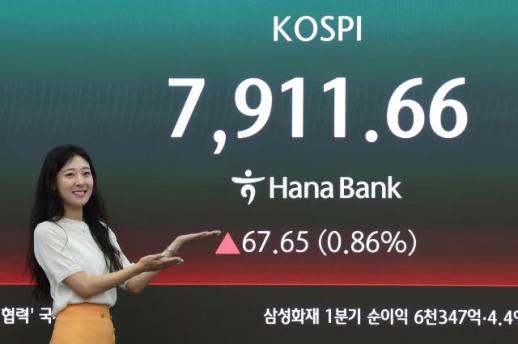 KOSPI Approaches 8000 as Retail Investors Favor Direct Stocks Over ETFs The KOSPI index is just 19 points shy of reaching the 8000 mark. It peaked at 7999.67 during trading, but closed at 7981, reflecting strong expectations for a breakthrough. This closing figure marks a record high for the index. Retail investors have been the primary drivers of this increase, showing a preference for direct investments in the KOSPI spot market over exchange-traded funds (ETFs) amid a rally that has seen recent record highs. According to the Korea Exchange, the KOSPI finished trading on May 14 at 7981.41, up 137.40 points from the previous day, setting a new all-time closing high. Retail and institutional investors made net purchases of 18.378 trillion won and 1.898 trillion won, respectively, while foreign investors sold off 21.445 trillion won. Retail investors have been particularly active in the recent rally. From May 4 to May 13, they recorded a total trading volume of 157 trillion won in the KOSPI market. Initially, there was a trend of net selling due to profit-taking and a wait-and-see attitude at the beginning of the month, but buying momentum quickly picked up. Retail investors sold off 4.79 trillion won on May 4 and 570 billion won on May 6, but reversed course starting May 7 with net purchases of 5.99 trillion won, followed by 3.97 trillion won on May 8 and 2.86 trillion won on May 11. Notably, on May 12, retail investors made net purchases of 6.68 trillion won, the largest amount during this period. This buying trend continued with net purchases of 1.88 trillion won on May 13 and 1.8378 trillion won on May 14. In contrast, the inflow of funds into KOSPI 200 ETFs during the same period was relatively limited. The KODEX 200 ETF recorded trading volume of 4.19 trillion won, while the TIGER 200 ETF saw only 625.1 billion won. The flow of funds into ETFs did not show a clear direction; KODEX 200 experienced fluctuations between net buying and selling, while TIGER 200 saw some inflow followed by outflows. KODEX 200 shifted from -1.238 trillion won to +1.459 trillion won in net purchases before returning to -286 billion won, while TIGER 200 moved from -302 billion won to +348 billion won and then back to -62 billion won. Market analysts suggest that as expectations for KOSPI growth rise, there is a stronger preference for direct stock purchases over diversified investments through ETFs. The recent upward trend in the stock market has been largely driven by large-cap stocks, leading to expectations that spot investments may yield higher returns than ETFs.* This article has been translated by AI. 2026-05-14 17:23:38
 -
 Korean Air and Asiana Airlines Begin Merger Process Amid Stock Surge Shares of Korean Air and Asiana Airlines rose following news that the two airlines have initiated their merger process. As of 2:26 PM on May 14, Asiana Airlines was trading at 7,730 won, up 14.86% (1,000 won) from the previous trading day. Hanjin KAL rose 4.28% to 117,000 won, while Korean Air increased by 3.30% to 26,600 won. On May 13, both Korean Air and Asiana Airlines held regular board meetings and approved the merger agreement. The two companies have set December 17 as the launch date for the merged Korean Air. The merger ratio has been determined at 1 to 0.2736432, which is expected to increase Korean Air's capital by approximately 101.7 billion won. The signing of the merger agreement comes five years and six months after the new stock subscription agreement between Korean Air and Asiana Airlines on November 17, 2020. Following approval from Asiana Airlines' shareholders, the merger is scheduled for December 16, with new shares expected to be listed on January 4, 2027. Jeong Yeon-seung, a researcher at NH Investment & Securities, stated, "Post-merger, the integration of overlapping infrastructures such as aircraft maintenance, ground operations, in-flight meals, and overseas sales networks will be possible. This is expected to lead to significant fixed cost reductions and economies of scale." He added, "Expectations for synergies will gradually increase starting in the fourth quarter, when some operational effects of the merger will be reflected. The merged entity will establish itself as the dominant number one player in the South Korean aviation market." However, Jeong noted that the number of new shares issued during the acquisition of Asiana Airlines by Korean Air will only account for 5.5% of the total shares, which is not expected to significantly dilute shareholder value.* This article has been translated by AI. 2026-05-14 15:55:46
 -
 Polled Shares Surge 300% on First Day of KOSDAQ Listing Shares of Polled, a company specializing in baby products and hygiene items, experienced a remarkable 300% increase on their first day of trading on the KOSDAQ. According to the Korea Exchange, as of 10:04 a.m. on May 14, Polled's stock was trading at 20,000 won, up 15,000 won from the initial public offering price of 5,000 won. Polled originated as an internal venture of Hyundai Motor Company and was established as a separate entity in 2019. The company has rapidly grown, focusing on premium baby electronics and living products, including its AIRLUV ventilation and heating sheets, as well as brands like Pixel, Franklin, Yufang, and Baby Brezza. Notably, AIRLUV has gained significant recognition both domestically and internationally, surpassing cumulative sales of 1 million units and establishing itself as a leading export brand in the K-baby product sector. Additionally, Polled's key product lines, including Pixel, Yufang, and Baby Brezza, have seen a steady increase in overseas sales due to growing global demand. Polled recorded a high subscription rate of 3,169.86 to 1 during the public offering for individual investors held from May 4 to 6, attracting approximately 5.2 trillion won in subscription deposits. Institutional investors also showed strong interest, with 2,372 institutions participating and a competition ratio of about 1,486.66 to 1. The offering price was set at 5,000 won, raising a total of 13 billion won, with NH Investment & Securities acting as the listing underwriter. For the previous year, Polled reported consolidated revenues of 79.933 billion won and an operating profit of 10.425 billion won. The company plans to utilize the funds raised from the IPO for research and development (R&D) operations and strategic investments to strengthen its long-term growth foundation, including the establishment of logistics centers.* This article has been translated by AI. 2026-05-14 11:38:15
 -
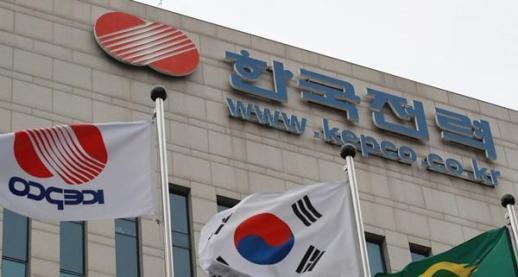 Meritz Securities Maintains 'Buy' Rating on Korea Electric Power Despite Lowered Consensus Meritz Securities reported on May 14 that while the lowered annual performance consensus for Korea Electric Power Corporation (KEPCO) is putting pressure on its stock price, focusing solely on short-term results could overlook structural improvements. The firm maintained its target price at 65,000 won and its investment opinion at 'Buy.' Analyst Moon Kyung-won noted that KEPCO's operating profit for the first quarter reached 3.78 trillion won, falling short of the consensus estimate of 4.24 trillion won. He attributed this shortfall primarily to a nuclear power utilization rate of 71.0%. He added that while the coal utilization rate was 52.4%, it was insufficient to compensate for the decline. Moon highlighted that the PRS (price-to-earnings swap) costs were lower than expected, predicting that the increase in PRS costs would diminish in the second half of the year. However, he expressed optimism about valuation increases due to the nuclear power business and the consolidation of power generation subsidiaries. He explained that the nuclear power business is progressing in phases, with external service results expected to be released in May or June. Following this, a governance integration focused on nuclear power exports led by KEPCO is anticipated. Moon expects that this will lead to concrete plans for nuclear investments in the U.S. in the second half of the year, and he noted that the selection of a contractor for the Ninh Thuan 2 nuclear project in Vietnam is expected by the end of the year. Additionally, he stated that the consolidation of power generation subsidiaries could enhance the company's value. If the government proceeds with the proposed 'Korea Power Generation Corporation Act' to purchase shares from KEPCO's five power generation companies, this process could lead to a reevaluation of the subsidiary's equity value. He also mentioned that the elimination of inefficiencies among power generation subsidiaries, acceleration of energy transition, and strengthening of KEPCO's independence are expected to contribute to valuation increases.* This article has been translated by AI. 2026-05-14 08:27:48
 -
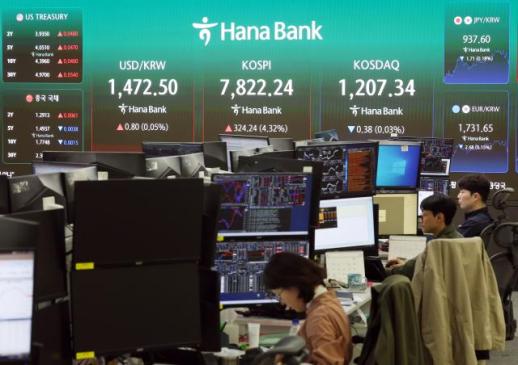 South Korea's Stock Market Capitalization Surpasses Taiwan's South Korea's stock market capitalization has surpassed that of Taiwan. Following a record high for the KOSPI, the rankings of the two countries' stock markets flipped in just one day. According to the Korea Exchange and the Taiwan Stock Exchange, as of May 11, South Korea's stock market capitalization was recorded at 7,084 trillion won. When converted at the exchange rate of 1,472 won to the dollar, this amounts to approximately $4.81 trillion. In contrast, Taiwan's stock market capitalization was about $4.34 trillion in dollar terms. South Korea's market capitalization is now approximately $470 billion higher than Taiwan's. Just a day earlier, on May 10, Taiwan's market capitalization was $4.72 trillion, while South Korea's was at $4.55 trillion, indicating that Taiwan had the upper hand before the rankings changed. Market analysts attribute the rise in the KOSPI to the expansion of market capitalization. The KOSPI index recently broke the 7,800 mark for the first time, consistently setting new records. The strong performance of large-cap stocks, particularly in semiconductors and secondary batteries, has contributed to the rapid growth of South Korea's overall market capitalization. On May 11, the KOSPI surged over 4%, closing at a historic high of 7,820. The index opened at 7,775.31, up 3.70% from the previous trading day, and at one point reached 7,899.32, nearing the 7,900 mark.* This article has been translated by AI. 2026-05-12 08:56:11
 -
 KOSPI Hits Record High Amid Samsung and SK Hynix Surge, Deepening 'K-Shaped' Market ◆Ajou Economic Major News ▷KOSPI reaches all-time high as semiconductor stocks rally - The KOSPI index has once again set a record high. - A rally in major semiconductor stocks, led by Samsung Electronics and SK Hynix, has pushed the KOSPI index close to the 7,900 mark. - However, the upward trend is concentrated on these two large-cap semiconductor stocks, leading to a pronounced 'K-shaped' divergence in stock performance. - Analysts are expressing optimistic forecasts, with domestic brokerages suggesting that the KOSPI could surpass 8,000 and even reach 9,000. Foreign investment bank JP Morgan has projected that the KOSPI could exceed 10,000. - The recent surge is primarily driven by the semiconductor sector. - On this day, Samsung Electronics and SK Hynix saw their shares rise by 6% and 13%, respectively, as expectations for increased demand for AI semiconductors grow, effectively leading the market's rise. ◆Key Reports ▷Impact of high oil prices expected to intensify by August - As the U.S.-Iran conflict drags on, the actual frequency of price increases will be determined by the secondary effects of rising oil prices. - The secondary effects are theoretically significant due to demand, and with South Korea's economic growth rate likely to rise to the upper 2% range this year, concerns are heightened. - The challenge is that the recent economic upturn is largely attributed to the semiconductor cycle, making it difficult to isolate the intensity of 'demand-side' inflation. - However, despite the current growth rate, particularly in private consumption, being lower than in the past, the actual extent of economic sluggishness is not as severe compared to the reduced potential growth rate, warranting careful monitoring of inflation trends. ◆Major Announcements After Market Close (May 11) ▷Lotte Shopping reports Q1 operating profit of 252.9 billion won, a record for department stores. ▷S-Oil posts Q1 operating profit of 1.2311 trillion won, influenced by rising oil prices. ▷Hanwha Ocean secures an additional order for an LNG carrier worth 363.2 billion won. ▷IS Dongseo signs a construction contract worth 63.5 billion won with SK Eco Plant for a new project in Cheongju. ▷KR Motors decides on a 5-for-1 stock consolidation to maintain appropriate circulating shares. ▷Korea Electric Power Corporation (KEPCO) reports Q1 operating profit of 37 billion won, up 374.6% year-on-year. ▷TYM announces Q1 operating profit of 35 billion won, a 131.5% increase year-on-year. ▷Kia changes its CEO, with Song Ho-sung becoming the sole representative director. ▷Samsung Securities reports Q1 operating profit of 609.5 billion won, an 82.1% increase year-on-year. ◆Fund Trends (as of May 8, excluding ETFs) ▷Domestic equity funds: -197.9 billion won ▷Overseas equity funds: -26.4 billion won ◆Key Schedule for Today (May 12) ▷China: Automobile sales (April) ▷Germany: Consumer Price Index (final, April), ZEW Economic Sentiment Index (May) ▷United States: Small Business Optimism Index (April), Consumer Price Index (April)* This article has been translated by AI. 2026-05-12 07:33:07
 -
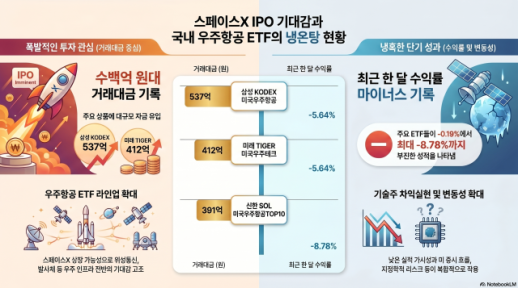 SpaceX IPO Approaches as Space ETFs See Increased Trading but Poor Returns With the SpaceX initial public offering (IPO) just over a month away, major asset management firms in South Korea are seeing increased investments in aerospace exchange-traded funds (ETFs). However, most of these funds have recorded negative returns over the past month. According to the Korea Exchange on May 11, Samsung Asset Management's KODEX U.S. Aerospace ETF has seen a return of -5.64% over the past month, with trading volume reaching 53.7 billion won as of May 8. Hana Asset Management's 1Q U.S. Aerospace Tech ETF recorded a return of -0.19% and a trading volume of 10.7 billion won. ETFs launched last month have shown similar trends. Mirae Asset Management's TIGER U.S. Space Tech ETF, which was listed on April 14, has a return of -5.64% and a trading volume of 41.2 billion won. The ACE U.S. Space Tech Active ETF from Korea Investment Trust Management, which also launched on the same day, recorded a return of -0.63% and a trading volume of 30.5 billion won. Shinhan Asset Management's SOL U.S. Aerospace TOP10 ETF, listed on April 21, has a return of -8.78% and a trading volume of approximately 39.1 billion won. Despite the asset management industry expanding its lineup of space-related ETFs in response to the growing perception of the space industry as a next-generation growth theme, short-term performance has fallen short of expectations. This is attributed to profit-taking in technology stocks on the U.S. market and the inherent volatility of the aerospace industry, which is characterized by low visibility in earnings. Some ETFs have a high concentration of defense stocks, making them susceptible to geopolitical risks and interest rate fluctuations. An industry insider noted, "The space industry has significant long-term growth potential, but it is still largely driven by expectations. If major events like the SpaceX IPO materialize, the related ETF market could regain attention."* This article has been translated by AI. 2026-05-11 15:36:29
 -
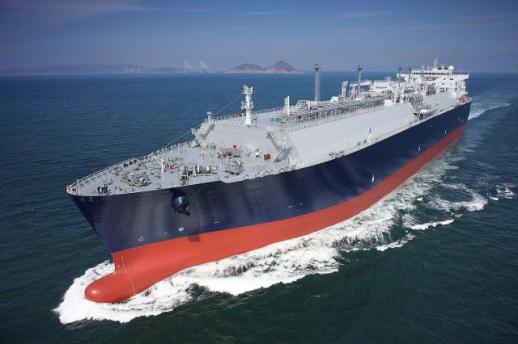
 Hanwha Ocean Shares Rise Over 3% Following Major Shipbuilding Contracts Hanwha Ocean's stock has surged by more than 3% as the company continues to secure large shipbuilding contracts from shipowners in Africa and Europe, reflecting positive investor sentiment. As of 1:46 PM on May 11, Hanwha Ocean shares were trading at 130,100 won, up 3.17% (4,000 won) from the previous trading day, according to the Korea Exchange. The company announced that it has secured a contract for one LNG carrier (LNGC) from a European shipowner, valued at approximately 363.2 billion won, which represents 2.8% of its consolidated revenue from last year. This contract is an additional order from a shipowner who had previously ordered seven LNG carriers last year, with delivery scheduled by June 15, 2029. A Hanwha Ocean official stated, "The continuous construction of vessels with the same specifications is expected to enhance efficiency in design, procurement, and production, contributing to stable profitability." On May 4, the company also signed a contract with an African shipowner for three Very Large Ammonia Carriers (VLAC), valued at approximately 507.4 billion won, which accounts for 4.0% of its revenue. The completion date for this contract is set for January 15, 2030, with payments made according to construction progress.* This article has been translated by AI. 2026-05-11 13:55:59
 -
 Samsung Heavy Industries Shares Surge Amid U.S.-Korea Shipbuilding Cooperation Samsung Heavy Industries shares experienced a significant increase early in the trading session, driven by expectations of strengthened U.S.-Korea shipbuilding cooperation. As of 10:06 a.m. on May 11, Samsung Heavy Industries shares rose 7.36% (2,530 won) to 34,300 won, according to the Korea Exchange. Other major shipbuilding stocks also saw gains during the same period, with HD Hyundai Heavy Industries up 3.04%, HD Korea Shipbuilding & Offshore Engineering rising 5.86%, Hanwha Ocean increasing by 4.20%, and HJ Shipbuilding climbing 3.00%. On May 10, the Ministry of Trade, Industry and Energy reported that Minister Kim Jeong-kwan visited Washington, D.C., from May 6 to 9 (local time) to discuss strategic investment projects and industrial cooperation with key U.S. government officials. Notably, the Ministry and the U.S. Department of Commerce signed a memorandum of understanding (MOU) for the 'U.S.-Korea Shipbuilding Partnership Initiative' and agreed to establish a 'U.S.-Korea Shipbuilding Cooperation Center.' In a report released today, Samsung Securities raised its target stock price for Samsung Heavy Industries from 39,000 won to 43,000 won, citing "the primary reason for the increase is the premium multiple due to efforts to enter high-growth new markets." The report further noted, "The company shows a strong willingness to enter the floating data center (FDC) market, as well as MRO and next-generation military support vessels, which are expected to see robust demand in the future. This anticipated long-term order growth could serve as a factor for applying a premium multiple."* This article has been translated by AI. 2026-05-11 10:15:19
 -
 Hana Securities Maintains Target Price of 80,000 Won for Hankook Tire Amid Temporary Profit Decline Hana Securities reported on May 11 that Hankook Tire & Technology (Hankook Tire) is expected to experience a temporary decline in profitability due to rising raw material and shipping costs driven by increasing oil prices. However, the firm stated that the impact will not be significant and maintained its target price at 80,000 won with an investment recommendation of 'buy.' Song Seon-jae, a researcher at Hana Securities, noted, "Historically, we have seen a cycle of 'cost increase - profitability decline - price increase - profitability recovery,' and this time will be no different. We expect Hankook Tire to maintain high profitability in its tire segment through excellent cost control, price increases, and improved product mix." He also highlighted that the performance of its subsidiary, Hanon Systems, which had previously burdened the company's financials, is improving, and shareholder returns are expected to increase. Song projected that the rise in raw material costs due to the recent conflict in the Middle East will be reflected in contracts starting in the second quarter, with actual costs being incurred three months later and profit and loss impacts expected to be seen four to six months afterward. He added, "While the related impacts will be reflected in the second half of the year, they are not expected to be very significant." He further explained that diversifying the sources of raw materials will help mitigate the impact of rising costs, and price increases are being prepared regionally. Although there are factors that could increase shipping costs due to rising oil prices, he anticipates that overall shipping demand will decline, leading to contracts in the second half of the year being similar to or more favorable than those in the first half. Additionally, he stated, "Production increases at the Tennessee plant in the U.S. are proceeding as planned, and we expect profitability to rise to average tire margins once full capacity production is achieved in the second half of the year."* This article has been translated by AI. 2026-05-11 08:58:03