
Journalist

Jang Sun-a
sunrise@ajunews.com
-
 Jung Won-oh Criticizes Oh Se-hoon on Safety Issues at Guui Station Jung Won-oh, the Democratic Party's candidate for Seoul mayor, intensified his criticism of Oh Se-hoon, the candidate from the People Power Party, on safety issues during his campaign on May 22. He highlighted the recent construction flaws at Samsung Station on the GTX-A line as a key concern. Jung began his day by attending a memorial event for the 10th anniversary of the Guui Station industrial accident in Gwangjin-gu, Seoul. He referenced the recently passed Life Safety Basic Act in the National Assembly, stating, "We will establish a Seoul City Life Safety Committee to protect citizens' fundamental right to safety." He also questioned Oh's absence from the memorial, asking, "I wonder why you did not participate in such an important agreement." Continuing his attack on Oh, Jung raised concerns about the ongoing issues during Oh's tenure as mayor, saying, "Don’t you wonder why there have been major safety incidents and fatalities during Oh Se-hoon's administration? This is not a coincidence; it is a structural problem created by a lack of safety awareness." In response to Oh's proposal for a public debate, Jung remarked, "It seems that Oh tries to deflect responsibility for his mistakes by politicizing them. He should visit the Samsung Station site to see the issues firsthand and devise solutions." Throughout the day, Jung campaigned in northern districts like Jungnang and Nowon, emphasizing his real estate policies and local pledges. He stated, "If there have been housing difficulties during your five years as mayor, you should apologize instead of blaming your predecessor. You are unqualified; we need change." He also criticized the decline in Seoul's gross regional domestic product (GRDP), asserting, "Shouldn’t we replace a mayor who cannot stimulate economic vitality?" He promised that if elected, he would transform Seoul into a vibrant economic city like Seongdong-gu. Jung pledged to issue 100 billion won in local currency, the Jungnang Love Gift Certificate, expedite the construction of the Myeonmok Line, and ensure timely completion of the GTX-B line. In Nowon-gu, he promised to support the timely opening of the Dongbuk Line and the bio-industry belt at Changdong Station. Regarding reconstruction and redevelopment, he stated, "We will assist associations in making swift decisions and streamline administrative procedures to ensure that reconstruction and redevelopment proceed quickly and safely."* This article has been translated by AI. 2026-05-23 19:44:13
 -
 Weather Forecast: Rain Expected Across Most of the Country on Saturday On May 23, overcast skies will prevail nationwide, with rain expected in most areas. Dense fog is anticipated in the mountainous regions of Gangwon and some inland areas, prompting caution for traffic safety. According to the Korea Meteorological Administration, rain will begin in Busan, Ulsan, and the eastern coast of North Gyeongsang Province from early morning until the afternoon, spreading to most of the country except for the eastern coast of Gangwon. Expected rainfall amounts are less than 5 mm in Seoul, Incheon, Gyeonggi Province, inland and mountainous areas of Gangwon, Chungcheong, Jeolla, Gyeongsang, and Jeju Island, while the five western islands may see 5 to 10 mm. The weather agency advised that roads may become slippery and visibility could be reduced in areas experiencing rain, urging drivers to maintain a safe distance and reduce speed. In the mountainous regions of Gangwon, visibility may drop below 200 meters due to dense fog, while inland areas of Jeolla are expected to see visibility under 1 kilometer. Maritime conditions are also expected to be poor. Thunderstorms and gusty winds may occur, particularly over the Yellow Sea, where dense sea fog is likely. On the eastern coast, high waves may wash over breakwaters and sandy beaches due to swells, necessitating extra caution for coastal safety. Morning low temperatures are forecasted to range from 10 to 16 degrees Celsius, with daytime highs expected between 18 and 24 degrees. Key morning low temperatures include: △Seoul 15 degrees △Incheon 15 degrees △Suwon 14 degrees △Chuncheon 12 degrees △Gangneung 13 degrees △Cheongju 14 degrees △Daejeon 14 degrees △Jeonju 14 degrees △Gwangju 14 degrees △Daegu 14 degrees △Busan 16 degrees △Jeju 17 degrees. Daytime highs are expected to be: △Seoul 24 degrees △Incheon 23 degrees △Suwon 23 degrees △Chuncheon 23 degrees △Gangneung 20 degrees △Cheongju 24 degrees △Daejeon 24 degrees △Jeonju 25 degrees △Gwangju 24 degrees △Daegu 22 degrees △Busan 21 degrees △Jeju 22 degrees. Air quality is expected to be rated 'good' across all regions.* This article has been translated by AI. 2026-05-23 19:27:24
 -
 Consumer Sentiment Rebounds Amid Semiconductor Exports and Stock Market Gains Consumer sentiment has turned optimistic again after a month, buoyed by strong semiconductor exports and a rising stock market. According to the Bank of Korea's "May Consumer Trend Survey" released on May 22, the Consumer Sentiment Index (CCSI) rose by 6.9 points from the previous month to 106.1. This marks a recovery above the baseline of 100, which it fell below for the first time in a year last month. The CCSI is calculated using six indices: current living conditions, future living conditions, household income expectations, consumption expenditure expectations, current economic conditions, and future economic conditions. A score above 100 indicates optimistic consumer sentiment compared to the long-term average (2003-2024), while a score below 100 indicates pessimism. All six components of the CCSI increased in this survey. Notably, the future economic outlook index surged by 14 points to 93. This increase is attributed to a first-quarter GDP growth rate that significantly exceeded expectations and upward revisions of growth forecasts by major institutions. The current economic conditions index also rose by 15 points to 83. Despite high oil prices, the current living conditions index increased by 2 points to 93, influenced by a booming stock market and support payments for high oil prices. The future living conditions index rose by 5 points to 97, while household income expectations (100) and consumption expenditure expectations (110) each increased by 2 points. Lee Heung-hoo, head of the Bank of Korea's Economic Sentiment Survey Team, stated, "The increase in consumer optimism is driven by strong exports centered on semiconductors and the rising stock market, marking a turnaround after three months of decline. We need to continue monitoring the energy supply situation due to Middle East tensions, global economic trends, and semiconductor export conditions." The interest rate outlook index (115) remains above the long-term average of 111, reflecting ongoing expectations for rising rates. However, it fell by 1 point due to easing tensions in the Middle East following reports of U.S.-Iran negotiations. The housing price outlook index (112) rose by 8 points, driven by a decrease in listings around May 10, when the government resumed higher capital gains taxes on multiple homeowners, leading to increased apartment prices in Seoul. The expected inflation rate for consumer prices over the next year is 2.8%, down 0.1 percentage points from the previous month. In contrast, the perceived inflation rate over the past year rose to 3.0%, an increase of 0.1 percentage points. Lee added, "The reports of negotiations between the U.S. and Iran in early May created expectations for peace. The government's inflation stabilization measures also seem to have eased consumer inflation expectations, according to our survey." He concluded, "To determine whether the decline in expected inflation in May is temporary, we need to monitor the energy supply situation due to future Middle East developments and the trend of consumer price increases."* This article has been translated by AI. 2026-05-22 06:15:00
 -
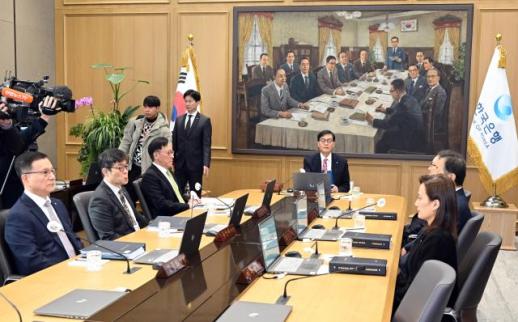 Economic Growth Forecast Rises to 2.8% Amid Semiconductor Boom Thanks to strong semiconductor exports and the government's expansionary fiscal policy, market experts have raised their economic growth forecast for this year to as high as 2.8%. However, the ongoing war in the Middle East, high oil prices, and market interest rate instability have been identified as significant variables affecting the South Korean economy. A survey conducted by Aju Economy on May 21 among eight leading bond and macroeconomic experts revealed that three of the seven respondents projected the country’s GDP growth rate at 2.8% for this year. Another three estimated it at 2.5%, while one expert anticipated a growth rate of 2.6%. These figures significantly exceed the Bank of Korea's previous forecasts, which estimated a growth rate of 2.0% for this year and 1.8% for next year in its economic outlook released in February. The recovery in exports, particularly in the semiconductor sector, has been stronger than expected, shifting the economic outlook. The growth rate for the first quarter of this year was recorded at 1.7%, well above the Bank of Korea's forecast of 0.9%. Subsequent industrial activity reports also indicated an overall improvement in production, consumption, and investment metrics, suggesting that robust growth may continue into the second quarter. Experts commonly cited the semiconductor supercycle and the government's fiscal expansion as key factors driving the upward revision of growth forecasts. Jo Yong-gu, a researcher at Shin Young Securities, stated, "The strong performance of semiconductor exports due to increased investment in artificial intelligence (AI) has exceeded expectations, and the government's supplementary budget and expansionary fiscal policies are supporting domestic demand and investment recovery. The increase in foreign tourists is also a positive factor for service consumption." Kim Sung-soo, a researcher at Hanwha Investment & Securities, projected a growth rate of 2.5% for this year and 2.2% for next year, noting, "The prolonged war in the Middle East poses the biggest downside risk, but the strong semiconductor market and government fiscal policies will likely boost growth rates." Concerns about inflationary pressures remain. Experts expect the consumer price inflation rate to reach between 2.6% and 2.7% this year. Upside risks include rising international oil prices due to the Middle East conflict and the strong semiconductor market, while downside factors include government measures aimed at stabilizing prices. Woo Hye-young, a researcher at LS Securities, remarked, "Even if there are no further increases in international oil prices in May and June, we anticipate a period of rising inflation rates. Particularly in terms of service prices, the impact of rising fuel surcharges and energy costs is contributing to ongoing inflationary pressures." Experts have assessed the recent fluctuations in the won-dollar exchange rate, which has hovered around 1,500 won, as an excessive depreciation of the won compared to fundamentals. They projected the upper limit for the exchange rate this year at 1,550 won and the lower limit at 1,380 won. Park Sang-hyun, a researcher at iM Securities, stated, "The exchange rate in the 1,500 won range reflects a significant undervaluation of the won against fundamentals. While there is potential for further increases if international oil prices rise, the exchange rate could quickly drop to the mid-1,400 won range if oil prices stabilize and geopolitical risks ease. Furthermore, the current account balance is expected to be much better than last year, which could also contribute to a stronger won in terms of foreign exchange supply and demand." Concerns have also been raised about the recent surge in government bond yields, with analysts warning of the potential for further increases. This is attributed to inflationary pressures from geopolitical risks, the government's expansionary fiscal stance, and concerns over U.S. interest rate hikes. Kang Seung-won, a researcher at NH Investment & Securities, noted, "The recent rise in government bond yields reflects concerns about inflation, expectations for expansionary fiscal policies next year, and the possibility of U.S. interest rate hikes, all contributing to widespread upward pressure. The market has already begun to factor in additional interest rate hikes this year, and there is a prevailing sentiment that further increases may occur two or three more times."* This article has been translated by AI. 2026-05-21 19:21:00
 -
 Government to Expand Experience-Based Economic Education with Tailored Content The Economic Education Association held discussions with stakeholders on enhancing economic education and innovating through artificial intelligence (AI). The government announced plans to build an economic education ecosystem that responds to the digital transformation era by expanding experiential learning and strengthening tailored content for different life stages. The Economic Education Association hosted its "2026 First Half Workshop" on May 21 at the DB Life Human Resources Development Center in Hwaseong, Gyeonggi Province. The event was attended by representatives from 51 member organizations across the private, financial, media, and public sectors, along with officials from government ministries and public institutions. They discussed future directions for economic education, exemplary practices in the field, and collaboration among member organizations. In his opening remarks, Park Jae-wan, president of the Economic Education Association, stated, "We will lead the activation and solidification of economic education based on solidarity and cooperation with our member organizations. We will also focus our efforts on the digitalization of economic education, including the integration of AI into our programs." Kim Young-no, policy planning officer at the Ministry of Economy and Finance, remarked, "This year, the government aims to promote experience-based economic education and expand tailored content for different life stages and social classes under the vision of 'dynamic economic education that reaches everyone.' Government policies must be integrated with the field experiences and cooperation of our member organizations to become truly effective."* This article has been translated by AI. 2026-05-21 15:16:23
 -
 Korean Finance Ministry Promotes K-GX for Climate Crisis Response On May 21, Heo Chang, the Second Vice Minister of Finance, stated that combining South Korea's climate technology and development experience with the Global Green Growth Institute's (GGGI) project development capabilities and the Green Climate Fund's (GCF) financial resources could present a new growth model in response to the climate crisis. He made these remarks during the GGGI-GCF joint conference held at the Four Seasons Hotel in Seoul, which was attended by over 100 participants, including diplomats. In his opening speech, Heo emphasized that the government is actively pursuing the Korean-style Green Transition (K-GX) to address the climate crisis and is expanding cooperation with international organizations based in South Korea, such as the GCF and GGGI. He expressed the intention to establish a virtuous cycle where climate crisis responses lead to future growth drivers. He further explained that through the Global Voluntary Carbon Market (GVCM), which is being developed in collaboration with the UN Framework Convention on Climate Change (UNFCCC) and GGGI, the GCF's carbon reduction achievements could be converted into carbon credits, potentially generating new revenue while contributing to both carbon reduction and development funding. The government plans to strengthen cooperation with major climate and green international organizations located in South Korea. A Ministry of Finance official stated, "We will actively seek ways to enhance collaboration with international organizations such as the GCF and GGGI in the future."* This article has been translated by AI. 2026-05-21 15:15:00
 -
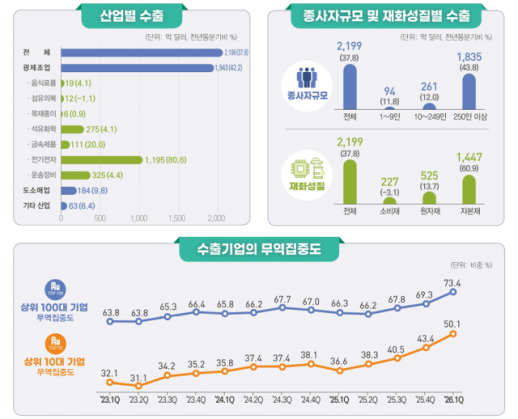 Surge in Semiconductor Exports Leads to Increased Concentration Among Top Companies The ongoing boom in semiconductor exports is intensifying the concentration of exports among a few large companies in South Korea. In the first quarter of this year, the trade concentration of the top 10 exporting companies surpassed 50% for the first time, reaching a record high. According to the "Q1 2026 and Annual Company Characteristics Trade Statistics" released on May 10 by the National Data Agency and the Korea Customs Service, the trade concentration of the top 10 exporting companies was recorded at 50.1%. This marks a 13.5 percentage point increase compared to the same period last year and is the highest level since the statistics began in 2010. The trade concentration among the top 100 companies also rose to 73.4%, an increase of 7.2 percentage points from the previous year, further highlighting the dominance of these firms, which now account for more than half of total exports, while the top 100 companies represent over 70%. This trend is largely attributed to the booming electrical and electronics sector, particularly semiconductors. In fact, the export of the manufacturing sector surged by 42.2% compared to the same period last year, driven by significant increases in the electrical and electronics and metal products sectors. By company size, exports increased across large, medium, and small enterprises, but the growth rates varied significantly. Large companies saw their exports rise by 52.9% year-on-year, demonstrating a robust increase, primarily due to the rise in capital goods and raw material exports. In contrast, medium-sized enterprises experienced a modest export increase of 7.4%, while small businesses saw a 10.7% rise. Medium-sized firms reported growth in capital goods, raw materials, and consumer goods, while small businesses showed increases across all categories. In addition to the manufacturing sector, retail exports grew by 9.8%, and other industries saw a 6.4% increase. Although sectors like information and communication and construction experienced declines, transportation and warehousing, along with facility management, showed growth. Exports also increased across all employee size categories. Companies with 250 or more employees reported a 43.8% increase in exports, while those with 10 to 249 employees saw a 12.0% rise, and firms with 1 to 9 employees experienced an 11.8% increase. This indicates a pronounced export growth trend among large companies. Imports also continued to rise. In the first quarter of this year, imports increased by 8.6% for large companies, 13.5% for medium-sized firms, and 14.5% for small businesses, reflecting a general expansion in capital goods, raw materials, and consumer goods imports. By industry, imports in the manufacturing sector rose by 8.6%. Although the petrochemical sector saw a decline, increased imports of electrical and electronics and metal products offset this drop. Retail imports surged by 17.4%, while other industries, particularly transportation and public administration, increased by 8.5%. Import growth was also noted across all employee size categories, with companies employing 250 or more workers increasing imports by 9.2%, those with 10 to 249 employees by 14.1%, and firms with 1 to 9 employees by 15.9%. Notably, small businesses saw increases in imports related to wholesale, metal products, and transportation and warehousing.* This article has been translated by AI. 2026-05-21 13:48:00
 -
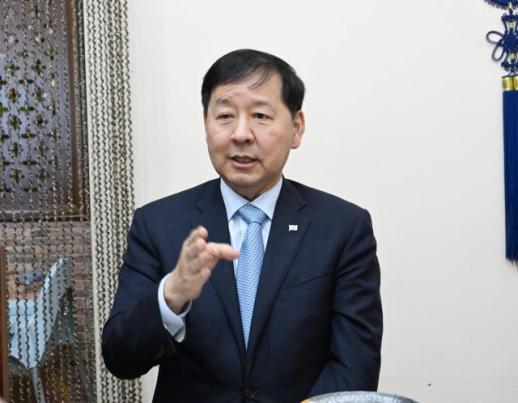 Korean Finance Minister Discusses Capital Market Reforms with HSBC and Schroders Koo Yun-cheol, the Minister of Economy and Finance, met with top executives from global financial institutions in London to discuss reforms in South Korea's capital markets and ways to enhance cooperation in the fields of artificial intelligence (AI) and advanced industries. On May 19, the Ministry of Economy and Finance announced that Koo held discussions with executives from HSBC and Schroders during the 'Korean Economy Investment Briefing' in London on May 18. They exchanged views on the growth potential of the South Korean economy and ways to expand cooperation. During his meeting with George Elhedery, CEO of HSBC, Koo outlined the South Korean government's policies for modernizing the foreign exchange and capital markets, as well as strategies for collaboration with global financial institutions. "We are focusing on making the capital market a key platform for economic growth and are committed to advancing the foreign exchange and capital markets," Koo said, emphasizing the importance of active participation from financial institutions with global networks like HSBC. Elhedery welcomed South Korea's ongoing efforts to reform its foreign exchange and capital markets, noting that the country is enhancing its openness and international connectivity in financial markets, thereby strengthening its role in the global economy. He added, "Having maintained ties with Korea since 1897, HSBC will expand cooperation in areas that drive future growth, such as AI infrastructure, energy transition, and advanced industries, while supporting the international expansion of Korean companies and investors in the long term." In his meeting with Richard Oldfield, CEO of Schroders, Koo discussed the achievements of South Korea's capital market reforms and investment opportunities in AI and advanced industries. He stated, "Reforming the foreign exchange and capital markets is not a short-term event but a structural and ongoing challenge, making collaboration with global investment institutions crucial. I hope to see increased participation from long-term investment capital like Schroders in new growth areas such as AI and advanced industries." Oldfield responded that the commitment to improving corporate governance, enhancing shareholder returns, and addressing the 'Korea Discount' is key to structural change. He expressed a desire to continue long-term cooperation with South Korea in areas such as renewable energy, energy transition infrastructure, and venture capital.* This article has been translated by AI. 2026-05-19 16:23:49
 -
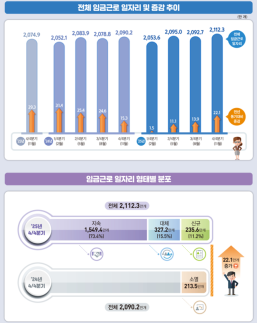 Wage Jobs Increased by 220,000, but Youth and Manufacturing Struggles Persist Wage jobs increased by over 220,000 in the fourth quarter of last year, continuing a recovery trend. However, challenges remain for youth employment and sectors like manufacturing and construction, highlighting disparities in the job market. According to the National Data Agency's report on "Wage Job Trends for Q4 2025," the total number of wage jobs reached 21,123,000 as of November last year, an increase of 221,000 compared to the same period the previous year. The growth in wage jobs saw a significant drop from 153,000 in Q4 2024 to just 15,000 in Q1 2025, marking the lowest level on record. However, there was a gradual recovery with increases of 111,000 in Q2, 139,000 in Q3, and 221,000 in Q4. Among all jobs, "sustained jobs," where the same workers remained employed, accounted for 15,494,000, or 73.4% of the total. "Replacement jobs," where workers changed due to retirement or job changes, numbered 3,272,000 (15.5%), while "new jobs" created through business formation or expansion totaled 2,356,000 (11.2%). Conversely, 2,135,000 jobs were lost due to business closures or downsizing. The employment trends varied by age group. Jobs for those under 20 decreased by 111,000, marking a 13-quarter decline since Q4 2022. Jobs for those in their 40s also fell by 37,000. In contrast, the number of jobs for those aged 60 and over increased by 246,000, while jobs for those in their 30s and 50s rose by 99,000 and 24,000, respectively. The employment struggles among youth were particularly pronounced in manufacturing and construction. For those under 20, significant job losses were seen in manufacturing (-31,000), construction (-17,000), and information and communication (-16,000). Meanwhile, the 60 and older age group saw job gains in health and social welfare (88,000), manufacturing (27,000), and business and rental services (26,000). Sector-wise, the service industry continued to show growth. The health and social welfare sector recorded the largest increase, adding 126,000 jobs compared to the previous year, driven by gains in social welfare services (81,000) and health services (45,000). The accommodation and food service sector also grew by 40,000 jobs, supported by increases in restaurant and bar services (37,000) and accommodation services (2,000). The professional, scientific, and technical services sector added 33,000 jobs, primarily in professional services (21,000) and architectural and engineering services (6,000). However, the construction sector continued to struggle, losing 88,000 jobs, while manufacturing saw a decline of 14,000 jobs. Manufacturing remains the largest sector by job share at 20.4%, followed by health and social welfare (13.1%), retail (10.3%), construction (8.5%), and business and rental services (7.0%).* This article has been translated by AI. 2026-05-19 12:59:09
 -
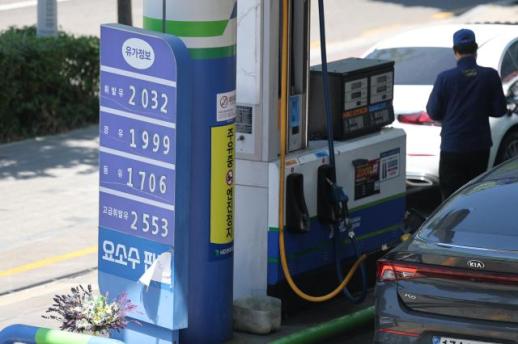 International Oil Prices Remain Above $100, Pressuring Inflation and Domestic Demand International oil prices have remained above $100 per barrel for an extended period, intensifying accumulated inflationary pressures. While the government has managed to suppress immediate price increases, there are concerns that rising import costs may eventually impact the domestic economy. As of May 18, Brent crude for July delivery rose 1.98% to $111.42 per barrel, while West Texas Intermediate (WTI) for June delivery increased by 2.43% to $107.98, marking the highest price this month. International oil prices averaged $128.52 per barrel in March and $105.70 in April, and they have continued to hover around the $100 mark in May. Brent crude has been above $100 since April 23, and WTI has remained at that level since May 11. The prolonged high oil prices are gradually amplifying inflationary pressures. Although import prices temporarily decreased last month, the overall inflation burden remains significant. According to the Bank of Korea, the import price index for April was 168.12, down 2.3% from the previous month. However, this decline was largely due to a base effect from a 16.1% surge in March. Compared to the same month last year, April's import prices were still 20.2% higher. With oil prices maintaining above $100 in May, analysts suggest that the accumulated import cost burden is likely to be reflected in consumer prices with a time lag. The government has implemented measures such as a cap on oil prices and a reduction in fuel taxes to mitigate short-term inflationary pressures, but companies are gradually facing increased cost burdens. The Korea Development Institute (KDI) has indicated that rising oil prices due to transportation uncertainties could elevate this year's consumer price inflation rate by 1.0 to 1.6 percentage points, with the possibility of high inflation persisting into next year. The Bank of Korea is also expected to revise its inflation rate forecasts upward in its upcoming economic outlook. The central bank has projected consumer price inflation rates of 2.2% for this year and 2.0% for next year. Earlier, KDI significantly raised its inflation forecast for this year from 2.1% in February to 2.7% this month. High oil prices are anticipated to exert pressure not only on inflation but also on the current account balance. As a major oil-importing country, South Korea faces increased dollar expenditures for the same volume of crude oil, leading to a heightened energy import burden. This is likely to result in a reduced trade surplus. Additionally, since most oil transactions are conducted in dollars, the increased demand for dollars by companies is also a concern. If rising fuel and electricity prices coincide, it could lead to a decrease in real household income, increased cost burdens for businesses, and a potential slowdown in investment, heightening the risk of domestic economic contraction. Analysts warn that prolonged high oil prices could trigger stagflation, characterized by simultaneous inflation and economic slowdown. Kim Jin-sung, a researcher at Heungkuk Securities, stated, "Private consumption is influenced by a complex interplay of factors, including expectations for economic recovery, policy support, inflationary pressures, and geopolitical uncertainties. If conflicts in the Middle East persist, the economic shocks following rising oil prices are likely to intensify."* This article has been translated by AI. 2026-05-18 19:24:00