
Journalist

Jang Sun-a
sunrise@ajunews.com
-
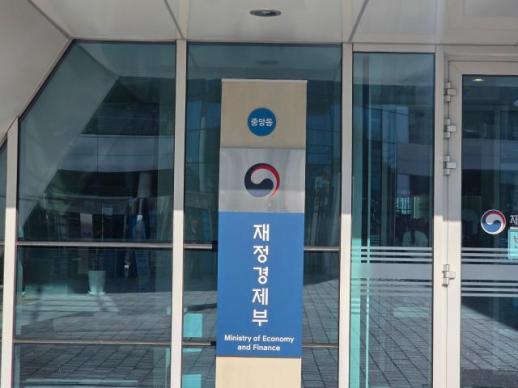 Government Seeks Public Ideas to Reduce Living Costs, Invites AI Policy Proposals The government is launching an initiative to gather public ideas aimed at reducing living costs. Focusing on areas with significant household expenses, such as housing, transportation, and communication, the initiative will also explore policies that utilize artificial intelligence (AI) technology. On May 18, the Ministry of Finance and Economy announced the "2026 Cost of Living Reduction Policy Idea Contest," which will run until July 27. The contest aims to alleviate the financial burden on citizens and discover policies that can be felt in daily life. This contest is designed to connect creative and practical ideas from the public with policy implementation, particularly in sectors where household spending is high. It will not be limited to traditional policy methods such as legislative amendments or institutional improvements but will also focus on generating cost-saving ideas that incorporate AI technology. The initiative aims to ensure that even those who are less familiar with digital devices can benefit from the latest technological advancements. Submitted ideas will undergo expert evaluation, and the final rankings will be determined through an online public vote from August 19 to September 2. An awards ceremony is scheduled for October, where the grand prize winner will receive a commendation from the Deputy Prime Minister and Minister of Finance, along with a cash prize of 2 million won. The total prize pool amounts to 5 million won.* This article has been translated by AI. 2026-05-18 15:01:13
 -
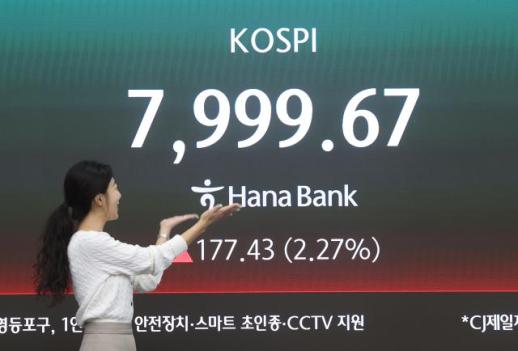 Debate Reignites Over Financial Investment Tax Amid Cryptocurrency Taxation Plans The debate over the potential reintroduction of the Financial Investment Income Tax (FIIT) is resurfacing as discussions about the taxation of cryptocurrencies gain momentum. With the implementation of cryptocurrency taxation set for next year, how to ensure equitable taxation between stocks and digital assets has become a key issue in tax reform discussions. According to sources in the financial sector on May 17, there is a growing call among government and political circles to overhaul the entire capital market taxation system. As the stock market thrives and capital gains increase, there is a rising awareness of the need for consistent tax standards across different asset classes as the deadline for cryptocurrency taxation approaches. In this context, discussions about the FIIT are also re-emerging. The FIIT was introduced during the Moon Jae-in administration under the principle of taxing income where it is generated, applying to net profits exceeding 50 million won from domestic stock investments. While the government emphasized the need for rationalizing the financial income tax system and enhancing equity, individual investors strongly opposed it, citing the potential for double taxation alongside the securities transaction tax. As the domestic stock market stagnated and concerns about weakened investor sentiment grew, the FIIT was effectively abolished just before its planned implementation in 2024. Recently, changes in the stock market environment have reignited discussions about the FIIT. The KOSPI has entered a new era, surpassing the 7,000 mark, and the ongoing AI rally has led to unprecedented increases in capital gains. Analysts note that the market's strength has significantly changed compared to when the FIIT was being debated. Additionally, the taxation of cryptocurrencies has emerged as a new variable. The government is preparing to impose a 22% tax rate on capital gains from cryptocurrency transactions starting next year. However, concerns have been raised that if stocks remain effectively tax-exempt while only cryptocurrencies are taxed, it could undermine equity in taxation across asset classes. Experts emphasize the need to evaluate both the necessity of taxation and the effectiveness and acceptability of the system. Bae Jin-soo, a researcher at the Korea Financial Research Institute, stated, "While the need for cryptocurrency taxation may be justified from a revenue perspective, it is essential to assess whether the actual revenue will be stable and whether it is an efficient tax measure when considering collection costs and taxpayer compliance costs. We must also consider the impact of taxation on the domestic cryptocurrency industry and investor protection comprehensively." Market analysts believe that the taxation systems for stocks and cryptocurrencies are likely to be adjusted together. If cryptocurrency taxation is implemented as planned, some adjustments to the stock taxation system will be unavoidable. Conversely, if discussions on the FIIT are delayed or its reintroduction is abandoned, there may be increased pressure to adjust cryptocurrency taxation as well. Concerns have been raised that applying taxation to only one asset class could distort the movement of investment funds. The government is also maintaining a cautious stance, aware of potential market shocks. Deputy Prime Minister and Minister of Economy and Finance Koo Yun-cheol has stated, "The Korean stock market is still at a lower level compared to advanced countries," adding that the introduction of the FIIT should be considered only after sufficient market conditions have been established. Researcher Bae emphasized, "While major countries have introduced cryptocurrency taxation based on social acceptance of existing capital gains tax systems, Korea is pushing for cryptocurrency taxation in a context where the foundation for capital gains taxation is relatively weak due to the abolition of the FIIT. A fundamental discussion on the basis and acceptability of taxation is necessary." * This article has been translated by AI. 2026-05-18 06:06:32
 -
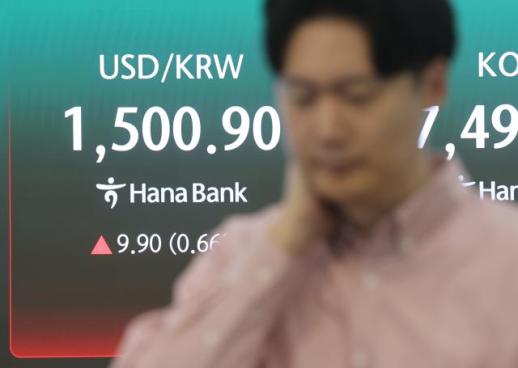 Korean Won Surges Past 1500 Against Dollar Amid Foreign Capital Outflow The won-dollar exchange rate has experienced significant fluctuations, rising nearly 70 won in just over a week to surpass the 1500 mark. This volatility is attributed to ongoing foreign capital outflows, compounded by geopolitical risks in the Middle East and strong dollar pressures. According to the Seoul foreign exchange market on May 17, the won closed at 1500.8 won per dollar on May 15, up 9.8 won from the previous trading day. On that day, the exchange rate opened at 1494.2 won, rising to the low 1500s by mid-afternoon. This marks the first time the rate has exceeded 1500 since April 7. Recent fluctuations in the exchange rate have been pronounced. The rate dropped to 1439.6 won on May 6, only to soar to 1507.7 won on May 15, creating a nearly 70 won gap between the low and high points within a week. Foreign capital outflows are a key factor driving the exchange rate increase. Foreign investors have consistently sold off domestic stocks over the past week, with net sales reaching 31 trillion won over seven consecutive trading days. Moon Da-woon, a researcher at Korea Investment & Securities, noted that foreign investors have been in a selling phase since the fourth quarter of last year, and the recent surge in domestic stock returns has led to additional selling pressure due to profit-taking and rebalancing. Deputy Prime Minister and Minister of Economy and Finance Koo Yun-cheol expressed concern, stating, "The excessive volatility in our economy is being driven by foreign investors selling stocks and speculative trading outside the country." Investor sentiment across the domestic financial market remains subdued. Uncertainties surrounding labor negotiations at Samsung Electronics and concerns over fiscal expansion have led to a sharp rise in bond yields. On May 15, the yield on three-year government bonds closed at 3.766%, up 11.2 basis points from the previous day. This marks the first time the three-year yield has reached the 3.7% range since November 16, 2023. Internationally, political instability in the UK has weakened the pound, further strengthening the dollar and increasing downward pressure on the won. The potential challenge to Prime Minister Keir Starmer from Manchester Mayor Andy Burnham, following his securing of parliamentary candidacy, has raised concerns over fiscal sustainability due to increased spending. As a result, the pound fell to its lowest level in over a month as of May 15. Geopolitical risks from the Middle East are also contributing to upward pressure on the exchange rate. Stalled peace negotiations between the U.S. and Iran, along with inconclusive results from the U.S.-China summit, have led to ongoing uncertainties regarding potential conflicts. Analysts warn that if high oil prices persist, risk appetite may diminish, potentially solidifying the won-dollar exchange rate in the 1500 range. However, some analysts suggest that further upward movement may be limited. Moon noted, "The current range between 1500 and the post-war peak of 1536 is a zone where government intervention is likely, and the burden of levels is quite high. This week, with domestic and external pressures on the exchange rate overlapping temporarily, we expect more short-term increases rather than a sustained rebound." * This article has been translated by AI. 2026-05-17 16:24:37
 -
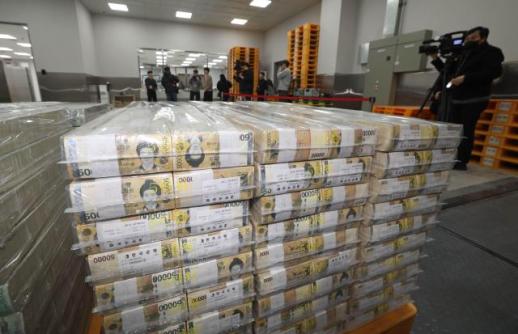 Rising Oil Prices Increase Burden on Cash Transport Industry, Bank of Korea Responds The Bank of Korea is facing increased pressure to maintain the currency circulation system due to a decline in cash usage and rising oil prices. On May 17, the bank announced that it discussed response measures with industry stakeholders during the regular meeting of the Currency Circulation System Related Institutions Council held on May 12. According to the Bank of Korea, while the proportion of cash as a payment method continues to decrease, the total amount of cash in circulation has been on the rise. As of the end of the first quarter of this year, the total currency issuance was approximately 215 trillion won, with steady demand for 50,000 won notes. In contrast, the circulation of coins has been declining since 2020, with a rapid reduction in the net issuance of 10 won coins. Kim Gi-won, head of the Bank of Korea's Currency Issuance Division, stated, "The decrease in cash usage is negatively impacting the profitability of cash transport and ATM operating companies. If this trend leads to reduced accessibility and acceptance of cash, there is a risk that the currency circulation system itself could contract." Participants in the meeting shared concerns that rising oil prices are increasing the cost burden on cash transport companies. Although the cash transport industry is working to defend its profitability through route optimization and expansion of new businesses, the surge in oil prices is exacerbating management challenges. A Bank of Korea official emphasized, "Maintaining a stable currency circulation system is a key responsibility of the central bank," adding that they plan to strengthen cooperation with relevant institutions and develop effective response measures.* This article has been translated by AI. 2026-05-17 12:18:24
 -
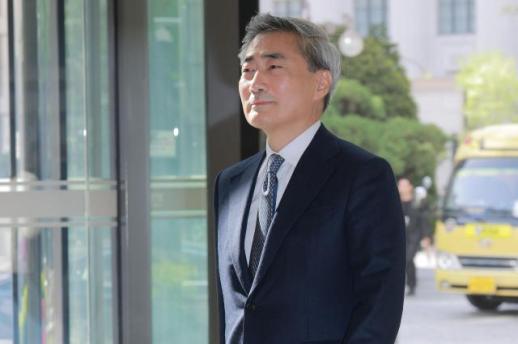 Bank of Korea Governor Shin Hyun-sung to Attend G7 Finance Track Meeting Shin Hyun-sung, the governor of the Bank of Korea, will attend the G7 Finance Track meeting, marking the first time a Bank of Korea governor has been officially invited to participate in this forum. According to the Bank of Korea on May 17, Shin is scheduled to attend the G7 Finance Ministers and Central Bank Governors meeting in Paris, France, on May 18-19 (local time). The meeting will include invited countries such as Brazil, India, and Kenya, alongside the G7 members. The G7 Finance Track serves as a platform to discuss global economic and financial issues and coordinate policy directions ahead of the leaders' summit. The discussions will later be reflected in a joint statement. Topics expected to be addressed at the meeting include global financial imbalances, critical mineral supply chains, and economic security issues related to monetary policy coordination. A Bank of Korea official stated, "During the meeting, Governor Shin plans to exchange views with finance ministers, central bank governors, and representatives from international organizations on key issues such as the global economic situation, monetary policy, and global imbalances."* This article has been translated by AI. 2026-05-17 12:13:00
 -
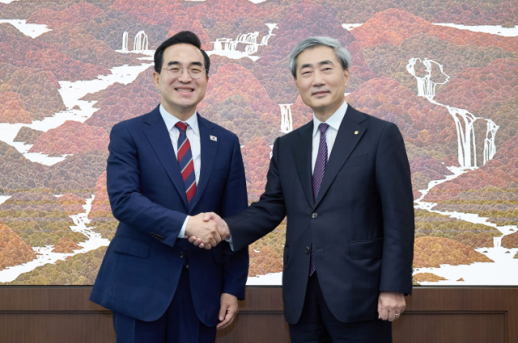 Finance Ministry and Bank of Korea Leaders Meet to Enhance Policy Cooperation Finance Minister Park Hong-keun and Bank of Korea Governor Shin Hyun-song held their first official meeting on May 14, agreeing to strengthen cooperation on fiscal and monetary policy to address complex crises. This marks the first official meeting between the heads of the two institutions in history. They pledged to work closely together to tackle challenges posed by the Middle East conflict, low growth, and demographic changes. During the meeting at the Bank of Korea headquarters in Seoul, Park stated, "The Ministry of Economy and Finance and the Bank of Korea must harmonize fiscal and monetary policies to enhance future growth potential and actively work to overcome structural crises." This meeting is the first since the revival of the Ministry of Economy and Finance after 18 years. Previously, Governor Shin met with Deputy Prime Minister and Minister of Economy and Finance Koo Yun-cheol just two days after his appointment on April 23. Park noted, "In response to the unexpected crisis of the Middle East conflict, we organized a supplementary budget of 26 trillion won in the shortest time in history. We are also working swiftly to ensure that citizens can feel the results more quickly." He added, "I visited the Bank of Korea to open a new path for cooperation and hope to maintain close and constructive communication on important policy tasks based on mutual respect for independence." He emphasized the need to address structural issues facing the South Korean economy and changes in the external environment. "As our economy continues to face structural problems amid fundamentally changing external conditions, the collaboration between the Ministry, which designs the country's medium- to long-term future strategy linked to fiscal policy, and the Bank, which prioritizes macroeconomic stability, is crucial at this time," he said. Park also highlighted the significant transformations in industrial structure and artificial intelligence, as well as the demographic changes. He stated, "We are witnessing structural challenges such as local decline, polarization, and the climate crisis, which can be effectively overcome through organic policy cooperation among various policy variables." He expressed hope that the meeting would enhance communication between the two institutions, allowing them to find solutions to economic challenges facing South Korea while sharing insights and collaborating closely. On this occasion, Park presented Governor Shin with a bonsai pine tree, explaining, "Just as roots and branches depend on each other, our two institutions should continuously cooperate for the nation and its people." In response, Governor Shin congratulated the Minister on the revival of the Ministry and his appointment, stating, "The bonsai pine embodies the values that our two institutions should strive for." He added, "Just as the pine tree's roots and trunk support each other to maintain its greenery over time, our institutions will work together to ensure that our economy remains stable amid domestic and external challenges." Shin further noted, "The Bank of Korea will operate policies aimed at price stability and financial stability while also deeply considering issues related to growth potential. Since complex economic issues cannot be resolved by the efforts of a single institution, we will continue to share insights and collaborate with the government."* This article has been translated by AI. 2026-05-14 13:48:10
 -
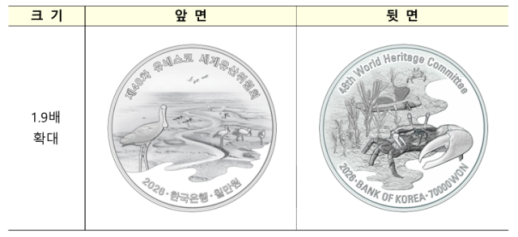 New Commemorative Coins Featuring Korea's Tidal Flats and Bangudae Petroglyphs Available for Pre-Order in June The Bank of Korea will issue two commemorative coins to celebrate the 48th session of the UNESCO World Heritage Committee being held domestically. On May 14, the bank announced it will release one silver coin and one nickel-brass coin to enhance Korea's international standing and increase interest in its natural and cultural heritage. The silver coin has a face value of 70,000 won, with a diameter of 32.0 mm and a weight of 14 grams, made of 99.9% pure silver. The nickel-brass coin has a face value of 30,000 won, with a diameter of 40.0 mm and a weight of 26 grams, composed of 75% copper and 25% nickel. The silver coin features Korea's tidal flats, a UNESCO World Natural Heritage site. The front depicts birds, including the black-faced spoonbill, set against a tidal flat background, highlighting the ecological characteristics and habitat value of Korea's tidal flats. The reverse side realistically portrays the white-legged crab and mudskipper, along with the salt marsh plant, highlighting the vibrancy and biodiversity of the tidal flat ecosystem. The nickel-brass coin is themed around the Bangudae petroglyphs, a registered World Heritage site. The front realistically depicts the actual rock surface and surrounding river and natural scenery, emphasizing some of the petroglyph patterns to enhance the sense of place. The reverse side rearranges images of animals and figures, including whales and deer, along with hunting scenes, to illustrate the relationship between prehistoric humans and nature, as well as their way of life at the time. A total of 14,000 coins will be issued, with 7,000 of each type. Individual coins will be limited to 2,000 each, while a set of both types will consist of 5,000 sets (10,000 coins total). Ninety percent of the total issuance will be available domestically, with the Korea Mint Corporation accepting pre-orders through NongHyup Bank and its online shopping mall. If domestic applications exceed the allocated amount, winners will be selected by random draw. The remaining 10% will be available for international orders through the Korea Mint Corporation's overseas sales network. Any unsold coins will be included in the domestic supply. Pre-orders will be accepted from June 1 to June 23 at Korea Mint Corporation and NongHyup Bank branches and online.* This article has been translated by AI. 2026-05-14 13:09:30
 -
 Bank of Korea Struggles to Retain Young Employees Despite Salary Increases Despite the Bank of Korea's efforts to improve employee conditions, including salary increases, the trend of voluntary resignations among junior employees remains persistent. While the overall number of retirements has decreased, demand for job changes continues among younger staff. According to data submitted to lawmaker Ogi-hyung of the Democratic Party of Korea, the number of employees with 1-5 years of service who resigned last year totaled 11, marking a 57.1% increase from 2024, which saw 7 resignations. Resignations among employees in their first five years surged from 10 in 2021 to 19 in 2022, then dropped to 15 in 2023 and 7 in 2024. However, the number rose back into double digits last year, and five employees left the bank in just the first four months of this year. If this trend continues, the number of junior resignations this year is likely to exceed last year's figures. In contrast, the total number of resignations at the Bank of Korea fell from 160 in 2022 to 89 last year, nearly halving over three years. This decline is believed to be partially influenced by recent efforts to improve employee conditions. The average salary for non-executive employees rose from 103.3 million won in 2022 to 110.3 million won this year. The starting salary for new hires also increased from 51.8 million won to 58.4 million won during the same period, a rise of approximately 12.7%. Nevertheless, the trend of junior employees leaving the bank has not significantly eased. Many junior resignations are attributed to job changes. Over the past five years, the proportion of resignations among employees with 1-5 years of service due to job changes has been recorded as follows: 80.0% in 2021, 57.9% in 2022, 33.3% in 2023, 57.1% in 2024, 45.5% in 2025, and 40.0% in the first four months of 2026. The reasons behind this trend include differences in personnel structures and treatment across job categories. Employees in comprehensive planning roles (G5) are hired based on various fields such as economics, management, law, statistics, and computer science, but most rotate through different departments after joining. This has led to concerns among some employees about the difficulty of accumulating expertise in specific areas over time. Many are considering career paths in the private financial sector or academia, where they can better utilize their expertise. For general administrative staff (C3), limited opportunities for promotion and conversion to comprehensive roles have contributed to lower job satisfaction. Recently, some C3 employees have reportedly transitioned to national policy banks after passing examinations. The salary gap with the private financial sector remains a significant concern. According to the Financial Supervisory Service's electronic disclosure system, the average annual salary for employees at the four major commercial banks (KB Kookmin, Shinhan, Hana, and Woori) was 122.75 million won last year, exceeding the average salary at the Bank of Korea by about 10 million won. Starting salaries, including various allowances, also reach levels between 60 million and 65 million won. A Bank of Korea official stated, "Some employees feel that they do not accumulate enough expertise after going through several rotations. There are cases where highly qualified individuals with doctoral degrees change careers to the private financial sector or academia due to a strong desire for expertise, which is regrettable from the organization's perspective." The official added, "Given that the work at the Bank of Korea tends to be more academic in nature, it is not uncommon for employees to transition to similar paths in research or academia after joining. As younger generations increasingly demand expertise, it is time to reconsider the rotational job structure."* This article has been translated by AI. 2026-05-14 11:45:07
 -
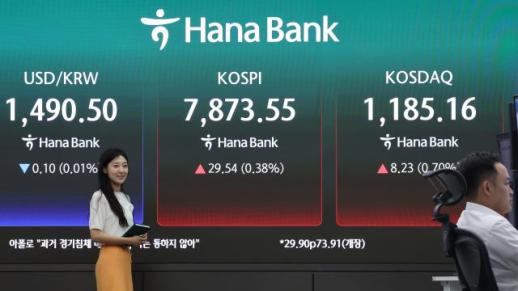 Oil Prices Hit $100 as U.S. Inflation Concerns Rise, Threatening 1490 Won Exchange Rate The exchange rate of the won against the dollar has shown volatility, surpassing the 1490 won mark during trading, influenced by rising international oil prices and inflation concerns in the United States. As of 9:20 a.m. on May 14, the exchange rate was trading at 1489.2 won per dollar. The rate opened at 1489.8 won, down 0.8 won, and briefly crossed the 1490 won threshold shortly after the market opened before retracting some gains. With ongoing geopolitical tensions in the Middle East, forecasts suggest that the blockade of the Strait of Hormuz will continue until the end of May, keeping international oil prices, particularly West Texas Intermediate (WTI), around the $100 per barrel mark. On May 13, WTI for June delivery closed at $101.02, down $1.16 (1.14%) from the previous session on the New York Mercantile Exchange. The U.S. Producer Price Index (PPI) for April surged by 1.4% month-over-month and 6.0% year-over-year, exceeding market expectations. Following the consumer price index (CPI), the PPI also surpassed forecasts, raising inflation concerns and leading to an increase in U.S. Treasury yields, particularly for long-term bonds. The dollar strengthened in tandem with rising Treasury yields. Minkyu Won, an economist at Woori Bank, noted, "The rise in bond yields is clearly contributing to a stronger dollar. Given this trend, there is a significant likelihood that the won will face downward pressure today." He added, "In addition to active buying by importers, the re-entry of demand for dollar conversions related to overseas stock investments due to a strong U.S. stock market supports the actual demand for dollars. However, the volume of export-related deferred negotiations and the authorities' caution regarding speed control may limit the upper range of the exchange rate."* This article has been translated by AI. 2026-05-14 10:03:19
 -
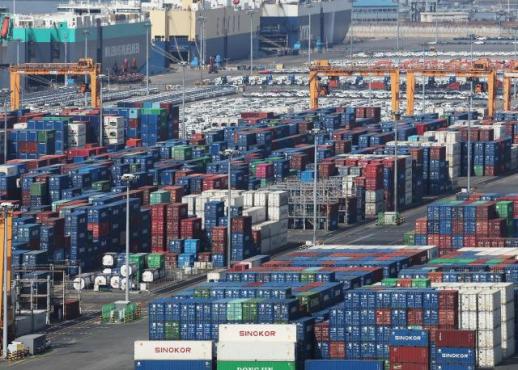 South Korea Posts Highest GDP Growth Among Major Economies in Q1 South Korea's economy recorded the highest growth rate among major economies in the first quarter of this year. Driven by strong exports, the country achieved a surprising growth, but concerns about base effects and external uncertainties suggest that growth may slow in the second quarter. According to the Bank of Korea's economic statistics system, South Korea's GDP growth rate for the first quarter was 1.694%, the highest among 22 countries that released preliminary figures as of the previous day. Indonesia (1.367%) and China (1.3%) followed, but the gap between them and South Korea was significant. Only these three countries recorded growth rates above 1% for the first quarter. Other major countries reported growth rates below 1%, including Finland (0.861%), Hungary (0.805%), Spain (0.614%), Estonia (0.581%), the United States (0.494%), Canada (0.4%), and Germany (0.334%). In contrast, France (-0.005%), Sweden (-0.21%), Lithuania (-0.444%), and Mexico (-0.8%) experienced negative growth, with Ireland showing a significant decline at -2.014%. After a fourth-quarter growth rate of -0.161% last year, South Korea fell to 38th among 41 major countries included in the Bank of Korea's statistics. However, the country has seen a dramatic rebound in rankings this year. If South Korea maintains its position after other countries release their final figures, it will mark the first time since the first quarter of 2010 (2.343%) that it has ranked first in quarterly growth in nearly 16 years. This unexpected growth in the first quarter was largely attributed to exports, particularly in the semiconductor sector. Exports surged by 5.1%, primarily driven by information technology (IT) products, contributing 1.1 percentage points to net exports. Samsung Electronics and SK Hynix reported impressive results of 57.2 trillion won and 37.6 trillion won, respectively, helping to drive the economic rebound. In light of the better-than-expected growth rate, both domestic and international institutions are adjusting their economic forecasts upward. The actual growth figure is nearly double the Bank of Korea's earlier forecast of 0.9% for the first quarter. However, it remains uncertain whether this growth trend will continue into the second quarter. Due to the nature of quarter-over-quarter growth rates, there is a tendency for growth rates to slow after reaching a high base. The government stated on April 23 that "the base effect from the significant growth in the first quarter, combined with the intensifying impacts of the Middle East conflict, suggests that a correction in growth is likely in the second quarter."* This article has been translated by AI. 2026-05-12 08:57:37