
Journalist

Kim Yu-jin
ujeans@ajunews.com
-
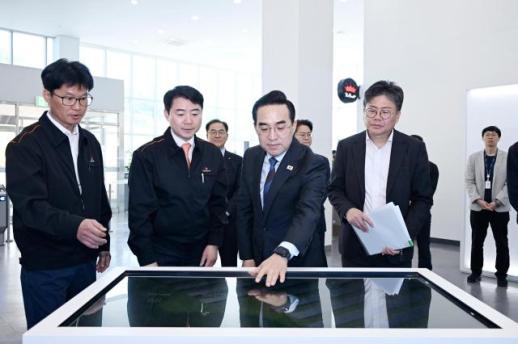 Minister Park Hong-keun Calls for Strengthened Central-Local Cooperation to Revive Solar Industry Park Hong-keun, the Minister of Economy and Finance, stated on May 8 that strengthening cooperation between the central government and local governments is essential for reviving the solar industry ecosystem. During his visit to Hanwha Solutions Q CELLS, a domestic solar cell manufacturer in Jincheon, Minister Park toured the production facilities for solar cells and modules and gathered feedback from officials. He highlighted the significance of the veranda solar power supply project in terms of securing energy supply chains and achieving carbon neutrality. However, he emphasized the need for the smooth implementation of energy transition projects, amounting to approximately 600 billion won, which are reflected in the supplementary budget for this year. An official from the company suggested that increased support is necessary to enhance the technological competitiveness of domestic firms, particularly in next-generation solar cells. In fact, the market share of domestic solar cell manufacturers dropped from about 50% in 2019 to around 25% in 2023, and it has recently fallen to just over 4%, highlighting the crisis facing the domestic industry. The Ministry of Economy and Finance believes that collaboration among the central government, local governments, manufacturers, and private associations is crucial for securing technological competitiveness and restoring the solar industry ecosystem. Minister Park plans to review the feedback gathered during the visit with relevant departments and consider it for the 2027 budget. He stated, "In addition to renewable energy supply projects like solar panels, we will implement various support measures, including research and development (R&D) and financial assistance, to enhance the global competitiveness of domestic producers." Additionally, Minister Park visited the Jincheon National Training Center to encourage athletes preparing for the Aichi-Nagoya Asian Games. He noted that 3 billion won has been allocated in the supplementary budget for the construction of an 'air mat' facility that allows for year-round winter training, pledging to improve the training environment for athletes.* This article has been translated by AI. 2026-05-08 14:33:26
 -
 Welfare Spending in South Korea Increased by 130 Trillion Won Over 18 Years South Korea's welfare spending has increased by over 130 trillion won in the past 18 years, primarily due to pension payments. This concentration of funds raises concerns about whether resources are being effectively allocated to other necessary areas. According to a report by the National Fiscal Research Institute, titled 'Trends and Implications of Welfare Sector Finance,' social welfare spending rose from 33.4 trillion won in 2008 to 165.9 trillion won in 2026, an increase of 132.5 trillion won.This year, the institute analyzed 344 detailed welfare projects, identifying 14 with budgets exceeding 1 trillion won, which accounted for 90.6% of total spending. This is up from 68.8% in 2008, indicating a steady rise in large-scale projects.Public pensions represent the largest portion of social welfare expenditures. The amount allocated to public pensions grew from 21.4 trillion won in 2008 to 97 trillion won today, maintaining a high percentage of total budget allocations at around 60% since 2008.The largest single expenditure among projects over 1 trillion won is the National Pension benefit payments, totaling 54.5 trillion won, followed by civil servant pension payments at 24.9 trillion won and basic pension payments at 23.1 trillion won.Kim Yong-won, a senior researcher at the National Fiscal Research Institute, noted, "From 2008 to 2026, total spending in the analyzed sectors increased by an average of 9.3% annually, with National Pension benefits rising by 14.5% and basic pensions by 16.0%, reflecting the impact of an aging population."Medical and livelihood assistance budgets were also significant, at 9.8 trillion won and 9.2 trillion won, respectively, but their average annual growth rates were lower than the overall average of 9.3%.Despite the focus on income security through public pensions, basic living security, which serves as public assistance, is limited to 22.2 trillion won, with social services at just 10.2 trillion won. These figures indicate that the budget for policies most directly felt by citizens is relatively low.When compared to other countries, South Korea's public social welfare spending remains low. According to OECD data, South Korea's public social welfare expenditure as a percentage of GDP rose from 6.8% in 2008 to 16.2% in 2022, while the OECD average increased from 18.5% to 20.5% during the same period.Although the United States has the lowest public social welfare spending among the G7 nations, it is projected to surpass South Korea by 4.5 percentage points in 2024, rising from 16.3% in 2008 to 19.8%.The findings indicate that while South Korea's social welfare spending has significantly increased, it remains below the levels of advanced nations, with expenditures concentrated in specific areas.The institute emphasized that while increased spending is necessary for transitioning to a welfare state, the concentration of funds in certain projects suggests that resources are not being allocated effectively. Kim concluded, "Our social welfare finance is still insufficient to be called a welfare state, necessitating detailed discussions and proposals for improvement in related areas." 2026-05-08 12:22:11
 -
 South Korea Establishes Arctic Route Committee to Boost Development The South Korean government is set to accelerate its Arctic route development initiative with the establishment of a new Arctic Route Committee under the Prime Minister's office, which will also focus on training professionals in related fields. On May 7, the Ministry of Oceans and Fisheries announced that three key bills—"Sustainable Coastal Fisheries Development Act," "Special Act on Promoting the Use of the Arctic Route and Supporting Related Industries," and amendments to the "Shipping Act"—passed the National Assembly. The Arctic route initiative is a major policy project for the ministry, which has already laid the groundwork by launching the Arctic Route Promotion Headquarters. The passage of the Arctic Route Special Act enables the formation of the Arctic Route Committee, which will facilitate the establishment of a basic plan, professional training, and financial support across government agencies. Additionally, the new legislation aims to reorganize the administrative framework for coastal fisheries, mandating reporting on fishing locations and catch data by species. It also establishes the basis for issuing catch certificates. The name of the state-subsidized route, which covers all operational losses, will change to "Public Route." The revised Shipping Act allows public institutions to manage these routes, enhancing safety through specialized oversight. The ministry plans to delegate some routes to public entities next year, with a full transfer expected by 2028. Minister of Oceans and Fisheries Hwang Jong-woo stated, "We will work diligently on the subordinate regulations and ensure the smooth implementation of the laws that have passed the National Assembly."* This article has been translated by AI. 2026-05-07 23:29:33
 -
 South Korea Speeds Subsidy Payments for Coastal Ferry Operators to Deploy Extra Budget The South Korean government will shorten the payment cycle for subsidies to coastal shipping companies and speed up disbursements to keep ferries running smoothly on routes often described as island residents’ lifeline. The Ministry of Oceans and Fisheries said May 7 it will quickly execute a total of 22.6 billion won in supplementary budget funds to support coastal shipping operators facing financial strain from a surge in global oil prices. The package includes oil price-linked subsidies and compensation for operating losses. Although the maximum price for marine diesel was set at 1,923 won on March 27, it remains about 32% higher than in February. Tax-free diesel rose 68.5% to 1,382 won, the ministry said. To accelerate support, the ministry revised the payment schedule for fuel tax subsidies (6.7 billion won) and oil price-linked subsidies (6.2 billion won). Amounts that were to be paid quarterly will instead be paid monthly. Local maritime and fisheries offices and the Korea Shipping Association plan to notify operators of application procedures and methods. Operating-loss compensation had been calculated based on deficits tallied at year’s end. To speed execution, the ministry will disburse part of the deficit incurred up to those points in June and August. It will then make a final payment within 30% of the deficit amount after an accounting review by the end of October, reflecting operating results from January through September. Of 99 coastal passenger routes, the ministry will disburse 2.9 billion won in additional operating-loss support for 42 routes by next month. Eligible routes include 29 state-subsidized routes and 13 deficit routes, including routes aimed at creating a “one-day living zone.” The remaining 57 routes will be supported using 6.8 billion won secured through a supplementary budget for the “2026 temporary operating-loss support project for short-term deficit routes.” Funds will be paid in three rounds at two-month intervals starting next month. The ministry said the subsidies are expected to ease some of the burden on operators covering losses on state-subsidized and deficit routes. Hwang Jong-woo, the oceans and fisheries minister, said coastal passenger ships are “like a lifeline” for South Korea’s coast and that disruptions could cause serious inconvenience for island residents. He said the ministry will “do everything possible” to support normal operations through rapid fiscal execution. * This article has been translated by AI. 2026-05-07 11:05:32
 -
 South Korea Launches Project to Give Sea Forests Official Names "I think you have to give it a name. How lonely would it be without one? I already named it 'Bonny.' Now I'll call this geranium 'Bonny.'" That line comes from the novel "Anne of Green Gables," when Anne names a geranium on the windowsill. The moment it has a name, it becomes more than just one plant among many. Naming something can be a gentle promise to care for it and stay with it. Underwater, South Korea has many places still waiting for that kind of attention: "sea forests." Sea forests are underwater areas where seaweeds such as kelp, Ecklonia and sea mustard grow in clusters, creating habitat for a wide range of marine life. They serve as feeding grounds and spawning and nursery areas, while absorbing carbon dioxide, releasing oxygen and helping clean the marine environment. The Ministry of Oceans and Fisheries said it created 375 square kilometers (145 square miles) of sea forests from 2009 through last year, an area more than half the size of Seoul. The term compares coastal seaweed beds that grow in sunlit waters to forests on land. Fish use these areas as spawning grounds and nurseries. They were previously referred to as seaweed grounds or seaweed forests, but the ministry said the term "sea forest" is now used. The sea forests built so far are large enough to absorb 127,000 tons of carbon dioxide a year, equivalent to emissions from 52,000 cars, the ministry said. In sea forests completed in 17 waters including Yeosu and Pohang from 2022 to 2025, a species-diversity index used to indicate ecosystem health rose 64.1% compared with before construction, it said. Even so, many of these sites have been recorded in project reports only by coordinates and administrative place names, such as the "Donghae Mukho sea forest" and the "Jeju Aewol-ri sea forest." The ministry contrasted that with well-known land forests and mountains that are remembered and protected by name. The ministry said places without names can be easier to overlook. When a sea forest is managed only as a set of coordinates, it can quickly fade from public memory after it is built. To change that, the ministry said it will launch a project called "Sea Forests, Adding Names" with Hyundai Motor Co. and the Korea Fisheries Resources Agency, both of which participate in sea-forest construction. The goal is to publicize sea forests and elevate them as places the public continues to watch and manage, described as a kind of "companion space." The first name created through the project is "Ullim," for a sea forest built in waters off Ulsan's Jujeon area. The ministry said the name carries the meaning of a "new forest of Ulsan" (蔚林) and reflects Hyundai employees' hope that the sea forest's recovery of marine ecosystems will spread as a powerful resonance. On May 10, Marine Planting Day, the ministry said the "Ullim sea forest" will also appear on map apps, turning an unnamed seaweed cluster into something more familiar, like a friend or neighbor. The ministry said the naming project is expected to expand into a global campaign, including in Argentina and Australia. South Korea designated May 10 as Marine Planting Day in 2012, the first in the world, to promote protection of marine ecosystems and awareness of the risks of ocean desertification. The ministry said it hopes the effort to name sea forests will help spur care and protection of sea forests worldwide.* This article has been translated by AI. 2026-05-07 09:36:15
 -
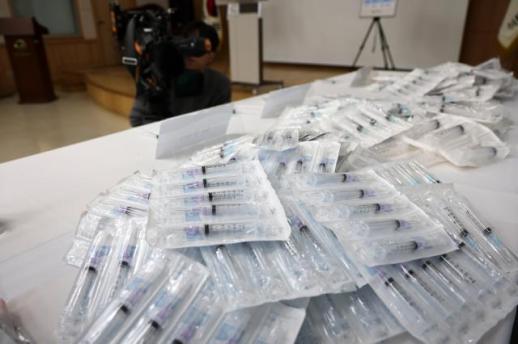 South Korea to name medical facilities hoarding supplies; prioritize plastic feedstock for makers As concerns grow that the war in the Middle East could disrupt supplies of medical products, the South Korean government will investigate and publicly disclose medical institutions holding excessive inventories. It will also prioritize plastic feedstock for manufacturers to keep production running smoothly. The Ministry of Health and Welfare announced the steps in a report titled “Medical product supply and price trends and measures in response to the Middle East war,” presented at a special interministerial task force on cost-of-living management. The government said it will make the supply chain more transparent. It has been conducting daily monitoring in cooperation with six medical associations, and will add a weekly nationwide survey of medical institutions’ inventories to track stock levels, including comparisons with the same period a year earlier. It also conducted on-site inspections from May 4 to May 7 at 24 medical institutions suspected of buying excessive quantities of syringes. For items at risk of short-term shortages — including packaging for IV solutions, syringes, medicine packaging and dosing bottles — the government will ensure manufacturers receive raw materials first. The measures will continue through May, and the government said it plans ongoing management after June as well. Jung Kyung-sil, director general for health care policy at the ministry, said the government will publish daily supply-and-demand updates, including syringe production, shipments and inventories, “to ease public anxiety and encourage voluntary self-correction in distribution.” To help ensure stable supplies for high-demand facilities such as dialysis clinics, the government has operated a “syringe supply chain hotline” since April 16. Since it began, 970,000 syringes have been supplied to online malls, and 210,000 have been delivered to medical institutions. The ministry also said patients who need around-the-clock management, including those with rare diseases, will be able to buy medical products through telemedicine platforms. Through telemedicine intermediaries, buyers will be identified as having rare or intractable diseases and allowed to place orders by distinguishing between covered and noncovered items. Jung said the ministry determined that shortages on online malls were fueling anxiety among patients, adding that syringes have been delivered using telemedicine platforms since May 4. Separately, the disposal interval for general medical waste at clinics and public health centers will be temporarily doubled to 30 days from the current 15 days. The measure will remain in place until next month’s 30th. The ministry said hospitals generate large volumes of waste and fill containers and plastic liners within 15 days, while clinics often dispose of waste before containers are full because volumes are smaller. Jung said the government is not moving to institutionalize the longer disposal interval for clinics. She said hospitals structurally use large amounts of plastic, adding that formalizing the change “could be considered as one option” to reduce reliance on plastic products, but that further talks with the Ministry of Climate, Energy and Environment are needed and it is difficult to say whether it could be adopted permanently. The government also adjusted National Health Insurance reimbursement rates for treatment materials to reflect the strong-dollar environment. Based on exchange rates over the past three years, it changed the exchange-rate reference grade for treatment materials from the 1,100-won range to the 1,300-won range and raised it by 6%. As a result, the average reimbursement for 27,000 separately calculated treatment materials rose 2%, with an expected support effect of 6.7 billion won per month. In addition, the government will provide emergency management stabilization funds to small and midsize companies that manufacture plastic-based medical products. 2026-05-07 09:08:02
 -
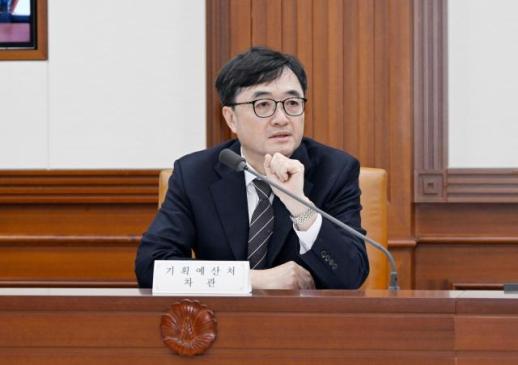 South Korea Budget Vice Minister Lim Ki-geun Meets Gates Foundation to Expand ODA Cooperation The Ministry of Planning and Budget and the Bill & Melinda Gates Foundation are moving to broaden cooperation in official development assistance, agreeing that faster digital change requires tapping private-sector capacity to create new value. Vice Minister Lim Ki-geun met on the 6th with Joe Cerrell, the foundation’s managing director for external relations, to discuss ways to improve the effectiveness of international development cooperation. The meeting followed Bill Gates’ visit to South Korea in August last year. During that trip, Gates met with President Lee Jae-myung to discuss global health and ODA cooperation. Gates said South Korea is among the few countries to have transitioned from an aid recipient to a donor, and urged it to continue supporting efforts to improve the global health environment. Lim praised the foundation’s results in global health and sustainable development. He said its approach of using its funding to draw in private capital and technology helps boost the effectiveness of development assistance. Cerrell said he highly values South Korea’s rise from an ODA recipient to a donor and expressed hope that the government will increase ODA support to show stronger leadership. Lim responded that the focus should be on strategic use of resources and spreading measurable results. “Through cooperation among diverse development partners, including the public and private sectors, we can create new added value,” he said, adding that in the digital and artificial intelligence era, private innovation in technology and networks should be used to the fullest. Lim and Cerrell also reviewed the outcomes and significance of global cooperation projects between South Korea and the foundation, including the International Health Technology Research Fund (RIGHT Foundation). They agreed on the need to identify promising cooperation projects in other areas as well. The ministry said it will work with ODA lead agencies, including the Foreign Ministry, to review the full process from budget execution to performance management and reflect the results in drafting the next budget proposal. * This article has been translated by AI. 2026-05-06 17:34:01
 -
 South Korea Tightens State Contract Rules After Serious Accidents, Raises Bond Requirements Contractors sanctioned after a serious industrial accident will have to post a higher contract bond if they sign a state contract after a court grants a temporary suspension of the sanction. The government will also tighten safety requirements at the bidding stage, allowing only companies with safety-related certification to bid on some contracts. The Cabinet on the 5th reviewed and approved a partial revision to the Enforcement Decree of the State Contract Act reflecting those measures. The revision focuses on easing management burdens through more rational payment procedures, strengthening safety management to ensure stable performance of state contracts, and improving fairness by supplementing contract rules. Earlier, the Ministry of Economy and Finance submitted to the National Assembly a report on follow-up actions to the 2024 National Assembly audit and said it planned to revise the enforcement decree. The move is seen as raising bond requirements for sanctioned firms while reducing burdens on contracting agencies. To strengthen safety from the outset, the revision creates a legal basis to limit eligibility for contracts requiring specialized safety standards to companies with safety certification and the necessary professional staff and technology. Firms sanctioned for serious violations — including serious accidents and bid rigging — will face higher bond requirements. If a sanctioned company signs a contract after a court accepts an injunction suspending the sanction’s effect, the contract bond rate will rise to 20% from 10%. The payment process will also be adjusted. Previously, when a competitive bid failed and a contract was then awarded through a private contract, only turnkey projects could reflect price changes by adjusting the total project cost and then revising the contract amount. Under the revision, contract amounts may also be changed when a private contract is signed after a basic-design technical proposal bid. To reduce companies’ burdens, the contract bond rate for construction contracts will be lowered to 10% from 15%. A new provision will also allow the bond for long-term construction contracts to be eased to 5% from 10% in an economic crisis such as a disaster or recession. The government also added measures to improve fairness. In cases where it was not possible to determine provisional prices for some cost items that make up the estimated price before bidding, agencies could sign contracts subject to a post-contract cost review. Citing concerns that oversight could be insufficient, the revision requires a resolution by the contract review committee when the combined share of such items is 20% or more, and requires both a contract review and notification to the Board of Audit and Inspection when the share is 50% or more. A ministry official said the government will continue working to reduce companies’ management burdens while strengthening safety management in the performance of public contracts, adding that it will keep improving the contract system by reflecting difficulties in the field. * This article has been translated by AI. 2026-05-06 16:48:17
 -
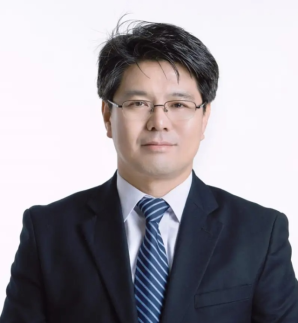 Ahn Young-cheol Appointed Head of Korea Maritime Transportation Safety Authority The leadership vacancy at the Korea Maritime Transportation Safety Authority (KOMSA) has been filled after about six months, following the end of Kim Jun-seok’s term. The Ministry of Oceans and Fisheries said Tuesday it appointed Ahn Young-cheol, a professor at Busan University of Foreign Studies, as KOMSA’s fourth chairman. His three-year term runs from Tuesday through May 5, 2029. Kim’s term ended Nov. 30 last year, but no successor was named, leaving the agency without a permanent chairman for months. Ahn earned a doctorate in public finance and economics from the University of Wuerzburg in Germany. He has served as an adviser to the Presidential Committee on Balanced National Development and as chairman of the Korea Climate Economy and Social Research Institute, building expertise in public policy. He is known for work on climate economics, environmental, social and governance management, and balanced regional development. The ministry and the authority said they expect Ahn to help stabilize the organization and respond proactively to changes in the policy environment, drawing on his public policy background. Ahn said he would “carefully assess the policy conditions the authority faces” and strengthen its policy response and execution so its evolving roles and functions match current needs. He also pledged to “build leadership that unites the organization based on expertise and communication.” * This article has been translated by AI. 2026-05-06 14:12:13
 -
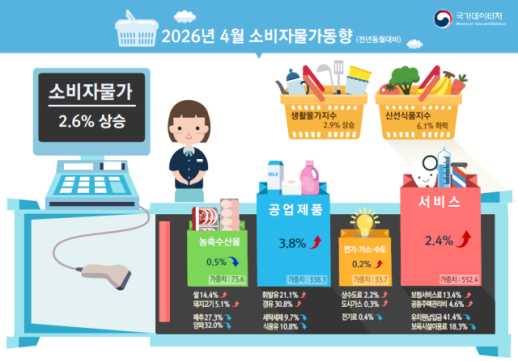 South Korea’s April Consumer Inflation Hits 2.6%, Highest in 21 Months on Fuel Surge Global oil prices kept climbing, driving a sharp jump in fuel costs and pushing consumer inflation to its fastest pace in 21 months. A government cap on fuel prices, in place since March, helped cushion the rise but did not prevent inflation from staying in the 2% range. Officials also warned that price pressures that have been concentrated in energy could spread to non-energy items starting in May. According to the National Data Center’s “April 2026 Consumer Price Trends” released Tuesday, the consumer price index stood at 119.37 (2020=100) in April, up 2.6% from a year earlier. Prices for agricultural, livestock and fisheries products fell, but the steep rise in petroleum products lifted overall inflation to its biggest increase in 21 months. Processed food prices, which had posted high gains since last year, rose 1.0% in April. The slower increase appeared to reflect cuts in factory-gate prices, the agency said. Petroleum product prices jumped 21.9% from a year earlier, the biggest increase since July 2022 during the Russia-Ukraine war, when the rise reached 35.25, marking the largest gain in three years and nine months. Over the same period, gasoline rose 21.1% and diesel climbed 30.8%. Kerosene increased 18.7%, the strongest rise in three years and two months since February 2023, when it gained 27.1%. The agency said the fuel price cap introduced in March acted as a buffer against inflation. The Korea Development Institute has also reported that the cap lowered March consumer inflation by 0.8%, according to its research findings. “Rising global oil prices pushed up petroleum products and international airfares in particular,” said Lee Du-won, the agency’s director for economic trends and statistical review. “However, compared with the OECD, the increase in petroleum products is smaller. The fuel price cap had some effect in easing the overall rise in consumer prices,” he said. Price pressures also extended into services. Public service prices rose 1.4% from a year earlier and personal services increased 3.2%. International airfares jumped 15.9% as fuel surcharges rose, leading the increase in public service prices, the agency said. Domestic airfares have not shown a marked rise so far, but increases are expected from May. The April fuel surcharge for domestic flights was calculated based on February levels, while May pricing is expected to reflect the impact of the Middle East war in late February, the agency said. Prices for rice and livestock products also continued to rise. Rice, including glutinous rice, posted larger increases due to reduced cultivation area. Livestock prices rose sharply for items such as imported beef and chicken, driven by higher import prices and avian influenza, the agency said. Still, the agency said higher oil prices had not yet spread broadly into non-energy categories. “So far, we are not seeing an overall rise in dining out or processed foods,” Lee said. He added that prices for paper diapers and sanitary pads have not fluctuated much, and that garbage bags fell 0.3% due to price adjustments by some local governments. The core inflation index excluding food and energy rose 2.2% from a year earlier. The index excluding agricultural products and petroleum products also increased 2.2% over the year. Among 458 items, the cost-of-living index covering 144 frequently purchased goods rose 2.9% from April last year. The fresh food index, however, fell 6.1% from a year earlier. An index excluding owners’ equivalent rent, which reflects the cost of housing services consumed by homeowners, rose 2.3% from a year earlier. * This article has been translated by AI. 2026-05-06 09:28:39