
Journalist

Seo Min-ji
vitaminji@ajunews.com
-
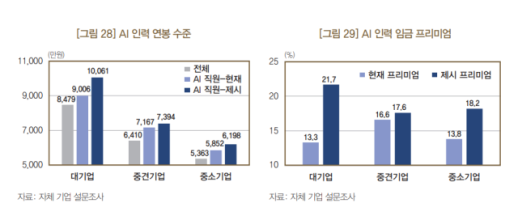 Low pay for AI talent is driving skilled workers overseas, BOK warns SEOUL, December 05 (AJP) - South Korea offers the lowest wage premiums for artificial intelligence specialists among major advanced economies, placing the country at a disadvantage in the global battle for high-tech talent, the Bank of Korea said in a report released Friday. The analysis, presented at a seminar co-hosted with the Korea Chamber of Commerce and Industry, called for upgrading compensation systems and research environments to meet international standards. Using data from LinkedIn profiles compiled by Revelio Labs, the report estimated South Korea had about 57,000 AI-skilled workers last year — more than double the 27,000 recorded in 2010 but far behind the United States (780,000), the United Kingdom (110,000) and France (70,000). South Korean AI professionals earned only a 6 percent wage premium over non-AI workers, compared with 25 percent in the U.S. and 18 percent in Canada. Wage premiums were higher in specialized fields such as pattern recognition and neuroscience, but remained low in core areas such as deep learning and machine learning. The weak premium has contributed to a persistent talent drain. Except for 2020, South Korea recorded a net outflow of AI professionals every year from 2010 to 2024. Last year, about 11,000 South Korean AI specialists were working overseas, including 6,300 in the U.S. “The high rate of overseas employment among workers facing low domestic wage premiums suggests a clear link between compensation and international mobility,” said Oh Sam-il, one of the report’s authors. “South Korea is losing ground in the global competition for AI talent.” Oh said rigid wage structures and intense global competition are suppressing domestic premiums. He urged the government and companies to focus on improving career development pathways and offering competitive compensation packages to retain and attract top-tier AI professionals. * This article, published by Aju Business Daily, was translated by AI and edited by AJP. 2025-12-05 16:28:36
 -
 South Korea's FX reserves rise for sixth month to $430.7 billion SEOUL, December 03 (AJP) - South Korea’s foreign exchange reserves climbed for a sixth straight month in November, rising by $1.84 billion to $430.66 billion — the highest level since August 2022 — the Bank of Korea (BOK) said on Wednesday. The steady increase follows a five-year low of $404.6 billion recorded in May. The central bank said the latest gain was driven by higher investment returns and an uptick in foreign-currency deposits held by domestic financial institutions. By asset type, securities including government and corporate bonds rose by $1.39 billion to $379.35 billion. Deposits increased by $490 million to $26.43 billion. Gold holdings were unchanged at $4.79 billion. As of end-October, South Korea ranked ninth globally in foreign reserves. China topped the list with $3.343 trillion, followed by Japan, Switzerland, Russia, India, Taiwan, Germany and Saudi Arabia. * This article, published by Aju Business Daily, was translated by AI and edited by AJP. 2025-12-03 08:46:10
 -
 Koreans spent nearly $6 billion abroad on cards in Q3, setting new record SEOUL, November 25 (AJP) - South Koreans’ overseas card spending hit an all-time high in the third quarter, buoyed by a rebound in outbound travel and steady demand for direct overseas purchases, the Bank of Korea said on Tuesday. Total spending abroad using credit and debit cards reached $5.93 billion between July and September, up 7.3 percent from the previous quarter’s $5.52 billion and surpassing the previous record of $5.71 billion set a year earlier. The central bank attributed the increase largely to stronger travel demand during the summer peak season. The number of South Koreans traveling overseas rose 4.8 percent on-quarter, from 6.77 million to 7.09 million. Credit card spending accounted for $4.09 billion, while debit card transactions totaled $1.84 billion, with both categories climbing more than 7 percent from the previous quarter. * This article, published by Aju Business Daily, was translated by AI and edited by AJP. 2025-11-25 16:17:18
 -
 Korea's household debt hits new high but loan growth slows sharply in 3Q SEOUL, November 18 (AJP) - South Korea’s household debt climbed to a record level in the third quarter, though the pace of borrowing eased markedly as tighter regulations took hold, preliminary data from the Bank of Korea showed Tuesday. Household credit rose to 1,968.3 trillion won ($1.43 trillion) at the end of September, up 14.9 trillion won from the previous quarter. The increase was roughly half the 25.1 trillion won rise recorded in the second quarter, reflecting the impact of recent lending curbs. Household credit encompasses loans from banks and non-bank financial institutions as well as credit card spending. Despite repeated warnings of debt growth, overall household credit has now expanded for six consecutive quarters, driven largely by mortgage borrowing. Household loans excluding card spending increased 12 trillion won to 1,845 trillion won, with home loans accounting for almost the entire gain — up 11.6 trillion won. Other borrowing, including unsecured loans, inched up 300 billion won. Kim Min-soo, who heads the central bank’s financial statistics team, said June’s regulatory measures — designed to slow mortgage demand and cap unsecured borrowing at levels tied to borrowers’ annual income — helped temper overall credit growth. Meanwhile, credit card spending climbed by 3 trillion won, buoyed by a rebound in private consumption and increased holiday-season purchases. Kim noted that rising value-added tax payments also contributed to the higher card usage. The Bank of Korea expects mortgage loan growth to cool further in the fourth quarter as additional measures introduced in October take effect, including stricter limits on high-value loans and borrower leverage. * This article, published by Aju Business Daily, was translated by AI and edited by AJP. 2025-11-18 14:16:47
 -
 Korean won recovers from 7-mo lows amid KOSPI rebound SEOUL, November 10 (AJP) - The U.S. dollar has retreated below 1,460 won as the Korean currency benefited from the global softening in the greenback and renewed foreign stock buying. The dollar fell 6.70 won to 1,453.30 in Seoul Monday morning after shooting up to 1,461.5 last Friday - the highest since 1,472 on April 9 amid presidential impeachment and U.S. President Donald Trump's tariff barrage. Foreign investors sold 7.26 trillion won ($5.4 billion) in Korean stocks over the five sessions last week - the largest weekly record. The heavy selling sent the won down 2 percent - the steepest among core currencies - with selling primarily targeting the two chip majors for their association with questions about bubbles around AI boom. The won has been one of the weakest even as the KOSPI has been performing strongest among key market and country has been keeping up record trade surplus thanks to red-hot chip exports - further exposing the Korean economy's vulnerabilities from over-dependence on chipmaking. The unfazed demand for the U.S. dollar also points to won's structural fragility. From January to September, South Koreans bought $99.85 billion overseas securities - mostly on the Wall Street -, more than tripling the $29.65 billion foreign purchase of Korean securities during the period. Companies have been holding export earnings in greenback amid continued volatility in external trade environment and pressure over Korea's $20 billion annual commitment of investment in the U.S. under a bilateral trade deal. Any foreseeable upside in the Korean won is unlikely, analysts agree. "With expectations of U.S. rate cuts diminishing and strong -dollar environment firmly in place on top of heavy foreign stock sales, the won faces persistent downward pressure," said Moon Da-un, a researcher at Korea Investment & Securities. Lee Jin-kyung, an economist at Shinhan Investment Corp., forecast the dollar-won exchange rate to go as high as 1,500 won in the first half of next year, given "structurally overwhelming outflows versus dollar inflows." * This article, published by Aju Business Daily, was translated by AI and edited by AJP. 2025-11-10 11:35:24
 -
 Bank of Korea chief warns of risks from won-based stablecoin SEOUL, October 29 (AJP) - Bank of Korea Governor Lee Chang-yong voiced caution on Wednesday over the potential introduction of a won-denominated stablecoin, warning that such a digital currency could trigger capital outflows and heighten volatility in the currency market. “Many people might take the won stablecoin abroad, which is worrisome,” Lee told lawmakers during a parliamentary audit, stressing that a hasty rollout could pose financial stability risks. Lee said any move toward a stablecoin backed by the South Korean won should proceed in stages, beginning with limited tests led by commercial banks. “If foreign exchange outflows are well controlled, then we can expand,” he said. The governor also raised concerns that a won-based stablecoin could be exploited to evade regulations — an issue that has long troubled policymakers in South Korea. His comments came in response to Democratic Party lawmaker Ahn Do-geol, who advocated for the adoption of a domestic stablecoin. “My view is very different,” Lee said, emphasizing the need for prudence over speed. Lee added that even with the launch of a won stablecoin, demand for dollar-based digital currencies would likely persist, as many investors use them to shift assets into dollars. “The idea that dollar stablecoins will dominate our won payment market is premature,” he said, “but we must strengthen regulation as their use continues to grow.” * This article, published by Aju Business Daily, was translated by AI and edited by AJP. 2025-10-29 15:06:14
 -
 Korean won weakens past 1,440 per US dollar, hitting 6-month low SEOUL, October 23 (AJP) - The South Korean won slid past 1,440 per U.S. dollar on Thursday, its weakest level in six months, as investors reacted to a mix of global and regional pressures — from U.S. policy uncertainty to shifting dynamics in Japan and China. The won was traded at 1,440.3 per dollar, down 10.45 won from the previous session as of 1:00 p.m., marking its lowest point since April 29. The currency opened at 1,431.8 won. Speaking at a press conference after the Bank of Korea held its key interest rate steady at 2.5 percent, Governor Rhee Chang-yong said that only about a quarter of the won’s recent depreciation could be attributed to the dollar’s global strength. The rest, he noted, stemmed from regional and policy factors, including delayed U.S.-Korea tariff negotiations, Japan’s anticipated fiscal expansion under newly elected Prime Minister Sanae Takaichi, and renewed U.S.-China trade tensions. Rhee cited uncertainty surrounding the U.S.-Korea tariff talks as a particular source of market pressure. “The dollar index shows that negotiation delays are weighing on the won's value,” Rhee said. “A reduction in U.S. tariffs on Korean goods — from the current 25 percent to around 15 percent — would likely ease pressure on the won.” Rhee also pointed to lingering concerns over a $350 billion U.S. investment funding package, saying its details would help clarify its influence on global capital flows. “We are monitoring closely and working to reduce volatility in the foreign exchange market,” he said. Meanwhile, the Japanese yen continued to weaken, trading at 152.45 per dollar, as markets braced for potential fiscal expansion and the Bank of Japan’s continued reluctance to raise rates following Takaichi’s election as the prime minister. * This article, published by Aju Business Daily, was translated by AI and edited by AJP. 2025-10-23 13:57:04
 -
 South Korea logs record C/A surplus for Aug, extends 28-mo gain SEOUL, October 02 (AJP) -South Korea posted a current account surplus of $9.15 billion in August, extending its black streak to 28 consecutive months, as a sharp fall in energy imports offset weaker exports to key markets including the United States and China. According to preliminary data from the Bank of Korea on Thursday, the August surplus was down from $10.78 billion in July but marked the largest for the month on record. The cumulative surplus for January–August reached $69.3 billion, up 24 percent from a year earlier. The goods account surplus stood at $9.4 billion, the second-largest for August but down $800 million from July. Exports fell 1.8 percent year-on-year to $56.44 billion, the first drop in three months. Shipments of semiconductors and passenger cars increased, while steel, computer peripherals, and wireless devices declined. Exports grew only to Southeast Asia, while shipments to the U.S., EU, Japan, and China fell. Imports slid 7.3 percent to $47.04 billion, led by a 10.6 percent drop in raw materials such as coal, petroleum products, and crude oil, reflecting lower global energy prices. Capital goods imports, including IT devices and semiconductor equipment, rose 3.1 percent. The services account logged a $2.12 billion deficit, little changed from July but nearly double the $1.11 billion shortfall a year earlier. The travel deficit widened to $1.07 billion, while the intellectual property account stayed in the red. The primary income account surplus narrowed to $2.07 billion from July’s $2.95 billion, as dividend income dropped by $1 billion to $1.58 billion on seasonal payouts. Still, it was the second-largest August reading. On the financial account, net asset growth totaled $7.88 billion. Direct investment rose with $1.44 billion in outbound and $2.15 billion in inbound flows. Securities investment saw $8.41 billion in outbound purchases—mainly stocks—while inbound investments added $290 million, also centered on equities. * This article, published by Aju Business Daily, was translated by AI and edited by AJP. 2025-10-02 09:26:36
 -
 Strong U.S. Data and Trump Remarks push the KRW-USD Above 1,410 SEOUL, September 26 (AJP) - The U.S. dollar shot up above 1,410 won in early Seoul trading Friday for the first time in four months on stronger-than-expected U.S. growth data and renewed jitters over trade prospects after U.S. President Donald Trump stressed that South Korea's $350 billion investment commitment in the U.S. should be made "up front". Fears about the hefty greenback price tag Korea may be forced to bear unsettled the markets. The KOSPI lost 2.1 percent and the secondary Kosdaq 1.7 percent as of 11:00 a.m. Friday. The dollar trades above 1,410, a level not seen since May 15. The dollar index, which measures the greenback against six major currencies, rose 0.70% to 98.485, as expectations for another Fed rate cut faded. The Commerce Department reported a revised second-quarter GDP growth rate of 3.8%, up from a preliminary 3.3%, marking the highest growth since the third quarter of 2023. The stalled trade deal with the U.S. weighed heavily over the Korean won. President Donald Trump reiterated that South Korea's investment in the U.S. under a trade agreement would be "up front" amid ongoing trade negotiations. The $350 billion figure amounts to 84 percent of South Korea's foreign reserves as of August. Government officials, including President Lee Jae-myung, have discussed a currency swap with U.S. Treasury Secretary Scott Besant to mitigate market impact, but the U.S. remains reluctant. "If Korea complies with the U.S., it could risk another financial crisis," said Moon Da-un, a researcher at Korea Investment & Securities. NH Futures economist Wi Jae-hyun added, "The strong dollar and investment uncertainty are increasing upward pressure on the exchange rate." At the same time, the won-yen cross rate was 941.71 won per 100 yen, up 0.70 won from the previous day, while the yen-dollar rate rose 0.68% to 149.840 yen. Meanwhile, Seoul sought to bolster foreign confidence at the Korea Investment Summit, an IR on Korean economy sponsored by the government in New York. The foreign exchange market trading hours will be be extended to around the clock instead of closing at 2 a.m. Seoul will also allow offshore won settlement institution enabling foreign institutions to open won-denominated accounts in Korea and directly manage won-based deals. Regulations will be eased to allow foreigners to freely trade, hold, and raise funds in the Korean won. Enhancing accessibility and freedom of FX trade is a prerequisite for Korea's bid to join the MSCI Developed Market status. * This article, published by Aju Business Daily, was translated by AI and edited by AJP. 2025-09-26 11:30:43