
Journalist

Kang Il-yong
zero@ajunews.com
-
 HMM Reaches Labor Deal to Move Headquarters to Busan, Plans North Port Office Tower HMM and its labor union, which had been locked in a sharp standoff that included talk of a possible general strike over the planned move of the company’s headquarters to Busan, reached a broad agreement after weighing concerns about potential disruptions to logistics at home and abroad and wider social impact. With union opposition — the last major obstacle — now removed, the relocation of the headquarters of South Korea’s largest container shipping line is expected to be confirmed at a special shareholders meeting on May 8. The company is expected to begin full-scale practical preparations for the move in the second half of this year. According to the shipping industry on the 30th, HMM and the union finalized the agreement and held a signing ceremony that day at the Kensington Hotel in Seoul’s Yeouido district. Attendees included Hwang Jong-woo, minister of oceans and fisheries; Choi Won-hyeok, HMM CEO; and Jung Sung-cheol, head of HMM’s onshore labor union. Under the agreement, HMM will revise its articles of incorporation at the May 8 meeting to designate Busan, not Seoul, as its headquarters, and the change will take effect immediately after the revision. Legal procedures, including relocation registration, will be completed within May. Because the company’s top two shareholders are state-run Korea Development Bank (35.42%) and Korea Ocean Business Corp. (35.08%), the articles change is expected to pass without major variables at the meeting. As it moves its headquarters to Busan, HMM also plans to build a landmark office building at Busan North Port (the former Busan Port). The decision was made with expected synergy in mind with government ministries and affiliated agencies based in Busan, including the Ministry of Oceans and Fisheries and the Korea Ocean Business Corp., the report said. Choi said the company intends to “properly build a symbolic headquarters building that represents Busan,” taking into account the roughly 300 HMM employees already working in Busan and the number of staff who will relocate from Seoul. Hwang said the ministry would “actively support” HMM’s swift construction of the new North Port headquarters, working with the Busan Port Authority and others. The scale and timing of relocations for employees currently working in Seoul will be decided through labor-management talks after the legal procedures for the headquarters move are completed. Staff handling sales and ship financing — functions that require communication with domestic and overseas shippers — are likely to remain in Seoul in a branch format, while other departments move to the Busan headquarters. HMM and the union have also begun discussions on support measures for relocating employees. To back the move, government ministries and the Busan city government have formed a consultative body and are working to detail support measures for the company and its workers. Hwang said that following last year’s relocation of the Ministry of Oceans and Fisheries to Busan and now HMM’s move, Busan is “beginning in earnest to take on the form of a maritime capital.” He added that the ministry would support HMM’s relocation and efforts to strengthen its global competitiveness “in various ways.” Choi said labor and management faced “many differences and hurdles” in talks but reached an agreement “in the broader interest” of balanced national development. He added that with a “deterioration in performance becoming visible” due to the war in the Middle East, labor and management would work together to overcome the crisis and further strengthen capabilities as the world’s eighth-largest global shipping company. 2026-04-30 14:36:24
 -
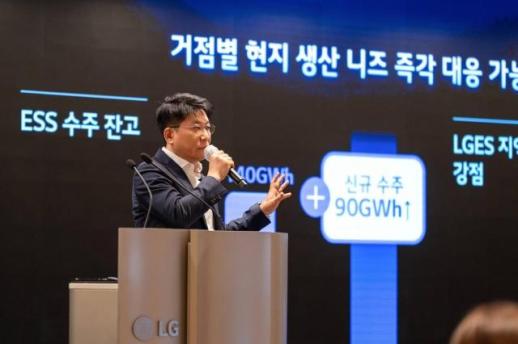 LG Energy Solution Targets ESS to Reach 35% of Revenue, Plans New LFP Product in 2028 LG Energy Solution said demand for cylindrical batteries used in energy storage systems helped lift first-quarter revenue despite weak electric vehicle demand. The company posted 6.555 trillion won ($?) in revenue for the quarter and said it aims to raise the share of ESS sales to 35% by year’s end, up from less than 10% last year and about 25% in the first half of this year. In a conference call on its 2026 first-quarter results on Wednesday, the company said it will use improved cost competitiveness to respond to customer demand for ESS and strengthen its mid- to long-term position. LG Energy Solution said it is preparing a new lithium iron phosphate, or LFP, product to be unveiled in 2028, with 10% higher energy density and 15% better price competitiveness than its existing LFP batteries. Chief Financial Officer Lee Chang-sil said the company had secured an ESS order backlog in North America of about 440 gigawatts as of late April. He said LG Energy Solution plans to secure more than 50 gigawatts of battery production capacity for ESS in North America by the end of this year. The company also expects benefits from the OBB (One Big Beautiful) law pursued by the Trump administration. It said maintaining a 50% to 55% share of U.S.-made batteries in ESS could allow tax credits of up to 40% of investment through 2030. Looking beyond the first quarter, Lee said North American ESS demand remains solid and demand in Europe for high-nickel batteries used in EVs and hybrid vehicles is holding up. He forecast second-quarter performance to grow about 10% from the first quarter and said revenue in the second half could rise 15% to 20% from the start of the year, supported by ESS demand. The company said it ultimately aims to return to profitability even excluding North American production subsidies under the Inflation Reduction Act, or IRA. Kim Min-su, who oversees ESS planning and management at LG Energy Solution, said ESS revenue growth became visible starting in the first quarter as U.S. battery production capacity expanded. He said the company has converted multiple EV production lines to ESS and will focus on stabilizing utilization and cutting costs to improve profitability. To meet North American ESS growth, LG Energy Solution said it will sequentially start ESS production lines not only at its Michigan and Ontario plants but also at its Lansing facility and at joint ventures with Honda and General Motors. The company said the plan would secure an additional 50 gigawatts of production capacity in North America. Kim said the North American ESS market, based on the power grid, is expected to grow about 30% annually through 2030. He added that forecasts of battery oversupply are premature given restrictions on Chinese companies entering the market and concerns about local supply shortages tied to the buildout of AI data centers. The company said sales of its cylindrical batteries, a core product, are expected to remain steady in the second through fourth quarters, supported by rising electric two-wheeler sales in China and India. It said it is also reviewing expanded cylindrical production at its plant in Poland to meet local demand. LG Energy Solution said its flagship 46-series products began shipping to customers from its Ochang plant late last year, and its Arizona plant could begin supplying products as early as this year. It said it has also won orders for volumes to be installed in premium products from European automakers including BMW, as it diversifies its portfolio. The company said it is also preparing next-generation prismatic and sodium batteries. It plans mass production of prismatic batteries for ESS in North America in late 2027. For EV prismatic batteries, it said it is preparing a joint response with customers through a pilot production line at the Ochang plant. LG Energy Solution said sodium batteries, which it described as having better performance than LFP, are expected to see demand mainly for ESS and as replacements for 12- and 24-volt lead-acid batteries. The company said it is working with multiple customers to test 12- and 24-volt sodium battery samples and plans to address the market. LG Energy Solution reported first-quarter 2026 revenue of 6.5550 trillion won and an operating loss of 207.8 billion won. North American production subsidies reflected in the quarter totaled 189.8 billion won. 2026-04-30 11:34:27
 -
 LG Energy Solution Sees Sodium Battery Demand in ESS, Lead-Acid Replacement Tests Planned ·* This article has been translated by AI. 2026-04-30 11:00:50
 -
LG Energy Solution: North America to Mass-Produce Prismatic ESS Batteries by Late 2027 * This article has been translated by AI. 2026-04-30 11:00:17
-
LG Energy Solution: North America Grid ESS Demand Growing 30% a Year; Too Early to Call Oversupply * This article has been translated by AI. 2026-04-30 10:49:57
-
LG Energy Solution Plans Step-by-Step ESS Output at Lansing, Honda and GM JVs; Targets 50 GW North America Capacity * This article has been translated by AI. 2026-04-30 10:49:31
-
LG Energy Solution Says It Began Supplying 46-Series Cells From Ochang, Eyes Arizona Shipments This Year * This article has been translated by AI. 2026-04-30 10:45:13
-
LG Energy Solution Says North America ESS Backlog at 140 GW; Early Fixed Costs in EV-to-ESS Line Shift * This article has been translated by AI. 2026-04-30 10:35:42
-
LG Energy Solution Targets ESS Sales Share Above 35% by Year-End * This article has been translated by AI. 2026-04-30 10:16:13
-
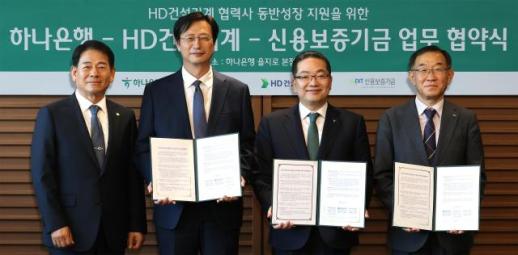 HD Construction Equipment to Back Suppliers With 85 Billion Won in Loan Guarantees HD Construction Equipment is launching a financial guarantee program totaling 85 billion won to help suppliers maintain stable operations. According to industry officials on Wednesday, the company signed a memorandum of understanding the previous day at Hana Bank’s headquarters in central Seoul with Hana Bank and the Korea Credit Guarantee Fund to support shared growth in the construction equipment industry. Attendees included Hana Bank CEO Lee Ho-seong, Korea Credit Guarantee Fund standing director Chae Byeong-ho, HD Construction Equipment President Moon Jae-young and supplier council head Kim Do-wan. The agreement is intended to provide practical support to suppliers facing funding difficulties amid recent economic uncertainty. The partners said they expanded the program after strong demand quickly depleted an existing shared-growth fund. Under the deal, HD Construction Equipment and Hana Bank will jointly create a fund of up to 5 billion won. Using that as a source of funding, the Korea Credit Guarantee Fund will provide guarantees of up to 85 billion won when suppliers seek loans from financial institutions. The program will operate in two tracks: a 40 billion won “joint project guarantee” for suppliers participating in future innovation projects such as new model development and mass production, and a 45 billion won “shared-growth financial support agreement guarantee” open to all suppliers. The program includes discounted guarantee fees and preferential interest rates. “Helping our suppliers prepare for the future without wavering, even in an uncertain external environment, is the true value of shared growth,” Moon said. He added that he hopes the support will strengthen competitiveness across the construction equipment industry through cooperation with suppliers.* This article has been translated by AI. 2026-04-30 09:15:19