
Journalist

AJP
-
 NCT DREAM to host live viewing events in 86 cities worldwide SEOUL, March 03 (AJP) - NCT DREAM will broadcast the finale concerts of its fourth world tour in cinemas across 86 cities worldwide, its agency SM Entertainment said Tuesday. NCT DREAM is a seven-member Korean boy group that debuted in 2016 as a unit of the broader NCT brand, known for hit tracks such as “Hot Sauce,” “Candy” and “ISTJ.” The “2026 NCT DREAM TOUR FINALE” will be held over six days, March 20–22 and March 27–29, at KSPO DOME in Seoul’s Olympic Park. All seats for the encore concerts have sold out. Two of the concerts, March 21 and 28, will be screened live in theaters in nine cities across Korea and 43 cities in Japan, as well as in Jakarta, Macau, Singapore, Taipei, Kaohsiung, Kuala Lumpur, Hong Kong, Bangkok and Chiang Mai, bringing the total to 86 cities worldwide. In addition, concerts on March 21, 22, 28 and 29 will be streamed globally through Beyond LIVE and Weverse. Throughout its fourth tour, the group set a record for the most concerts held at Seoul’s Gocheok Sky Dome and became the first K-pop act to perform at Hong Kong’s Kai Tak Stadium. It also staged shows at Thailand’s Rajamangala National Stadium, Jakarta International Stadium and Taipei Dome. The Seoul encore concerts will mark the conclusion of the group’s fourth tour. 2026-03-03 14:23:16
 -
 BoA Launches New Agency, Baypal Entertainment, After Leaving SM Singer BoA, who recently ended her long relationship with SM Entertainment, has announced the launch of a new entertainment company. BoA posted photos on social media on March 3 showing herself and acquaintances with bags pulled over their heads. She tagged both her own account and the Baypal Entertainment account. Baypal Entertainment also posted photos with BoA, adding the caption “???” and hashtags. Baypal Entertainment said BoA “chose a new structure to more clearly realize her musical direction.” The company said Baypal Entertainment is an agency BoA founded herself. The name combines “BoA” and “pal,” meaning friend, and it aims to be a company built together by BoA and her fans. BoA’s side said, “The precious memories and valuable experiences built over a long time are the most important assets that made BoA the strong artist she is today,” adding, “Based on what we have learned, we will further strengthen the substance of her music.” BoA ended her 25-year partnership with SM Entertainment in January.* This article has been translated by AI. 2026-03-03 13:48:17
 -
 Hyundai Motor Group unveils autonomous robot for high-risk firefighting SEOUL, March 03 (AJP) - Hyundai Motor Group released a video showcasing a new autonomous firefighting robot designed to penetrate high-risk disaster zones where human entry is restricted. The "physical AI" solution revealed Tuesday targets environments with collapsing structures, toxic gas, or extreme heat to secure the "golden time" for fire suppression. Developed with the National Fire Agency, the robot features an advanced 6X6 in-wheel motor system that allows for 360-degree rotation on the spot. It moves at about 50 km/h—roughly twice as fast as a running human—and can scale 300mm vertical obstacles or steep warehouse ramps. To overcome blinding smoke, the unit utilizes AI-enhanced thermal imaging and infrared cameras to transmit high-definition data to operators in real-time. It also deploys a high-pressure photoluminescent hose that glows in the dark, serving as a literal lifeline for firefighters to find their way out. "The true value of this robot is not merely its heat resistance or fire suppression power, but its role as a ‘Physical AI’ that operates in actual disaster sites," said Kim Seung-ryong, acting commissioner of the National Fire Agency. He added that the technology marks a "great transition" toward a hybrid era where humans and robots overcome their respective limits. The robot saw its first combat deployment during a factory fire in Eumseong, North Chungcheong Province, on Jan. 30. Beyond active suppression, the platform functions as a mobile data hub, capturing smoke density and temperature levels to refine its machine-learning algorithms. Hyundai Motor Group plans to evolve the system into a fully autonomous "firefighting response platform" capable of analyzing fire origins and calculating the most efficient suppression methods independently. The group said it remains committed to developing technologies that support "uniformed heroes" and ensure public safety. 2026-03-03 13:31:30
 -
 LIG Nex1 Opens Large-Scale Hiring for First Half of 2026 LIG Nex1 said Tuesday it will conduct a large-scale open recruitment drive for the first half of 2026. Applications opened Tuesday and will be accepted through March 18 via the company’s recruitment website. Openings include missile systems, electronic warfare, radar, maritime, unmanned and robotics, electro-optical and information convergence, satellites and AI, the company said. The hiring will cover a range of roles, including R&D positions in hardware, software and mechanical engineering, as well as domestic and overseas business management, quality management and corporate support. The company expects to hire at least a three-digit number of employees. Detailed job descriptions by field are available in the “Recruiting Book” on the recruitment website. Candidates who pass an online AI competency assessment and document screening will move to a software coding test (for software roles), followed by job-specific interviews and then a leadership interview before final selection. With public interest rising in South Korea’s defense industry, LIG Nex1 said it will also hold campus recruiting at 31 universities nationwide. The company said about 60% of its workforce is engaged in R&D. As of February, it had 5,748 employees, up 1,204 over two years, a 26% increase, and was named a “Top Job-Creating Company” by the Labor Ministry for a third consecutive year. A company official said the large-scale hiring is aimed at strengthening competitiveness across the rapidly advancing defense industry and encouraged interest from talent expected to lead future growth businesses. * This article has been translated by AI. 2026-03-03 13:27:16
 -
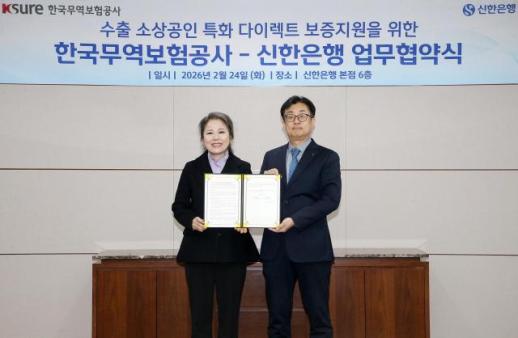 Shinhan Bank, K-Sure Expand Support for Small Exporters Up to 120 Million Won Shinhan Bank said Monday it will strengthen direct guarantee support tailored to small exporters in partnership with the Korea Trade Insurance Corp. The agreement targets small exporters that have struggled to obtain financing because of low credit ratings or limited export track records. The partners said they will expand small-amount guarantees and help promote overseas market entry. Under the deal, Shinhan Bank and the trade insurer will expand the lineup of non-face-to-face guaranteed loan products for low-credit small exporters, fully cover guarantee fees for companies using the “Light” guarantee, and raise guarantee limits for firms that repay direct guarantees on time. With the expanded program, companies rated B- or higher by Korea Evaluation Data can apply for export promotion funds backed by a Korea Trade Insurance Corp. guarantee certificate, from a minimum of 10 million won to a maximum of 120 million won, depending on their rating. “We improved the product structure to support small business owners with export capacity who faced limits on financing due to credit ratings or performance requirements,” a Shinhan Bank official said. The official added the bank will continue to expand practical funding support for small businesses in financial blind spots as part of its inclusive finance efforts. * This article has been translated by AI. 2026-03-03 13:24:00
 -
 VLCC Tanker Charter Rates Top $400,000 a Day After Iran War, Data Show U.S. and Israeli strikes on Iran have pushed daily charter rates for very large crude carriers above $400,000, as fears grow that Iran could block shipping through the Strait of Hormuz. Rates that had been in the low $200,000s surged to nearly double in a short period as Iran escalated its threats. Some analysts say rates could climb toward $800,000 a day if a blockade takes hold. According to a Middle East-to-East Asia (MEG-China) VLCC route indicator obtained by Ajunews, the Worldscale (WS) tanker index stood at 410.44 as of March 2. That implies a daily time-charter equivalent, or TCE, of $423,736. That is more than double the WS 224.72 and TCE $218,154 recorded on Feb. 27, just before the outbreak of war between the U.S.-Israel side and Iran, the data showed. In January, the WS index was 96.12 and the TCE was $78,793, meaning rates have risen more than fivefold in about a month. Worldscale is a standard benchmark used to settle international tanker freight, with 100 typically treated as the baseline. A reading above 400 is widely seen as an extreme level reflecting war risk rather than ordinary market strength. Iran said through the semiofficial ISNA news agency that “the Strait of Hormuz has been closed,” warning that “any vessel that attempts to pass will be burned by the Revolutionary Guards and the regular navy.” It added that it would ensure “not a single drop of oil” leaves. Market participants fear tanker freight could jump more than tenfold from prewar levels if the Hormuz route is effectively shut, as marine insurance — a major component of shipping costs — continues to rise sharply. About 20% of the world’s seaborne crude oil passes through the Strait of Hormuz, making it a strategic chokepoint. Some in the market say that if tensions persist, the WS index could approach 800 and daily charter rates could near $800,000. The surge in tanker costs is also adding upward pressure on energy prices in South Korea, which relies heavily on Middle Eastern crude. Higher Middle East-to-East Asia transport costs are likely to raise refiners’ import costs, and, together with rising global oil prices, could lift domestic prices for petroleum and petrochemical products and consumer inflation. A shipping industry official said the strait has not been “physically completely blocked,” but the risk of attack means shipping companies “effectively view it as a blockade.” The official added that WS 400 is “an extreme level beyond market common sense,” and that if war-related uncertainty continues, the shock could spread beyond shipowners to global logistics overall. 2026-03-03 12:03:22
 -
 BTS Comeback D-17: Show goes on regardless of Middle East tensions SEOUL, March 03 (AJP) - With 17 days to go, BTS is pressing ahead with its long-awaited return, undeterred for now by escalating military tensions across the Middle East. The group is set to release its fifth studio album on March 20, followed by a free concert at Gwanghwamun in central Seoul on March 21 — a symbolic stage meant to herald its first full-group comeback in nearly four years. “The schedules will proceed as announced,” a source close to the matter said, adding that plans to include additional Middle East dates in the world tour calendar “will be put on hold.” BTS will kick off its “ARIRANG” world tour on April 9 in Goyang, South Korea, with 82 performances planned across 23 countries over the next year. While no immediate changes have been made to the announced itinerary, widening conflict in the Middle East has introduced logistical uncertainties. Industry observers note that prolonged airspace closures and maritime disruptions could complicate global tour preparations. Flight tracking service Flightradar24 reported that more than 4,000 flights per day have been cancelled across the Middle East. Aviation analytics firm Cirium said 79 percent of flights to Qatar and 71 percent to the United Arab Emirates were cancelled, with Israel and Bahrain seeing cancellation rates exceeding 80 percent. Several regional carriers have suspended regular commercial operations, maintaining only limited special or repatriation flights as airspace restrictions persist. The suspension of key Middle Eastern routes highlights the broader disruption to international travel in the region. While no BTS tour dates have been announced for Middle Eastern cities, prolonged flight cancellations could potentially affect fans planning cross-border travel for major live events, depending on how the situation evolves. Large-scale stadium tours rely on intricate cross-border coordination, including the transport of stage structures, lighting systems, sound equipment and merchandise. Certain high-spec components are often shipped via air freight, making aviation disruptions a potential bottleneck. For now, organizers say no direct impact on scheduled events has been identified. 2026-03-03 11:50:23
 -
 Samsung showcases AI-powered devices at Mobile World Congress in Barcelona SEOUL, March 3 (AJP) - Samsung Electronics has been showcasing artificial intelligence (AI)-based network services and other technologies at this year's Mobile World Congress (MWC) in Barcelona, Spain, which kicked off on Monday. The electronics giant set up a large booth at the Fira Gran Via, the venue of the annual tech expo, featuring its flagship Galaxy phone series and highlighting its aim to offer customers services beyond mobile devices while expanding into a broader ecosystem. Featuring its latest Galaxy S26 series, Samsung created hands-on zones where visitors could experience its various devices and gadgets designed to enhance customers' everyday tasks and convenience. Samsung also highlighted expanded connectivity across its lineup including the Galaxy Buds4 series for immersive audio and the Galaxy Book6 series, designed for high performance and optimized productivity. It also showcased personalized health experiences powered by AI and highlighted future mobile directions with next-generation devices including the Galaxy XR and Galaxy Z Tri-Fold. The annual MWC runs from March 2 to 5. 2026-03-03 11:41:46
 -
 Director Jang Hang-jun to Return to SBS Radio as Film Nears 10 Million Viewers The film “The Man Who Lives With the King” is closing in on 10 million moviegoers, drawing attention to whether director Jang Hang-jun will walk back a joking pledge he made earlier this year. Jang will appear with BA Entertainment CEO Jang Won-seok on a recorded broadcast of SBS PowerFM’s “Bae Seong-jae’s Ten” on March 4. The episode is scheduled to air March 8. Interest is focused on how Jang will address his so-called “10 million pledge,” made during a January appearance on the program. At the time, he said, “It won’t happen, but if it does, I’ll change my phone number, change my name, get plastic surgery so no one recognizes me. I’m even thinking about changing my nationality. I hope no one looks for me. I’ll have to throw a party on a boat.” That joke is now closer to becoming reality. According to the Korean Film Council’s integrated box office system on March 3, the movie drew 2,479,933 admissions from Feb. 27 to March 2, a holiday period, bringing its cumulative total to 9,213,368. Online, users have teased Jang for speaking too soon while cheering the film on toward the 10 million mark. 2026-03-03 11:36:18
 -
 Asian markets stay low, KOSPI down nearly 3% but defense stocks fly SEOUL, March 3 (AJP) — Asian markets remained lower Tuesday as the region is expected to bear the collateral damage from the closure of the Strait of Hormuz responsible for 70 to 90 percent of fuel imports from the Middle East. The Seoul bourse was heavily volatile, with the KOSPI swinging between 6,180 and 6,040.60 amid a tug-of-war between retail buying and foreign selling. As of 11:10 a.m., the benchmark index was down 2.89 percent at 6,063.39. On the secondary bourse, the tone diverged. Foreign and institutional investors kept buying while retailers took profits, helping the KOSDAQ edge up 0.31 percent to 1,195.15. Heavyweight chipmakers retreated but remained above the psychological milestones they broke last week. Samsung Electronics fell 2.31 percent to 211,500 won, while SK hynix declined 2.26 percent to 1,037,000 won. Japan’s Nikkei 225 slid 1.27 percent to 57,320.94 in morning trade. Hong Kong’s Hang Seng Index managed a modest 0.45 percent gain, though broader sentiment remained fragile. While losers overwhelmed gainers on the KOSPI by 749 to 160, defense stocks stood out as clear beneficiaries of heightened geopolitical risk. Hanwha Systems surged 23.68 percent to 140,200 won, and Hanwha Aerospace jumped 13 percent to 1,353,000 won. LIG Nex1 soared 28.59 percent, while Hyundai Rotem gained 9.11 percent and Poongsan advanced 10.09 percent, reflecting expectations of widening battles and an accelerating arms race. The Korean won weakened sharply to 1,465.30 per dollar, around 2 percent off from Friday’s close of 1,438.4, highlighting capital outflow pressures. Safe-haven demand lifted gold 1.40 percent to $5,385.91. Bitcoin initially tumbled after the announcement but later rebounded 3.59 percent to $68,934, underscoring volatile risk sentiment. Battery makers came under pressure, with LG Energy Solution down 2.93 percent and Samsung SDI slipping 2.90 percent. Automakers were among the sharpest decliners. Hyundai Motor Company fell 3.71 percent to 649,000 won, while Kia Corporation dropped 5.55 percent to 194,100 won. Financials were mostly lower. KB Financial Group fell 1.95 percent, Shinhan Financial Group edged down 0.10 percent, and Mirae Asset Securities declined 1.94 percent. Industrial and shipbuilding shares were mixed. HD Hyundai Heavy Industries gained 1.66 percent and Hanwha Ocean rose 3.47 percent, while Doosan Enerbility slipped 1.41 percent. Biopharma heavyweights also retreated, with Samsung Biologics down 2.81 percent and Celltrion losing 1.47 percent. Steelmaker POSCO Holdings dropped 3.27 percent. Entertainment stocks were weaker, with HYBE down 3.61 percent, JYP Entertainment falling 1.72 percent and YG Entertainment declining 3.65 percent. 2026-03-03 11:30:17