
Journalist

AJP
-
 Museums Near Seoul’s Gwanghwamun to Close for BTS ‘Comeback Live’ Crowd Major museums around Seoul’s Gwanghwamun Square will temporarily close on March 21, when “BTS Comeback Live: ARIRANG” is set to be held at 8 p.m. at the square, as officials brace for heavy crowds. Industry officials said on the 27th that the National Museum of Korean Contemporary History decided to close that day, and the National Folk Museum of Korea has joined the shutdown. The museums said the closures are necessary to protect visitors as large crowds are expected. Up to 260,000 people are projected to gather in the Gwanghwamun area on the day of the BTS event. Other nearby museums are also considering temporary closures, officials said. The Korea Heritage Service is discussing with the Ministry of the Interior and Safety and police whether to temporarily close the National Palace Museum of Korea and suspend operations at Gyeongbokgung Palace and Deoksugung Palace. “We plan to make a final decision on closures and palace shutdowns sometime next week,” a Korea Heritage Service official said, adding that the agency will hold a final meeting with related institutions to confirm details, including the scope. The Sejong Center for the Performing Arts is also adjusting its schedule. The musical “Anna Karenina,” the play “Wasp,” and the dance performance “Double Bill Bliss and Jackie,” which had been scheduled for that day, will not be staged. The center said it is in talks about rescheduling “Park Shin-yang’s Exhibition Show: The Fourth Wall.” Opening some Sejong Center spaces to BTS fans is also under discussion. “We are reviewing multiple options, and nothing has been finalized,” a Sejong Center official said. Police are also preparing safety measures. The Seoul Metropolitan Police Agency has asked Seoul Metro to consider having trains pass through three subway stations — Gwanghwamun, Gyeongbokgung and City Hall — without stopping as a precaution against overcrowding. Traffic controls will also be imposed on Sejong-daero, which will be used as the performance venue, and on nearby roads including Saemunan-ro, Jongno, Sajik-ro and Yulgok-ro. The police agency said it will provide advance notice through electronic road signs once control hours are set.* This article has been translated by AI. 2026-02-27 08:16:31
 -
 Renault Korea Scenic E-Tech Named Korea’s 2026 Import Car of the Year Renault Korea said Feb. 27 that its compact electric SUV, the Scenic E-Tech 100% Electric, was named 2026 Import Car of the Year at the Korea Car of the Year (K-COTY) awards hosted by the Korea Automobile Journalists Association (KAJA). The Scenic E-Tech had earlier won Electric Crossover of the Year at another Korea Car of the Year program hosted by the Korea Automobile Expert Journalists Association (AWAK), giving it two major domestic “car of the year” awards this year. Renault Korea said the recognition follows last year’s award for its midsize SUV, the Grand Koleos, which was named SUV of the Year. The company said the back-to-back wins reflect strong evaluations of both its locally produced models and vehicles it imports and sells in South Korea. Renault also said it became the first non-German brand to win the Import Car of the Year category in South Korea. Since the category was introduced in 2016, winners through last year had all been models from two German premium brands, the company said. Renault Korea, which changed its corporate name and logo in 2024 and announced a renewed push in the domestic market, said it operates under the motto “born in France, made in Korea.” The company said it contributes to the local economy as an automaker rooted in Busan, while offering both domestically produced vehicles from its Busan plant and imported models to broaden its lineup. The Scenic E-Tech is equipped with an 87-kilowatt-hour high-performance NCM (nickel-cobalt-manganese) battery from LG Energy Solution and has a maximum driving range of 460 kilometers under South Korea’s Ministry of Trade, Industry and Energy certification standards, Renault Korea said. It also features “Fireman Access,” a patented battery-fire response technology developed with French fire authorities, the company said. The Scenic E-Tech previously won the 2024 European Car of the Year award.* This article has been translated by AI. 2026-02-27 08:15:22
 -
 HMM Busan Relocation Plan Gains Traction as Major Shareholders Signal Support President Lee Jae-myung’s remarks, followed by signals of support from Korea Development Bank, a major shareholder, have brought a possible relocation of HMM’s headquarters to Busan back into focus. Industry watchers say the company could replace three outside directors whose terms end next month, then call an extraordinary shareholders meeting to revise its articles of incorporation to enable the move. Union opposition, including the possibility of a strike, remains a key variable. According to the industry on Wednesday, KDB Chairman Park Sang-jin said at a press briefing the previous day that the Ministry of Oceans and Fisheries and the Korea Ocean Business Corp. had presented a schedule to complete HMM’s move to Busan in March or April. “If the relocation is confirmed, we will actively support it,” Park said. The comments effectively formalized the relocation push in line with Lee’s presidential campaign pledge. KDB and the Korea Ocean Business Corp. are HMM’s No. 1 and No. 2 shareholders, holding 35.42% and 35.08%, respectively. The biggest obstacle is HMM’s articles of incorporation, which stipulate that the company’s headquarters is in Seoul. The company must revise the articles at a shareholders meeting before it can begin practical work for a relocation. Amending the articles requires a special resolution backed by at least two-thirds of shareholders present. With KDB, the Korea Ocean Business Corp. and the National Pension Service holding more than 70% of HMM shares, the government could secure approval if the item is put to a vote. Investment banking sources said the agenda for HMM’s regular shareholders meeting on March 26 is not expected to include an articles change. No such item was included in shareholder proposals that closed earlier this month. In the shipping industry, a leading scenario is that KDB and the Korea Ocean Business Corp. will replace the three outside directors whose terms expire at the regular meeting, convene an April board meeting to approve an articles-change proposal, and then seek shareholder approval at an extraordinary meeting in May. Practical work for the Busan move is expected to ramp up in the second half of this year. HMM’s onshore union, made up of employees working in Seoul, is strongly opposed. It is expected to begin rallies in the Yeouido area next week and hold a strike resolution rally in front of Cheong Wa Dae to block the relocation, according to reports. Under labor law, management decisions such as relocating a headquarters are generally not subject to lawful industrial action. However, that could change when the amended Trade Union and Labor Relations Adjustment Act, known as the Yellow Envelope law, takes effect next month. If a management decision is interpreted as having a substantial impact on working conditions, it could be treated as a legitimate subject of labor action. If an HMM strike materializes, it would be the first general strike at a major company since the law’s implementation, drawing close attention from business, labor and legal circles. 2026-02-26 18:04:31
 -
 Hyundai Ioniq 9 Named 2026 Korea Car of the Year by Auto Journalists Group The Korea Automobile Journalists Association said on the 26th that Hyundai’s Ioniq 9 has been selected as the 2026 Korea Car of the Year. The Ioniq 9 earned an overall satisfaction score of 82.30 out of 100 in the final judging for the 2026 Korea Car of the Year (K-COTY), held on the 5th at the Korea Transportation Safety Authority’s Automobile Safety Research Institute in Hwaseong, Gyeonggi Province, the association said. A total of 18 models from 10 brands competed in the final round: Kia, Land Rover, Renault, Mercedes-Benz, Volvo, BMW, Audi, KG Mobility, Peugeot and Hyundai Motor Co. (listed in Korean alphabetical order by brand). Judges evaluated vehicles across 10 criteria: exterior design; interior and perceived quality; ease of instrument operation; handling and driving feel; acceleration; noise and vibration; high-speed stability and braking; safety and convenience features; fuel economy and maintenance; and price and purchase intent. The Ioniq 9 is Hyundai’s flagship electric SUV built on the E-GMP dedicated EV platform. The association said it offers class-leading interior space and a 110.3 kWh battery, with a maximum range of 532 kilometers on a single charge. It was also named SUV of the Year and EV of the Year. Renault’s Scenic E-Tech 100% Electric was chosen as Import Car of the Year with an overall satisfaction score of 70.07 out of 100. The association described it as a model based on a dedicated EV platform and noted it won the 2024 European Car of the Year at the 2024 Geneva Motor Show. Kia’s PV5 won Utility of the Year and Innovation of the Year. The association said the PV5 offers multiple lineups, including passenger and cargo versions, aimed at tailored mobility for business and leisure needs. Peugeot’s All-New 3008 Smart Hybrid was selected as Design of the Year. The association said it is a full model change introduced to the domestic market for the first time in eight years and received high marks from the panel. Mercedes-AMG GT received the Performance of the Year award. The association said it uses an F1-inspired P3 hybrid system and can accelerate from a standstill to 100 kph in 2.8 seconds. Jeong Chi-yeon, chair of the selection committee, said winners were chosen after rigorous testing and verification using key tracks at the Automobile Safety Research Institute, including a high-speed circuit and steering performance course. “I offer my sincere congratulations to the brands that rose to the top in each category amid fierce competition,” Jeong said. The 2026 K-COTY awards ceremony was held that evening at the Sebitseom Convention Hall in Banpo, Seoul, with attendees including government officials, related agencies, auto industry representatives, and association executives and members.* This article has been translated by AI. 2026-02-26 18:03:40
 -
 Love in the grey zone; how K-dating shows captured the world SEOUL, February 26 (AJP) – The island is fictional, the sand sun-bleached, the contestants impossibly polished. There is no king or queen of the jungle. No one makes grand declarations of love. Instead, they wrestle — sometimes almost literally — for a cup of iced Americano or a coveted night at a luxury hotel called "Paradise." Five seasons in, Single's Inferno has barely altered its rules. Contestants remain immaculate, well-educated, courteous to a fault — and curiously restrained in courtship. What fuels the tension is not overt seduction, but hesitation. In Korean dating reality, love is rarely declared. It is inferred. And that inference — the delicious agony of not knowing — has become a global obsession. The Grammar of "Sseom" At the center of this cultural export is one untranslatable word: "sseom." Loosely rendered in English as "something," or perhaps "situationship," sseom describes the suspended moment before a relationship is defined. It is a shared awareness without confirmation — a mutual gravitational pull neither party names aloud. In Western dating shows, attraction often accelerates toward confession and coupling. In Korean formats, it lingers. The camera dwells on glances, silence, anonymous messages delivered at night. Emotional escalation is slow, almost ceremonial. "The real pleasure lies in inference," says Haerin Shin, professor of media and communication at Korea University. "Viewers decode glances, gestures and hidden intentions. Romance becomes a social puzzle." On Single's Inferno, contestants can send anonymous notes revealing their interest — but never openly discuss their feelings unless invited. That anonymity intensifies ambiguity. A simple text can alter alliances. A coffee invitation can ignite rivalry. It is civility weaponized. A Streaming Juggernaut The numbers underscore that this is not niche programming. According to Netflix's Global Top 10 data for February 16–22, 2026, Single's Inferno: Reunion ranked No. 7 among non-English TV shows worldwide, recording 1.5 million views and 5.5 million hours watched in a single week — its second consecutive week on the chart. Season 1 marked a milestone as the first Korean reality series to enter Netflix’s Global Top 10 (Non-English TV). Season 2 stayed on the chart for four consecutive weeks, accumulating 65.08 million viewing hours during its Top 10 run. This is not a one-week curiosity spike. It is a repeatable global performance. Netflix's distribution model amplifies reach. Once a show enters the Global Top 10, it surfaces across territories, algorithmically recommended from São Paulo to Stockholm. Korean dating formats, once domestic experiments, now enjoy the same international exposure previously reserved for K-dramas and films. "Global distribution dynamics have been a major factor," Shin notes. "But what sustains viewership is the narrative style itself." Romance as Mystery Genre Korean dating shows occupy a curious middle ground between melodrama and detective fiction. Studio panelists observe in real time, offering commentary. Viewers join them — parsing eye contact, decoding who lingered beside whom at the fire pit, replaying ambiguous smiles. "It resembles a mystery genre," Shin explains. "Audiences test hypotheses about hidden emotions. They are participating, not just watching." Social media extends the experience. Fans create analysis threads, freeze-frame breakdowns, even behavioral charts mapping possible romantic trajectories. The show ends each week; the speculation does not. Unlike more explicit Western formats, Korean dating reality thrives on restraint. The "guilty pleasure" lies not in voyeuristic intimacy, but in suspense. In an era oversaturated with exposure, ambiguity feels radical. Love in an Age of Scarcity The global resonance of sseom also reflects shifting romantic realities. Across Korea, Europe, North America and Japan, marriage rates are falling and partnerships delayed. Economic pressure, social anxiety and digital isolation have reshaped dating norms. "In Korea, we speak of the 'N-po generation' — young people who feel compelled to give up dating, marriage or childbirth," Shin says. Similar patterns echo elsewhere: declining birth rates in Europe, adolescent social isolation in the United States, withdrawal phenomena such as hikikomori in Japan. Within that context, dating reality shows function as mediated participation. "For some viewers, these programs provide vicarious fulfillment," Shin notes. "They offer anticipation, jealousy, rejection and connection without personal risk." At the same time, they serve as observational spaces — informal tutorials on communication strategies and relational dynamics. In other words, they are not just escapism. They are social laboratories. Evolution on the Island Korean dating formats are also evolving alongside changing attitudes. Shows such as His Man spotlight same-sex relationships. Last Love explores later-life romance. Cross-cultural formats like My Korean Boyfriend broaden the lens further. The core structure — emotional inference, indirect confession, prolonged ambiguity — remains intact. But the cast has diversified, mirroring societal shifts. The success of Korean dating reality is not merely about being "less provocative" than Western counterparts. Nor is it solely the result of Netflix's algorithmic muscle. It lies in the tension of the grey zone. On a remote island where no one says "I love you," millions around the world are leaning closer to their screens — trying to read between the lines. 2026-02-26 17:50:11
 -
 How 60-second micro-dramas are redefining screen culture SEOUL, February 26 (AJP) - Over the past two decades, researchers have found that the average time people remain focused on a single task has fallen from roughly 2.5 minutes to about 40 seconds. For a generation raised on scrolling rather than scheduled programming, sitting through a two-hour film can feel like a commitment. A drama told in one or two minutes, however, fits neatly into the rhythm of daily life. Micro-dramas — serialized stories delivered in 60 to 120 seconds — are rapidly becoming one of the most consumed forms of visual entertainment worldwide. In South Korea, the surge has been particularly pronounced. According to Seoul-based short drama platform Beegloo, four of the five most-watched series this month are micro-dramas. While many titles initially targeted women in their 20s to 40s, the audience is broadening. Data show the core demographic is older than expected: women aged 35 and above now account for more than half of Beegloo’s global users. The rise of micro-dramas signals a structural shift within the already booming short-form content market. For years, web dramas with 10- to 15-minute episodes dominated digital storytelling. Now the attention economy favors speed, compression and emotional intensity. Micro-dramas are not confined to South Korea. Data from British research firm Omdia show the global market was valued at $11 billion last year and is projected to reach $14 billion this year. Nearly half of the $3 billion generated outside China comes from the United States alone. Regional breakdowns underscore the genre’s breadth. Latin America accounted for 27 percent of all short-form drama app downloads in the first quarter of last year — nearly 100 million downloads, up 69 percent year-on-year. Southeast Asia followed with 24 percent, a 61 percent annual increase. India, Europe and the U.S. each now hold between 7 and 11 percent of the global share. China remains a major growth engine, powered by domestic apps such as ReelShort and DramaBox. Both reported in-app purchase revenue growth exceeding 30 percent over the past year. According to Omdia’s analysis based on SensorTower data, ReelShort users in the U.S. average 35.7 minutes of daily viewing time — surpassing Netflix (24.8 minutes), Amazon Prime Video (26.9 minutes) and Disney+ (23 minutes). “I’m looking at Korean ones now through Vigloo and can compare them to shorts I often see on TikTok, YouTube and Instagram. The sheer volume of short sequences is striking,” said Patrick Parra Pennefather, a professor at the University of British Columbia. “Chinese and Korean micro-dramas are more developed,” he added. “With tools like Seedance 2, we may see new micro formats emerge — perhaps even original content built around generative AI. I’ve seen good, bad and a lot of slop.” A Battle for Attention Despite high daily viewing times, micro-drama platforms still trail major streaming services in monthly active users. Netflix counts roughly 12 million active users in the United States — about ten times more than ReelShort. Yet the disparity reveals something more nuanced: even with fewer users, micro-drama apps generate longer engagement per viewer. Their addictive brevity and algorithmic targeting reward repetition. “Micro-dramas aren’t just replacing television — they’re reprogramming how we consume stories,” said David Oh, professor of global media at Syracuse University. “Their power lies in how seamlessly they fit our digital habits.” Micro-dramas first gained traction in China’s mobile video ecosystem before spreading across Asia and onto global platforms such as TikTok, YouTube Shorts and Instagram Reels. Their narrative DNA blends soap opera melodrama with mobile-first design. Episodes often open mid-crisis — an affair exposed, a slap delivered, a betrayal revealed — pulling viewers instantly into the next clip. Earlier theories linked the popularity of webtoons and web dramas to commuting culture — watching or reading while riding the subway. But that explanation no longer suffices. “This isn’t just about mobility,” Oh said. “It’s about how deeply the mobile phone has become the center of everyday life.” Shortened attention spans, constant multitasking and algorithm-driven “instant payoff” loops form the psychological foundation of this viewing culture. Even pop songs are getting shorter. Time compression has seeped into storytelling, music and cognition itself. Micro-dramas embrace melodrama unapologetically. Betrayal, revenge and infidelity are recycled at high speed, echoing the “makjang” dramas once dominant in Korean prime time — but now compressed to 10x tempo. Emotional clarity replaces narrative complexity. In Southeast Asia and Latin America in particular, micro-dramas have become accessible entertainment for lower-income smartphone users with limited data plans or time. Light bandwidth, brief runtimes and emotional directness make them globally adaptable in ways prestige streaming often is not. As micro-dramas reshape storytelling grammar, traditional television faces recalibration. High-concept series such as Breaking Bad or Game of Thrones are likely to retain loyal audiences. But mid-tier shows may increasingly borrow from micro-drama logic. “We’re seeing split attention — people scrolling while watching TV,” Oh noted. “That means hour-long shows will pack in more frequent payoffs: twists, fights, shocks. It’s not a revolution, but an intensification of television’s existing strategies.” Long-form storytelling may begin to mirror short-form rhythms — faster cuts, sharper escalation and denser emotional triggers. Film faces a more uncertain path. On streaming platforms, the social discipline of the theater — no phones, no distractions — has weakened. To hold attention, films may simplify narratives and amplify spectacle. But the opposite scenario is plausible. As everything else shrinks, cinema could double down on scale: immersive sound, collective viewing and emotional grandeur. “Survival for film,” Oh suggested, “may depend on reminding audiences what ‘big’ really feels like.” In Seoul, telecom companies are already exploring micro-dramas as a subscription driver. Bundling short-drama platforms into mobile plans mirrors earlier streaming strategies: the more users watch, the longer they remain within an ecosystem. Production houses are investing heavily. Some operate industrial-scale studios churning out serialized one-minute episodes. Others experiment with generative AI tools to script dialogue and edit footage to algorithmic pacing. 2026-02-26 17:38:32
 -
 Samsung joins $1 trillion club as AI rally ripples across Asia SEOUL, February 26 (AJP) - Samsung Electronics emerged as Asia's standout winner Thursday, joining the exclusive $1-trillion market-cap club as overnight Nvidia earnings sent the tech giant soaring 7 percent. The breakthrough came as AI enthusiasm — reignited by blockbuster earnings from Nvidia — swept across regional markets, propelling South Korea and Japan to fresh highs while China-related bourses lagged. The benchmark KOSPI jumped 3.7 percent, or 223.4 points, to close at 6,307.3 after touching a record intraday high of 6,313.3. Turnover ballooned to 38.3 trillion won ($26.8 billion), underscoring the intensity of the move. The tech-heavy KOSDAQ gained 2 percent to 1,188.2. Beyond Samsung, the rally spread across the semiconductor ecosystem: SK hynix climbed 8 percent , Hanmi Semiconductor soared 28.4 percent, LG Electronics advanced 10.1 percent, and Hyundai Motor rose 6.5 percent The gains were driven by expectations that high-bandwidth memory (HBM), advanced packaging equipment and industrial AI applications will remain core beneficiaries of sustained infrastructure spending. Foreign investors were net sellers of 2.11 trillion won on the KOSPI, while institutions bought 1.24 trillion won and individuals added 661 billion won — suggesting domestic liquidity powered the breakout. The regional tone followed Nvidia’s fiscal fourth-quarter results, which showed revenue of $68.13 billion, up 73 percent year-on-year. Data center sales accounted for more than 90 percent of total revenue — a figure that reaffirmed the durability of AI infrastructure demand across the semiconductor supply chain. CEO Jensen Huang also sought to calm fears that AI agents would cannibalize the broader software industry, arguing instead that they would act as users of software tools rather than replacements. The remarks helped stabilize sentiment across AI-linked equities globally. In Tokyo, the Nikkei 225 rose 0.3 percent to 58,753.4, marking its second straight record close. The index briefly surpassed 59,000 for the first time, hitting 59,332.4 before trimming gains on profit-taking. A weaker yen and overnight strength on Wall Street supported sentiment. Investors also weighed the nomination of two dovish academics to the Bank of Japan’s policy board, reinforcing expectations that monetary tightening will proceed gradually. Market participants noted that a sustained push toward 60,000 would require continued earnings momentum and credible government-backed growth initiatives. Mainland Chinese and Hong Kong markets ended lower. The Shanghai Composite slipped 0.01 percent to 4,146.6, while the Hang Seng Index fell 1.13 percent to 26,462.5 as investors locked in gains ahead of upcoming policy meetings. The Korean won weakened slightly to 1,429.2 per dollar. U.S. 10-year Treasury yields stood at 4.043 percent, while the VIX eased to 17.9, signaling reduced near-term risk anxiety. 2026-02-26 17:38:08
 -
 SK hynix, Sandisk launch joint effort to standardize 'HBF' memory for AI SEOUL, February 26 (AJP) - South Korean chipmaker SK hynix and U.S. data storage company Sandisk have partnered to standardize a next-generation memory technology dubbed High Bandwidth Flash (HBF) to target the expanding artificial intelligence inference market. The two companies held a kick-off event for the HBF standardization consortium on Thursday at Sandisk's headquarters in Milpitas, California. To advance the initiative, they will form a dedicated joint workstream under the Open Compute Project (OCP), a global data center technology cooperative. The collaboration comes as the AI industry's focus rapidly shifts from training large language models (LLMs) to the inference stage, which powers actual user services. Existing memory structures face limitations in simultaneously handling the massive data loads and power efficiency required for surging, concurrent AI requests. HBF is positioned as a new memory tier sitting between ultra-fast High Bandwidth Memory (HBM) and high-capacity Solid State Drives (SSDs). It is designed to bridge the gap by offering capacity scalability and power efficiency, ultimately aiming to lower the total cost of ownership (TCO) for AI systems. While HBM will continue to handle maximum bandwidth requirements, HBF will serve a complementary role. "The core of AI infrastructure goes beyond the performance competition of a single technology; it is about optimizing the entire ecosystem," said Ahn Hyun, Chief Development Officer at SK hynix. Industry demand for such complex, hybrid memory solutions is projected to see significant growth around 2030. SK hynix and Sandisk plan to utilize their combined expertise in memory design, packaging, and mass production to accelerate the standardization and commercialization of the product. 2026-02-26 17:20:08
 -
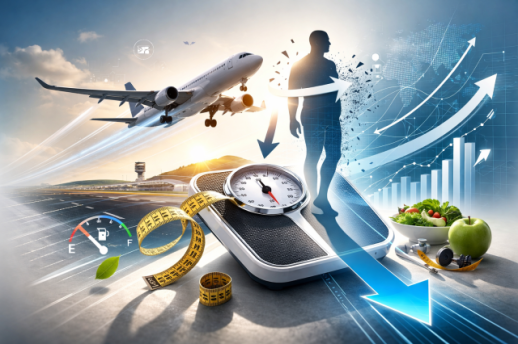 Small Weight Changes Can Signal Bigger Health Shifts, Experts Say Early this year, U.S. investment bank Jefferies said major U.S. airlines could save as much as $580 million (about 8.255 trillion won) in fuel costs this year. The analysis linked the savings to the surge in glucagon-like peptide-1 (GLP-1) obesity drugs, saying lower average passenger weight could reduce takeoff weight and improve fuel efficiency. The report estimated that a 10% drop in average passenger weight could cut fuel costs by up to 1.5%. For airlines, it is an unexpected benefit. In 2018, United Airlines saved about $290,000 (about 412.69 million won) a year in fuel by printing its in-flight magazine on lighter paper. Before that, it pursued weight cuts down to the gram, even removing a single olive from a salad. Now passenger weight loss has emerged as a new variable. The same principle applies to the human body: small changes can drive measurable effects. Weight is often treated as a simple marker of dieting success, but even a 1 to 2 kilogram shift can prompt sensitive responses across body systems. Understanding how the body detects small weight changes can support more precise health management. Blood pressure is a clear example. In obese patients with hypertension, losing 1 kilogram is associated with a 1.6 mmHg drop in systolic blood pressure and a 1.3 mmHg drop in diastolic pressure. The numbers may look small, but for people with hypertension they can be meaningful enough to affect medication dosing and cardiovascular risk. Joints also respond quickly. A 1-kilogram weight gain adds 3 to 4 kilograms of load to the knee joint, helping explain why stair climbing can worsen pain. Conversely, many people say their knees feel noticeably better after losing just 2 to 3 kilograms. Sleep quality can be sensitive as well. Snoring and sleep apnea are linked to excess fat around the neck, which can press on the airway and interfere with breathing. With a 1-kilogram weight loss, the respiratory disturbance index, or RDI, tends to fall by about 0.5 to 1 event. As aircraft fuel efficiency reacts to small shifts in weight, the body’s functions also move in tandem with modest weight changes. Metabolic function can respond especially fast, and small adjustments in weight may improve blood sugar and inflammation levels over a short period. Medical research has recently drawn attention to “metabolic age” as an indicator used to gauge healthy lifespan and aging. Even without formal testing, it can be inferred through indirect signals. A larger waistline (90 centimeters for men, 85 centimeters for women), higher fasting blood sugar (100 mg/dL) and rising triglycerides are commonly cited signs that metabolic stress is building. Kim Jeong-eun, director of the 365mc Fat Stem Cell Center and a family medicine specialist, said a higher metabolic age suggests the body is gradually losing efficiency in burning energy. “When metabolic function declines, you can gain weight more easily even with the same food, and recovery from fatigue can be slower,” Kim said. Experts say close observation of physical changes is central to health management, and that improving daily habits is key to keeping metabolism “younger.” Basic steps include cutting back on simple sugars and refined carbohydrates that rapidly raise blood sugar, and eating enough protein to prevent muscle loss. A vegetable-centered diet that includes berries, dark leafy vegetables and omega-3 fats can reduce inflammation and help stabilize metabolism. Kim said not only what people eat but also the order matters. Kim recommended eating vegetables slowly for about five minutes just before or at the start of a meal, then moving to protein. That sequence, Kim said, can promote the release of hormones that increase fullness and help control overall intake. Exercise is most effective when it combines strength training and aerobic activity. Lower-body strength exercises such as squats, lunges and deadlifts stimulate large muscle groups and can help improve metabolism. Doing 100 to 150 minutes a week of aerobic exercise such as brisk walking or running, two to three times a week, can support steadier blood sugar and fat burning. Kim said that for people with diabetes or those who need blood sugar control, light walking within 30 minutes after a meal is especially effective because it helps muscles use glucose. 2026-02-26 17:18:58
 -
 Galaxy S26: a phone with "nunchi" – and a price to match SEOUL, February 26 (AJP) - “Nunchi” is one of those Korean words that resists direct translation. It refers to a kind of social intuition — the ability to read the ambience, anticipate needs, and move before being asked. Those who lack it are considered daft; those who possess it are quick, nimble, perceptive. With the new Samsung Galaxy S26, Samsung Electronics is attempting to embed that instinct into hardware. After nearly three decades of phone-making, Samsung’s latest flagship is framed less as a device that waits for commands and more as one that anticipates them — an invisible hand moving ahead of its user. “Now Nudge”: AI that steps in While texting a friend to set up plans, the phone’s “Now Nudge” feature quietly cross-checks the calendar and surfaces a reminder about a conflicting appointment. No separate query required. Even Bixby has grown more agile. “My eyes are tired — how should I change the settings?” Instead of directing users to menus, the assistant applies “Eye Comfort Shield” directly within the chat interface, eliminating the friction of navigation. The aim is compression: fewer taps, fewer searches, fewer interruptions. Privacy, built in If anticipation is one pillar, privacy is the other. For Seoul’s tightly packed subway commuters, the standout feature may be “Privacy Display,” available exclusively on the Samsung Galaxy S26 Ultra. Unlike aftermarket privacy films, the Ultra integrates the technology at the display-panel level, diffusing light pixel by pixel. Activated through the quick panel, the screen remains clear to the user while appearing black from side angles — top, bottom, left, and right. Security has also been upgraded. An AI-driven “Call Screening” function answers unknown numbers on the user’s behalf, summarizes the caller’s intent in real time, and analyzes live conversations to flag potential voice-phishing attempts. Visual AI: Circle to Search evolves Visual AI — bypassing even voice and text — continues to expand. Samsung’s upgraded “Circle to Search” recognizes multiple elements simultaneously. Draw a circle around a celebrity’s outfit — top, pants, and bag — and the phone retrieves shopping results for all items at once. What once required multiple searches is compressed into a single gesture. The camera as canvas In the AI era, cameras are no longer confined to capturing reality. With the upgraded “Photo Assist” tool, users can select a full-body photo, choose a jacket saved in the gallery, and type: “Put these clothes on me.” The AI image signal processor (ISP) modifies the wardrobe seamlessly, preserving a history log that allows edits and reversions without creating duplicate files. Daytime photos can also be transformed into nighttime scenes with natural lighting adjustments — turning static images into editable environments. Comforts come at a cost Automation, however, carries a premium. Powered by Qualcomm’s Snapdragon 8 Elite Gen 5 for Galaxy, the S26 lineup enters new pricing territory. The base Galaxy S26 starts at 1,254,000 won (about $940). The Galaxy S26 Ultra begins at 1,797,400 won. The 512GB Ultra model surpasses the two-million-won threshold for the first time in the series, priced at 2,050,400 won. The question now is not whether the phone is capable. It is whether users — particularly younger consumers — will view AI-driven anticipation as liberation from friction or as an over-eager assistant that intrudes too often. Samsung has given its phone nunchi. Whether consumers welcome that instinct — and pay for it — will determine whether anticipation becomes the next default in the smartphone era. 2026-02-26 17:08:06