
Journalist

AJP
-
 Trot Singer Yoon Tae-hwa Reveals Divorce on TV Chosun’s “Miss Trot 4” Trot singer Yoon Tae-hwa has revealed that she divorced. Yoon appeared on the Feb. 19 afternoon broadcast of TV Chosun’s trot survival show “Miss Trot 4,” competing in the second round of the “Legend Mission” solo stage. She chose Choi Jin-hee’s “Repentance,” a song about deep regret after a breakup. Asked by Choi why she picked the song, Yoon said, “After finishing ‘Miss Trot 2,’ I got married, but after living together for a year, I came back.” She previously married a non-celebrity man eight years older than her on March 8, 2022. Yoon added that when “Miss Trot 2” began, her mother collapsed and it was a difficult time. She said that even after marrying her then-boyfriend, she remained the family breadwinner. “I had to take care of my mother, so I couldn’t fully play the role of a wife, and after talking things through, we decided to live our own lives,” she said. She added that the song resonated with her, leading her to choose it. After the performance, Yoon made the “Miss Trot 4” top 10.* This article has been translated by AI. 2026-02-20 08:42:06
 -
 KB Kookmin Bank Union Faces Impeachment Bid Against Chair After Labor Deal KB Kookmin Bank’s labor union has finalized its 2025 wage and collective bargaining agreement, but an unprecedented move to impeach the union chair is now being raised. The push comes after a majority of members voted against the tentative deal, yet the chair moved ahead with it under his authority. The union says it is prepared to take the dispute to court over issues including bonuses that have already been paid, signaling the conflict could drag on. According to the financial industry on Thursday, the union has formed an emergency committee and will begin voting Feb. 23 on whether to file an impeachment motion against union chair Kim Jeong. If at least one-third of members agree, the motion can be formally submitted. After a motion is filed, the chair must convene the impeachment decision-making body within two weeks. If at least two-thirds of members vote in favor, the chair must step down. Members’ anger centers on Kim’s decision to implement compensation based on the tentative agreement despite its rejection. In a second vote held Feb. 11, 5,443 of 9,369 members voted against the deal, defeating it. The tentative agreement included a 3.1% wage increase (3.3% for contract workers), a profit-sharing bonus (P/S) of 300%, a special incentive payment of 7 million won, elimination of the P/S cap and a plan to rebuild the profit-sharing system within three quarters, and a 4.9-day workweek that includes leaving work one hour early on Fridays. Internal dissatisfaction remained over the raise and the compensation structure. Kim, who won reelection last month, had made “up to 600% in bonuses” a key campaign pledge, which the union said helped drive the majority “no” vote. Even so, Kim pushed the agreement through, citing the approaching Feb. 13 deadline for paying bonuses to employees taking voluntary retirement, despite the deal being rejected twice. The union said, “Even after an overwhelming majority opposition was confirmed twice in a membership vote, Kim trampled members’ will with a single statement and forced the agreement through,” calling it “a serious matter that undermines the foundation of democratic legitimacy.” In a statement issued Wednesday, Kim said, “As the payment deadline for our retired seniors drew closer, my heart burned, and I ultimately made a lonely and heavy decision with the resolve to bear all criticism alone.” He added, “As chair, I cannot wash away with any excuse that I did not fully follow members’ wishes, and I will not avoid responsibility but face it head-on.” The infighting could also spill into legal action. With the profit-sharing bonus already paid after Kim moved ahead, some observers say a court is less likely to grant an injunction to invalidate the agreement. The union, however, believes it could still prevail in a lawsuit on the merits. 2026-02-20 08:30:00
 -
 K-Pop Boosts Hanbok’s Global Profile, but Experts Say Daily Wear Is the Next Test As K-pop artists including BTS raise the hanbok’s profile on the global stage, calls are growing to find ways to root the traditional Korean outfit in everyday life. Industry officials said Feb. 20 that with BTS’ full-group return nearing, attention is on whether K-pop’s global reach can translate into new momentum for the hanbok industry. BTS has frequently used hanbok-inspired looks onstage, helping recast the garment as a modern, trend-forward style. The group drew worldwide attention on NBC’s “The Tonight Show Starring Jimmy Fallon,” performing with Gyeongbokgung Palace and Geunjeongjeon Hall as a backdrop while wearing stage outfits that reinterpreted hanbok elements. For “IDOL,” BTS wore costumes based on hanbok, updated with modern takes on traditional patterns and colors. Member Suga also sparked buzz by wearing a gonryongpo in the music video for his solo track “Daechwita.” BTS has also introduced hanbok as “Korean culture” in interviews with major overseas media outlets. Hanbok is also taking on a role as a symbol of K-culture in diplomacy. Ahead of Brazilian President Luiz Inacio Lula da Silva’s visit to South Korea, first lady Rosangela da Silva posted photos on social media wearing a hanbok gifted by the local Korean community. “At this moment, ahead of an official visit to South Korea, I had the honor of receiving a hanbok as a gift,” she wrote, describing it as “a traditional Korean outfit mainly worn for festivals, weddings, holidays and cultural events.” Kim Hye-kyung, recently named an “honorary hanbok ambassador,” has worn hanbok while accompanying President Lee Jae-myung on overseas trips, officials said. At a recent hanbok New Year gathering, she said, “Hanbok is a precious cultural heritage that represents Korea and a core asset of K-culture,” adding, “I will devote myself even more to promoting the beauty of hanbok.” Experts say the next step is making hanbok part of daily life, moving beyond the idea that it is only formal wear. Many argue it should be used across a wider range of content, including K-pop, games and virtual reality. Kim So-hyun, a professor in the Department of Hanbok Culture Contents at Baewha Women’s University, said content is needed so people can experience hanbok in virtual spaces as well. She pointed to examples of companies such as Louis Vuitton offering brand experiences to younger users in virtual platforms like Zepeto and generating revenue through item sales. “Hanbok is changing into cultural content people enjoy as play by combining it with films, dramas, webtoons and games,” she said. “The space for hanbok in everyday life is expanding into virtual worlds such as the metaverse.” Kwon Hye-jin, CEO of hanbok studio Hyeon and an adjunct professor at Ewha Womans University, said idol stars bowing to fans around the world are helping spread awareness of hanbok. She called for strategies to increase hanbok exposure through K-content, including collaborations with Korean Wave stars. She also proposed hanbok festivals that friends, couples and families can enjoy together, similar to Brazil’s Carnival or Japan’s matsuri. 2026-02-20 08:03:00
 -
 Lee Hae-in Places Eighth in Olympic Debut, Finishes in Top 10 in Women’s Figure Skating Lee Hae-in of Korea University finished in the top 10 in women’s singles figure skating in her first Olympics. Competing at the Milan Ice Skating Arena, Lee scored 74.15 in technical elements and 66.34 in program components for 140.49 in the free skate. With her short program score of 70.07, she totaled 210.56 to place eighth. She became the sixth South Korean to place in the Olympic top 10 in women’s singles, following Kim Yuna (gold at the 2010 Vancouver Games and silver at the 2014 Sochi Games), Choi Da-bin (seventh at the 2018 Pyeongchang Games), You Young (fifth at the 2022 Beijing Games) and Kim Ye-lim (eighth at the 2022 Beijing Games). Lee set season bests in both the free skate and overall total. She surpassed the 132.06 free-skate score and 196.84 total she posted at the ISU Challenger Series Denis Ten Memorial Challenge in October. Her personal bests are 148.57 in the free skate and 225.47 overall, both set at the 2023 Team Trophy. After placing ninth in the short program with a season best, Lee skated 16th in the free. Performing to the opera “Carmen,” she landed a double Axel-triple toe loop combination and a triple Lutz-double toe loop-double loop combination cleanly, along with steady triple Salchow and triple loop jumps. Her flying camel spin earned Level 4, and her choreographic sequence was Level 1. In the second half, she completed a triple Lutz, a triple flip-double Axel sequence and a triple flip. She closed with Level 4 marks on her flying change-foot combination spin, step sequence and change-foot combination spin. Shin Jia of Sewha High School, also making her Olympic debut, placed 11th with a free-skate score of 141.02 (75.05 TES, 65.97 PCS). Combined with her short program score of 65.66, she finished with 206.68. Shin bettered her previous official personal best in the free skate of 138.95 from the 2024 ISU World Junior Championships, but fell short of her official personal best total of 212.43. After finishing 14th in the short program on Feb. 18 following a jump error, Shin skated 11th of 24 in the free. Skating to “Liebestraum,” she opened with a clean double Axel, then landed a triple Lutz-triple loop combination and a triple Salchow. She wobbled on the landing of her triple loop and touched the boards but stayed on her feet. She received Level 3 on her change-foot combination spin, then stayed steady in the second half, which carries a 10% bonus. She completed a triple flip-double toe loop-double loop combination, a triple flip-double Axel sequence and a final triple Lutz. Despite a Level 2 on her flying camel spin, she finished with a Level 4 step sequence, a choreographic sequence and a Level 4 flying change-foot combination spin. The women’s singles gold medal went to American Alysa Liu with 226.79. After placing third in the short program, she moved into first with a free-skate score of 150.20. Japan’s Kaori Sakamoto won silver with 224.90, and Japan’s Ami Nakai took bronze with 219.16.* This article has been translated by AI. 2026-02-20 07:51:00
 -
 Seoul ready to push economic ties with New Delhi to new level - trade minister SEOUL, February 20 (AJP) -A deeper economic cooperation with India has become more important than ever for South Korea as the global trade environment undergoes rapid change, Seoul's Trade Minister Yeo Han-koo said Thursday. Speaking at the Korea-India Economic Cooperation Conference at Lotte Hotel Seoul, Yeo described India as “a central country” in South Korea’s New Southern Policy and “a leader of the Global South.” He said there is significant room for growth in bilateral trade, noting that South Korea’s annual trade with 11 ASEAN countries — whose combined gross domestic product is similar to India’s — totals about $200 billion, while Korea-India trade currently stands at around $25 billion. The event, held under the theme “The Future of Korea-India Economic Cooperation for Shared Prosperity,” focused on future directions for bilateral cooperation. India, the world’s most populous country, is drawing attention as a next-generation manufacturing base and supply-chain hub, backed by a large domestic market and annual economic growth of 6 to 7 percent. The congress drew around 200 figues, including Indian Ambassador to South Korea Gourangalal Das and Rajat Kumar Saini, CEO of the National Industrial Corridor Development Corporation, along with government officials and representatives from companies and institutions from the two countries. The Indian envoy in an interview with AJP last month said New Delhi was in talks with Seoul to arrange a state visit by South Korean President Lee Jae Myung to elevate strategic partnership between the two countries to encompass new-growth area. In a presentation session, the Korea Institute for International Economic Policy said India is sustaining rapid growth based on its young and abundant population, financial stability and active industrial strategy. The institute called for stronger cooperation in advanced industries and supply chains to deepen bilateral ties. South Korean companies operating in India in areas such as advanced manufacturing, consumer goods and content shared their local experiences and business results. Indian government officials outlined the country’s investment environment, incentives and policies to promote shipbuilding and marine industries, pointing to new opportunities for cooperation. A panel discussion involving participants from the Korea Trade-Investment Promotion Agency, the Korea Institute for Advancement of Technology and the POSCO Research Institute also explored ways to maximize synergies through strategic cooperation among government, industry and research. Panelists said South Korea and India should work together in areas where their strengths are complementary, including artificial intelligence, advanced manufacturing, and space and aviation. Yeo said Seoul will expand partnerships with India in AI, digital technology, supply chains, green energy and manufacturing to meet the demands of a new trade era. He added that South Korea will work closely with New Delhi to swiftly conclude key pending issues, including negotiations to upgrade the Korea-India Comprehensive Economic Partnership Agreement, to create the best possible environment for cooperation. 2026-02-20 07:48:32
 -
 South Korea’s Shin Jia sets personal-best free skate at Milan-Cortina Olympics; Lee Hae-in posts season best South Korea’s women’s singles figure skaters Shin Jia (Sehwa Girls’ High School) and Lee Hae-in (Korea University) delivered strong performances in their first Olympics. Shin scored 141.02 points in the free skate on Feb. 20 (Korea time) at the Milan Ice Skating Arena in Italy, earning 75.05 in technical elements (TES) and 65.97 in program components (PCS). With her short program score of 65.66, she finished with 206.68 overall. Her free-skate score topped her previous official personal best of 138.95 set at the 2024 International Skating Union (ISU) World Junior Championships. She fell just short of her official personal-best total of 212.43. After placing 14th in the short program on Feb. 18 following a jump error, Shin skated 11th among 24 competitors in the free. Performing to “Liebestraum,” she opened with a clean double Axel, then landed a triple Lutz-triple loop combination and a triple Salchow. She wobbled on the landing of a triple loop and touched the boards but stayed on her feet. She completed a change-foot combination spin at Level 3 to close the first half, then remained steady in the bonus second half. Shin landed a triple flip-double toe loop-double loop combination, a triple flip-double Axel sequence and a final triple Lutz. She received Level 2 on the flying camel spin but finished with a Level 4 step sequence, a choreo sequence and a Level 4 flying change-foot combination spin. Lee also turned in a composed free skate, scoring 140.49 with 74.15 TES and 66.34 PCS. Combined with her short program score of 70.07, she posted 210.56 overall. The results marked season bests for Lee in both the free skate and total score, surpassing the 132.06 free-skate score and 196.84 total she recorded at the ISU Challenger Series Denis Ten Memorial Challenge last October. Lee’s official personal best in the free skate is 148.57, set at the 2023 Team Trophy, and her personal-best total is 225.47. Lee, who was ninth after the short program with a season-best score, skated 16th in the free. Performing to the opera “Carmen,” she opened with a steady double Axel-triple toe loop combination and followed with a clean triple Lutz-double toe loop-double loop combination. She also landed a triple Salchow and triple loop, then earned Level 4 on the flying camel spin and Level 1 on the choreo sequence. In the second half, Lee completed a triple Lutz, a triple flip-double Axel sequence and a triple flip. She closed with Level 4 marks on the flying change-foot combination spin, step sequence and change-foot combination spin.* This article has been translated by AI. 2026-02-20 07:06:00
 -
 U.S. wins Olympic women’s hockey gold, beats Canada 2-1 in overtime at Milan 2026 The United States beat rival Canada to win Olympic gold in women’s ice hockey. The Americans defeated Canada 2-1 in overtime in the final of the 2026 Milan-Cortina Winter Olympics on Feb. 20 (Korean time) at the Santa Giulia Ice Hockey Arena in Milan, Italy. The victory gave the United States its first Olympic title since the 2018 Pyeongchang Games, and its third overall. Canada, which had reached eight straight Olympic finals since the 1998 Nagano Games and won five of them, took silver this time. The United States entered the final 6-0 with 31 goals scored and one allowed, but conceded first. Canada struck 54 seconds into the second period on a short-handed counterattack, when Kristin O’Neill finished a pass from Laura Stacey for the opening goal. The Americans struggled to break through Canada’s defense until they pulled their goalie with 2:04 left in the third period. Captain and veteran Hilary Knight then deflected a teammate’s long-range shot to tie it. The game was decided in overtime. At 4:07, Megan Keller beat a defender and scored the winner, sealing the U.S. title in women’s ice hockey at the Milan Winter Games.* This article has been translated by AI. 2026-02-20 07:03:00
 -
 Kim Da-eun, Lee So-young miss women’s halfpipe final in Milan-Cortina Olympic qualifying South Korea’s Kim Da-eun of Kyung Hee University and Lee So-young of Sangdong High School failed to reach the Olympic women’s halfpipe final in freestyle skiing. In qualifying at Livigno Snow Park in Italy, Kim scored 41.50 points to place 20th among 21 athletes. The event uses the better of two runs, with the top 12 advancing to the final. Kim posted 23.25 on her first run after a landing mistake midway through, then improved to 41.50 on her second but remained outside the cutoff. Kim finished 17th at the 2022 Beijing Olympics and again ended her schedule in qualifying. Lee, competing in her first Olympics, scored 26.75 on her first run and 29.25 on her second to finish 21st. China’s Gu Ailing, the 2022 Beijing gold medalist in the event, fell after getting caught on the pipe wall on her first run but rebounded with an 86.50 on her second to advance in fifth. Britain’s Zoe Atkin led qualifying with 91.50. The final is scheduled for 3:30 a.m. Korean time on the 22nd.* This article has been translated by AI. 2026-02-20 05:57:00
 -
 KAI, Hanwha System Vie for South Korea’s Microsatellite SAR Program South Korea’s major defense companies are increasingly targeting space as a new growth area, and competition is intensifying for government contracts. Korea Aerospace Industries (KAI) and Hanwha Systems are set to face off over a government microsatellite program. Industry officials said the government plans to select a prime contractor this year for a dual-use, civil-military microsatellite system development project. Budgeted at about 1.4 trillion won, the program aims to build a cluster-based surveillance system operating 40 microsatellite synthetic aperture radar (SAR) satellites simultaneously by 2030. A detailed request for proposals is expected around August. SAR, the program’s core technology, uses radar signals and processes tiny differences in return time to map terrain and observe the Earth’s surface. Because it relies on radar, it can operate day or night and in bad weather. The government plans to expand its SAR satellite fleet from the current five to more than eight times that number for direct use in civilian and military operations. With the prime contractor decision approaching, both companies are stepping up their bids. KAI is highlighting decades of space-industry experience dating to the 1990s and its track record building satellite platforms, and it has begun producing a prototype. Hanwha Systems, a later entrant, is betting on its SAR capabilities and says it is confident about winning the project. Both companies operate space centers capable of manufacturing, assembly and testing. A Hanwha Systems official said the Jeju Space Center is designed so work can be carried out in a single workflow from start to finish, enabling production of more than 100 small satellites a year along with rapid response and stable operations. Companies are moving into small satellites because of their growth potential. Unlike large satellites, which typically operate for more than 10 years, microsatellites have a shorter lifespan of two to three years, leading to faster replacement cycles that the industry views as more profitable. Efforts to build global competitiveness for exports are also continuing. KAI recently discussed cooperation with Saudi Arabia’s Ministry of Investment in space, satellites, communications and aviation at the 2026 World Defense Show. A KAI official said the company plans to advance satellite technology based on three decades of experience and to secure a “second growth engine” for defense exports by linking it with aircraft exports. The official added that KAI will pursue development of low-cost, multipurpose microsatellites and reusable launch vehicles to lead South Korea’s space industry.* This article has been translated by AI. 2026-02-20 05:03:50
 -
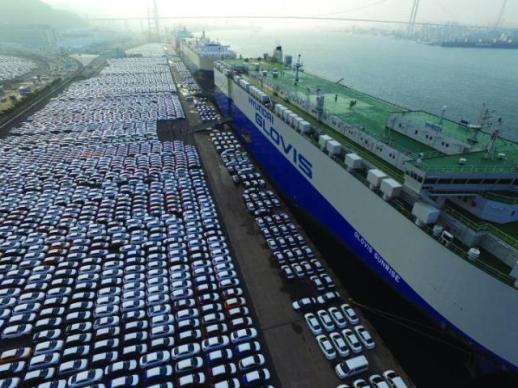 Hyundai Glovis Hits 7% Operating Margin Goal Early, Eyes Global Logistics Growth Hyundai Glovis is accelerating its push to become a global logistics company after reaching its 2030 target of a 7% operating profit margin ahead of schedule. The company is expanding vehicle shipments beyond Hyundai Motor and is also moving cargo tied to advanced industries such as defense, energy storage systems (ESS) and hydrogen. According to industry officials on Feb. 19, Hyundai Glovis posted 29.567 trillion won ($) in sales last year and 2.073 trillion won in operating profit, up 4.1% and 18.3% from a year earlier. Its operating margin came to about 7.1%, achieving a goal CEO Lee Kyoo-bok had set five years early. At a "CEO Investor Day" in June 2024, Lee outlined a plan to invest 9 trillion won by 2030 to reach 40 trillion won in sales and a 7% operating margin. All business lines grew: integrated logistics handling domestic and overseas transport (35%), the distribution unit covering CKD parts and used-car exports (47%), and ocean shipping (18%). A company official said Hyundai Glovis has helped clients cut logistics costs by leveraging routes built through Hyundai vehicle exports and by shortening lead times for auto-parts transport. The official added that proactive responses to free trade agreement risks and efforts to reduce costs at overseas plants helped win global customers. Hyundai Glovis has signed long-term ocean shipping contracts with automakers including Volkswagen, BMW, Ford and GM, and it also transports vehicles from Tesla and China’s BYD across Europe. It recently shipped defense products to Poland and other parts of Europe, including 124 K2 tanks and 60 K9 self-propelled howitzers. The company is also expanding into heavy and oversized breakbulk cargo that cannot be loaded into containers, such as power-generation equipment, trains, aircraft and mining machinery. It aims to lift non-affiliate revenue to 50% within four years. As of last year, cargo from affiliates accounted for 60.7% of volume, down 4.8 percentage points from the previous year. Hyundai Glovis plans to deploy four LNG carriers by 2027 to transport cargo for Middle Eastern shippers and to begin ocean-shipping projects involving high-speed trains, petrochemical plant equipment and ESS batteries. It also plans to start transporting ammonia and liquefied hydrogen around 2031. A company official said Hyundai Glovis aims to increase finished-vehicle ocean shipments from about 3.4 million units to 5 million and become the No. 1 car-carrier shipping company by 2030. The official said the company will build on its 147 logistics networks across 27 countries, freight-rate competitiveness and supply-chain flexibility to become a top-tier global player linking logistics, shipping and distribution. * This article has been translated by AI. 2026-02-20 05:03:00